A Scholarly Redraft on the White Ancestral Forms of the Storm Queen
Introduction
Among the major Òrìṣà, Ọya stands at one of the most difficult thresholds in Yorùbá religion. She governs storm, violent wind, lightning, the Odò Ọya (the Niger), and—just as importantly—the boundary between the living and the dead. Standard reference summaries consistently preserve this dual profile: Ọya is a deity of atmospheric upheaval and transformation. But she is also deeply bound to funerary process, ancestral passage, and the domain of Egúngún.
Her best-known praise-name, Ìyáńsàn-án, is traditionally understood as “Mother of Nine,” linked to the sacred ninefold logic that runs through her mythology and cult. In public retellings, this is often reduced to the story of her nine children. In deeper ritual interpretation, however, the nine becomes more than fertility. It becomes a number of completion under pressure, a number of multiplied force, and in cemetery-facing theology, a number of ordered ancestral functions.
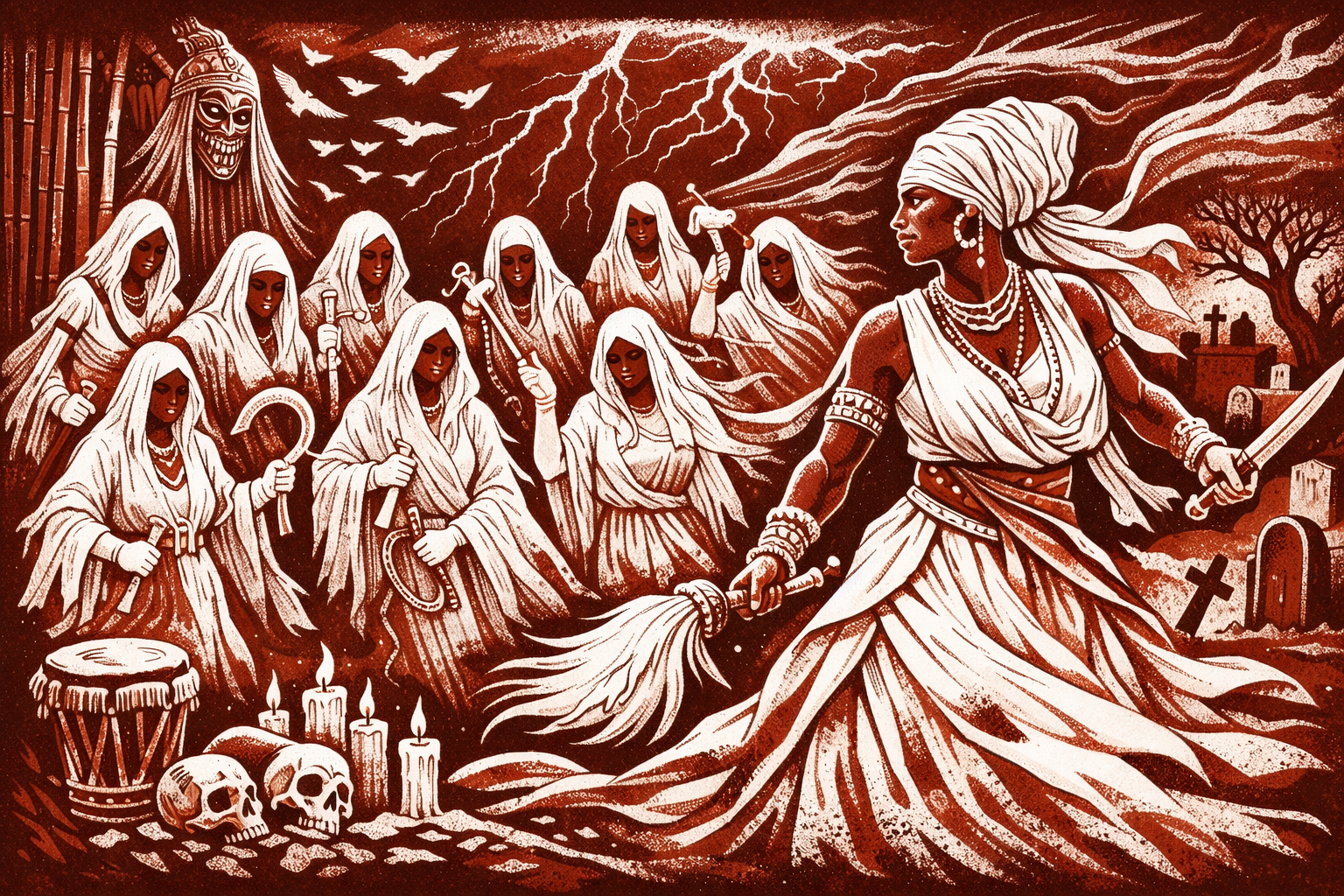
That mortuary register is where Ọya Ìgbálẹ̀ becomes central. In this form, Ọya is not merely the red and copper queen of storm. She is the white-clad ruler of the graveyard threshold, the one who governs the passage of spirits, the management of the newly dead, and the discipline of the ancestral field. In Lukumí and Brazilian house language, this is the Ọya who “works in the cemetery at night with the Égún.” Even when lineages differ on details, that core description is strikingly stable.
Traditional Prayer/Anthem for Oyá
What can be stated securely—and what cannot
A distinction is essential at the outset. The broad theology is well supported: Ọya is tied to wind, storm, death, Egúngún, and the sacred nine. What is not securely standardized in the academic literature is a single, universally agreed pan-Yorùbá list of nine named Ìgbálẹ̀ forms. No major scholarly source publicly fixes one uncontested roster in the way it fixes the names of principal Òrìṣà.
What does exist is something subtler and entirely real: a recurring ninefold mortuary structure preserved in Brazilian and Cuban/Lukumí house traditions, with overlapping named forms that appear again and again in practitioner compilations. These lineages do not always give the same list, but they cluster around a recognizable core. The correct scholarly move is therefore not to pretend that a fixed universal canon exists, but to distinguish between:
- the academically stable theology of Ọya and Egúngún, and
- the liturgically stable but lineage-sensitive ninefold roster preserved in Afro-Atlantic ritual transmission.
African wisdom on Ọya’s mortuary role
Even where the nine names are not systematized in academic African publications, African scholarship does preserve crucial clues about Ọya’s deeper cemetery and ancestral authority.
P. Morton-Williams, in a classic study of Yoruba responses to death, records the figure “Egungun Oya, the Executioner of Witches in Ilesha”. That single phrase is extremely important. It shows that in African ritual thought, Ọya’s relationship to Egúngún is not merely decorative or symbolic. It can be judicial, punitive, and socially regulatory. In other words, Ọya’s ancestral force includes enforcement, not only passage.
A second clue appears in J. Adedeji’s work on Yoruba masque theatre, where an Egúngún line is summarized as: “She sees and knows and keeps the secrets of Egungun.” This supports a second major dimension of Ọya’s mortuary power: she is not only the mover of spirits; she is also the keeper of ancestral secrecy, ritual knowledge, and hidden continuity.
Taken together, these African witnesses point toward a more precise theological picture. Ọya’s cemetery power is not simply that of “death” in a general sense. It includes at least three distinct functions:
- escort and passage,
- discipline and protection,
- custody of ancestral secrecy and order.
That triad is exactly what makes the later ninefold Ìgbálẹ̀ structures intelligible.
Why the Ìgbálẹ̀ forms are white
In her public and tempestuous aspect, Ọya is often linked with red, burgundy, copper, brown, and storm-rich tones. Yet in many Brazilian and Cuban house traditions, the Ìgbálẹ̀ forms are specifically dressed in white, sometimes with raffia or cemetery-associated vegetal materials. This is one of the most consistent features of the tradition.
The symbolism is theologically sharp. White here does not negate Ọya’s storm nature. It marks a different jurisdiction. The public Ọya tears, revolts, and electrifies. The cemetery-facing Ọya cools, orders, seals, and escorts. White therefore signals burial cloth, ash, bone, ancestral coolness, and the grave’s authority. The color shift is not aesthetic; it is juridical.
This also aligns well with what is known more broadly about Egúngún costuming. Britannica notes that Egúngún ensembles often use flowing cloth and palm materials, and that the inner sack resembles the shroud in which the dead are wrapped. That broader funerary cloth logic makes the white-cemetery association of Ọya Ìgbálẹ̀ especially coherent.
The most recurrent ninefold roster
Across Brazilian and Lukumí practitioner transmissions, the most recurrent nine-name sequence is:
- Egunitá
- Fúnán
- Furé (often paired with Tánán)
- Padá
- Gerê
- Fakarebó
- Adágambará
- Leyé
- Tonimbé
This exact or near-exact sequence appears in multiple independent compilations, although some lineages substitute names such as Até Ojú or preserve alternate spellings. The safest conclusion is that these names form a widely recurring diaspora roster, not a single continent-wide canon.
The nine Ìgbálẹ̀ and their characters
What follows is the most careful way to present their functions: not as a falsely rigid dogma, but as the best-supported liturgical character of each form based on recurring house descriptions.
1. Egunitá
Egunitá is the most consistently emphasized of the nine and, in practice, often the clearest gateway into the whole Ìgbálẹ̀ current. Across house descriptions, she is strongly associated with the dead, cemetery wind, and bamboo or rustling vegetal movement, often appearing as the form most directly tied to accompanying spirits. She is frequently treated as the one most visibly linked to the raw presence of the ancestral field.
Theologically, Egunitá is best understood as the manifest cemetery wind—the form in which ancestral movement becomes perceptible.
2. Fúnán
Fúnán is one of the most stable names after Egunitá. In recurring house descriptions, she is associated with cold winds, storm-clouds, rainwater, and the inner or older weather of death-space. She is often treated as a heavier, more interior, and more severe current than the outwardly dramatic public Iansã.
Fúnán is therefore best read as the inner storm of the cemetery: colder, denser, and more directly linked to the escorted movement of souls.
3. Furé / Tánán
Furé—often paired with or identified alongside Tánán—is one of the clearest functional forms in the entire roster. A recurring description presents this form as the one who receives the dead at the portal. That language is unusually precise and appears across multiple house explanations.
Furé/Tánán is thus the threshold-receiver: the first inner custody of the newly dead.
4. Padá
Padá is consistently presented as a guiding and protective form, and one widely repeated formula states that she illuminates the path of the dead. This makes her one of the most intelligible of the nine. If Furé receives, Padá directs.
Padá is best understood as the path-lighting and road-stabilizing form of Ọya Ìgbálẹ̀.
5. Gerê
Gerê (sometimes closer to Guerê in Brazilian spelling) is less publicly explained, but it recurs steadily in the roster. In lineages that gloss her more fully, she is often associated with the harsher margin of the ancestral field—the outer, rougher, more dangerous edges of death-space, where wilderness, decay, and liminality overlap.
Gerê is therefore best read as the grave-margin or death-forest edge within the ninefold system.
6. Fakarebó
Fakarebó is a stable recurring name, though more esoteric in public explanation. Where a functional reading is implied, she often appears in the more operational side of the cemetery current: dispatch, ritual action, movement of obligations, and the carrying out of mortuary work.
In theological terms, Fakarebó can be read as a ritual-executive form—one who enacts, carries, and delivers what must be done in the ancestral domain.
7. Adágambará
Adágambará is another name that recurs strongly across rosters. In house interpretations, she is frequently linked with threshold intelligence, crossings, and active command at difficult entrances, which is why she is often treated as one of the more forceful and structured forms.
Adágambará is best understood as the crossing-commander of the nine: the form that regulates difficult transitions and unstable gates.
8. Leyé
Leyé is one of the least publicly glossed of the nine, but the name is stable in the most repeated diaspora roster. Because it occupies a consistent place in the sequence even when other names vary, it likely preserves a recognized function whose fuller explanation is often held more initiatically than publicly.
The safest scholarly reading is that Leyé is a sealed or interior ancestral title within the system—one preserved more reliably in naming than in open doctrinal commentary.
9. Tonimbé
Tonimbé is the final recurring name and, like Leyé, tends to remain publicly underexplained. Its stability across lists suggests that it is not incidental. In the logic of ninefold completion, the ninth position typically carries a crowning or closing function.
Tonimbé is therefore best read as the closing, senior, or crowning station of the Ìgbálẹ̀ current: the form in which the ninefold cemetery administration resolves into sovereignty.
What Cuban/Lukumí tradition adds
Cuban/Lukumí sources available in public circulation do not usually publish a scholarly “nine-name doctrine” either. What they do preserve, very clearly, is the role of Oyá Igbalé as the road that works in cemeteries at night with the Égún, often also linked to elevated or sacred wild places, and characterized by instruments such as the whip, irunké, and fan.
That is an important corroboration. Even where the nine names are not formally unpacked, Lukumí agrees on the core of the theology: Oyá Igbalé is the cemetery-working, Égún-governing, transitional form of Oyá.
So the Cuban contribution is less a universally published list and more a strong preservation of the function: the night-working queen of the dead, the driver of spirits, and the one whose authority continues after death rather than ending there.
A more precise synthesis
If the evidence is read conservatively, a strong synthesis emerges:
- African scholarship confirms Ọya’s binding to Egúngún, funerary transition, punishment, secrecy, and ancestral governance.
- Brazilian and Cuban house traditions preserve a recurring ninefold cemetery structure under Ọya Ìgbálẹ̀, even though the exact roster is not standardized across all lineages.
- The white-clad forms are best understood not as a different goddess, but as the cooling, burial-facing, juridical register of the same Ọya who in public appears as the red force of storm and upheaval.
That yields the cleanest theological distinction:
Ìyáńsàn-án is Ọya in her expansive, visible, kinetic, storm-charged ninefold abundance. Ọya Ìgbálẹ̀ is the same power under the law of the dead: white, sealing, escorting, judging, organizing, and ruling the ancestral threshold.
Final reading
The nine Ìgbálẹ̀ should not be read as a random list of alternate names. They are better understood as a ninefold ancestral administration—a ritual map of how death-space is governed under Ọya’s authority: the wind that reveals the dead, the cold storm that gathers them, the gate that receives them, the path that guides them, the outer margins that contain danger, the executive force that carries out mortuary work, the crossings that must be regulated, and the sealed senior stations of ancestral sovereignty.
That is why the white forms matter so much. They reveal that the deepest power of Ọya is not only to tear open the sky. It is to govern what happens after the tearing.
Iansã in Brazil, Oyá in Cuba: How the Cemetery Forms Change Across Candomblé and Lukumí
When Ọya crosses the Atlantic, she does not lose her identity, but she does change her ritual profile. In both Brazil and Cuba, she remains the force of wind, storm, violent transition, and the dead. What changes is the way communities organize that force. In Brazilian Candomblé, she is most publicly known as Iansã, and her cult often becomes highly differentiated through qualidades or marcas—types, manifestations, or ritual faces of the same orixá. In Cuban Lukumí / Regla de Ocha, the equivalent logic is usually expressed through caminos—roads or paths—each preserving a distinct temperament, task, or mythic memory. Candomblé itself explicitly recognizes that the orixás have multiple “types” or “qualities,” and it also preserves the broader cosmology in which Ọ̀run is divided into nine levels, a detail that helps explain why Ọya’s sacred nine becomes so structurally powerful in diaspora readings.
The most important Atlantic shift is this: the public, visible, storm-charged Iansã and the cemetery-facing Ọya Ìgbálẹ̀ are often treated as two different registers of one power. The first is hot, mobile, dramatic, erotic, combative, and socially visible. The second is white-clad, funerary, ancestral, and juridical. In other words, the Atlantic traditions do not usually split Ọya into two separate goddesses; they split her into two ritual jurisdictions. That distinction is especially clear in Brazilian house systems and remains strongly legible in Cuban paths of Oyá linked to the cemetery and the dead.
Brazil: why the public name is Iansã
In Brazil, the name Iansã comes from the Yorùbá praise-name “Ìyáńsine,” but in practice the Brazilian name often carries a very specific emotional and ritual charge. Along many terreiros, Iansã evokes the public and kinetic face of the deity: the storm-bringer, the warrior, the woman of intense love, swift decisions, fierce passion, and visible movement. In Candomblé-facing descriptions, she is associated with wind, lightning, storms, copper, red or coral tones, the sword, and the buffalo current, and she is frequently described as one of the first major female orixás to appear prominently in public ceremony.
That public face is not just aesthetic. It reflects how Afro-Brazilian ritual life often exter session, costume, rhythm, and visible differentiation. One modern synthesis of Afro-Brazilian religion notes that Brazilian traditions often frame Oya/Iansã through spirit-channeling and mediumistic experience in ways that differ from more strictly African settings, even when the underlying deity remains recognizably the same.
How Candomblé organizes Iansã: many qualities, not one single face
Brazilian house traditions often preserve a large number of Iansã qualities. Some compilations list thirty or more manifestations, including currents such as Onirá, Biniká, Senó, Abomi, Gúnán, Bagán, Kodun, Yapopô, Onisóni, Bagburé, Topê, Semi, Sinsirá, Sirê, Fúnán, Furê, Gerê, Toningbé, Fakarebó, Adágambará, Até Ojú, Petú, Messan,and others. This does not mean every terreiro works all of them. It means that Brazilian Candomblé often preserves a highly developed theology of ritual specialization: one deity, many operational faces.
That multiplicity is not random. The qualities cluster into recognizable zones. Some are public-storm and warrior forms. Some are water-adjacent forms. Others are tied to specific allied orixás. And a particular cluster—mo the white cemetery current of Ọya Ìgbálẹ̀.
The hot and public Brazilian forms
A few Brazilian qualities illustrate how far Iansã extends beyond the cemetery:
- Oyá Messan (Yansan) is often treated as the archetypal or original Iansã, half woman and half buffalo, sometimes less a se core title.
- Oyá Petú is one of the most Ṣàngó-facing forms, linked to lightning, sparks, and copper force.
- Oyá Afefé / Afefere expresses wind itself—directional, mobile, and mind-opening.
- Oyá Bin warrior current.
- Oyá Bagán is a forest-and-war form, explicitly linked to Egdé.
These public forms help explain a basic Brazilian distinction the cemetery queen**. She is also love, fury, speed,rket-force, and the violent intelligence of weather. The cemetery forms are therefore not the but a specialized inner chamber of it.
The white Brazilian cemetery current
Inside that much broader Brazilian spectrum sits the most esoteric cluster: the white Ìgbálẹ̀ forms. These are frequently described as the “white” or “funfun” cemetery-facing manifnreserve the same core names: Egunitá, Fúnán, Furê (or Tánán), Padá, Gerê, Fakarebó, Adágambará, Leyé, and Tonimbé, with some lineages substituting names such as Até Ojú. These forms are typically dressed in white, often associated with mariwo, bamboo, raffia, Eruexim/Iruexim, and the handling of the dead.
Their roles tend to differentiate the cemetery process itself:
- Egunitá is the wind already entangled with the dead—the cemetery breath, the bamboo-rustle, the soul-bearing movement.
- Fúnán is theield, linked to guiding the dead.
- Furê / Tánán is the portal form, strongly tied to the immediate passage from life to death.
- Padá itective current that leads the dead onward.
- Adágambará and **Fakaremore threshold-operational and dispatch-oriented forms.
One Brazilian formula “nine witches of Ọ̀run”, which is less an insult than an acknowledgment of hly operative power in ancestral space. The same house logic repeatedly states that they wear white because tn current and the law of death rather than to Iansã’s hotter public color-speech.
Brazilian theology of nine: “mother of the nine rooms”
A particularly revealing Brazilian title presents Iansã as “Mother of the Nine Rooms.” In some house interpretations, this aligns with the idea that she guides the dead through one of tctors of Ọ̀run according to their state or action. That interpretation becomes especially intelligible when placed next to the broader Candomblé cosmology in which Ọ̀run is already imagined as nine-leveled and the dead move through structured postmortem states—from the recently dead to more stabilized ancestral conditions.
This does not prove that every terreiro teaches the same “nine rooms” doctrine. It does show that the sacred nine in Brazil is often read not only as nine children, but as **nine chambers, nine operations, osat is exactly the kind of theological deepening one would expect in a mature house tradition.
Cuba: Oyá in Lukumí is less color-coded and more road-coded
In Lukumí / Regla de Ocha, the structure is similar in principle but different in style. Instead of a large public culture of “qualidades” in the Brazilian sense, Cuban tradition more often speaks in terms of caminos—roads. These roads are no a fixed public list across all houses, but they carry the same basic logic: the deity is one, yet appears through different mythic, ritual, and situational modalities. One widely circulated Lukumí summary explicitly describes Oyá Igbalé as the road that works in the cemetery at night with the Égún, and associates her with graveyard space and the governance of the dead.
This means that Cuba tends to preserve the same theological core as Brazil—storm, cemetery, Egún, transition—but distributes it differently. Brazil often externalizes the system into many visible qualities. Cuba often preserves it through a more narrative and road-based architecture, where specific caminos are recognized by their tasks, myths, and ritual location rather than by one singr list.
The cemetery roads in Lukumí
Several Cuban-facing roads make the cemetery theology especially clear.
Oyá Onibodó / Onibodé is one of the most important. In the circulated road traditions, she is described as a warrior form who resides at the door of the cemetery, rules with strictness and justice, and guides souls onward—sometimes specifically toward Babalú Ayé. This arest Cuban confirmations that the cemetery function is not a minor appendix to Oyá; it is one of her major ritual jurisdictions.
Oyá Odó is another striking path. In this road, Oyá is connected to dark, nocturnal, and dangerous companionship with the Eguns. She is often described as walking in darkness with the dead and as a more secretive, more sorcerous, and less socially domesticated form. Even if house details differ, the pattern is clear: this is not the bright public storm queen, but a more shadowed anad.
Oyá Niké is described as a road of hills, heights, and commanding winds from above, while still dealing with the Eggunsand leading them on the spiritual path. This makes her a very useful bridge between the two major sides of Oyá: atmospheric sovereignty and cemetery function.
Together, these roads show something important about Cuban theology: rather than fwhite nine” in the Brazilian manner, Lukumí often preserves the same cemetery intelligence through named roads with very specific situational tasks.
Cuban roads that overlap with Brazilian qualities
Some roads in Cuban and wider Afro-Cuban transmission names better known in Brazil:
- Onirá survives as a strongly water-adjacent and warrior-linked road, sometimes treated in Brazil as part of Iansã’s system, even though some traditions insist it had a more independent African cult. lá**, and Tomboro appear in wider Afro-Cuban-facing rosters as specialized roads tied respectively to storm-dance, prosperity, and healing/plant knowledge.
- Topê appears as a rarer, outer-yard, white-clad form with threshold-like attributes.
This overlap matters because it shows that Brazil and Cuba are not preate universes. They are preserving different distributions of the same broader sacred archive. Some names become major qualities in one place and minor roads in another. Some remon and initiatic in another.
**The key difference between Brazanest comparison is this:
In Brazil, Iansã is often divided through a highly visible and sometimes expansive qualidade system. The result is a spectrum in which the hot, erotic, warlike, storm-facing forms coexist with a white cemetery cluster of Ìgbálẹ̀manifestations. That makes the distinction between public Ian especially legible.
In Cuba, the same division often appears less as a “white nine” publicly enumerated in every house, and more as a set of caminos whose functions are encoded in myth, placement, and task: the road at the cemetery gate, the road that walks with Égún in darkness, the road of high winds that still leads the dead, and so on. The mortuary logic remains, but it is ordr than through one universally displayed cluster of named white forms.
So the difference is not theological essence. It is ritual architecture.
What stays the same in both traditions
Despite all the variation, four deep constants remain across both Brazil and Cuba:
First, the deity remains fundamentally the same power: wind, storm, transition, and the dead.
Second, the cemetery-facing register is always treatee dangerous, and more restricted than the public storm register.
Third, white or funerary symbolism marks the cooling and juridical side of this power, even when the public cult of Iansã/Oyá uses hotter colors.
Fourth, the sacred nine continues to shape how the deity is imagined after death: as mother of nine, mother of nine rooms, or sovereign over multiple ordered sectors of postmortem passage.
A strongeron
The Atlantic traditions did not make Ọya simpler. They made her more structurally explicit.
Brazil turned her into a rich network of visible qualit te cemetery Igbalé can be read almost as two ritual climates of one divinity. Cuba preserved the same complexity through roads, where cemetery power, gatekeeping, nocturnal Egún work, and atmospheric stinct without always being gathered into one public nine-name display.
That is the real lesson of Part II: the Atlantic did not erase the hidden cemetery queen. It gave her new ritual grammars.
The Nine of Ọya and the Daughters of Olókun: Correspondences, Differences, and the Additional Bridge of Calunga
The most important starting point is that the nine of Ọya and the daughter-structure of Olókun are not the same kind of sacred architecture. Even when both are expressed through multiplicity, they organize different domains. In the broad Yorùbá frame, Ọya is tied to storm, violent wind, and the ancestral sphere through Egúngún; African and diaspora sources alike preserve her as a deity of upheaval and of the dead.
By contrast, Olókun is consistently described in modern summaries as a power of the sea, hidden depth, prosperity, fertility, and the larger watery field from which life is sustained. That makes Olókun’s multiplicity fundamentally different in tone: not primarily a map of postmortem sorting, but a map of depth, hidden resource, and differentiated water-life.
So the first distinction remains essential: Ọya’s nine is best read as a theology of transition and ancestral jurisdiction; Olókun’s daughters are best read as a theology of medium, emergence, and aquatic differentiation. One governs what happens as form crosses out of ordinary life; the other governs the many ways life is carried, nourished, concealed, and transformed within and through water.
Where the two systems genuinely correspond
There is still a real and meaningful correspondence between them. In both systems, sacred multiplicity exists because the primary force is too large to be reduced to one function. Ọya cannot be reduced to “wind,” just as Olókun cannot be reduced to “sea.” Both traditions therefore break a vast divine field into distinguishable operations. That is not decorative complexity; it is a way of making the unseen legible.
A second true correspondence is that both systems are concerned with thresholds. Ọya governs the threshold between life and death, form and disembodiment, one condition and another. Olókun and the water-daughter logic govern thresholds between hidden and visible, deep and shallow, river and sea, containment and flow. The overlap is not sameness, but shared concern with passage.
Where they sharply diverge
The sharpest difference is domain. Ọya’s ninefold logic belongs to cemetery order, ancestral passage, and the governance of the dead. Even where the names vary by lineage, the deeper pattern remains funerary, juridical, and transitional. Olókun’s daughter-logic belongs to water-space: it describes the modes of hidden life, wealth, depth, motion, threshold-water, and the conditions of embodiment.
Put simply: Ọya’s nine is about what happens after severance; Olókun’s daughters are about how life is borne within the field of waters before, during, and around becoming. That is why the two systems illuminate each other so well without ever becoming identical.
An additional bridge: Olókun as primordial matrix and the sea of return
This is where the comparison becomes more profound. In many theological readings—especially in modern interpretive and house-based work—Olókun is not only the owner of the deep sea, but the primordial deep itself: the abyssal reservoir in which life, wealth, and undifferentiated potential are held before they take visible form. Even the more basic modern summaries already preserve the key elements that support this reading: Olókun is associated not only with the ocean, but with fertility, prosperity, and all bodies of water. Those are precisely the traits that allow Olókun to be read as a matrix of becoming.
At this point, an Afro-Atlantic comparison becomes especially useful: in Kongo and Cuban-Kongo / Palo cosmology, Kalunga (often rendered Calunga) is explicitly described as the watery boundary between the living and the dead, even as “the vast sea of the dead.” One source describes the Kalunga line as the literal and metaphorical water mark separating the world of the living from the world of the dead; another calls Kalunga the sea-boundary where ancestral souls meet; another speaks of it as the “horizontal liquid membrane” of the cosmogram.
That comparison is powerful—but it must be framed correctly. Calunga / Kalunga is primarily a Kongo and Afro-diasporic concept, not a classical Yorùbá technical term for Olókun. The point is not to claim that Yorùbá and Kongo systems are identical. The point is that in the Atlantic world, many readers and ritual communities have found a compelling comparative bridge: the deep sea can be imagined not only as origin, but also as return; not only as womb, but also as the immense ancestral receiving-ground.
Framed this way, Olókun gains a second metaphysical resonance. Olókun is not only the depth from which forms emerge, but can also be read—especially in a wider Afro-Atlantic symbolic sense—as the vast watery field into which forms dissolve, return, and are reabsorbed. In that comparative reading, the sea becomes both matrix and cemetery, both beginning and return.
Why this creates a meaningful complement to Ọya
This is where the complement to Ọya Ìgbálẹ̀ becomes especially elegant. If Olókun is read as the abyssal field of origin and return, then Ọya can be read as the force that governs the actual crossing. In other words:
- Olókun is the immense medium: the depth, the container, the primordial and terminal vastness.
- Ọya Ìgbálẹ̀ is the dynamic and juridical force: the one who tears, separates, escorts, routes, and governs passage into ancestral order.
That distinction matters because it prevents a false equivalence. The deep sea and the cemetery are not identical spaces in classical Yorùbá thought. But in a broader Afro-Atlantic metaphysics, they can become complementary symbolic zones: one is the great ontological reservoir, the other the ritual and spiritual administration of transition.
So the strongest refined formulation is this: Olókun represents depth itself—silent, primordial, containing, and ultimately reabsorptive—while Ọya represents the event of crossing: active, disruptive, discriminating, and transformative. One is the abyssal medium of becoming and return; the other is the sovereign of the threshold.
A more careful comparative map
With that bridge in place, the comparison becomes clearer and cleaner.
The guiding, path-making, and threshold-ordering side of Ọya’s ninefold cemetery logic has a broad analogue in the carrying and threshold-making side of the aquatic powers. Rivers carry the living; cemetery powers carry the dead. Lagoons mediate between types of water; cemetery thresholds mediate between types of existence. The parallel is real, but it is analogical rather than literal.
The colder, heavier, and more interior faces of the cemetery current also resonate with the gravity of the deep sea. But again, the difference remains decisive: Olókun’s depth is the gravity of hidden life, hidden wealth, and primordial reserve; Ọya’s cemetery depth is the gravity of death, judgment, and ancestral placement.
The most important non-correspondence
The deepest non-correspondence should remain explicit. Olókun’s daughter-logic remains fundamentally life-bearing in its medium, even when it includes dangerous or forceful waters. It is still about the conditions of nourishment, manifestation, wealth, and fluid transformation. Ọya’s ninefold cemetery logic remains fundamentally transition-bearing in its jurisdiction. It is about severance, revelation, routing, discipline, and the reordering of being after death.
That is the real difference in metaphysical tone:
- Olókun’s multiplicity is generative and abyssal.
- Ọya’s multiplicity is juridical and transformative.
Final synthesis
Read together, the two systems reveal two complementary sacred maps.
The nine of Ọya is a map of jurisdiction: who receives, who moves, who illuminates, who regulates, who governs the dead.
The daughters of Olókun are a map of medium: which water holds, which water emerges, which water carries, which water enriches, which water stands at the threshold of form.
And with the added Afro-Atlantic bridge of Calunga/Kalunga, a further insight becomes possible: Olókun can be contemplated as the primordial depth from which life comes and, symbolically, the vast sea of return to which form may go—while Ọya remains the sovereign power that governs the crossing itself.
That is why the two belong in the same comparative meditation even without being the same theology. One reveals the sacred logic of origin and return. The other reveals the sacred logic of passage and placement.
Ìbà Ọya.
Èpà héyì.
Ìbà Olókun.
Omi ò.