
Ikin and ọ̀pẹ̀lẹ̀ are two principal instruments associated with Ifá divination: sacred palm nuts and a divining chain. Their physical differences are easy to recognize. Understanding their religious work requires a further distinction. An instrument establishes a sign within an authorized practice; a sign opens a relationship with an extensive corpus; interpretation brings that corpus into a particular concern. The visible object is one part of this relationship, rather than a complete oracle that explains itself.
This study draws on Bàbálórìṣà and Bàbáláwo Tilo Plöger de Àjàgùnnà’s Odù Ifá Divination, especially its substantive treatment of instruments, figures, regional variation, and verses. Museum and university records provide independently documented objects and public material context. The aim is to understand the instruments and the authority surrounding them. Handling instructions, consecration formulas, and a universal counting decoder would not supply the training or relationships required for religious practice, and are outside this account.
Two instruments, a shared field of signs
In Tilo’s account, both palm nuts and chain are used to establish Odù within the same field of 256 figures. The chain displays a configuration through its eight linked elements; the palm nut procedure produces successive distinctions recorded as a figure. The different material operations do not imply that each instrument has a separate dictionary of unrelated Odù names or a wholly different literary corpus.
This point changes how a newcomer understands speed. The chain can yield a complete configuration through one cast, whereas the palm nut process unfolds through repeated operations. That is a difference in the production of a figure. It does not measure how long thoughtful interpretation must take, how many verses a practitioner knows, or how demanding the client’s concern may be. A quickly established sign can still require careful explanation.
The Odù introduction provides the larger literary setting. A sign is not a single sentence waiting to be read off a chart. Its associated narratives can address different circumstances and responses. Two instruments may establish the same named reference while the work of selecting, reciting, and explaining relevant material remains substantial. Mechanical economy should therefore not be confused with interpretive simplicity.
Ikin are sacred palm nuts, rather than generic counters
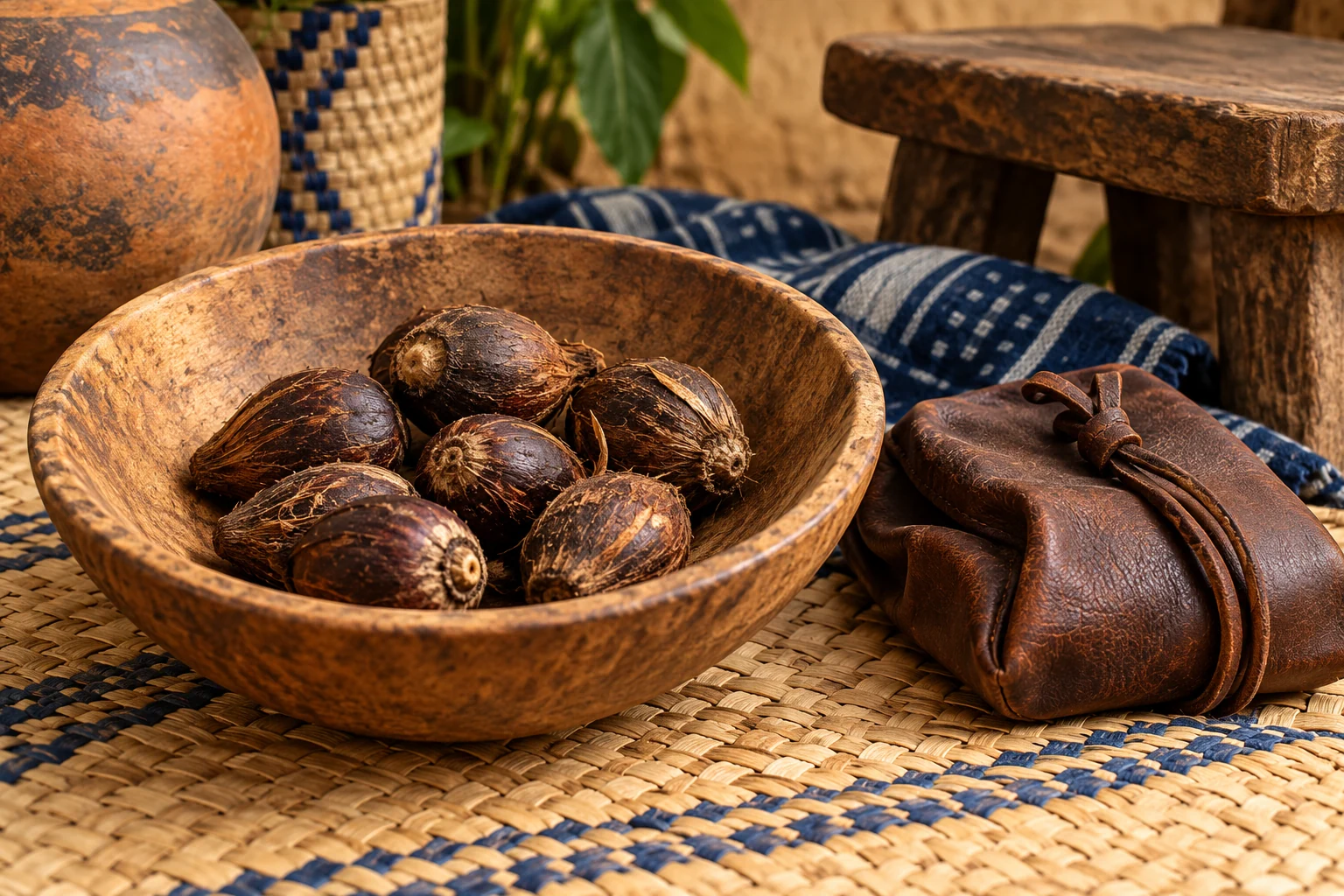
Tilo’s book describes ikin as consecrated palm nuts associated with Òrúnmìlà and treated as sacred presences. Their significance consequently exceeds the fact that they can be counted or moved between the hands. The material belongs to relationships of reception, care, and obligation. A casual handful of palm kernels may resemble a divining set without sharing its religious history or status.
The book also records variation in the physical “eyes” of the nuts and the composition of sets, including descriptions attributed to specific places and earlier researchers. Those details are valuable because they interrupt a misleading expectation of perfect uniformity. They should not become a shopping specification through which an outsider declares a set authentic or inauthentic from a photograph. Material appearance and acknowledged religious standing are connected, but they are not interchangeable.
A further distinction concerns a working set and every nut that may be present within its wider arrangement. Tilo discusses accounts of additional guardian or resident nuts in particular contexts. These accounts do not justify treating every visible nut as part of the active sign-producing operation. A photograph of seventeen or more nuts cannot, by itself, refute a description involving sixteen working nuts.
The useful public question is therefore what a set is understood to be within its own practice. Who received or maintains it, what role it has, and how its care is transmitted are more informative than counting objects in an image. The religious identity of ikin rests within a maintained relationship as well as a recognizable material form.
The chain makes an ordered configuration visible
The ọ̀pẹ̀lẹ̀ described in the book consists of eight linked elements, commonly fashioned from divided seeds or similar materials with distinguishable faces. Four elements fall on either side of its central division. Their ordered configuration matters. A figure is not identified merely by totaling how many elements show one face and how many show the other.
This distinction can be understood without learning to cast. Two arrangements may contain the same overall number of one type of face but place those faces differently. They can therefore establish different figures. A photograph that obscures order, reverses perspective, or omits orientation markers can preserve the objects while losing information required to name the sign correctly.
Tilo points to beads, cowries, metal pieces, or other attachments used to distinguish the chain’s ends. These can have a practical identifying role alongside their material and symbolic interest. In the book’s example, exchanging the sides could confuse an Ògbè–Òyèkú pairing with Òyèkú–Ògbè. The example illustrates ordered identity; it does not imply that the two mixed Odù can be interpreted merely by swapping two generic paragraphs.
The chain’s physical form therefore helps hold a distinction that language also preserves. Naming order, visual order, and the practitioner’s viewing position belong together. A beautifully reproduced diagram can still be misleading if it silently changes one of them. Reliable educational illustration needs an explicit orientation and source, not only attractive symbols.
Object count and sign count answer different questions
The chain’s eight elements, the working palm-nut set, and the 256 figures are different kinds of count. The first concerns positions in a visible configuration. The second concerns material used in a repeated operation. The third concerns possible named figures. Confusing these levels can make the instruments appear to disagree even when they establish references within the same sign field.
A further count concerns literature. Several verses associated with a figure do not add several new figures to the system. Nor does a practitioner’s knowledge of many versions imply a separate instrument for each version. The configuration and the repertoire stand in a relation of reference, rather than a one-object-to-one-story correspondence.
These distinctions matter for museum displays and introductory books. An exhibition may preserve the chain without its vessel, or show a vessel without a complete working arrangement. A photograph may illustrate a material type rather than a session in progress. The number of pieces on display should therefore be interpreted through the record’s stated purpose. Counting is useful evidence, but only after the reader establishes what is being counted and what the display is intended to represent.
The tray records, frames, and relates
Ọpọn Ifá names the divination tray on which a figure may be marked in powder during palm nut divination. Tilo’s treatment includes variation in tray shape, carved borders, and orientation. The tray is a working surface, a religious object, and a work of skilled making. Its carved field should not be reduced to an ornamental border surrounding the supposedly meaningful marks.
LACMA’s record for a tray dated 1920–1930 identifies a Yorùbá wooden work with traces of white and blue pigment. Its curatorial note describes the role of the babaláwo, the marked figure, and contextual verse interpretation, and identifies Èṣù in the carved face. This is evidence for a particular collected object and the museum’s public explanation, rather than a complete procedural account of every tray. LACMA, Opon Ifa.
The central space and its rim do different work, yet they belong to one object. A figure can be made, read, and cleared while the carved relationships endure. Thinking about that contrast helps a reader see why the tray is more than an erasable board. A particular consultation enters a material setting whose significance is not recreated from nothing each time.
The face of Èṣù also directs attention toward communication and mediation within the source’s religious account. It should not be treated as a generic symbol of wickedness or used to import an unrelated devil image. The named religious relationship explains more than a superficial resemblance between facial features in different artworks.
Powder, tapper, vessel, and bag have distinct jobs
The surrounding ensemble includes iyèrosùn, the powder in which figures are marked; ìróké Ifá, a tapper associated with invocation; àgéré Ifá, a vessel for sacred palm nuts; and àpò Ifá, a bag associated with carrying a diviner’s materials. Spelling and object forms vary across descriptions. These terms should help distinguish functions, rather than become interchangeable names for anything displayed near a tray.
The Smithsonian’s account of a divination cup supported by mudfish places vessel, tapper, nuts, and tray in the same material setting. It connects the ensemble with seeking counsel from Òrúnmìlà. That institutional description supports the relation among implements; it does not make the sculptural subject a universal message about every person who consults. National Museum of African Art, “Divination cup.”
Tilo’s discussion of iyèrosùn also records differences in explanations of source material and terminology. That diversity is a reason to avoid casually replacing the powder with any visually similar substance. Public understanding does not require a preparation recipe. It requires recognizing that a working medium may have inherited requirements which cannot be recovered from color or texture alone.
Will Coleman’s photographic teaching collection at the Atlanta University Center’s Robert W. Woodruff Library separately labels tray, chain, ikin, and tappers. As an educational comparison it is useful precisely because the implements remain distinct. A complete looking arrangement does not mean that each item has the same function or that its owner holds every relevant authority.
Sculpture makes relationships visible without decoding a client
A concrete example is the Metropolitan Museum’s àgéré Ifá from Owo, dated to the seventeenth through nineteenth centuries. A kneeling woman supports its bowl. The museum identifies ivory as an exceptional material for this vessel type and associates the work with a regional artistic tradition. The bowl held sacred palm nuts; its sculpture gives that function a human and devotional form. The Metropolitan Museum of Art, Àgéré Ifá with kneeling woman.
The object invites attention to posture, balance, skilled labor, and offering. These are visible relationships within the artwork. They do not license the claim that every kneeling figure represents one fixed message that should be delivered to a contemporary client. Nor does a costly medium guarantee superior interpretation. Museum description, historical attribution, devotional significance, and present divinatory authority remain distinguishable kinds of knowledge.
This distinction matters when images circulate online without their records. A photograph may be captioned only “Ifá tools,” losing its place, date range, material, and particular form. Restoring those details turns a generic emblem back into an individual work. It also restores the artisan’s contribution, which disappears when objects are treated as anonymous containers of spiritual information.
Tilo’s wider approach encourages attention to sacred material as a maintained relationship. Here the sculpture provides a useful human interpretation: knowledge depends on acts of support, reception, and care. That is a reading of the visible form and religious setting, not an asserted secret meaning disclosed by the museum object.
Ritual standing and practical efficiency are different judgments
Tilo’s book presents accounts in which ikin have higher ritual prestige while the chain is widely used for efficient consultation. These descriptions should remain situated. They do not establish that every lineage reserves exactly the same occasions for palm nuts or that a consultation with ọ̀pẹ̀lẹ̀ is inherently shallow. The instrument’s standing and the practitioner’s competence need separate explanation.
The distinction is important because outsiders often assume that slower procedures must be more profound. Duration can reflect the material operation, the occasion, the number of questions, or the extent of recitation. A lengthy session may include much that a short session does not, but elapsed time alone cannot identify which work was required or how well it was done.
Equally, efficiency should not become an argument that one instrument has made the other obsolete. Sacred objects can have ceremonial relationships, histories of reception, and obligations which are not exhausted by their ability to generate a configuration. Two means of determining the same named figure need not have identical places in religious life.
A hypothetical seeker choosing whom to consult therefore needs a better question than “Which object gives the strongest answer?” They need to understand the practitioner’s tradition, the proposed occasion, and the work that practitioner is recognized to conduct. The answer concerns a relationship of authority and learning; an instrument’s material alone cannot provide it.
A figure is an entry into literature
UNESCO’s description places interpreted signs alongside a literary corpus divided into Odù and ẹsẹ. This broad institutional context is enough to challenge the idea that instrument handling completes the process. A figure points toward a repertoire of narratives and recitations through which a present concern can be addressed. Recognizing the figure and interpreting relevant literature are related achievements, not the same achievement.
Tilo’s chapter on figures, drawing on earlier scholarship including Bascom, explicitly connects both instruments with the same verses. His later chapters distinguish abstract thematic approaches from fuller narrative interpretation. The latter requires attention to named diviners, clients, occasions, counsel, responses, and outcomes. An accurate figure cannot explain those relations without learned literary work.
Consider a hypothetical observer who correctly identifies a configuration from a photograph. They may have recognized a sign, yet know nothing about the question, orientation, verse chosen, or advice received. Their visual success does not entitle them to announce the client’s destiny. The missing information is substantial because the same sign can address different concerns through different relevant narratives.
The study of reading ẹsẹ Ifá follows this interpretive passage in detail. It shows why recitation, translation, and explanation should remain connected. The instrument helps establish the reference; it does not eliminate the need for language, memory, judgment, or a relationship with the person seeking counsel.
Authority includes training, recognition, and responsibility
Babaláwo is the familiar title for an Ifá specialist in many public accounts. Titles and the recognition of women specialists, including ìyánífá in some settings, require their own lineage context. A photograph with a tray or chain cannot settle those questions. The public presence of an instrument proves neither completion of training nor permission to conduct every ceremony associated with Ifá.
Training also includes more than accumulating signs and stories. It involves knowing how the relevant material is transmitted, how a question is framed, what kind of clarification is being made, and how responsibilities are explained. A practitioner’s teacher, community, and acknowledged work situate that learning. None of these relationships can be replaced by the visual impression that someone owns an elaborate ensemble.
For a client, recognition matters because interpretation has consequences. Advice may concern conduct, obligations, or further religious work. The client needs to understand what is being asked of them and who is responsible for explaining it. That does not require access to every restricted detail. It requires intelligible counsel within a relationship the person can knowingly enter.
The Orí study places personal direction alongside this question of authority. A practitioner can address a person’s concern without becoming the owner of their choices. Respect for sacred office and responsibility for one’s actions can coexist. An instrument should not be used as a reason to make the client’s questions about meaning or obligation disappear.
Images and records can lose essential information
A sign photographed from the client’s viewpoint may appear reversed to someone reading it from the practitioner’s viewpoint. A chain can be turned around after use. A sketch can omit distinguishing attachments. A handwritten record can preserve the name without showing whether it was the principal sign, a clarification, or an element of a different ritual phase. Each loss changes what can responsibly be inferred.
This is why the relation between visual and verbal records matters. A name can clarify an ambiguous image, while an image can preserve features a name omits. Neither substitutes for the question and the position the sign occupied. The study of ìbò and orientation explains why additional signs may select among alternatives rather than supply independent narrative portraits.
A hypothetical person who finds an old family photograph of a tray should therefore begin with what the image actually preserves. They may be able to identify an instrument type and recognize a material setting. Establishing who used it, in which tradition, and for which occasion requires further evidence. A family memory or consultation note may help, but absent information should remain absent rather than be filled from a chart.
The same discipline improves educational writing. Diagrams should explain their viewing direction, and descriptions should distinguish a typical form from a documented specimen. Precision is a form of respect for both the object and the people whose religious knowledge gave it a place.
Digital resemblance does not confer religious status
A computer can represent eight binary positions and display 256 combinations. That mathematical fact helps explain the finite structure of the sign field. It does not establish that a random number generator, personality questionnaire, or self-selected diagram performs Ifá divination. Material operation, religious authorization, invocation, corpus, and responsibility cannot be inferred from a matching number of possible outputs.
Tilo’s book includes modern comparative and abstract models alongside descriptions of inherited practice. Those models can support study when their authorship remains visible. Elemental correspondences or geomantic extensions should not be silently projected backward as the universal reason every practitioner uses ikin or ọ̀pẹ̀lẹ̀. Similar formal structures support comparison; they do not automatically establish shared history or jurisdiction.
The Personal Exploration companion belongs to educational reflection. It can help organize questions and consider published themes, but it cannot receive sacred objects, establish ritual standing, or confer an initiated personal Odù. Naming that scope makes the tool more useful because readers can distinguish learning about an instrument from entering the religious relationship in which it operates.
The lasting lesson of ikin and ọ̀pẹ̀lẹ̀ is therefore relational. Materials make distinctions visible, figures open a corpus, trained people interpret, and clients must understand the responsibilities brought into their lives. The instruments deserve careful attention precisely because they belong to that larger work. Their significance grows when we can see the learning and care around them, rather than asking the objects to explain everything alone.
Sources and further reading
- Tilo Plöger de Àjàgùnnà, Odù Ifá Divination. Substantive instrument, figure, regional variation and verse sections consulted. Contemporary synthetic models retained as authored interpretations.
- The Metropolitan Museum of Art, Àgéré Ifá with kneeling woman. Full object description and metadata consulted; evidence for this Owo vessel and its curatorial interpretation.
- National Museum of African Art, “Divination cup”. Institutional object account retrieved through search; supports public ensemble context.
- LACMA, Opon Ifa, 1920–1930. Object metadata and curatorial note consulted; broad language is not adopted as a detailed casting manual.
- Atlanta University Center, Robert W. Woodruff Library, “Images of Ifa Hermeneutics / Divination”. Will Coleman’s labeled teaching photographs consulted for distinctions among implements.
- UNESCO, “Ifa divination system”. Institutional search description consulted for signs and literary corpus; direct page presented an access challenge.
- William Bascom, Ifa Divination. Publisher metadata consulted; full book not independently consulted. Named scholarly witness through Tilo’s treatment.
- Continue with the DAILY IFÁ Academy collection.