Introduction
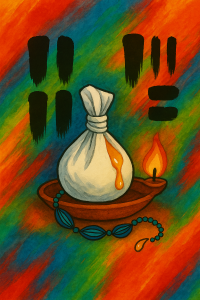
Source: Odu Ogbe Meji on Amazon US
At the hour when dawn is still deciding whether it is truly dawn—when the sky holds a thin, pearl-colored hesitation—Èjì Ogbè arrives in the Ifá corpus like first breath. Not the dramatic breath of a storm, but the simple, unstoppable breath that proves life intends to continue.
One well-known myth
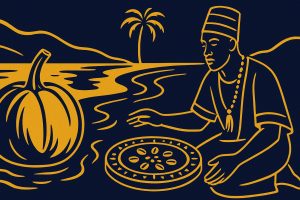
One well-known story of Èjì Ogbè begins as a domestic tragedy disguised as ordinary routine: a household, a meal, a gourd of water. In the telling preserved across West African and diasporic lineages, a newborn child speaks—impossibly early—interrupting the motion of a hand reaching toward food and drink. The child warns: Stop—this is poisoned. The warning happens twice, once for each parent, as if the infant carries two tongues (or two truths) at once. From this double rescue comes the name often glossed as “double salvation,” and the sign’s older naming as “two languages.”
If that sounds like a miracle, it is also a psychology: Èjì Ogbè is the moment consciousness becomes bright enough to recognize what would quietly harm it. It is insight that arrives early, before the damage has time to become a habit.
Another relevant myth
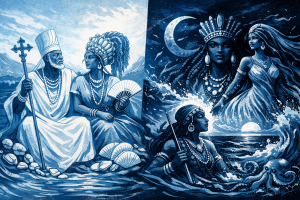
A second myth deepens the same teaching, but shifts the stage to the celestial. In this account, Orí (inner head/destiny-self; the seat of personal destiny and discernment) exists as a divinity among divinities. The beings of heaven, strangely, are first imagined without heads—because the Head itself is a sovereign power. When Ọ̀rúnmìlà (Ifá’s witness of destiny; the òrìṣà of wisdom and divination) seeks wholeness, he is instructed to make offerings and to wait for the one being meant to “complete” the body. Many try and fail. At last Orí arrives, is washed, welcomed, anointed—and then breaks the kola nuts with a thunderclap that reorganizes heaven’s politics. The body parts agree to unite beneath Orí, crowning the Head as ruler of the body. Èjì Ogbè stands, in this story, as patron of Orí’s enthronement.
Both myths say the same thing in different weather. Life improves when the “head” is not merely clever, but honored — cleansed of distortion, treated as sacred, placed where it belongs.
A Yorùbá quote associated with an Èjì Ogbè story of reputation and reversal is preserved as a chain of diviners’ praise-names — words that move like wind through a crowded market of opinions:
“Efìfì níì sọ́jú ọmọ tẹrẹ́ tẹrẹ́, Ọ̀kpa Tẹrẹ́ bẹ́ ẹjọ́ lẹ́yìn, Ọ̀ṣùdì Ẹ̀rẹ̀kẹ̀, Ọ̀ṣùdì Ẹ̀rẹ̀kẹ̀.”
“The gentle breeze cools a child’s face softly; the advocate pleads the case from behind; Ọ̀ṣùdì Ẹ̀rẹ̀kẹ̀—again, Ọ̀ṣùdì Ẹ̀rẹ̀kẹ̀.”
In the story that carries this chant, a mother consults Ifá when people mock her child’s good works. After divination and offerings, the public voice changes—like food transformed by salt, like a hen’s call changing when she settles to hatch life. The chant becomes an image of Èjì Ogbè’s subtle power: not force, but air—the slow, pervasive element that eventually fills every room.
What this Odù teaches
Èjì Ogbè is often described as pure light and expansion: light moving outward from an origin until an “open road” appears in practical life. In Ifá language, that open road is not only external opportunity; it is also internal coherence—when actions, character, and destiny are aligned rather than at war.
Several teachings commonly recur in Èjì Ogbè material:
- Destiny is chosen, then remembered. Many Ifá lineages teach àtúnwá (returning again to the world; reincarnation as a cycle of re-entry), where a person selects a life-pattern before birth. Harmony with that pattern tends to be associated with longevity, abundance, and stable kinship. Misalignment tends to correlate with illness, poverty, or loneliness.
- Good character is not decorative—it is protective. In Ifá ethics, ìwà (character/existential comportment) is a spiritual technology: it keeps light from turning into glare.
- The shadow of “open roads” is arrogance. When things move smoothly, Èjì Ogbè warns that the easiest danger is to drift out of alignment precisely because resistance has relaxed. The sign’s negative expression is frequently framed as pride or inflated certainty.
- Orí must be crowned daily. Not with fear, but with attention: decision-making that respects consequences. Self-knowledge that refuses self-deception. Humility that remains intact even inside success.
If Èjì Ogbè feels like “good news,” it is also a strict teacher. Its light reveals—without drama—where a person’s life is not yet in agreement with itself.
Key myths and happenings
Èjì Ogbè carries an unusually dense mythic memory. Different lineages emphasize different roads (ọ̀nà), but several themes remain recognizable.
1) The birth of “double salvation”
The newborn who speaks twice—saving both parents—becomes a symbol of doubled clarity: insight that arrives in time, and then arrives again to confirm itself. The sign is tied to balance (“two sides identical”), a sense that harmony is not passive luck but a symmetrical force.
2) The enthronement of Orí (the Head)
In the myth of Orí’s divinity, the Head becomes king because it succeeds where strength fails. It breaks what cannot be broken, not by brute force but by rightful relationship—welcome, cleansing, honoring, placement. Psychologically, this reads like a map of integration: the “parts” of a person unify when the inner head is treated as sacred rather than ignored.
3) The coronation of Èjì Ogbè among the Olódù
Another story narrates how the sixteen principal Odù meet to choose a leader. Èjì Ogbè is repeatedly given the “head” portion in the division of animals—an emblem that looks like a joke until it becomes destiny. Through counsel from Èṣù (the crossroads-messenger; opener and tester of roads), Èjì Ogbè acts with humility and timing, helps an elder woman who is secretly divine, and returns transformed—recognized as king.
The lesson isn’t that power is seized; it is that power can arrive through service, patience, and unseen sponsorship.
4) Reputation turns like a voice changes
The story of Olayori and the mockers centers on social reality: how quickly a community can become a court without due process. After divination and offerings, public speech changes from contempt to praise.
Èjì Ogbè, here, is not naïve about society. Light includes strategy.
5) Èjì Ogbè as “the straight road”
Some interpretive materials frame Èjì Ogbè as “roadness” itself—straightness not as rigidity, but as alignment. That straight road is contrasted with the “crooked” or circular way of darkness/death motifs associated with other principal signs.
In lived life, this often becomes a question: Is this path truly mine, or merely available?
Relevant Òrìṣà in this Odù
In many teachings, Èjì Ogbè is affiliated broadly—so broadly that it can be said to “touch all òrìṣà.” Still, several presences appear with particular brightness.
- Ọ̀rúnmìlà (wisdom/divination; witness of destiny): Èjì Ogbè frequently frames the conditions under which Ifá guidance becomes especially clarifying—when life is poised at the beginning of a cycle, or when success risks turning into carelessness.
- Èṣù (crossroads messenger; keeper of consequence): In Èjì Ogbè stories, Èṣù often appears as the one who makes timing real—turning good intention into effective outcome.
- Obàtálá (whiteness/clarity; shaper of human form): White cloth, coolness, patience, and clean perception often cluster around Èjì Ogbè descriptions, linking it to Obàtálá’s aesthetic of refined power.
- Ṣàngó (fire/justice/authority): When light needs force—when dissent or chaos requires discipline—Ṣàngó’s thunder frequently becomes a narrative partner to Èjì Ogbè’s airy clarity.
- Ògún (iron/roads/work): Even when Ògún is not “owner” of this Odù, the theme of roads and decisive movement can call his frequency: the machete that clears what blocks the straight path.
- Ajé (wealth; prosperity force): Èjì Ogbè often speaks of abundance as a consequence of alignment, not merely acquisition—wealth that does not poison the household.
- Ìbejì (twins; doubled blessing): “Double salvation” naturally resonates with twin motifs—doubling as multiplication of good, and as accountability (two eyes watching).
Across Yorùbá and diasporic practice, Ifá itself is commonly defined as a 256-sign geomantic divination system overseen by Ọ̀rúnmìlà, with practitioners known as babaláwo (fathers of secrets) and, in some communities, ìyánífá (mothers of Ifá).
Key topics for lived life and development
Several themes recur when Èjì Ogbè is read as a life-teacher (rather than merely a fortunate sign):
- Alignment over intensity. Many people can be intense; fewer people are aligned. Èjì Ogbè praises the calm decisiveness that comes from coherence.
- Visibility and responsibility. An “open road” often brings visibility. Visibility amplifies small flaws. The sign’s warnings about arrogance can feel less like moralism and more like physics.
- The head (Orí) as a daily coronation. The mythic coronation of Orí (inner head/destiny-self) suggests a lived practice: choices that honor long-term destiny rather than short-term appetite.
- Reputation as a field of power. The Olayori story frames community voice as something that can be influenced—through spiritual means in ritual contexts, and through integrity, consistency, and strategy in everyday life.
Spiritual development
If Èjì Ogbè is “light,” its spirituality is not only mystical illumination. It is the kind of brightness that exposes where a person has been bargaining with their own conscience.
In practical spiritual terms, Èjì Ogbè often reads like:
- A call toward clean perception: noticing what is actually happening rather than what one wishes were happening.
- A refinement of ìwà pẹ̀lẹ́ (gentle character; ethically grounded temperament): not softness as weakness, but softness as mastery—like breath that moves everything without bruising anything.
- An invitation to relationship with Orí: the inner head as destiny-compass. The myth of Orí being washed and honored suggests that “clarity” is not merely mental—it is also devotional.
In some lineages, Èjì Ogbè also carries the idea that a person may arrive with certain blessings and lack others — wealth without health, health without children, status without peace. And that balance can be sought through discernment and spiritual work appropriate to one’s tradition.
Love and intimacy
Èjì Obe seductive in love: new attention, new possibility, the sense that the future is finally spacious. Yet its myths quietly insist on discernment.
The “double salvation” story is, among other things, a parable about domestic risk: poison can come from inside the home, not only from enemies outside. In modern psychological term
- Patterns of suspicion, sabotage, or unspoken resentment
- The way power struggles hide behind “care”
- The temptation to win rather than to understand
Èjì Ogbè doesn’t demand pessimism; it suggests clarity. Intimacy flourishes when truth is breathable—when the air in the room can circulate.
Family and ancestry
Family is where destiny meets repetition.
Because Èjì Ogbè is often tied to Orí and to the ethics of alignment, it can show up around questions like:
- “What in my family line is genuinely mine to carry?”
- “What is merely inherited habit dressed up as fate?”
- “Which elders deserve honor—and where does honor require boundaries?”
The Odù’s emphasis on seniority and order appears frequently in interpretive texts, not as blind obedience, but as a recognition that communities survive through structure—while also needing spiritual intelligence to keep structure from becoming tyranny.
Health and vitality
Èjì Ogbè’s symbolism of breath, head, and “daylight” can be read as a health ethic: vitality often improves when life becomes less internally divided. Some source materials explicitly connect Èjì Ogbè with the head (Orí, inner head/destiny-self) and with maintaining life’s flow.
A grounded way to interpret this—without collapsing spirituality into medicine—is:
- Stress and chronic vigilance often manifest “in the head”: sleep disruption, scattered focus, tension, rumination.
- Alignment practices (ethical repair, consistent routines, supportive community) can reduce the inner friction that burns vitality.
- In traditional settings, health concerns often become moments when consultation is considered, precisely because the question is not only “What is happening?” but “What is the meaning of what is happening, and what response restores balance?”
(Any medical condition should be assessed by qualified clinicians; Ifá-oriented interpretation functions differently—more like meaning, timing, and ethical-spiritual response.)
Work, vocation, money, leadership
Èjì Ogbè is often associated with leadership: not merely being “in charge,” but becoming a stabilizing center—someone whose presence reduces chaos rather than multiplies it. Some materials describe the sign as indicating a destiny among rulers, administrators, and mediators, where visibility and responsibility intensify.
In work and money, Èjì Ogbè can express as:
- Momentum that arrives quickly: projects open, connections appear, doors swing wider than expected.
- A test of character under ease: success asks, Who are you when nothing is blocking you?
- Wealth as “replacement” rather than obsession: some passages frame a movement where death and sorrow are symbolically replaced by celebration and prosperity—less as a guarantee, more as a map of possibility when alignment is maintained.
Leadership in Èjì Ogbè is rarely glamorous in the myths. It is often earned by timing, humility, and the ability to help others on the road without needing applause for it.
Meaning in Ìrẹ̀ and Òṣogbo
Ìrẹ̀ (fortune/blessing; alignment, ease, supportive outcomes) and Òṣogbo (challenge/misalignment; friction, warning patterns) are not simplistic “good vs. bad.” They are signatures—ways the same energy behaves under different conditions.
Ìrẹ̀ (fortune) signatures in Èjì Ogbè
- Open road with clean conscience: progress that does not require self-betrayal.
- Recognition that follows service: being “seen” because one helped, not because one performed.
- A calm mind that chooses well: Orí feels “crowned”—decisions reduce future regret.
- Stability that multiplies: doubled blessings—supportive allies, repeated confirmations, paired opportunities.
Òṣogbo (challenge) signatures in Èjì Ogbè
- Arrogance disguised as confidence: certainty that stops listening, pride that outruns wisdom.
- Speed without destiny: look like open roads but lead away from the chosen path.
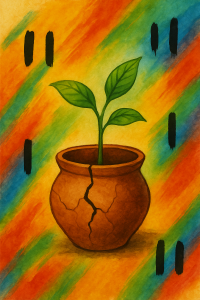
- Household tension and subtle sabotage: the “poison in the gourd” motif—conflict hidden inside routine.
- Reputation under attacorming quickly; the need for strategy, patience, and ethical steadiness.
Èjì Ogbè’s deeper promise is frictionless, but that clarity becomes available—and clarity is a kind of mercy.
When consultation tends to matter
Because Èjì Ogbè is associated with beginnings, alignment, and the head (Orí, inner head/destiny-self), consultation in its atmosphere often becomes relevant when:
- A major life doorway is opening: marriage, relocation, launching a business, accepting leadership, beginning training or initiation.
- Life is going well—but feels spiritually “off”: the classic Èjì Ogbè paradox where external ease hides internal drift.
- Reputation, conflict, or disputes intensify: especially when public narratives distort private truth (as in the Olayori story).
- Health or vitality concerns overlap with destiny questions: when the issue is not only symptom relief but restoring balance, timing, and ethical-spiritual alignment.
In many communities, consultation is approached less as superstition and more as a structured conversation with tradition. One that frames choices, consequences, and repair. Broadly, Ifá is described as a 256-sign divination corpus with a deep literary body used to interpret human situations through mythic precedent and ethical guidance.
Further Reading
Daily Ifa Blog — About Odu Ogbe