
Some relationships do not become simple merely because one person is no longer physically present. Ìbejì brings this continuity into a religious language of twins, care and remembrance. The subject includes joy and abundance, but also the demanding work through which a community acknowledges that a bond has not disappeared without a trace.
Two related forms suggest connection without interchangeability.
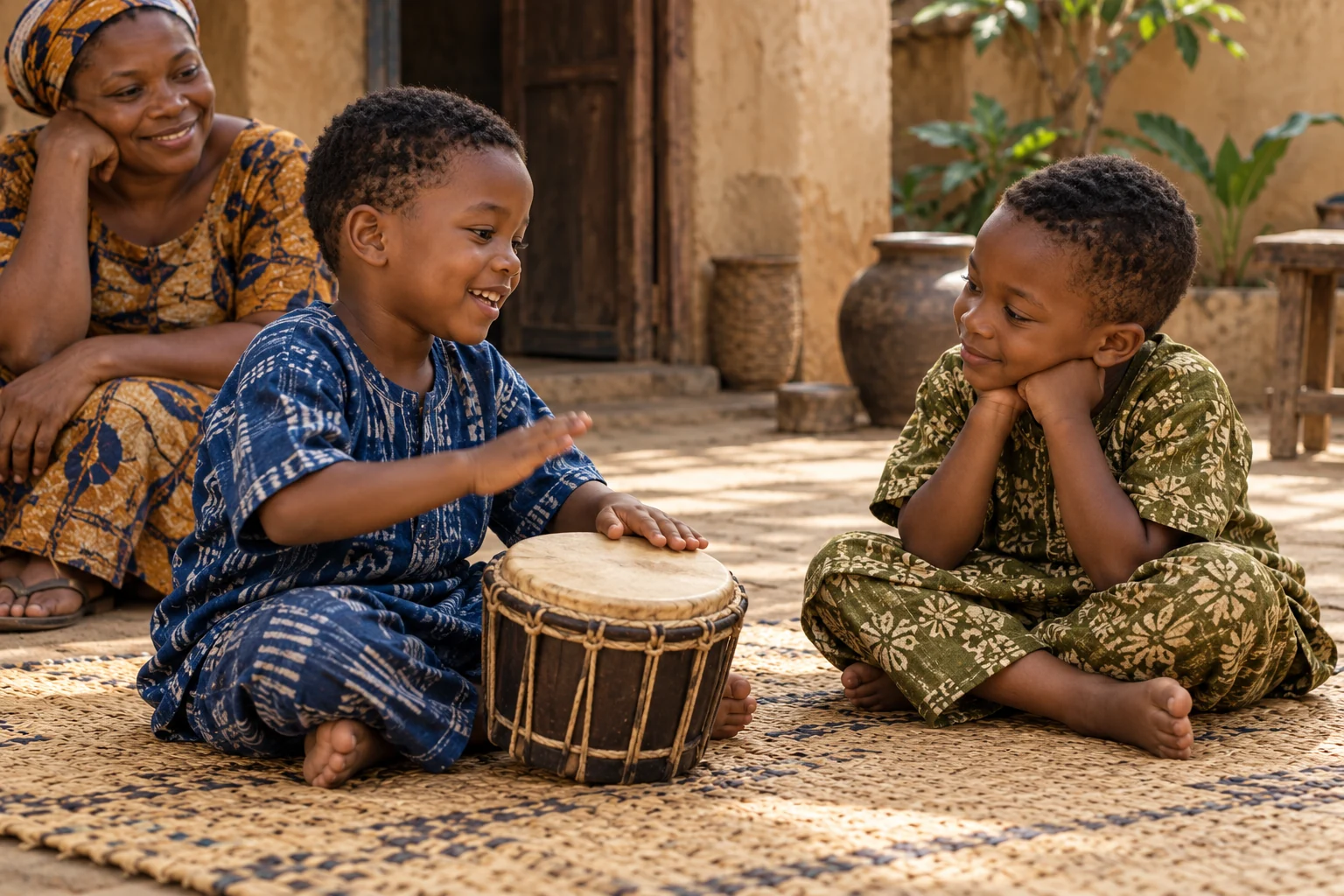
1. Twins in religious and social life
Ìbejì is associated with twins in Yorùbá traditions. Brazilian Ibeji and Cuban Ibeyi have their own histories, narratives and devotional forms. Twinship should not be reduced to a decorative symbol of balance, nor should every pair of figures in African art be identified automatically as Ìbejì.
The particular religious relationship matters. It includes families, caretakers and practices through which children and the continuing significance of twinship are recognized. A reader gains more from understanding that relationship than from treating twins only as an abstract opposition of two halves.
2. What an ere ibeji can show
The Metropolitan Museum’s twin figure explains a context in which a memorial figure receives continuing care after a twin’s death. The mature adult representation is a deliberate artistic convention, not a failure to portray the age of the child.
This is a strong example of why looking carefully matters. A quick glance may see a small carved adult. A contextual reading encounters a relation sustained through a material form. The object should not be generalized into a rule that every Yorùbá or diaspora community handles loss in an identical way.
3. Key narrative motif: the twins and an adversary
Well-known diaspora narratives show twins using alternating performance, rhythm or play to overcome a dangerous adversary. Versions differ in the opponent and sequence. The important theme for a public introduction is not the reconstruction of one unverified script, but the possibility that cooperation and timing can succeed where isolated force fails.
In contemporary reflection, a second person can make more than twice the effort possible. One continues while the other rests; one notices what the other cannot; one prevents exhaustion from becoming defeat. The relationship creates a form of endurance that neither could produce alone.
The lesson does not require idealizing every sibling bond. Actual families can contain rivalry, unequal treatment and grief. A meaningful study can honor the force of the relationship while also making room for the different people within it.
4. Care that continues, grief that changes
Remembrance can become an active responsibility rather than a demand to remain frozen at the moment of loss. A family may maintain a bond while allowing its living members to develop. The difficult balance is to avoid treating remembrance either as an obstacle that must be discarded or as a claim that no future happiness is permitted.
These are contemporary questions, not instructions for a ritual. A person grieving a child deserves attentive care rather than a generalization about what a symbol supposedly means for them. Religious context may support that care, but it should not be used to rush the person toward an explanation they have not chosen.
5. Distinct relationships across traditions
Ṣàngó appears in particular accounts connected with twins. Brazilian public culture also brings encounters with figures and celebrations that should be studied in their own religious histories. One should not assume that every twin-related devotion is simply another label for the same practice.
Yemọja offers a related but distinct conversation about care, continuity and the capacity to release. Kórìkóto opens further study of children’s sacred protection in specific Yorùbá settings. The connections help enlarge the field without dissolving its differences.
6. Alternation as an intelligence of relationship
The twins’ alternating performance offers a distinctive way to think about endurance. A task that defeats one body can become possible through a relation that knows how to pass the work. Rest is then part of the structure of success rather than evidence of insufficient commitment.
The contemporary application reaches into families and teams. Sometimes the strongest arrangement is not the one in which everyone gives the same effort at every moment. It is the one in which people understand when another has reached a limit and can carry the next part without turning the exchange into a competition.
Such cooperation needs trust. If every pause becomes evidence of laziness, no one can rest honestly. If one person always receives the pause while another always performs the continuation, alternation has become an attractive description of unequal labor. The relationship must remain visible in how the work actually moves.
7. Two people are not interchangeable halves
Twin imagery can encourage a language of perfect sameness. Actual twins, like any siblings, need room for different experiences and futures. A strong bond does not require identical wishes, talents or responses to grief.
This is an important contemporary reading of paired representation. A community can honor the relationship without making either person carry the obligation to complete the other. The individual and the bond can both matter. Neither needs to erase the other in order to be real.
8. Continuing care and the pace of mourning
A memorial relationship may be maintained through small repeated acts whose value is difficult for an outsider to measure. The act can organize attention, keep a name present and give grief a form that can be carried through ordinary days.
That does not mean everyone should mourn in the same way. The person who appears active may be grieving deeply; the person who remains quiet may not be rejecting the relationship. Care improves when the observer asks what support is wanted rather than interpreting the outward form as a complete account of the inward life.
Public study can make room for that patience. It does not need to translate every continuing bond into either a psychological problem or a perfect spiritual resolution. A human relationship may remain important while changing its form.
9. Religious identity and the scope of this study
Ìbejì concerns a sacred relation carried through living twins, family life, divine narratives, and material forms of continuing care. The pair is more than an abstract emblem of balance. Actual children arrive within relationships of attention, dependence, delight, fear, and obligation. The author’s portrait follows this density into the double, sibling rivalry, play, grief, and the possibility of becoming distinct without destroying a bond. Its value lies in keeping resemblance and difference active together.
The Metropolitan Museum’s twin figure gives a concrete anchor. Its account describes a carved memorial presence and the repeated handling through which a relationship continues after death. The adult form of the small figure is an artistic convention, not an accidental failure to portray a child. This detail immediately complicates a superficial reading of appearance. A viewer needs context to understand the relationship the object carries.
Brazilian and Cuban forms require their own histories. A documented Brazilian connection with Cosme and Damião is meaningful without making every twin-related devotion interchangeable. Nor should Ibeji, Erê, and every childhood presence be collapsed into a single category. The central human question is how a relationship can remain consequential while each person has a distinct life, including when loss changes the relationship’s material conditions.
10. Knowledge that gives the figure depth
10.1 How does a carved twin figure carry more than resemblance?
The Met’s object record describes a memorial figure that remains a point of relationship after a twin’s death. Its surface records repeated care, while its mature physiognomy differs from the age of the child remembered. These details show why the object cannot be understood simply by asking whether it looks like its subject. The form participates in a religious relationship whose meaning is carried through use as well as appearance.
The author makes a related distinction between consolation and ritual reality. A modern viewer might assume that a figure is only a symbolic substitute, valuable because it helps a bereaved person feel better. The religious account is more demanding: a relationship remains active in a changed material mode. Psychological interpretation can learn from that without claiming to settle the ontology or measuring the object solely by an emotional effect.
The knowledge gained is that memory may be enacted rather than merely stored. Repeated gestures carry continuity; materials acquire traces; a family’s responsibility is not exhausted by a private thought. This does not make one object a universal model for all twin loss. The particular institution, region, and religious account still matter. It does show how a small carved body can disclose an entire relational world that an isolated catalogue of attributes would miss.
Evidence: The Metropolitan Museum of Art, Twin Figure: Female (Ibeji), object 1979.527.27 — Specific memorial figure; adult representation, continuing care, traces of handling, and Nigerian regional context.
10.2 Why is play treated as a consequential intelligence?
The book’s narratives of the twins outwitting a death-bearing adversary turn on timing and coordinated performance rather than superior force. One can continue while the other changes position or rests. The pair creates a rhythm that a solitary performer could not sustain in the same way. This is a theology of relation before it becomes a contemporary lesson about cooperation: the story gives sacred force to an apparently small or childlike mode of action.
The author also includes dangerous mischief. That matters because play is not identical with harmlessness. Curiosity and immediacy can renew an exhausted world while disrupting its necessary limits. Adults often want childhood to represent innocence without agency. The twins resist that arrangement. Their vitality has consequences, so care must neither extinguish it nor pretend that consequence does not exist.
A contemporary application concerns groups that value only solemn forms of competence. They may overlook improvisation, humor, rhythmic coordination, and the ability to try again without turning failure into a total verdict. These capacities can make work possible where command alone has become brittle. The book’s play reading nevertheless retains responsibility: flexibility matures through form, not exemption from it. The narrative is most revealing when play and limit remain related rather than treated as enemies.
10.3 Why does the child after twins change the meaning of the pair?
The author gives Ìdòwú more than a footnote in birth order. A third presence can interrupt a pair organized too completely around resemblance or rivalry. Attention must be redistributed, a shared world expands, and the bond can no longer claim to be the whole of reality. This is the book’s interpretive development of the child-after-twins field, not a universal assertion about every actual family containing twins.
The knowledge lens concerns the difference between a bond and a closed system. Two people may confirm one another so intensely that disagreement appears to threaten the relationship’s existence. They may also compete in a way that leaves no space for a value outside their ranking. A third perspective can make another form of relation thinkable. It need not destroy intimacy; it can permit intimacy to become less absolute.
This distinction also protects the third person from being treated merely as a tool for the pair’s development. A sibling has their own needs and destiny, not a duty to stabilize others. The symbolic reading becomes ethically useful when it enlarges the family field rather than assigning a child an invisible job. The book’s concern with Orí reinforces the point: kinship is consequential, but no person’s singular life is exhausted by the relational role others need them to occupy.
11. A depth-psychological reading
Interpretive basis: The dedicated chapter in Babá Tilo de Àjàgùnnà’s The Orishas and the Human Soul, especially “Ìbejì”, “Before the Òrìṣà Become Archetypes”. The dedicated portrait supplies the author’s mythic and psychological interpretation; introductory and ecological chapters govern distinction between sacred relationship and analytical resonance. Contemporary examples here are contemporary interpretations, not reports of ritual outcomes.
11.1 Being recognized without becoming a copy
The book’s double captures both the comfort of resemblance and the fear of replacement. A person may long for someone who responds so precisely that loneliness finally disappears. Yet a counterpart who must always agree is not allowed a distinct life. Recognition becomes a demand for duplication. Difference then feels like withdrawal of love rather than evidence that two people exist.
An illustrative sibling situation concerns a family that repeatedly assigns one child the role of the successful one and another the role of the difficult one. The labels give the pair a recognizable structure while constraining each person’s development. The successful child may become afraid to struggle; the difficult child may experience improvement as disloyalty to the only identity the family recognizes. Comparison organizes both lives even when their interests are quite different.
The author’s attention to distinct Orí makes the developmental question exact. Shared beginning does not require identical destiny. A person can remain deeply related while choosing work, relationships, or values that the other does not mirror. The task is also reciprocal: one must permit the other’s difference rather than reserve singularity for oneself. Mature relation does not abolish the wish to be understood. It loosens the condition that understanding requires sameness. Ìbejì’s psychological field is useful because it preserves the ache of separation without making fusion the only possible answer.
11.2 Continuing love without freezing the living
The author’s grief reading begins from a relationship that death changes without making it meaningless. This challenges an overly simple demand to detach. A person may continue to address, remember, or care in relation to someone absent without refusing the fact of death. The important question concerns the form of continuation: can the bond remain significant while present life develops?
The opposing danger is that remembrance becomes an instruction against every future attachment or pleasure. A survivor may feel that growth would betray the one lost, especially where identity was deeply paired. Others may reinforce the demand by treating the living person as a representative of the absent one. The book’s continuing-bond motif makes the complexity visible without settling how any individual should grieve.
An illustrative situation is a sibling who wants to pursue an opportunity that the deceased sibling never had. Joy can bring guilt precisely because the relationship matters. The interpretive task is not to argue the person out of love. It is to ask whether love requires repeating the deprivation. A changed bond might accompany rather than prohibit a future. This is a contemporary application, not a prescribed ritual or a clinical claim about bereavement. The figure’s religious reality remains distinct from psychological utility. The reading honors loss most carefully when neither severance nor permanent arrest is imposed as the only legitimate form of fidelity.
11.3 Joy that renews and brightness that prevents feeling
The book refuses a flat account of the twins as happiness. Joy can enlarge contact with life, while constant brightness can protect a person from feeling loss. The difference is not whether laughter occurs beside grief; it often can. It is whether laughter remains one available response or becomes the only permitted response. A person who must always entertain may be lively without feeling safely known.
An illustrative group situation involves a member whose humor reliably ends uncomfortable conversations. Everyone values their wit, and the person learns that belonging depends on keeping the room light. When they become distressed, others expect another joke. The same capacity that once opened contact now prevents a needed change in the relationship. The problem is not play itself but the narrowing of emotional possibility.
The author’s transitional-space reading helps preserve the positive function. Play allows experimentation between fantasy and ordinary reality; it can make an unresolved situation thinkable without immediately forcing a final answer. Mature play therefore includes the capacity to pause, acknowledge consequence, and return. It need not dominate every moment. The twins’ dangerous mischief adds the question of limits, while their cooperative victory shows that rhythm can sustain life. Inner development concerns access to a wider range: joy without denial, seriousness without deadness, spontaneity without exemption from responsibility. This is a symbolic reading, not a description assigned to every literal twin or person devoted to Ìbejì.
12. What this relationship means for a person
12.1 In an established devotional or initiatory relationship
An established religious relationship involving Ìbejì should be approached through its actual family and community context. The book itself warns that the twin field does not simply reproduce the standard model of a single personal head deity. Its discussion of possession and crowned identity belongs to the author’s account and should not be promoted into a universal rule without local confirmation. The essential distinction is that relation to twins has forms that cannot be inferred from a personality resemblance or a generic initiation template.
Within a sustained devotional life, reflection can ask how joy, care, and singular destiny are carried together. Are actual children taken seriously as persons, or only celebrated as an image of innocence? Does a family honor twinship while permitting each child different needs and desires? Does remembrance create a place for an absent person without requiring the living to stop growing? These questions concern conduct and the distribution of attention rather than an attractive identity as playful or fortunate.
Long relationship can also include the work of ordinary repetition. Care is sustained through small acts, objects receive attention, and stories are taught to new listeners. The psychological portrait can deepen respect for that labor without explaining the religious relationship away as a coping mechanism. It may also expose a shadow in the community: a demand for permanent delight can make sorrow difficult to voice. Mature devotion can remain joyful while allowing difficult feeling, difference, and responsibility to become fully present.
12.2 When the figure becomes relevant in consultation
If Ìbejì is encountered in consultation, the appearance should not become a prediction of twins, a pregnancy, a lost sibling, or an invisible counterpart. None follows automatically from a public association. The practitioner’s actual explanation and the question asked remain decisive. A paired sacred presence may become relevant to cooperation, shared responsibility, childhood, comparison, play, grief, or a particular religious obligation. The reference offers vocabulary for hearing those possibilities without selecting one in advance.
The book’s concern with distinct Orí prevents another confusion. A relational pattern does not erase a person’s singular direction. If a consultation concerns a partnership, the question may be how the bond can support each participant rather than demand identical development. If it concerns rivalry, the person may ask which comparison has taken over their measure of worth. If grief is relevant, continuing love may need a form that does not prohibit life. These are contemporary interpretive extensions, not substitutes for the consultation.
The encounter also does not establish a universal initiation or mean that someone must identify as a child of twins. A person may be asked to attend to a specific relationship or responsibility rather than adopt a permanent spiritual profile. Psychological usefulness lies in precision: what is the pair doing in this situation, what would allow differentiation, and which form of cooperation is actually possible? Such questions keep the sacred field alive without turning it into an automatic explanation for every experience of resemblance, loneliness, or joy.
13. Nature, materials and human knowledge
Ìbejì’s ecology includes carved wood, traces of handling, family relationships, beginnings, rhythm, and vulnerable childlife. The Met object shows materials within an ongoing relation rather than isolated art for looking. The author adds river sources and germination as images of emergence, while the cooperative narratives make temporal alternation as important as physical pairing. This is an ecology of conditions through which new life continues, not a numerical table in which every pair automatically belongs to the same sacred power.
Human relations are especially concrete. Attention is divided, caretaking must be distributed, siblings are compared, and memory requires forms. A shared beginning can intensify care while making unequal treatment painful. The book’s distinct-Orí emphasis keeps each person visible within that field. Material continuity should not become an argument that the living are merely interchangeable carriers of a family bond.
Contemporary relevance includes noticing the repeated acts through which relationship is sustained. Cooperation requires timing and rest; play requires a setting in which consequence can be learned; remembrance requires room in ordinary life. These conditions are not decorative additions to an inner process. They help constitute it. The religious figure exceeds any such analytical account, yet the ecology teaches why personhood is difficult to understand as an isolated possession existing before relation.
14. Diaspora, comparison and syncretism
A Brazilian correspondence with Cosme and Damião is documented by the Museu da Língua Portuguesa’s Ibêji record. Bahia’s official heritage account also identifies a connection between the saints and Ibejis within the caruru tradition. This is a specific cultural and religious relationship, not proof that the Catholic saints and Yorùbá twin powers have identical histories or that every community understands the connection in the same way.
The Bahian account is useful because it locates the association within families, terreiros, and shared cultural practice. Its significance is larger than the resemblance of two depicted figures. Collective transmission carries the relation. The museum’s brief lexical definition should likewise be recognized as a collection gloss rather than a complete theological statement.
Other childhood names require separate attention. The book explicitly warns that Ibeji, Erê, and diaspora formulations do not always name the same register. A shared festival or an exhibition’s gathering of childhood presences cannot by itself abolish those distinctions. The same principle protects comparison with spiritual doubles and unseen companionship. Those ideas may illuminate the author’s wider twin psychology without establishing that every lonely person has a hidden twin or that every paired sacred figure belongs to one universal system of doubleness.
Evidence: Museu da Língua Portuguesa, Ibêji, collection record pacr_aud_275 — Brazilian lexical collection gloss documents identification with Cosme and Damião; not comprehensive theology; Government of Bahia, SECOM / Ascom IPAC, Caruru de São Cosme e São Damião completa um ano de reconhecimento como patrimônio imaterial da Bahia — Bahian heritage context linking saints and Ibejis within families, terreiros and collective tradition.
15. Questions for a fuller understanding
15.1 Does deep twinship mean two people must share the same destiny?
No. The book stresses that proximity and resemblance do not erase distinct Orí. A pair can be deeply related while its members have different needs, opportunities, interests, and directions. Comparison becomes damaging when one person’s flourishing is treated as the other’s failure or when difference is heard as abandonment. A useful contemporary question is whether the bond permits each person to become more fully themselves. This does not require denying shared history. It asks that history to remain a source of relation rather than a demand for duplication. The same interpretive principle can help illuminate siblings, friends, or partners without declaring them literally or spiritually twins.
15.2 Does continuing care after loss mean refusing to mourn?
Not necessarily. The author interprets ère ìbejì through a changed relationship rather than a simple refusal of absence. The Met object supplies a material example of continuing religious care. Psychological reflection can recognize that a bond may remain important while its form changes. The difficult question concerns whether continuation supports present life or prevents it. Remembrance can accompany new relationships, growth, and joy; it can also become frozen when every future possibility feels disloyal. No single response should be imposed on a bereaved person. The religious account deserves respect on its own terms, while the contemporary interpretation asks how fidelity and continued living might coexist.
16. Correlations to life dimensions
| Dimension | A question for reflection |
|---|---|
| Cooperation | What becomes possible when the work can pass between people? |
| Family | Can I honor a bond without erasing each person’s difference? |
| Grief | Which form of remembrance supports life as well as memory? |
| Care | Who is sustaining the relationship through small repeated acts? |
| Play | Have I dismissed a form of intelligence because it arrives through rhythm or joy? |
17. If Ìbejì is important in your life
Begin with your family and religious context rather than a universal personality profile. Being a twin, knowing twins or feeling drawn to paired imagery does not establish a particular initiatory relationship. Public study can offer a careful vocabulary for an important truth: a relationship has a life that is carried through what people continue to do for one another.
18. Sources for the expanded interpretation
Interpretive basis: The dedicated chapter in Babá Tilo de Àjàgùnnà’s The Orishas and the Human Soul, especially “Ìbejì”, “Before the Òrìṣà Become Archetypes”. The dedicated portrait supplies the author’s mythic and psychological interpretation; introductory and ecological chapters govern distinction between sacred relationship and analytical resonance. Contemporary examples here are contemporary interpretations, not reports of ritual outcomes.
-
The Metropolitan Museum of Art. Twin Figure: Female (Ibeji), object 1979.527.27. Specific memorial figure; adult representation, continuing care, traces of handling, and Nigerian regional context. Public institutional page, actual descriptive text read; current web edition.
-
Museu da Língua Portuguesa. Ibêji, collection record pacr_aud_275. Brazilian lexical collection gloss documents identification with Cosme and Damião; not comprehensive theology. Public institutional page, actual descriptive text read; current web edition.
-
Government of Bahia, SECOM / Ascom IPAC. Caruru de São Cosme e São Damião completa um ano de reconhecimento como patrimônio imaterial da Bahia. Bahian heritage context linking saints and Ibejis within families, terreiros and collective tradition. Published 26 September 2025, page updated 5 October 2026; actual institutional text read.
Possession/crowning distinctions are scoped to the author’s account, not asserted as universal. No fetal-loss diagnosis, invisible-twin claim, fertility prediction, ritual procedure, or clinical efficacy established.