
Ògbè Ìwòrì is a mixed Odù in Ifá’s 256-part corpus. The opening stories approach recovery through an unexpected encounter: people taking a crop become prospective family, while a displaced farmer rescues a stranger and finds a new home. This sign can be approached through the tension between hospitality and unequal power. Its agricultural images make livelihood tangible, while the origin list separately associates it with divination instruments, confinement, and Osanyin’s authority.
A question to carry through the study: When does a generous offer create belonging, and when does it create an obligation that needs examination?

This Academy reads the right column first, then the left. Each row carries a single or double mark.
Where this Odù belongs
Ògbè Ìwòrì belongs to the Ògbè family in this Academy’s study sequence. It is a mixed Odù, distinct from Ìwòrì Ògbè. The order matters. Its teaching is approached through its own narratives, rather than by adding two general descriptions of the principal signs together.
Key Òrìṣà and sacred relationships
The figures below are selected for their roles in the accounts discussed here. They offer connected reading paths through the tradition.
-
Ọ̀rúnmìlà. He plants the peanuts after receiving Ifa’s guidance in the marriage narrative, and separately advises Awó Kerere to seek a livelihood elsewhere.
-
Òsanyìn. His secret is located near the endangered stranger’s well and becomes associated with cultivation after Kerere’s rescue, linking land, specialist knowledge, and settlement.
Author’s further study: The Myths and Revelations of Odù Ògbè Ìwòrì develops this sign at book length. The inherited accounts discussed here retain their named witnesses and religious settings.
Key myths and their meanings
Peanuts and conditional pardon
Orunmila grows peanuts while seeking a spouse. Discovering two women taking the crop, he hears their plea to avoid the identity of thieves. He forgives them on condition that they stop stealing, and the episode ends in marriage to both women. Agricultural loss becomes the occasion for a changed social relationship, within a specifically Cuban-labeled narrative.
The encounter is useful for examining how a community negotiates an injury without fixing a person permanently to it. Yet pardon and marriage are joined through an imbalance: the crop owner controls both the accusation and its resolution. We can keep that complication visible and avoid presenting this arrangement as a general recommendation for intimate relationships.
Narrative setting: Cuban-labeled narrative in the accounts considered here; no independently established narrator or publication history.
Rescue beside the well
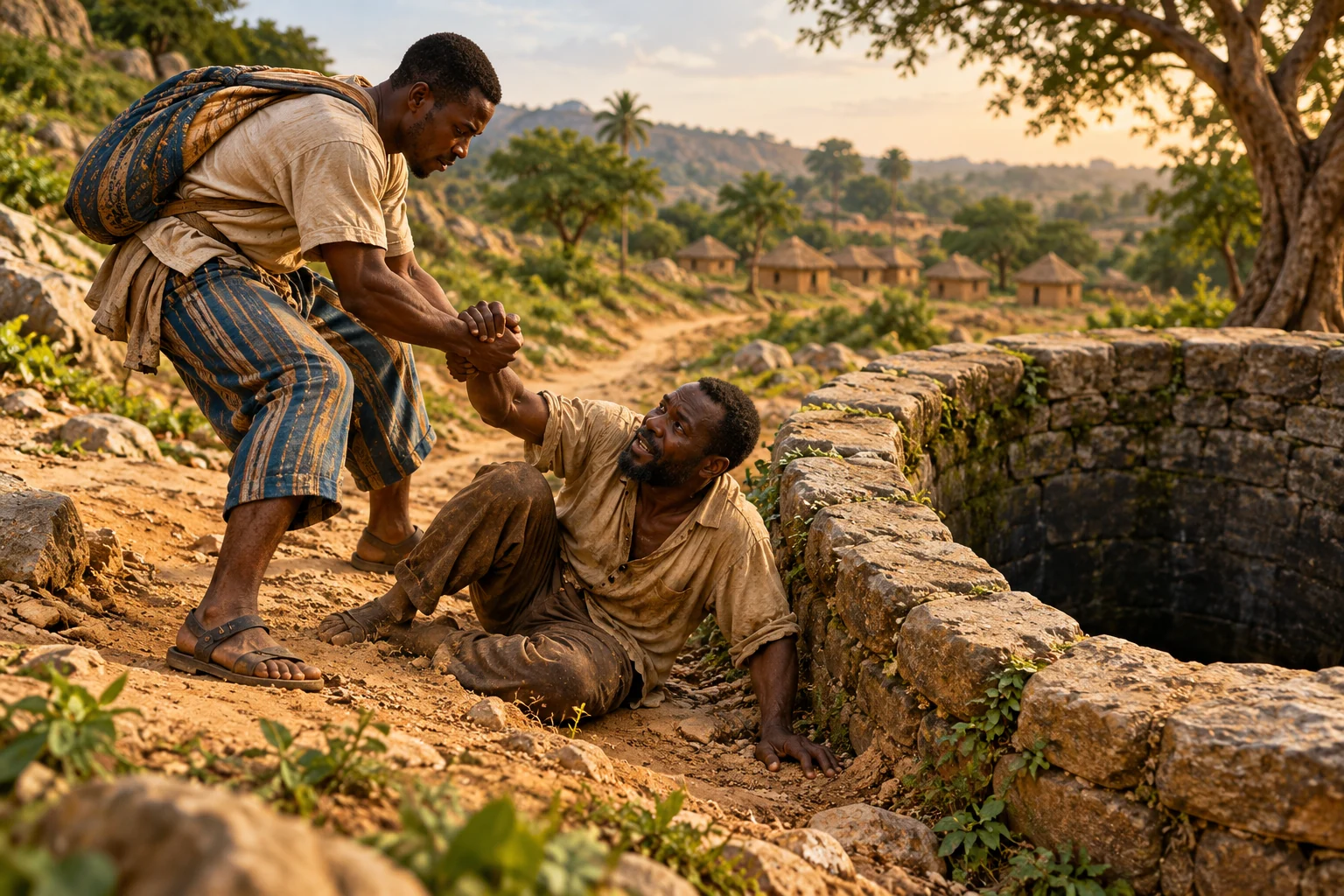
Awó Kerere leaves a place where his livelihood has collapsed. On the journey he encounters a man endangered while drawing water and saves him. The rescued stranger offers shared wealth and land. Both men describe estrangement from envious relatives, and a well associated with Olokun and Osanyin becomes the setting for renewed cultivation and a market.
The rescue changes Kerere’s position before he has achieved commercial success: he contributes something another person needs. Their common experience of damaged kinship makes cooperation possible beyond the birth community. The text does not establish that relocation always resolves conflict; its distinctive question concerns the difference between ties inherited automatically and ties built through reciprocal acts.
Narrative setting: Cuban-labeled narrative in the accounts considered here; no independently established narrator or publication history.
A young diviner proves his claim through a drum
A young diviner becomes the meeting host for older practitioners. At a festival discussion, he proposes that a dead goat can produce a stronger voice than a living one. The elders require a demonstration. He has a drum made with a skin and brings it discreetly to the gathering. Its music draws the participants into dancing before they return to the disputed claim. He then reveals the material of the instrument, and the assembly accepts that his apparently absurd statement has been demonstrated. Recognition follows an experience shared by his skeptical audience, rather than an unsupported declaration of exceptional ability.
The demonstration works by changing what counts as a voice. The elders initially understand the claim through the living animal; the younger practitioner understands it through an instrument people can make from what remains. That shift allows continuity and transformation to coexist: the sound depends on earlier life, craft, rhythm, and listeners. His youth also matters because the audience already benefits from meeting at his house while still questioning his interpretation. The story does not simply replace elders with youthful genius.
An elder remembers the original question when the pleasurable performance threatens to distract everyone from it. Innovation therefore needs both a new form and someone who insists that the form answer the claim actually made. The account is stronger when these roles remain separate. Its ritual materials belong to the narrative setting, while its interpretive value lies in how a community can experience and evaluate a difficult proposition without reducing disagreement to disloyalty.
Narrative witness and setting: Explicitly attributed in the compilation to Osamaro Iyamu Ibie; Yoruba/Bini-framed narrative.
An enslaved farm worker refuses the son’s abuse
Olufon purchases Olo after refusing a diviner’s preliminary demand because he wants to retain the money for the purchase. Olufon’s son Ajana imposes repeated household and farm tasks on the enslaved newcomer and strikes him when they are not done. Legba encourages Olo to stop tolerating the treatment. Olo swallows Ajana, bringing the father urgently to the farm. The withheld resources are finally supplied, Ajana is released, and Olo becomes a vodun associated with the farms, while Ajana is located in the domestic sphere. The ending distributes religious places without narrating a restoration of the earlier ownership arrangement.
The story makes the household’s prosperity depend on labor it treats as purchasable and endlessly available. Ajana intensifies his father’s domination, even though his own authority rests only on being the owner’s son. Olo’s refusal breaks the assumption that a purchase removes the worker’s capacity to set a limit. The swallowing is a fantastic reversal, not an acceptable method of resolving workplace abuse, and the father’s fear does not erase the system that produced the confrontation. Legba occupies an unsettling double position: he urges resistance and then tells the father what must be given to secure release.
He does not act as an impartial mediator standing outside the conflict. The movement from ownership to distinct sacred locations leaves a more interesting question than simple obedience to an oracle. It asks whether recognition of another’s irreducible presence becomes possible only after the powerful experience dependence on the person whose labor they had regarded as an object.
Narrative witness and setting: Fon Fá/vodun narrative explicitly attributed to Bernard Maupoil, misspelled Maulpoil in the local heading.
What was born in this Odù
“Born” can name an explicit traditional origin association or what emerges through a story: a capacity, relationship, practice or order of life. Interpretations drawn from a narrative are labelled below, so their basis remains clear.
Osanyin’s oath
Selected traditional source association.
The origin list locates an oath involving Osanyin in Mandinka territory and gives variant materials. Preserve the existence of the association without treating its geography or ritual details as independently verified history.
Divination implements taken by Oshun
Selected traditional source association.
The list associates Oshun with taking the board, chain, and divining powder from Orunmila. This is an origin motif about access to knowledge; the selected marriage and migration stories do not narrate that episode.
Correlations to life dimensions
These questions bring the selected stories into contemporary life. They are interpretive invitations for study.
Work and resources
Kerere’s new livelihood follows an act of rescue and an offer of shared land, rather than a solitary accumulation of goods. The market arises after settlement and cultivation, suggesting that resources include a trustworthy collaborator and a place where work can continue.
Reflect: Which relationship makes productive work possible?
Relationships and family
Both selected episodes turn difficult encounters into new affiliations. The marriage episode also places considerable power in the hands of the injured crop owner, so a reading about reconciliation should retain questions of agency and the conditions attached to forgiveness.
Reflect: Can everyone involved refuse the proposed reconciliation?
Character and inner life
Kerere responds to a stranger’s immediate danger while carrying his own losses. His capacity to act usefully survives the failure of his previous circumstances. That detail supports a focused reflection on continuing responsibility during a period of displacement.
Reflect: What useful response remains possible during loss?
Community and responsibility
The new farm becomes a destination for buyers, connecting personal recovery to a wider exchange network. The story makes a new community imaginable through practical cooperation, without erasing the estrangement that preceded it or promising automatic repair of old relationships.
Reflect: Who benefits when a new partnership succeeds?
A deeper reading of the sacred relationships
Consultation and exchange make transformation effective
In the drum account, consultation precedes the transformation of animal skin into an instrument heard at an Ifa festival. The sound is not merely an ingenious analogy: it takes its place within a religious gathering and makes the diviner’s counsel effective through a shared performance. In the Fon account, Olo’s emergence as vodun follows a refused exchange finally fulfilled, after which farm and household receive distinct sacred presences. These are different religious logics, not interchangeable ritual rules. The earlier peanut planting likewise begins with Ifa’s direction, while Kerere’s new settlement is connected with a well and Osanyin’s knowledge. Spiritual relationships organize what the protagonists can recognize and accomplish; contemporary social interpretations should remain additional readings of those relations.
The household depends on people beyond its titleholders
Olo performs essential labor without authority, while Ajana exercises authority without a corresponding contribution. The rescued stranger in Kerere’s story supplies land, knowledge, and hospitality after first needing Kerere’s help. Both accounts unsettle a stable division between benefactor and dependent. Someone able to offer resources in one scene may require another person’s intervention in the next. The histories differ sharply, however: Kerere’s partnership is invited after rescue, whereas Olo’s position begins in enslavement and coercion. A depth study should therefore examine reciprocity without making a false equivalence between freely accepted cooperation and a hierarchy in which one participant cannot refuse the assigned work.
Recognition has several different witnesses
The elders hear the drum, Legba sees and helps shape the confrontation at the farm, the two women address the crop owner directly, and Kerere’s new partner acknowledges an immediate rescue. Recognition thus does not arise from a single kind of proof. It may concern a sound, a limit, an account of conduct, or a practical act. Keeping those forms distinct prevents the four stories from becoming one formula about being seen. It also reveals who remains underrepresented: Ajana’s eventual response and the women’s later married lives are not described, so their continuing consent or transformation cannot be supplied merely because the narratives reach a public conclusion.
Questions that deepen the study
Does the drum story say that the young should replace elders?
Its events support a narrower conclusion. The young host has a valuable interpretation that the elders initially cannot imagine, but the assembly supplies an occasion and a standard of demonstration. One elder also prevents the successful performance from replacing the original issue. The scene therefore shows learning distributed across different roles, rather than making age a sufficient qualification in either direction. A contemporary reader can ask whether a new idea is allowed to become intelligible without demanding instant agreement. That reflection remains distinct from a universal claim about how every Ifa lineage should assign seniority or ritual office.
Is the father’s eventual payment a complete repair of Olo’s treatment?
The narrative establishes a release of Ajana and a new religious status for Olo, but it does not describe a complete settlement of the preceding exploitation. The resources withheld at the start acquire urgency when the owner’s family becomes vulnerable. That change exposes the father’s earlier calculation without necessarily transforming his values. A careful interpretation can recognize Olo’s refusal while asking what freedom and acknowledgment would require beyond emergency compensation. The story’s sacred ending should not be used to make enslavement acceptable or to assume that a person harmed through labor owes reconciliation after being paid.
Why do the four accounts repeatedly change the direction of help?
Their assistance is rarely one-directional for long. Kerere arrives in need but first saves a stranger; a crop owner seeking a spouse encounters women seeking release from an accusation; an admired assembly needs a young person’s new form of knowledge; an owner depends on the person he bought. These changes make fixed identities such as helper, recipient, superior, and subordinate inadequate descriptions of a whole relationship. The reflective question is which dependency has been hidden by the title people habitually use. That does not mean every unequal situation is reciprocal: Olo’s inability to refuse remains a decisive difference.
What the four narratives reveal together
The four accounts make renewed relationship possible through different changes of position, but they do not authorize one uncomplicated moral. The peanut encounter moves from accusation toward marriage, leaving agency and power unresolved. Kerere’s rescue creates an invited partnership beyond damaged kinship. The drum changes an assembly’s understanding through a crafted, audible demonstration. Olo’s confrontation interrupts ownership and abusive labor through a fantastic reversal. Their strongest shared inquiry concerns what another person can contribute that a familiar label has concealed.
Their differences matter just as much: evidence for a proposition, an offer of marriage, reciprocal hospitality, and recognition after coercion require different standards of judgment. The explicitly Yoruba/Bini-framed Ibie material and Fon Fá/vodun material attributed to Maupoil supply complementary witnesses rather than interchangeable versions. Read together, they support examining how recognition is earned, withheld, and negotiated without pretending that each resolution settles every participant’s freedom.
Living with this Odù
A continuing life or initiatory relationship
For someone whose received life or initiatory Odù is Ògbè Ìwòrì, recognition can remain a question about the terms on which a new relationship forms. The well-side rescue permits cooperation beyond damaged kinship, while the peanut episode joins pardon to an unequal intimate arrangement. These motifs prevent a simple rule that every new bond is liberating. The person may need to distinguish a contribution freely recognized from acceptance made conditional on yielding too much authority over their life.
The young diviner’s drum adds a different demand: a difficult claim becomes intelligible through craft, shared experience, and an elder who returns the assembly to the original question. Long development can involve making knowledge demonstrable without assuming that skepticism is persecution. The Fon account of Olo adds a boundary that must remain distinct. Enslavement and violent labor are not ordinary failures of reciprocity; Legba’s intervention and Olo’s changed sacred location disrupt ownership itself.
Across changing circumstances, the received sign can support more exact judgments about contribution, freedom, and evidence. A person may need cooperation, public demonstration, or refusal of an abusive arrangement. The narratives do not supply a fixed personality. They ask which form of recognition a situation requires and what unresolved costs remain after apparent reconciliation.
A particular consultation and its question
A consultation involving Ògbè Ìwòrì can distinguish several situations that superficially resemble a new beginning. Kerere’s rescue produces a partnership through a contribution made before wealth is shared. The peanut account raises a harder question about pardon controlled by the person who names the offense. The drum demonstration concerns a proposition whose audience needs evidence. Olo’s Fon Fá setting concerns enslavement and abuse, where asking for a nicer exchange would fail to name the coercive condition.
The practitioner can therefore examine what is being sought: welcome, verification, material cooperation, or freedom from domination. Who can decline the proposed relationship? Does a skeptical assembly offer a meaningful chance to demonstrate knowledge? Is an offer of forgiveness joined to demands unrelated to repairing the initial harm? These questions follow the actual motifs without claiming that the visitor is a victim, thief, genius, or rescuer.
Religious agency remains differentiated. The well’s relation to Olokun and Osanyin, the divinatory setting of the demonstration, and Legba’s intervention in the Fon account should not be collapsed into one generic helpful spirit. A particular result is an encounter concerning a specific question, not automatic evidence of a permanent affiliation or a command to imitate a narrative’s fantastic resolution.
Constructive and adverse possibilities
Constructively, recognition can create a relationship in which a real contribution becomes consequential. Kerere’s aid opens shared cultivation; the drum allows a contested proposition to be experienced and judged; Olo’s refusal breaks the assumption that purchase extinguishes personhood. The settings differ, but each reveals something that an earlier label concealed. Religious agency helps change the arrangement rather than merely improve someone’s reputation within it.
Adversely, apparent resolution can preserve unequal control. Pardon may bind a vulnerable person to terms set by the accuser; emergency payment may secure a release without repairing prior coercion; a successful performance may distract the assembly from testing the original claim. Iré or adverse conditions cannot be inferred from the sign alone. These contrasts ask what freedom, evidence, and acknowledgment actually become possible, while retaining the difference between cooperative exchange and the abolition of an ownership claim over a person.
An illustrative situation in everyday life
Hypothetically, a displaced craft worker helps prevent a flood in a workshop and is offered space by its owner. Their practical cooperation resembles the well-side rescue’s opening beyond inherited belonging. A neighboring employer offers another worker forgiveness for a disputed loss only if she accepts personal obligations unrelated to the damage. The craft worker initially calls both offers generous because each provides a place to stay. Comparing the motifs helps him notice different terms: contribution can establish partnership, while pardon can become leverage. If he proposes a new craft method, the drum account suggests making its value observable rather than demanding immediate belief. The hypothetical situation illustrates judgment among relationships; it neither equates precarious employment with enslavement nor recommends a ritual response.
Sources and reading context
The first two narrative witnesses
The selected narratives are labeled Cuban oral literature within a modern multilingual compilation. Their contemporary interpretations are not treated as additional evidence. The Mandinka reference belongs to a separate origin list and does not establish the origin of either selected story.
Narrative motifs are summarized independently. The life-dimension reflections are contemporary interpretation. How these reference studies are built explains the wider source approach and the distinction between a reference article and personal divination.
Additional named witnesses
-
Osamaro Iyamu Ibie. Explicit source heading precedes the festival demonstration involving the younger diviner and his drum.
-
Bernard Maupoil; Fon Fá/vodun narrative. The local attribution is misspelled, but the passage explicitly uses vodun, Fá, Legba, Olufon, and Ajana and assigns distinct farm/domestic locations.
The African author headings are explicit compilation attributions, not independently verified editions. A mistranslated word near the drum’s disclosure does not alter the clear skin-and-instrument plot. The Fon account must retain slavery and coercion as historical hierarchy, without endorsing either or collapsing its figures into universal Yoruba equivalents.
Bibliographic identification
-
C. Osamaro Ibie. Ifism: The Complete Work of Orunmila. Lagos; multivolume publication beginning 1986. Library catalogue record. Related bibliographic record for the named narrative witness. Exact volume, edition and page of the transmitted account have not been independently matched.
-
Bernard Maupoil. La Géomancie à l’ancienne Côte des Esclaves. Paris: Institut d’ethnologie, 1943. Library catalogue record. Historical bibliographic context for the Fon Fá witness; Fon and Yorùbá traditions retain their distinct settings.
Read the source method and wider scholarly context.
The catalogue links identify published works and their authors. They are separate from proof of an individual episode’s wording or attribution. Contemporary comparisons and the synthesis above are editorial interpretation. The author’s books and Academy companions below provide further study; their sales links are separate from the source references.