
A leaf can be seen and still remain unknown. Knowing its name is one beginning; understanding its place, use and limitations requires much more. Òsanyìn makes that difference visible. The figure brings knowledge into a relationship with care, asking whether the desire to possess a useful thing has outrun the discipline needed to handle it responsibly.
The leaf points to trained knowledge beyond identification alone.
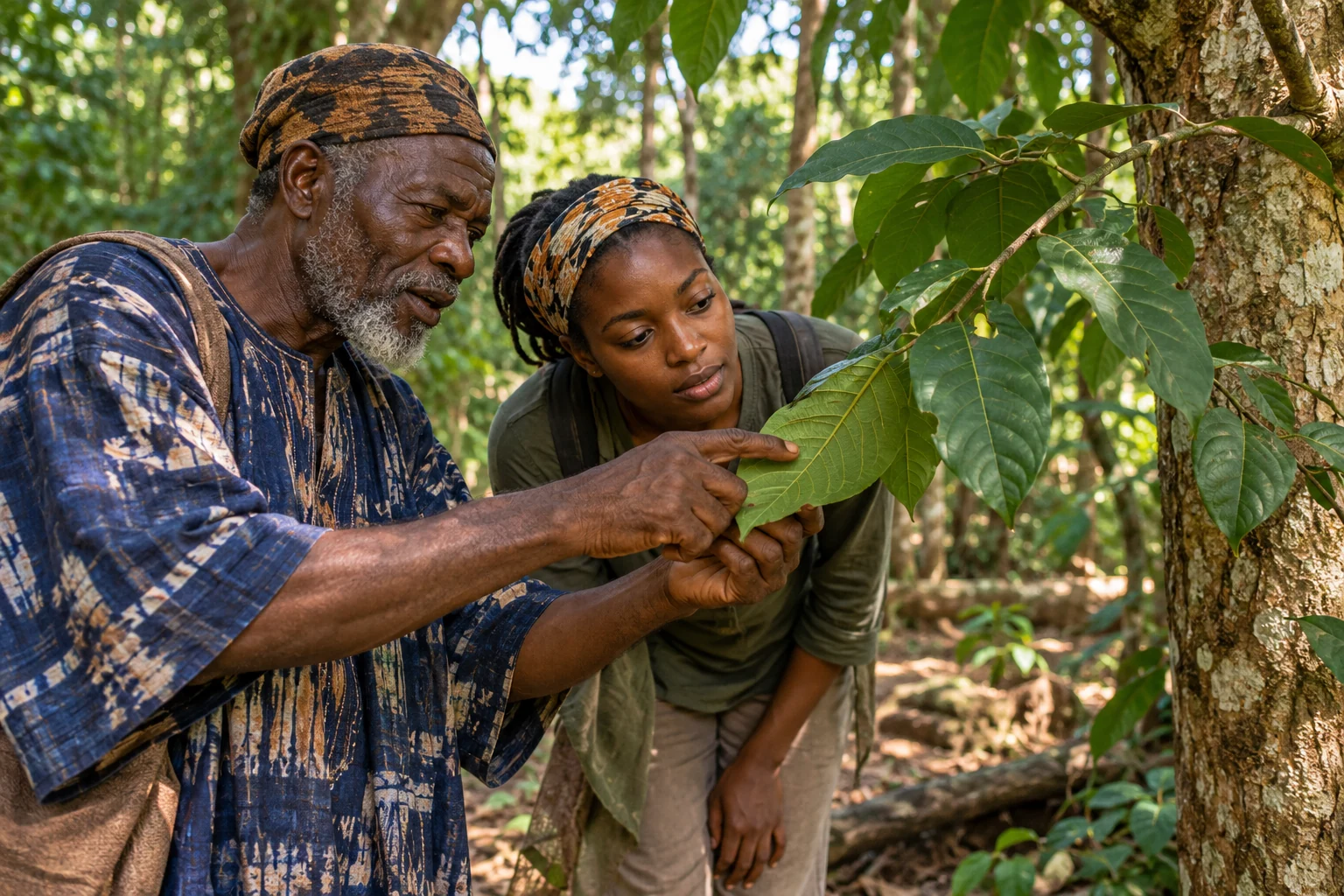
1. Knowledge rooted in the forest
Òsanyìn is associated with leaves, herbal knowledge and the forest in Yorùbá traditions. Osain and Ossaim appear in Lucumí and Brazilian settings with particular histories and forms of devotion. The importance of leaves is not limited to a modern opposition between medicine and religion. In religious life, material, spoken words, trained practice and relationships can belong to the same act.
That integrated understanding should not be mistaken for permission to issue medical advice from a myth. A public reference article can explain a religious domain without presenting a plant list as a safe prescription. Species, preparation, dose and personal circumstances matter in actual healthcare; sacred significance and clinical efficacy are different questions.
2. A concrete object and what it can show
The Metropolitan Museum’s Òsanyìn puppet documents a particular southwestern Nigerian setting involving herbalists and consultation. The museum also describes bodily difference in some accounts of Òsanyìn. It is evidence for a specific representation and practice, not a universal explanation of every image found across the Atlantic.
An object can sharpen a reader’s attention precisely because it has limits. One can ask who made it, how it was used and what the account says. Those questions are more informative than assuming that any unusual bodily form has the same meaning everywhere. They also prevent disability from becoming a vague metaphor for spiritual deficiency.
3. Key mythic motif: the dispersal of leaves
Brazilian narratives often discuss the sharing or scattering of leaves that had been held under Ossaim’s special knowledge. The motif allows the power of leaves to become connected with many Òrìṣà while knowledge of their use remains significant. Versions differ in the role of wind, other figures and the action that changes the distribution. The story is more useful when that variation is respected.
In a contemporary reading, possession and knowledge are not the same thing. Receiving a material does not mean one has acquired the skill of handling it. A document, database or instrument may be widely accessible while responsible use still requires training. The lesson is not simply that knowledge must be secret. It is that access does not remove the obligations of understanding.
4. Sharing without emptying the knowledge
The tension also works in the other direction. Expertise can become a form of domination when its holder uses other people’s dependence to avoid accountability. A serious interpretation therefore needs two questions at once: what deserves careful training, and how should the person with knowledge answer to the community that relies on it?
In ordinary life, this appears whenever one person controls information essential to others. A manager may call a decision too complex to explain. A professional may use technical language to prevent questions. Genuine knowledge can tolerate an appropriate account of its limits. Care is strengthened when a learner understands why a boundary exists rather than merely being told that curiosity is disobedience.
5. Birds, iron and relationships
Bird imagery appears in many Òsanyìn staffs, but the image should be read through the object and setting in which it occurs. The Smithsonian’s herbalist staff offers one concrete point of reference. An emblem is not an instruction to merge Òsanyìn with every sacred figure associated with birds.
Ògún brings iron tools into the gathering and preparation of materials. Ọ̀ṣọ́ọ̀sì brings forest attention and sustenance. Ọya enters the comparative study of wind and movement in particular narratives. Ìyámi Òṣoronga opens a distinct conversation about birds and maternal power. Each connection needs an explanation; none should be treated as automatic identity.
6. When access travels faster than understanding
A modern reader can obtain information about a plant, technique or sacred object in seconds. That access is useful, but it can create a false feeling of completed apprenticeship. The original question is often missing: under what conditions was this knowledge learned, and who is answerable when its use goes wrong?
An interpretation of the dispersed-leaves motif can distinguish two kinds of sharing. One makes knowledge usable by giving context, limits and an appropriate path of learning. Another simply releases fragments that appear self-sufficient because the relationships around them have disappeared. The difference matters in religious education as much as in medicine or technology.
The answer is not that everything valuable must be hidden. An accountable teacher can explain what a public introduction can establish and what requires further training. The learner can then develop a more exact question instead of mistaking an unexplained boundary for proof that all curiosity is unwelcome.
7. Care and the difficulty of saying I do not know
People often offer an answer because another person’s need makes uncertainty uncomfortable. The wish to help can become a wish to be the helper who knows. An ungrounded suggestion is then given the emotional force of reassurance, even when the situation requires a different kind of expertise.
In contemporary reflection, responsible care sometimes begins with a clear limit. The limit is more useful when it also identifies a next step: whom to consult, what information is missing or what kind of assessment is needed. A refusal to pretend can make a relationship safer rather than colder.
The same discipline applies to an educational website. A beautiful paragraph does not become evidence by sounding confident. An exact distinction, a properly scoped public source and an honest statement about an unresolved account can teach more than a detailed but invented correspondence list.
8. The place from which the leaf comes
Plant knowledge also depends on environments that can be damaged. A person may admire the tradition while remaining indifferent to the land on which its materials and teachers depend. The contemporary ecological question is whether recognition has any effect on how a place is treated.
Preserving a resource is not identical to preserving a religious relationship, but the two can become practically connected. The forest cannot be respected only as an idea while its living conditions are treated as expendable. Care asks for attention both to what a leaf may mean and to what allows it to grow.
9. Religious identity and the scope of this study
Ọ̀sányìn concerns the religious knowledge of leaves, forest materials and their empowered use. The book gives him a dedicated portrait that repeatedly distinguishes possessing a substance from understanding how it becomes effective within a trained relationship. That distinction is central to the opening discussion and can sustain a much deeper article. The Metropolitan Museum's puppet record provides an independent material setting: an effigy associated with a herbalist's consultation, sometimes in collaboration with an Ifá priest. The record describes a particular practice and representation, not one identical form across Yorùbá, Lucumí and Brazilian traditions.
Names such as Osain and Ossaim therefore require their own contexts. Contemporary psychological inquiry can examine expertise, restraint, secrecy and the responsibilities of handling knowledge on which others depend. It must not equate religious power with clinical efficacy or turn a leaf's sacred significance into a safe remedy. The figure also cannot be reduced to a generic healer archetype. Speech, material, forest, training and community belong together in the religious field. An expanded entry should let that specificity shape its analysis, asking how one learns enough to help without claiming mastery prematurely and how genuine expertise remains answerable to those who rely on it.
10. Knowledge that gives the figure depth
10.1 Why does distributing leaves not distribute mastery?
The book presents a myth in which leaves are dispersed among the Òrìṣà while a deeper knowledge remains with Ọ̀sányìn. Versions vary, including the role played by wind and other figures, so the article should describe the motif through attribution rather than declare one universal plot. Its conceptual force is the distinction between distribution and mastery. Materials can become widely available without the knowledge required to handle them becoming equally available. A contemporary application might concern a database or instrument that many people can access while only trained users understand its limitations.
That analogy should not dissolve protected religious knowledge into information management. It clarifies a tension already visible in the story: dependence on expertise can persist after possession is shared. The ethical question works in two directions. A learner should not confuse access with competence, but the expert should not use complexity as an excuse to refuse every accountable explanation. The book's gourd and speech motifs give knowledge a form of containment rather than unlimited display. Contemporary analysis can ask what requires preparation, what can responsibly be explained and how the holder's authority is tested. Such questions deepen the myth without treating it as a manual or implying that every secret is justified simply because it is old.
Evidence: Metropolitan Museum of Art, Òsanyìn puppet, 1986.471 — Specific southwestern Nigerian effigy/consultation setting, herbal knowledge and multicolored bead reference to leaf diversity; bodily difference account explicitly limited to some traditions.
10.2 How can restraint begin knowledge?
Another narrative in the dedicated chapter describes Ọ̀sányìn recognizing valued plants where a task appears to require indiscriminate clearing. The author interprets refusal to destroy as a beginning of medicinal discernment. This is an especially specific way to develop the existing article's forest attention. Knowledge changes what an action means: what looked like obstructive grass becomes a differentiated living world. A contemporary extension concerns the restraint that follows recognition. A person may discover that a convenient intervention would remove conditions they had not previously noticed.
Good judgment then includes the capacity to pause, not merely the capacity to act decisively. This should not become a claim that all land clearing is wrong or that every plant has a verified treatment use. The story belongs to the author's religious and symbolic account. Its analytic value is the change from undifferentiated removal to exact attention. The relation with Òrúnmìlà in the narrative also prevents solitary genius from being the only theme: knowledge is recognized and brought into a broader field of consultation.
We can ask how different forms of expertise cooperate without collapsing into one another. Interpretation, material knowledge and care can be related while remaining accountable to different questions and limits.
Evidence: Metropolitan Museum of Art, Òsanyìn puppet, 1986.471 — Specific southwestern Nigerian effigy/consultation setting, herbal knowledge and multicolored bead reference to leaf diversity; bodily difference account explicitly limited to some traditions.
10.3 What can a consultation effigy establish?
The Met's puppet record gives a concrete consultation setting in which representation, voice and herbal knowledge meet. Its beadwork is explained through the diversity of leaves, making material surface part of the account rather than mere decoration. The museum also describes bodily difference in some traditions. That qualification matters. An expanded article should not universalize the image or turn disability into a metaphor for deficiency, secret virtue or inevitable vocation. The record's claim about suffering belongs to its specific representation and religious explanation. Contemporary interpretation can ask how a healer's authority is made present through performance without deciding that performance means deception or that visible intensity proves efficacy.
The book's method allows devotional, symbolic and psychological levels to remain distinct. A puppet can be a charged medium in its religious setting while also being an object made through human skill. Neither observation eliminates the other. The knowledge question is what the object participates in: who operates it, who understands its voice and what relationship gives the consultation its authority? The inspected record answers only part of that question. Keeping its limits visible makes the object more useful, because it directs the learner toward context rather than inviting a universal theory from an arresting appearance.
Evidence: Metropolitan Museum of Art, Òsanyìn puppet, 1986.471 — Specific southwestern Nigerian effigy/consultation setting, herbal knowledge and multicolored bead reference to leaf diversity; bodily difference account explicitly limited to some traditions.
11. A depth-psychological reading
Interpretive basis: The dedicated chapter in Babá Tilo de Àjàgùnnà’s The Orishas and the Human Soul, especially “Ọ̀sányìn”, “Before the Òrìṣà Become Archetypes”, “Trees, Plants, Leaves, and the Living Intelligence of the World”. Dedicated chapter supplies plant discernment, distributed leaves, activation, secrecy and limits of remedy. Three named lenses and examples are new interpretations; medical efficacy is not inferred.
11.1 Depth psychology: expertise without omniscience
A depth psychological lens can examine the expert identity that cannot tolerate uncertainty. The book's Ọ̀sányìn chapter distinguishes remedy from total cure and treats mastery as more than possession. Applied contemporarily, that distinction exposes the fear that admitting a limit will destroy authority. An illustrative knowledgeable person may answer every question rather than say they do not know, because others have come to depend on them as the one who always understands. Their real skill becomes entangled with a demand for omniscience. The symbol of reserved knowledge offers a different possibility: depth includes knowing what cannot yet be handled responsibly.
This should not be used to romanticize vagueness or make every refusal sound wise. The limit must have a reason connected with the work and the people affected. Another person may hide competence indefinitely because being useful feels dangerous; their task differs from the inflated expert's. The book's framework supports that differentiation. Inner development concerns the capacity to let knowledge become service without making it the whole basis of personal worth. A person can remain valuable while consulting others, correcting an error or declining a task outside their competence.
No clinical conclusion or personality type follows. The contemporary lesson is an ethic of proportion: enough confidence to act where knowledge is real, enough humility to recognize where it ends.
11.2 Relational development: asymmetry and accountable care
A relational lens examines asymmetry between the person who knows and the person seeking help. The book's secrecy discussion recognizes that some knowledge needs containment, while its larger method keeps care distinct from domination. An illustrative client may be frightened and therefore readily surrender judgment to anyone who speaks with certainty. An expert may respond with appropriate clarity, or may use dependence to prevent questions. Ọ̀sányìn's field helps ask what a responsible boundary does. It should protect the person or the integrity of the work, rather than merely protect the holder from scrutiny.
Conversely, demanding immediate access to every detail can disregard the preparation that makes knowledge usable. A mature relation can explain the existence of limits without pretending all limits are arbitrary. This is contemporary analysis, not a claim that religious teachers must disclose protected practices. The practical psychological inquiry concerns how authority is experienced: does it enlarge the seeker's capacity to understand their situation, or require permanent helplessness? Care can include referral, uncertainty and acknowledgment that different kinds of help answer different needs. The leaf motif remains specific because it brings living material into this relation; handling it affects bodies and environments, so confidence alone is not enough. Trust becomes stronger when knowledge and its limits are carried in an accountable way rather than through a performance of infallibility.
11.3 Collective systems: stewardship and transmission
A collective systems lens can follow how knowledge is distributed among roles. The scattered leaves motif does not make every recipient fully autonomous, while the consultation narrative places different specialists in relation. This permits an original analysis of institutions where information is shared unevenly. A team may depend on one person who has never been given time to teach others; the resulting bottleneck is then treated as their personality rather than a structural arrangement. Another institution may deliberately keep people dependent because concentrated access secures power.
The same surface pattern can therefore arise from different causes. The book's Ọ̀sányìn field asks what knowledge must remain specialized and what transmission is needed for continuity. Contemporary interpretation should not assume that openness is always good or secrecy always harmful. The question is what each arrangement does in practice, whose capacity it supports and whose vulnerability it increases. The ecological dimension adds another collective responsibility: expertise relies on living environments and inherited teaching that no individual created alone. Recognition of that dependence can counter the fantasy of privately owning all useful knowledge.
This is not a proposal to make religious materials universally public. It is an ethical inquiry into stewardship and succession. A sustaining knowledge system protects what needs context while creating responsible pathways through which future people can learn, contribute and question authority where questioning is appropriate.
12. What this relationship means for a person
12.1 In an established devotional or initiatory relationship
An established devotional or initiatory relationship involving Ọ̀sányìn should be located within the relevant tradition and house. Yorùbá, Lucumí and Brazilian settings are connected historically but do not supply one interchangeable institutional form. Public prose cannot define their protected duties or assume that every devotee has identical access to specialized knowledge. The dedicated chapter can nevertheless deepen reflection within an already acknowledged relation. Its questions concern how a person handles living materials, carries authority and responds when uncertainty interrupts the wish to help. Sustained relationship may make restraint as important as action.
A practitioner can learn to recognize the difference between a boundary that protects care and a boundary that merely protects their self image. They may also need to acknowledge what other specialists know. These are contemporary ethical applications rather than ritual instructions or claims that religious practice guarantees clinical results. The material world remains essential: forest and leaves are not only metaphors for inward potential. Their availability, identification and care belong to the conditions of actual practice, which require accountable teaching. An established relation also exceeds a public identity as healer.
It can involve patience, apprenticeship, correction and acceptance of limits that are less glamorous than mastery. The book's analysis is most useful when it supports that seriousness without speaking over lineage. A person can draw psychological insight from secrecy and activation while preserving the distinction between reflection, religious authority and healthcare decisions appropriate to the situation.
12.2 When the figure becomes relevant in consultation
When Ọ̀sányìn appears in consultation, the interpretive question may involve knowledge, remedy, restraint or the relation between available resources and their responsible use. Those themes should not become a diagnostic checklist attached mechanically to the name. The actual consultation determines what matters. An illustrative person may possess many possible solutions while never learning any well enough to act safely. Another may have sound expertise but refuse help from anyone else, making isolation part of the problem. The book's distinction between leaves and the knowledge of leaves can illuminate both cases differently.
It also helps separate a wish for complete rescue from a realistic form of support. Consultation does not establish that a leaf will cure a disease, that symptoms have a particular spiritual cause or that the client has acquired an initiatory identity. A public reference should not assign an Odù from a health concern or convert myth into a preparation list. Its contribution is a more exact account of the relation: what is known, what remains uncertain, who is qualified and what kind of help is being sought?
Psychological reflection can ask whether fear, shame or the need for authority is affecting participation, while leaving actual healthcare and ritual judgments to the appropriate accountable people. Encountering Ọ̀sányìn may therefore direct attention toward disciplined learning and careful care without making the figure an interchangeable name for every process called healing.
13. Nature, materials and human knowledge
Ọ̀sányìn's ecology is the living relation among forest, leaf, language, skilled handling and the people who depend on knowledge. The book treats the leaf as differentiated rather than generic medicine, and the forest as a place whose value changes when its forms are recognized. The Met's material object adds worked wood, beadwork and voice to that network. Bird imagery in related staffs can be discussed through verified particular objects, but it should not be used to merge Ọ̀sányìn with every bird associated power. This research did not complete a new inspection of the Smithsonian staff record, so its details should remain a bounded earlier discussion rather than an expanded claim.
A contemporary environmental interpretation can ask whether gathering knowledge or materials preserves the conditions that sustain them. That includes teaching communities as well as habitat: an extracted plant list can omit the relationships that made its use intelligible. The book's ecology method makes such extraction visible without claiming that every traditional practice has the same conservation outcome. Sacred meaning, empirical effectiveness and ecological sustainability are related questions that require different evidence. The article should keep them together as concerns while refusing to make any one of them automatic proof of the others.
14. Diaspora, comparison and syncretism
Osain, Ossaim and Ọ̀sányìn should be named with their relevant Lucumí, Brazilian and Yorùbá contexts rather than treated as typographical variants of one uniform practice. The book also mentions trans traditional vegetal comparisons, but its interpretive portrait does not independently verify every claimed equivalence. Katendê in Kongo Angola and Agué in related but distinct religious histories should therefore remain separate figures unless a specifically documented community's comparison is being described. Shared concern with leaves does not establish identical initiation, language or ritual authority. The inspected Met source does not supply a Catholic saint identification, so none is added here.
A careful syncretism section can explain the difference between historical transmission, functional resemblance and actual correspondence used in practice. A reader who recognizes a similar staff or medicinal domain has found a question worth investigating, not proof that the traditions are interchangeable. The same applies to contemporary healing language: psychotherapy, botany, healthcare and religious leaf knowledge may enter conversation while answering different questions. The book's method explicitly supports such distinctions. Its psychological contribution is strongest when it enlarges attention without claiming that modern categories have finally explained the deity. Specificity preserves the possibility of learning from each tradition's own relationships rather than translating every forest power into a familiar label.
Evidence: Metropolitan Museum of Art, Òsanyìn puppet, 1986.471 — Specific southwestern Nigerian effigy/consultation setting, herbal knowledge and multicolored bead reference to leaf diversity; bodily difference account explicitly limited to some traditions.
15. Questions for a fuller understanding
15.1 Why is access not competence?
Why is access different from competence? A material or text can be available before a person understands its context, limits and consequences. The book's dispersed leaves motif makes that distinction vivid. Contemporary application can examine how training turns information into responsible judgment, including the ability to recognize when another kind of expertise is needed. This does not mean all knowledge should remain hidden or that authority deserves no questions. It means the form of access should be considered alongside preparation and accountability. In Ọ̀sányìn's field, the living material makes the issue especially serious. Knowing a name does not settle what may be done with the thing named, and admiration for knowledge does not automatically authorize its practical use.
15.2 When is secrecy care?
Can secrecy express care rather than control? It can, when withholding protects someone from handling a power or situation without adequate preparation. It can also conceal domination, error or fear of scrutiny. The book's account permits that tension rather than turning secrecy into an automatic virtue. A contemporary question is what the boundary accomplishes and whether an appropriate account of its reason can be offered. This does not demand disclosure of protected rites. It asks how trust is carried between people with unequal knowledge. A responsible expert can recognize limits and cooperate with others; a learner can respect preparation while remaining attentive to consequences. Ọ̀sányìn's symbolic field deepens that inquiry without replacing the community's actual teaching or clinical judgment.
16. Correlations to life dimensions
| Dimension | A question for contemporary reflection |
|---|---|
| Knowledge | Am I confusing access to information with the ability to use it well? |
| Care | Have I understood the limits of the help I am offering? |
| Work | Does my expertise make other people more capable or more dependent? |
| Environment | Can I learn from a living place without treating it as an unlimited stockroom? |
| Spiritual life | What training and relationships give a material its religious meaning? |
17. If Òsanyìn matters in your practice
Let your own house identify the relevant stories and responsibilities. A public introduction cannot teach protected procedures or replace the person accountable for a particular practice. It can, however, help restore respect for the labor of knowing. The leaf is not made less powerful by acknowledging that we have more to learn before claiming to understand it.
18. Sources for the expanded interpretation
Interpretive basis: The dedicated chapter in Babá Tilo de Àjàgùnnà’s The Orishas and the Human Soul, especially “Ọ̀sányìn”, “Before the Òrìṣà Become Archetypes”, “Trees, Plants, Leaves, and the Living Intelligence of the World”. Dedicated chapter supplies plant discernment, distributed leaves, activation, secrecy and limits of remedy. Three named lenses and examples are new interpretations; medical efficacy is not inferred.
- Metropolitan Museum of Art. Òsanyìn puppet, 1986.471. Specific southwestern Nigerian effigy/consultation setting, herbal knowledge and multicolored bead reference to leaf diversity; bodily difference account explicitly limited to some traditions. Public institutional record or research text inspected; claim scope stated.
Named diaspora qualities and cross tradition equivalences in book not independently verified here and not universalized. Met account is a particular representation. No medical recipe, efficacy claim, disability typology or universal initiation.