
The hunter cannot succeed by wanting everything at once. Attention has to narrow without becoming blind. A sound, a movement and the condition of the ground may matter more than a display of force. Ọ̀ṣọ́ọ̀sì opens a study of precision: the ability to choose a meaningful aim while remaining answerable to the living world that makes the pursuit possible.
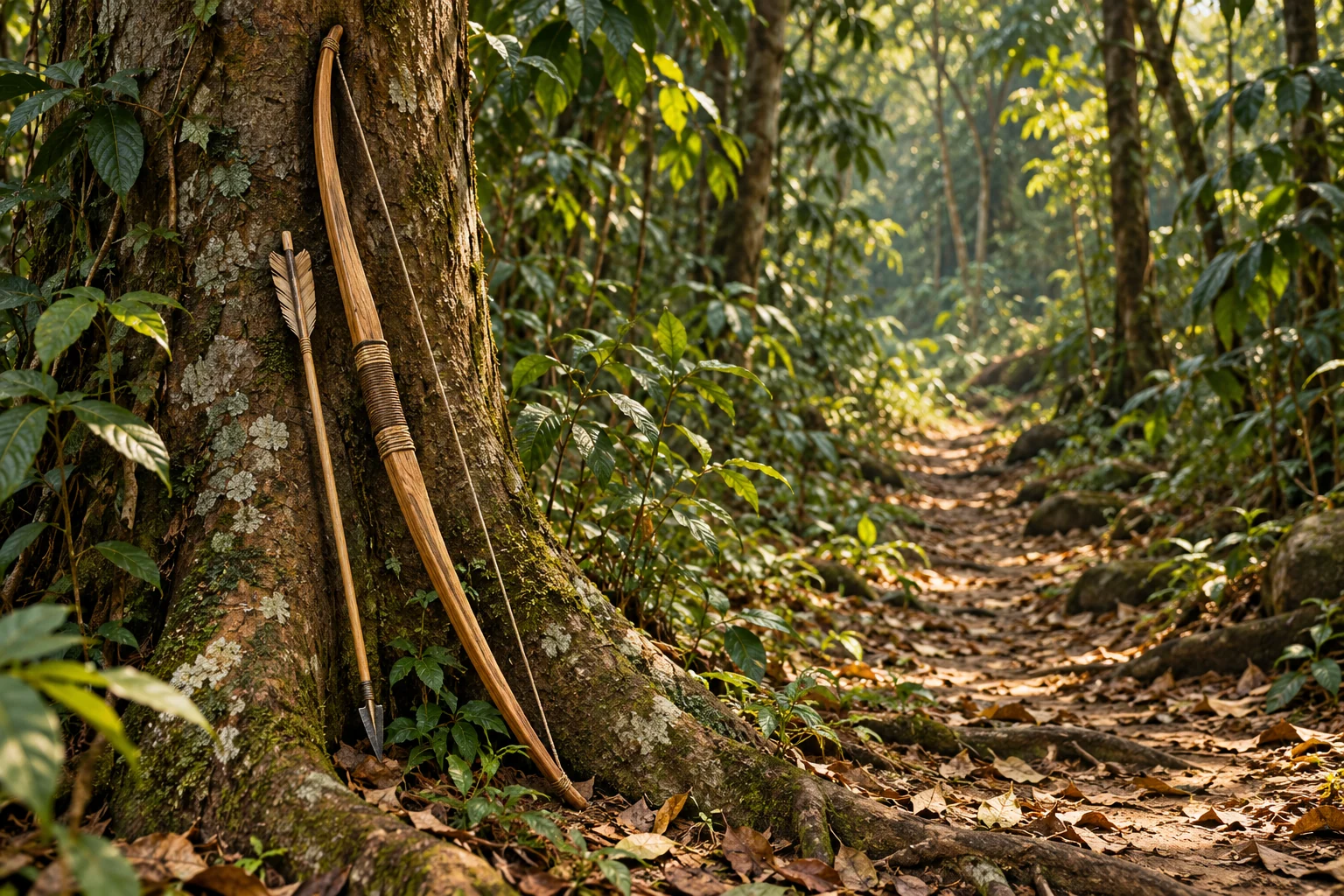
The single-arrow motif joins precision to the knowledge that returns as provision.
1. The hunter and the forest
Ọ̀ṣọ́ọ̀sì is strongly associated with hunting and forest life. In Brazilian Candomblé, Oxóssi is also a major presence in accounts of sustenance, abundance and knowledge. The forest is not simply a wilderness waiting for human conquest. It is a living setting in which survival depends on observation, relationship and limits.
Hunting brings a real tension into the study. Food supports life, yet taking life cannot be made weightless by calling it useful. A modern article need not prescribe a ritual or a universal ecological doctrine to recognize the seriousness of that tension. The figure invites a reader to think about how need, skill and restraint belong together.
2. Key myth: the single arrow
The single-arrow hunter is a well-known motif in Brazilian narratives associated with Oxóssi. A dangerous bird threatens the community; the decisive act belongs to a hunter whose effective aim matters more than an accumulation of arrows. Particular retellings differ in their preparations, relationships and explanation of success. Their details should not be merged into an invented original.
João Marcos Souza’s study of the single-arrow hero offers a published Brazilian interpretation using Jungian ideas. That analytical framework belongs to contemporary scholarship. It should not be presented as a traditional doctrine secretly contained in every narrative.
For present-day reflection, the motif asks whether a person understands what they are trying to do. More resources can conceal a poorly chosen aim. Repeating an action with greater intensity can postpone the moment of admitting that attention has been misplaced. Precision begins with an honest relation to the problem, including the possibility that the first description of it was wrong.
3. Knowledge that comes through attention
Forest knowledge is situated. It develops through repeated encounters with a place and through people who teach how to notice. A generic chart of colors and objects cannot reproduce that relationship. This is one reason to study a religious figure through narrative and practice rather than treating the figure as a collection of detachable attributes.
The idea also speaks to modern expertise. A doctor, musician, teacher or craftsperson learns differences that a novice does not yet perceive. Attention becomes educated. The lesson is not that every intuitive impression is reliable, but that genuine sensitivity often rests on long discipline. The quiet act of noticing may contain years of work.
4. Desire, scarcity and enough
Abundance is not always the same as accumulation. A person can acquire more while becoming less able to recognize sufficiency. The hunter’s image offers a way to ask what need is being served and whether pursuit still has a stopping point. This is a contemporary ethical interpretation, not a statement that every house explains Oxóssi in economic terms.
In relationships, a similar question concerns attention. Someone may seek endless confirmation because no single gesture is allowed to count. In work, another may keep extending a project to avoid submitting it to judgment. A meaningful aim needs a condition of completion. Without one, skill becomes the servant of an appetite it cannot satisfy.
5. Related figures and distinct stories
Ògún brings the instrument and the cleared path into the study. Òsanyìn brings knowledge of leaves. Erinlẹ̀, Otin and Lógun-Èdè open connected hunter and river traditions. They should not become minor aliases under a single dominant figure. Their local settings and family narratives deserve their own space.
Brazilian accounts connecting Lógun-Èdè with Oxóssi and Oxum are particularly useful for following the meeting of forest and river. The relationship can guide comparative reading without proving that every African, Cuban and Brazilian lineage preserves the same genealogy.
6. Precision without the cruelty of perfection
The single-arrow image can inspire attention, but it can also be misused as a demand that a person never fail. A mythic feat is not a reasonable performance contract for an actual human life. The deeper question is how preparation and a clear aim can reduce waste, while leaving room to learn from an imperfect result.
A person afraid of missing may postpone the shot indefinitely. The project stays in preparation; the decision remains theoretical; the relationship is never asked an honest question. What looks like discipline can become a way to avoid the exposure that any real action involves. Precision then needs courage as well as restraint.
Another person acts constantly because stopping would expose the absence of a chosen aim. The difference is not between active and passive personalities. It is between action guided by attention and action used to escape attention. The hunter’s image can help make that distinction visible without turning a sacred figure into a diagnosis.
7. The forest is not only a test of the hunter
When a story is told entirely through the successful person, the surrounding world becomes a stage for their ability. Yet the forest has other lives, rhythms and uses. A serious contemporary ecological reading asks whether expertise makes the hunter more capable of recognizing those relations, or merely more efficient at taking what is wanted.
The question can also enter study and professional life. A researcher may become highly skilled at extracting information from a community while remaining inattentive to what the encounter costs its members. A leader may become excellent at obtaining effort while learning little about the lives from which the effort is drawn. Competence needs a relationship with the setting that makes it possible.
This reading does not claim that one hunter narrative provides a complete modern environmental policy. It asks the reader to remain attentive when a symbol of knowledge is separated from the living place in which knowledge is learned.
8. A question for choosing an aim
Before another attempt, ask what success would actually change. Would the result sustain a life, complete a responsibility or simply offer temporary relief from comparison? A precise answer may reveal that the desired target is not the one currently being pursued.
Knowing enough to alter an aim can be a greater exercise of skill than persisting in the wrong direction. Attention is valuable partly because it allows the world to correct our first intention.
9. Religious identity and the scope of this study
Ọ̀ṣọ́ọ̀sì belongs to a sacred hunter field in which attention, sustenance and knowledge of a world beyond the settled center remain connected. Human Soul gives him a dedicated portrait and carefully distinguishes him from Ògún, Ọ̀sányìn and Erinlẹ̀. The distinction is essential: opening a passage is different from tracking a living being, and tracking is different from knowing the full vegetal or river environment. The broader name Odé identifies hunting rather than proving that every hunter figure is the same Òrìṣà. Brazilian Oxóssi and Cuban Ochosi belong to specific histories of religious transmission; a common bow or a related name cannot establish identical practice.
The book's one arrow image provides the psychological center of this study. It asks what happens when desire acquires an aim, knowledge must return as provision, and a gift for solitary pursuit becomes difficult to bring home. Sacred efficacy remains first. Devotees do not encounter only their own capacity for focus; they stand within received relationships, histories and obligations. The contemporary comparison then examines selective attention, perfectionism, epistemic humility and the cost of belonging to a pursuit. The figure becomes more than a patron of success when the hunter's target, habitat, dependent community and responsibility for return all remain visible.
10. Knowledge that gives the figure depth
10.1 What is the one arrow image asking beyond focus?
The one arrow motif is often reduced to an encouraging message about focus. Human Soul makes it richer by connecting aim with the conditions of sustenance. An arrow's accuracy is meaningful because something depends on the encounter. The image joins restraint, perception, timing and an irreversible release. It therefore asks what kind of knowledge is needed before acting. In an illustrative investigation, collecting a huge amount of information may feel industrious while avoiding the exact question that would make the inquiry useful. The hunter comparison redirects attention toward the distinction that matters: what would count as evidence, what would change the present understanding and what consequence follows from acting too soon?
This should not be interpreted as a doctrine that a worthy person never makes mistakes. The same image can become oppressive if a person believes every act must be perfect on its first attempt. Its positive significance is economical and relational rather than magical. Limited resources can produce a responsible result when they are directed by attention. The religious motif still exceeds the analogy; a public article cannot explain sacred efficacy as merely superior concentration. Its contemporary usefulness lies in showing that force, quantity and speed do not substitute for the task of knowing what one is actually pursuing.
Evidence: Museu Afro-Brasileiro, Universidade Federal da Bahia, Material do professor — Afro-Brasileiro — Institutional teaching publication identifies Carybé carved panels, well known and less publicly familiar Òrìṣà including Otin; search text also identifies Oxóssi and associated teaching materials. Does not prove a complete Otin genealogy or universal survival/extinction of worship; Instituto Federal de Pernambuco repository, Espacialidades simbólico-culturais do terreiro de umbanda templo espiritualista pai Oxoce — Situated academic account records Ogum/Saint George and Oxóssi/Saint Sebastian calendrical associations; does not universalize to all Brazilian houses.
10.2 Why must knowledge return as provision?
The hunter's provision gives knowledge a social destination. Human Soul interprets Ọ̀ṣọ́ọ̀sì as a seeker whose discoveries remain tied to feeding life, rather than to private display of intelligence. The forest is not only a place where an individual becomes exceptional. It is a place from which something necessary must be brought back. This allows a precise analysis of modern expertise. A researcher can become so invested in the prestige of knowing that communication with those affected feels like a distraction. A specialist can return with a technically correct answer that no one can use.
The hunter field asks what it means to translate discovery into provision without reducing knowledge to immediate utility alone. Some inquiry requires a long period in which its value cannot yet be demonstrated. The ethical issue is whether the seeker remains answerable to a world beyond admiration. In an illustrative community project, useful research might include learning how people describe their own conditions before imposing an expert category. Returning with knowledge then involves a change in the researcher as well as a delivery of findings. The specific distinction from a generic wealth figure matters: Ọ̀ṣọ́ọ̀sì's abundance emerges through attention, movement and a living relationship to conditions, not simply through possessing an attractive symbol of prosperity.
Evidence: Museu Afro-Brasileiro, Universidade Federal da Bahia, Material do professor — Afro-Brasileiro — Institutional teaching publication identifies Carybé carved panels, well known and less publicly familiar Òrìṣà including Otin; search text also identifies Oxóssi and associated teaching materials. Does not prove a complete Otin genealogy or universal survival/extinction of worship; Instituto Federal de Pernambuco repository, Espacialidades simbólico-culturais do terreiro de umbanda templo espiritualista pai Oxoce — Situated academic account records Ogum/Saint George and Oxóssi/Saint Sebastian calendrical associations; does not universalize to all Brazilian houses.
10.3 How do forest alliances limit the fantasy of total knowledge?
The chapter's forest alliances prevent curiosity from becoming a fantasy of total knowledge. The hunter can enter a place and still become vulnerable to another power's authority. The Ògún rescue and Ọ̀sányìn encounter motifs make clear that access, pursuit and specialized knowledge are different competences. A contemporary article can follow this structure without turning every narrative into a fixed historical event. In an illustrative field study, an outsider may know how to navigate a landscape yet fail to understand what a local name, prohibition or seasonal sign means.
The ability to arrive does not make the visitor the sovereign interpreter. The same pattern appears when a technically trained person assumes they can understand a community because they have mastered a dataset about it. Real inquiry requires the humility to receive knowledge that may change the question itself. This is not a rejection of expertise. It is a more exact account of expertise as situated and partial. The hunter's gift remains real while its limits become visible. Ọ̀ṣọ́ọ̀sì's distinct place among allied powers therefore supports a serious epistemology: pursue carefully, distinguish what one knows from what one merely has access to, and remember that discovery creates obligations toward the places and people through which it became possible.
Evidence: Museu Afro-Brasileiro, Universidade Federal da Bahia, Material do professor — Afro-Brasileiro — Institutional teaching publication identifies Carybé carved panels, well known and less publicly familiar Òrìṣà including Otin; search text also identifies Oxóssi and associated teaching materials. Does not prove a complete Otin genealogy or universal survival/extinction of worship; Instituto Federal de Pernambuco repository, Espacialidades simbólico-culturais do terreiro de umbanda templo espiritualista pai Oxoce — Situated academic account records Ogum/Saint George and Oxóssi/Saint Sebastian calendrical associations; does not universalize to all Brazilian houses.
11. A depth-psychological reading
Interpretive basis: The dedicated chapter in Babá Tilo de Àjàgùnnà’s The Orishas and the Human Soul, especially “Ọ̀ṣọ́ọ̀sì”, “Animals, Birds, Serpents, Fish, and the Mythic Body of Instinct”. Dedicated portrait supports attention, provision, solitude, perfection and differentiation from allied hunter/forest powers. Contemporary research/relationship examples are new interpretations.
11.1 Exactness and the paralysis of perfection
One inner dynamic is the conversion of exactness into perfectionism. The one arrow image can organize excellent attention, but it can also become an internal demand never to risk a visible mistake. A person then delays action while imagining that one more preparation will make failure impossible. Their standards may be impressive, yet the pursuit never reaches the world where it could feed anyone. Human Soul explicitly recognizes this shadow in the hunter field. The distinction is psychologically precise: excellence responds to the requirements of a task; perfectionism protects the person's worth from being tested by an imperfect result.
In an illustrative artist, careful study can become a way to avoid showing a first piece because an ordinary response would threaten the fantasy of exceptional ability. The arrow is held indefinitely, and the restraint appears wise until one asks what it serves. The contemporary task is not to glorify careless action. It is to make the scale of risk visible, distinguish a reversible trial from an irreversible act and allow learning to occur through contact with reality. Ọ̀ṣọ́ọ̀sì's relevance comes from the tension between attentive economy and the fear of a miss.
A mature aim can include correction and renewed learning. The sacred motif should not be used to shame someone for limited resources or promise that enough concentration guarantees success.
11.2 Solitary vocation and trustworthy return
A second dynamic is the divided life of the solitary seeker. A person may need long periods of concentration, distance or exploration to do meaningful work. Those capacities are not automatically signs of relational failure. Yet the pursuit can also become a defended place where no other person is allowed to make a claim. Human Soul's myths of hunting, separation and difficult domestic belonging make this tension central rather than incidental. In an illustrative partnership, a researcher repeatedly promises that attention to the relationship will begin after the next discovery.
Each achievement produces a fresh horizon, so the return is endlessly deferred. The pursuit offers genuine vocation while also protecting the seeker from the vulnerability of ordinary mutual dependence. The psychological question is whether solitude is serving a gift that can enter relation, or preserving an identity that does not know how to be encountered outside competence. A partner also has a responsibility to recognize that demanding permanent availability may erase a real calling. The tension cannot be settled by declaring either independence or closeness the higher good. Ọ̀ṣọ́ọ̀sì's field asks how the return becomes trustworthy.
Can the seeker communicate limits, share what has been found and remain present long enough to receive what happened at home? The gift matures when the horizon and the house can have a relationship without one becoming an excuse to neglect the other.
11.3 Curiosity, consent and the risk of extraction
A third dynamic is curiosity that becomes possession or extraction. The wish to know can feel inherently generous because learning is culturally praised. Yet a person can pursue another's secrets without regard for consent, or treat a living environment as valuable only because it offers discoveries. Human Soul's relation between hunter and forest powers makes the limit of curiosity visible. The seeker is not entitled to everything that can be reached. In an illustrative friendship, someone who prides themselves on psychological insight may keep pressing for personal disclosures after the other person has signaled discomfort.
They call the pressure care because their identity as an attentive person makes it difficult to recognize intrusion. The same structure appears in research when local knowledge is gathered without adequate recognition of those who supplied it. The hunter comparison asks what the pursuit does to the being pursued and what obligations accompany receiving. This does not make all inquiry predatory or all boundaries permanently closed. It makes the relation itself part of the knowledge. An answer obtained through coercion may be factually informative while ethically deforming the encounter. Ọ̀ṣọ́ọ̀sì's contemporary relevance is therefore not merely to focus more sharply. It is to aim responsibly, know when not to release the arrow and let the living world remain more than an inventory of potential gains.
12. What this relationship means for a person
12.1 In an established devotional or initiatory relationship
For an established devotee of Ọ̀ṣọ́ọ̀sì, the relation is received and sustained within a particular religious world. Public knowledge of hunting, forest imagery or a preference for solitude does not establish a personal Òrìṣà. The dedicated Human Soul portrait can nevertheless deepen the inward language of the relationship by asking how attention, provision and return become character. A devotee may recognize that a valued capacity for focus has become too anxious, or that independent learning has weakened the ability to receive instruction. Another may need to honor a real calling rather than continually surrender it to demands for conformity.
These possibilities should remain distinct; a single personality description would flatten them. Established devotion may also sharpen the ecological responsibility inside the hunter image. Receiving from a place or community creates a question of reciprocity, not merely a claim to expertise. The article need not prescribe how this is ritually expressed. It can notice whether the devotee's ordinary conduct recognizes contributors, respects limits and brings a useful contribution back into relationship. A long relationship also provides time to distinguish vocation from avoidance. Solitude may make a gift possible, while a house or family may help the person see when pursuit has become a way to remain unreachable.
These reflections accompany sacred teaching rather than overrule it. The public entry is useful when it provides a precise vocabulary for an actual conversation with elders, preserves Erinlẹ̀ and other hunter figures as distinct, and refuses to infer sacred identity from occupation, temperament, gender or aesthetic attraction.
12.2 When the figure becomes relevant in consultation
In consultation, the hunter field may concern an immediate aim, an unseen distinction or the relation between pursuit and provision. Its meaning should be determined through the actual divinatory reading, not by assuming that the presence always means to concentrate harder. An illustrative student may be scattered among too many goals, while another may be paralyzed by a single impossibly perfect one. Both involve attention, but the needed change differs. A work question might concern whether more resources are necessary or whether the target has never been defined.
A relationship question might concern whether a person is being heard as a full other or merely tracked as the object of desire. The one arrow image helps ask what information must be received before action and what consequence follows from acting without it. The forest alliances then add another question: who possesses knowledge the seeker lacks? Consultation may direct attention toward a teacher, a local account or a competence that cannot be improvised from enthusiasm. Any specific sacred response remains with qualified guidance. The psychological application can clarify conduct without pretending to determine the oracle: identify the actual question, recognize a boundary, communicate the terms of a return, or distinguish a necessary risk from compulsive pursuit.
These are illustrative responsibilities rather than instructions. A situational encounter with Ọ̀ṣọ́ọ̀sì need not establish a lifelong identity. Its force may lie in a single corrected aim that changes how a person meets a living world.
13. Nature, materials and human knowledge
Ọ̀ṣọ́ọ̀sì's ecology includes forest, animals, hunger, a hunting instrument and the people sustained by the return. None of these has a fixed meaning outside relation. Human Soul's animal ecology is especially useful here: an animal may be pursued, protected, feared, encountered or implicated in a sacred narrative, and those roles cannot be collapsed into a trait list. The forest likewise contains powers and knowledge that exceed the hunter's view. This prevents the landscape from becoming mere scenery for individual achievement. Psychologically, the concrete behavior of tracking matters.
It requires an attention capable of receiving small differences rather than imposing a ready made category. It also requires restraint because not every perceived possibility should be acted upon. The contemporary extension can reach research, art and skilled observation while retaining the difference between those activities and a sacred hunt. The ecological question remains what supports a life and what obligations follow from receiving sustenance. The MAFRO teaching context helps place Oxóssi within a publicly represented Afro Brazilian sacred world, but a visual panel does not establish every local narrative. A careful article keeps material, habitat, community and divine relation together, allowing precision to mean responsibility toward a world rather than mastery over it.
14. Diaspora, comparison and syncretism
A situated academic account from the Instituto Federal de Pernambuco records an Oxóssi/Saint Sebastian calendrical association in the community it studies. This is usable evidence for a particular Brazilian correspondence, not a universal saint identity. Regional and house differences require their own documentation. The fact that an image carries an arrow may help a community recognize a relation, but visual resemblance alone cannot explain its theology or history. The article should avoid transferring the documented association into Cuban Ochosi settings without a separate source. The broader distinction between Odé and a single named Òrìṣà is equally relevant.
A hunter designation can gather related powers without establishing that Erinlẹ̀, Otin and Ọ̀ṣọ́ọ̀sì are interchangeable. Psychologically, a matching chart often encourages the same mistake as a personality quiz: a shared attribute becomes a total identity. A responsible comparison instead names the actual community, object or calendar through which the relation is encountered. That allows a reader to recognize that religious transmission can preserve connection and produce meaningful difference at the same time. The figure's dedicated psychological portrait is then a companion to study rather than a universal code for decoding every bow, saint, forest presence or person's temperament.
Evidence: Museu Afro-Brasileiro, Universidade Federal da Bahia, Material do professor — Afro-Brasileiro — Institutional teaching publication identifies Carybé carved panels, well known and less publicly familiar Òrìṣà including Otin; search text also identifies Oxóssi and associated teaching materials. Does not prove a complete Otin genealogy or universal survival/extinction of worship; Instituto Federal de Pernambuco repository, Espacialidades simbólico-culturais do terreiro de umbanda templo espiritualista pai Oxoce — Situated academic account records Ogum/Saint George and Oxóssi/Saint Sebastian calendrical associations; does not universalize to all Brazilian houses.
15. Questions for a fuller understanding
15.1 When does attention become a means of control?
Exact attention allows a situation to correct the observer. Surveillance in the service of control gathers detail while refusing that correction. In an illustrative relationship, listening carefully means hearing a person's stated limit even when it frustrates one's desire. Tracking them only to discover how to overcome the limit is a different use of perception. Human Soul's hunter alliances and ecological method help make the distinction: knowledge remains partial, and the world is not exhausted by the seeker's aim. The one arrow image therefore involves restraint as well as accuracy. A responsible aim asks whether the pursuit itself is justified, not only whether the actor can succeed.
15.2 How can solitude serve a relationship?
Solitude serves vocation when it makes a contribution possible and remains connected to a trustworthy return. It becomes avoidance when every new horizon postpones all claims of mutual life. The dedicated chapter holds both possibilities rather than treating independence as inherently mature or inherently wounded. In ordinary reflection, ask whether the seeker can communicate the need for distance, share what has been found and receive what others experienced in their absence. A meaningful pursuit may require sacrifice from a household, but that sacrifice should not disappear from the story of the seeker's achievement. The hunter's provision is a relation, so the return belongs inside the calling rather than after it.
16. Correlations to life dimensions
| Dimension | A question for reflection |
|---|---|
| Study | Which small distinction have I not yet learned to notice? |
| Work | Is the problem really a lack of resources, or an unclear aim? |
| Desire | What would enough look like in this situation? |
| Relationships | Am I attending to this person, or only to what I want from them? |
| Environment | What obligations follow from receiving sustenance from a living place? |
17. A personal relationship with the hunter
If Ọ̀ṣọ́ọ̀sì is your personal Òrìṣà, explore the particular accounts through which that relationship was received. Public study can widen your vocabulary and help you bring better questions to your elders. It cannot establish the relationship from a personality description. Begin with attention: to the story, to the place from which it comes, and to the consequences of the aim you choose.
18. Sources for the expanded interpretation
Interpretive basis: The dedicated chapter in Babá Tilo de Àjàgùnnà’s The Orishas and the Human Soul, especially “Ọ̀ṣọ́ọ̀sì”, “Animals, Birds, Serpents, Fish, and the Mythic Body of Instinct”. Dedicated portrait supports attention, provision, solitude, perfection and differentiation from allied hunter/forest powers. Contemporary research/relationship examples are new interpretations.
-
Museu Afro-Brasileiro, Universidade Federal da Bahia. Material do professor — Afro-Brasileiro. Institutional teaching publication identifies Carybé carved panels, well known and less publicly familiar Òrìṣà including Otin; search text also identifies Oxóssi and associated teaching materials. Does not prove a complete Otin genealogy or universal survival/extinction of worship. Indexed institutional PDF text inspected; direct fetch returned502, so claims limited to explicit indexed content.
-
Instituto Federal de Pernambuco repository. Espacialidades simbólico-culturais do terreiro de umbanda templo espiritualista pai Oxoce. Situated academic account records Ogum/Saint George and Oxóssi/Saint Sebastian calendrical associations; does not universalize to all Brazilian houses. University/institute repository indexed passage inspected; full dissertation metadata not extracted.
No global saint map or claim that all Odé figures are identical. MAFRO indexed evidence limited to teaching/representation; initiatory identity is not inferred from concentration or profession.