
Ògbè Òdí is a mixed Odù in Ifá’s 256-part corpus. One narrative elevates Ogbe Di through a learned morning address; another places him at the center of a struggle over succession. Knowledge creates recognition but also exposes its bearer to jealous relatives. The sign’s origin list includes camouflage, deliberative institutions, and fishing implements, making the difference between appearance, skill, and legitimate authority a productive focus.
A question to carry through the study: How can recognition of competence avoid becoming a claim to superiority?

This Academy reads the right column first, then the left. Each row carries a single or double mark.
Where this Odù belongs
Ògbè Òdí belongs to the Ògbè family in this Academy’s study sequence. It is a mixed Odù, distinct from Òdí Ògbè. The order matters. Its teaching is approached through its own narratives, rather than by adding two general descriptions of the principal signs together.
Key Òrìṣà and sacred relationships
The figures below are selected for their roles in the accounts discussed here. They offer connected reading paths through the tradition.
-
Òṣun. She teaches the address used to wake Orunmila and sends Ogbe Di to deliver it; knowledge arrives through instruction before it becomes public prestige.
-
Ọ̀rúnmìlà. His awakening provides the setting in which Ogbe Di’s learning is recognized and a continuing responsibility is assigned to the younger figure.
-
Òsanyìn. Ogbe Di seeks his assistance after suspecting a hostile invitation, associating specialist protective knowledge with the dangerous consequences of political rivalry.
Author’s further study: The Myths and Revelations of Odù Ògbè Òdí develops this sign at book length. The inherited accounts discussed here retain their named witnesses and religious settings.
Key myths and their meanings
A new voice at dawn
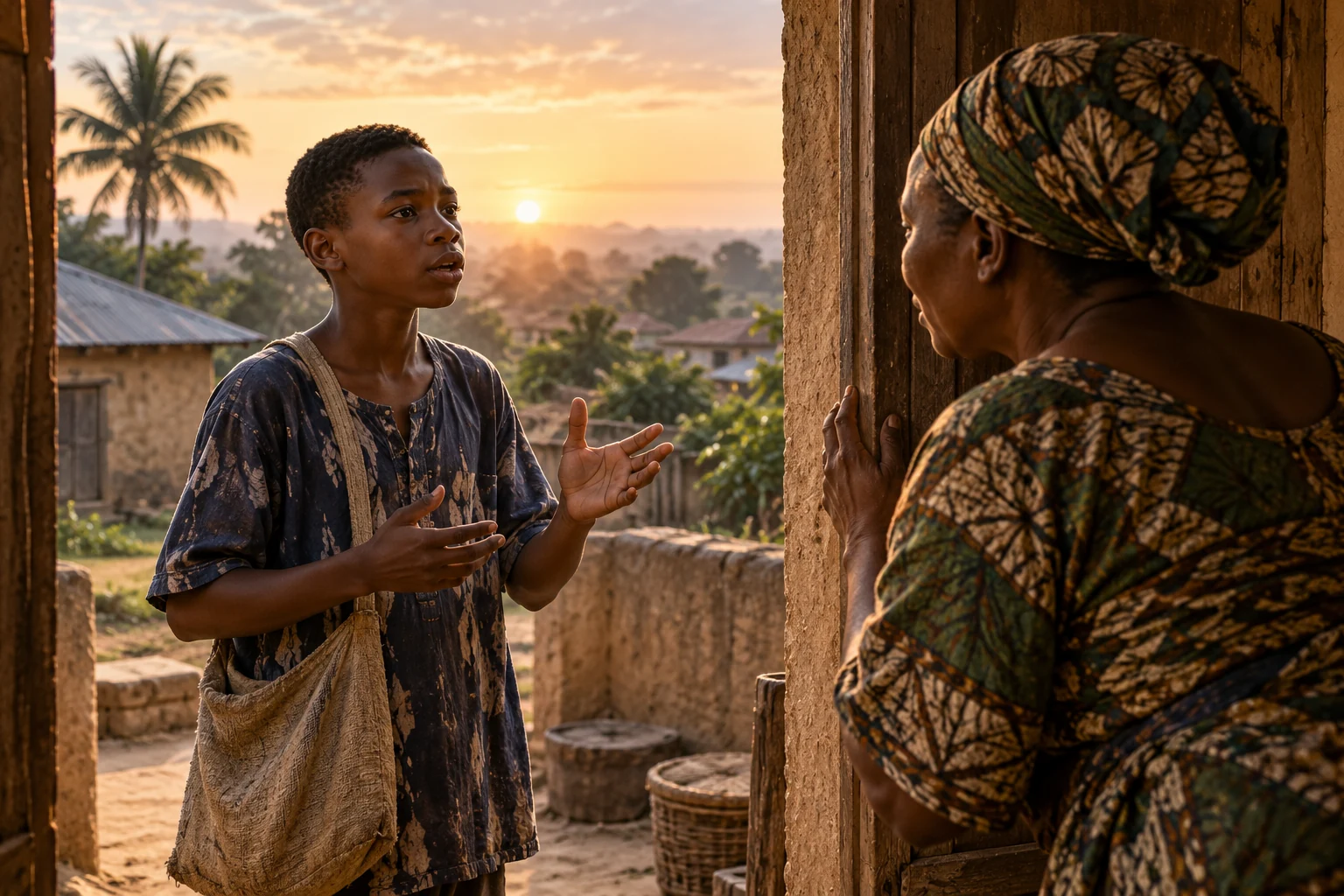
Ogbe Di arrives at Orunmila’s house in the early morning, sent by Oshun. Yeyematero permits him to deliver the address he has learned. When Orunmila awakens, the visitor’s knowledge is acknowledged, and he is assigned the continuing duty of waking him. A young practitioner gains a position through a specific performance rather than through a claim alone.
Learning is relational here: Oshun teaches, a household figure permits entry, and Orunmila’s recognition confirms the task. Public competence depends on several people making room for it. The succession from another attendant remains a tension; a new appointment can honor learning while also unsettling someone whose earlier responsibility has been displaced. The displaced attendant remains part of the transition.
Narrative setting: Cuban-labeled narrative in the accounts considered here; no independently established narrator or publication history.
The ruler and the poisoned celebration
After Ogbe Di gains a high appointment, his arrogance aggravates conflict with his brothers. Ogbe Yekun organizes a celebratory invitation intended to conceal an attack. Ogbe Di suspects the flattering approach, obtains assistance associated with Osanyin, survives the attempt, and returns visibly alive. The episode leaves the ruler facing a continuing internal conflict rather than a settled victory.
The story places threats inside the family and inside the ceremonial language of honor. Its political insight is that status does not produce trust, especially when appointment and boastfulness reinforce resentment. The miraculous survival belongs to the religious narrative; the usable analytical issue is how an institution handles succession before opposition becomes covert violence within the household.
Narrative setting: Cuban-labeled narrative in the accounts considered here; no independently established narrator or publication history.
The shelter mistaken for an elephant’s opening
Ogbe sets out hunting after disregarding preliminary counsel about obstacles. Rain interrupts the expedition, and he runs into what seems to be an opening in a tree or mound. It is instead an elephant’s bodily opening, which closes around him. His companions search without finding him and eventually undertake the religious response he had declined. The elephant later releases him, ending his disappearance. The passage adds a name explanation based on the manner of his emergence. That explanation belongs to the narrated wordplay and is not needed to understand the concrete sequence of misrecognition, collective search, and release from an unexpected enclosure.
Rain transforms an ordinary opening into an urgent promise of shelter, and urgency prevents Ogbe from recognizing the living context of what he enters. The body then becomes a place that cannot be navigated like the inert refuge he imagined. His companions are important because the protagonist cannot explain his situation from within the enclosure. They must continue to act despite having no direct confirmation of where he is. Their religious intervention is part of the narrative’s account of rescue, not a practical response to a missing hunter.
The story’s comic or humiliating bodily setting also complicates its end: survival may occur in a manner that unsettles a heroic self-image. Rather than claim an authentic etymology from this episode, a research supplement can examine how a community remembers a vulnerable disappearance and whether a degrading nickname preserves shared experience or keeps a rescued person permanently attached to an embarrassing moment.
Narrative witness and setting: Explicit compilation attribution to Afolabi Epega; African Ifa narrative.
Stolen fish, a mistaken bag, and an unequal judgment
Eshu fishes successfully while owing money to other divinities. They send him on several distant errands so they can divide his catch in his absence. He returns unexpectedly, exposes the theft, and obtains cancellation of their claims. Orunmila, carrying a bag prepared after his own consultation, denies taking fish. Eshu assumes a visible protrusion proves otherwise and brings him before a court. The bag contains rabbits, disproving that particular charge. Orunmila rejects successive offers of compensation, and the elders assign Eshu to continued service outside his house, with a promise that food eaten inside will be shared with him.
The narrative begins by making a creditor group plainly guilty: they exploit Eshu’s obligations to obtain his labor’s product while pretending that their errands are legitimate. Their eventual concession is therefore not charity toward a debtor. The reversal comes when Eshu treats one remaining suspicion as already proven. A visible feature of a bag becomes decisive only after its contents are examined, distinguishing a plausible inference from a substantiated accusation. Yet the court’s consequence is not proportionate simply because the allegation fails.
Permanent service and exclusion from the house create a new hierarchy after the first theft has been exposed. Orunmila’s promise to share food makes care coexist with domination rather than eliminating the latter. The account can therefore sustain two inquiries at once: how an exploited person remains responsible for the accuracy of a counteraccusation, and how institutions may punish that error in ways that protect a powerful figure’s status more than they restore a fair relationship.
Narrative witness and setting: Explicit compilation attribution to Afolabi Epega; African Ifa narrative concerning Eshu and Orunmila.
What was born in this Odù
“Born” can name an explicit traditional origin association or what emerges through a story: a capacity, relationship, practice or order of life. Interpretations drawn from a narrative are labelled below, so their basis remains clear.
Camouflage
Selected traditional source association.
Camouflage appears in the origin inventory as a distinct association. It can be discussed alongside the disguised hostility of the feast, but that thematic connection is an interpretation rather than an explicit origin story given by the text.
The parliament
Selected traditional source association.
The inventory associates this sign with parliament. Treat this as the compilation’s institutional motif of speech and assembly, without converting it into a historical claim that any particular political institution began with this sign.
Correlations to life dimensions
These questions bring the selected stories into contemporary life. They are interpretive invitations for study.
Work and resources
The morning task turns acquired knowledge into a recognized responsibility. Its value lies in doing a particular job within an existing household, rather than in possessing information abstractly. The rival story warns that prestigious appointments also require social preparation.
Reflect: What responsibility demonstrates the value of a skill?
Relationships and family
Brothers appear as rivals after authority is concentrated in one person. Kinship supplies access and emotional force but does not resolve a dispute about rank. A focused reading should examine how recognition is distributed and how grievances can be made speakable.
Reflect: Which grievance has no open place to be heard?
Character and inner life
Ogbe Di’s learning and his arrogance coexist in the same account. Competence does not excuse conduct that intensifies rivalry. The dawn story supports disciplined performance; the feast story complicates any easy equation between exceptional knowledge and mature judgment.
Reflect: Does recognition change how you treat peers?
Community and responsibility
Yeyematero’s permission and Oshun’s instruction show that authority has supporting participants. Remembering their roles prevents the appointment from becoming a solitary genius story. The political narrative then asks what happens when the wider network no longer accepts the distribution of office.
Reflect: Who helped make an appointment possible?
A deeper reading of the sacred relationships
A prepared religious relationship precedes public proof
Orunmila’s bag is prepared after consultation before Eshu brings the accusation, so its later opening is more than an accidental piece of favorable evidence within the account. It manifests a religious preparation whose significance the accuser cannot read from the outside. The hunter’s companions similarly act through Ifa when ordinary searching has not located him. In the Cuban dawn story, Oshun’s taught address establishes a proper relation to the awakening Orunmila, while Osanyin’s assistance sustains the threatened ruler. These accounts place efficacy in relationships with distinct powers and forms of knowledge. They do not make each power a substitute for another, nor do their religious resolutions eliminate the ethical questions their resulting obligations create.
The absent person needs someone to keep acting
Ogbe’s companions cannot rescue him by relying on his own explanation, because the enclosure makes communication unavailable. In the poisoned-feast episode, a threatened ruler also depends on assistance prepared before entering the hostile gathering. These situations differ from the stolen-fish plot, where absence is deliberately manufactured so others can exploit it. The shared issue is who benefits when a participant cannot observe or answer what is being done. A useful depth lens asks what responsibilities remain with witnesses, hosts, and colleagues during another person’s absence. Neither a temporary lack of evidence nor an inability to speak should automatically transfer control of their work or identity to others.
Religious hospitality can conceal hierarchy
The sources provide several forms of entry: Ogbe Di enters Orunmila’s household to perform a new duty, a ruler attends a feast disguising hostility, and Eshu is required to remain outside a house he must serve. A door or invitation therefore cannot be treated as a simple sign of belonging. The terms determine whether the entrant becomes recognized, endangered, or subordinated. Orunmila’s promise of food in the Epega account supplies an ongoing obligation but does not make the resulting service free. Keeping this distinction visible prevents a sacred etiological story from becoming an endorsement of arrangements in which provision is offered as a substitute for equal standing.
Questions that deepen the study
Does being exploited excuse Eshu’s accusation against Orunmila?
The first theft explains his suspicion but does not establish the contents of Orunmila’s bag. The narrative explicitly separates the stolen fish found among the other divinities from the rabbits revealed in court. That distinction supports holding a real grievance and an erroneous inference together. Contemporary interpretation can ask how an injured person obtains evidence without being required to abandon the original wrong. It should also examine the punishment independently: finding an accusation unproven does not make perpetual service proportionate. The story offers material for both responsibility in accusation and scrutiny of the institution deciding its consequences.
Why retain the hunter’s humiliating setting instead of replacing it with a dignified rescue?
The bodily enclosure is what makes the episode distinctive. A would-be refuge is alive, mobile, and beyond the hunter’s control, while his companions must search without hearing his account. Removing that setting would erase the misrecognition driving the plot. The useful contemporary question concerns how a community remembers someone after an undignified escape, not whether such a fantastic event literally occurs. The attached name explanation is likewise a narrative claim, not established linguistic history. Preserving the episode while declining a universal etymology allows its vulnerability, humor, and dependence on companions to remain available for careful interpretation.
What connects these new stories to the earlier succession conflict?
Each includes a gap between someone’s visible position and the relationship actually operating around them. A prestigious invitation can hide an attack; a creditor’s errand can hide theft; a useful-looking opening can hide a living enclosure; a household appointment can reveal competence through performance. The connection is therefore not that every surface deceives. It is that different settings require different forms of verification and accountability. A contemporary reading can ask who controls the conditions under which a claim is tested. That question remains grounded in these plots rather than turning the sign into a prediction of betrayal.
What the four narratives reveal together
The original pair concerns an appointment earned through a learned morning performance and a ruler endangered by jealous relatives. The Epega-attributed additions move the research toward two other kinds of exposure: a hunter enclosed by a mistaken refuge and a debtor whose successful challenge to theft becomes an unsupported accusation. Across the four stories, authority never removes the need to interpret a situation, but the available evidence changes. Listening establishes competence at dawn; preparation and allies interrupt the feast; companions act for a missing person; opening a bag corrects a courtroom inference.
The outcomes should not be flattened into a doctrine of flawless justice. Both the ruler’s continuing conflict and Eshu’s imposed service leave unresolved costs after an immediate danger or question has been settled. The African-attributed material broadens the witnesses while retaining the earlier Cuban accounts as distinct sources of narrative meaning.
Living with this Odù
A continuing life or initiatory relationship
For someone whose received life or initiatory Odù is Ògbè Òdí, competence and the conditions surrounding recognition deserve repeated examination. The morning performance shows knowledge becoming a continuing responsibility through Oshun’s teaching, Yeyematero’s permission, and Orunmila’s acknowledgment. The threatened ruler shows that high appointment does not settle relationships with those displaced or offended by its conduct. A life can contain genuine ability and a need to change how that ability is carried among others.
The Epega-attributed accounts add two different vulnerabilities. The hunter mistakes a living enclosure for shelter when urgency narrows perception. Eshu exposes theft but then turns a plausible suspicion about Orunmila’s bag into a false accusation. Together they make verification a changing task: an opening, an invitation, and a protruding object require different kinds of attention. Earlier injury does not make every later inference correct.
Long-term development can involve permitting assistance without treating dependence as humiliation. The hunter’s companions continue when he cannot explain his position, while religious preparation precedes the ruler’s survival and the bag’s public disclosure. The received sign does not predict betrayal. It can encourage careful attention to who controls entry, evidence, and judgment, including whether an apparently successful resolution creates a new unjust hierarchy.
A particular consultation and its question
In a consultation, Ògbè Òdí can help distinguish earned recognition, concealed hostility, urgent misrecognition, and an accusation awaiting evidence. A visitor asking about appointment may need to consider the relationships left unsettled by succession. A visitor concerned about an offer may need to examine its actual terms rather than assume that ceremonial honor proves safety. The morning scene also asks whether a useful contribution has a proper occasion to be heard.
The hunter and stolen-fish stories complicate blanket advice to trust appearances or distrust everyone. The hunter’s situation makes external assistance necessary because direct communication fails. Eshu’s case makes examination necessary because a visible clue does not settle the bag’s contents. A practitioner can ask what kind of knowledge is available and who is unable to answer for themselves. The stories do not establish that a visitor is secretly threatened or falsely accused.
Religious relations remain active and distinct: Oshun teaches, Osanyin assists, consultation prepares Orunmila’s bag, and the missing hunter’s companions seek Ifa’s response. Their efficacy belongs to the narratives. A particular result does not prescribe contemporary rescue methods or permanent personal identity. It helps focus the actual question, including the proportionality of any institutional consequence after evidence becomes clear.
Constructive and adverse possibilities
Constructively, knowledge can receive a task, a missing person can remain the concern of companions, and a mistaken accusation can be corrected through disclosure. The dawn appointment, the search, and the opened bag each show a community becoming more exact about what someone can do or what has happened. Religious preparation does not replace responsibility; it shapes the conditions under which action and recognition become possible.
Adversely, status can intensify rivalry, urgency can make an enclosure appear to be refuge, and an exploited person can mistake suspicion for proof. The court’s imposition of ongoing service also warns that correcting a false charge does not guarantee a proportionate outcome. Provision can coexist with domination. These are contrasting relational possibilities rather than a fixed verdict on Ògbè Òdí. The actual consultation determines its condition; interpretation should examine both immediate resolution and the hierarchy that remains afterward.
An illustrative situation in everyday life
Hypothetically, a newly appointed project coordinator receives an invitation to a celebratory meeting from colleagues whose grievances were never discussed. She is tempted to read the invitation as proof that the transition is settled. At the same time, an absent colleague is accused of taking equipment because a bulging bag was seen near the storeroom. The feast motif distinguishes public honor from restored trust, while Eshu’s litigation distinguishes a suggestive observation from examined contents. The coordinator can clarify the meeting’s purpose and preserve the absent person’s right to answer. Her own earlier experience of exclusion may sharpen attention without making every suspicion accurate. This hypothetical example concerns verification and fair process, not a claim that the stories predict an attack or supply a protective procedure.
Sources and reading context
The first two narrative witnesses
These are Cuban-labeled narratives in a compilation that also includes African association lists. The poison episode is treated as a religious story about rivalry, without transmitting its medicinal or protective instructions. The institutional origin motifs are symbolic attributions rather than verified historical origins.
Narrative motifs are summarized independently. The life-dimension reflections are contemporary interpretation. How these reference studies are built explains the wider source approach and the distinction between a reference article and personal divination.
Additional named witnesses
- Afolabi Epega. The compilation explicitly places both the elephant-enclosure account and Eshu’s stolen-fish litigation under this author’s name.
No edition or page is established by these headings. The hunter’s name explanation is narrated wordplay, not verified etymology. Eshu’s resulting service is a hierarchy the account explains, not one the research endorses. The ritual solution to disappearance is not contemporary rescue advice.
Bibliographic identification
- Afolabi A. Epega and Philip John Neimark. The Sacred Ifa Oracle. San Francisco: HarperSanFrancisco, 1995. Library catalogue record. First-edition bibliographic record. The particular edition underlying the narrative witness has not been established.
Read the source method and wider scholarly context.
The catalogue links identify published works and their authors. They are separate from proof of an individual episode’s wording or attribution. Contemporary comparisons and the synthesis above are editorial interpretation. The author’s books and Academy companions below provide further study; their sales links are separate from the source references.