
Òdí Méjì is a principal Odù in Ifá’s 256-part corpus. The selected Cuban narratives place bodily protection beside the maintenance of maternal relationships. Òdí Méjì acquires shoes after thorny ground makes walking painful, while Keleyi seeks help after losing children and reconnects with Òṣun Iyumu. These are particular religious explanations of shelter and continuity, rather than biological accounts. Together they ask how productive work can coexist with the less visible work of caring for vulnerable bodies and relationships.
A question to carry through the study: Which relationship sustains your work while receiving too little of your attention?
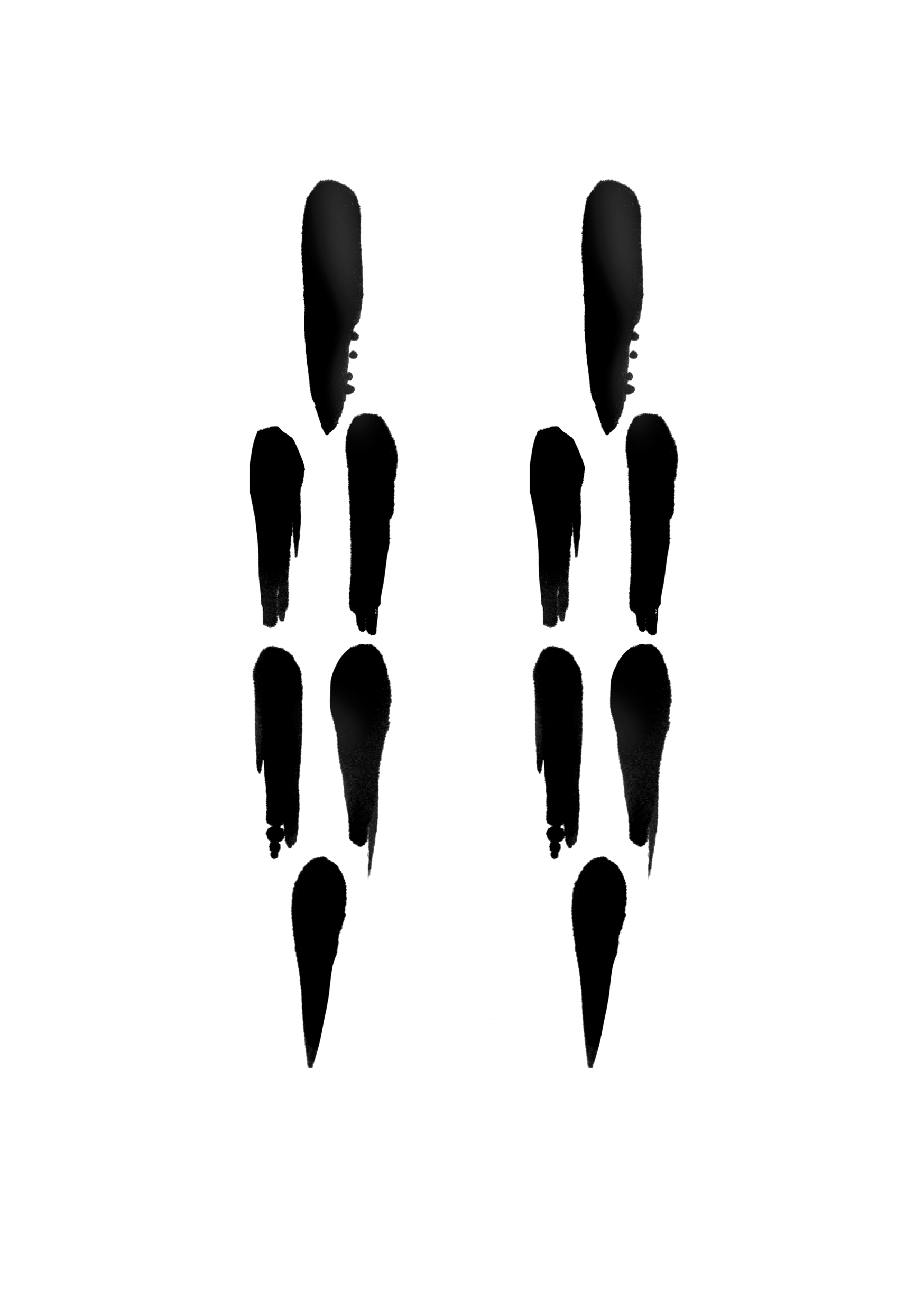
This Academy reads the right column first, then the left. Each row carries a single or double mark.

Where this Odù belongs
Òdí Méjì is the principal, doubled Odù of the Òdí family in the Academy’s study order. It sits beside fifteen mixed combinations. A doubled name identifies the sign’s structure; its teachings unfold through particular verses, stories and the circumstances in which they are interpreted.
Key Òrìṣà and sacred relationships
The figures below are selected for their roles in the accounts discussed here. They offer connected reading paths through the tradition.
-
Òṣun. In the Keleyi account, Òṣun Iyumu is the neglected maternal presence whose recognition restores a damaged relationship; bracelets also become a visible sign of remembrance.
-
Ọ̀rúnmìlà. Òrúnmìlà interprets Keleyi’s situation and reconnects her everyday priorities with her maternal religious obligations; his role is mediation within the story, not medical diagnosis.
Author’s further study: The Myths and Revelations of Odù Òdí Méjì develops this sign at book length. The inherited accounts discussed here retain their named witnesses and religious settings.
Key myths and their meanings
Thorns and the first shoes
At the beginning of the story, people travel barefoot through ground crowded with thorny plants. Òdí Méjì injures his feet and becomes unable to move easily. Divine counsel introduces shoes as durable protection. His seated posture and the arrival of gifts at his feet become part of the explanation of how an ordinary protective object acquired religious significance.
The central change is practical: the body needs an interface with a difficult environment. Protection enables movement without requiring the thorns to disappear. The story also refuses to make mobility the only basis of receiving good things. We can examine accommodation and dependence while keeping the account’s religious explanation distinct from claims about disability or the historical invention of footwear.
Narrative setting: Cuban account in the selected account.
Keleyi remembers her mother
Keleyi, described as a daughter of Òṣun, devotes herself to work, stored food, and pleasure while neglecting Òṣun Iyumu. After repeated loss, she turns to Òrúnmìlà. The account resolves through renewed recognition of that maternal bond and associates the sound of bracelets with Òṣun’s presence. It presents family continuity through religious remembrance rather than through material accumulation alone.
This motif places emotional and religious care beside labor. Keleyi has been active, but activity does not automatically maintain relationships. The story’s account of child loss must remain contextual: it should never become an accusation against grieving parents. Its central tension is the discrepancy between visible provision and the quieter acts by which a person remembers those who make life possible.
Narrative setting: Account explicitly marked Cuba.
The market tree gains space but remains exposed
A tree described as chief of the market seeks an extensive place to settle. Consultation distinguishes obtaining that place from remaining there securely. The tree completes the response for acquisition but not the part concerning continued occupation. Once established, it spreads branches and roots widely. People then cut those extensions. Explanatory notes identify the tree as a fig commonly planted for shade in Yoruba marketplaces and clarify that its arms and legs are branches and roots. The account places successful settlement, public usefulness, and damage to a living support within one sacred precedent about an achievement whose continuation cannot simply be assumed.
The tree’s expansion creates both its public benefit and its exposure. It cannot supply shade while remaining wholly unavailable, yet the use others make of its presence does not entitle them to injure it. Within the account, incomplete sacred response explains the vulnerability, and that explanation must be retained rather than replaced with a modern maintenance checklist. Contemporary analysis can nevertheless ask about the users’ responsibility, which the witness gives less attention than the tree’s preparation. Read beside Òdí Méjì’s shoes, the episode distinguishes a body reaching a place from that body remaining able to inhabit it.
The shoes mediate the relation between feet and thorny ground; roots and branches mediate the tree’s relation to a market. Keleyi adds another kind of continuation, where productive work does not automatically maintain a maternal religious bond. The comparison does not make all later damage deserved. It opens a precise question about what successful arrival leaves unfinished, spiritually and materially.
Narrative witness and setting: Passage explicitly attributed to William Bascom, numbered 52–2
Sun comes from heaven in royal splendor
A figure preparing to enter earthly dwelling places receives divination before leaving heaven. The account identifies this publicly splendid presence as Sun and compares its rising with a ruler appearing in ceremonial state. Notes explain the arranged seats, carpets, and posture of royal display, and clarify the rendering of Day as Sun in the passage. The applied interpretation concerns a child carrying destiny and gaining distinction, but that prediction can be separated from the cosmological precedent. The narrative’s visible action is a prepared celestial arrival whose recognition extends across dwelling places rather than remaining within one household or market.
The royal comparison makes distinction relational. Sun’s appearance is explained through a culturally specific scene in which a ruler’s body, surroundings, and public recognition belong together. It is not merely an assertion that a bright object naturally deserves human admiration. The religious preparation before earthly entry also gives visibility a prior history in heaven, so a contemporary reading of celebrity cannot exhaust the episode. The earlier seated Òdí Méjì offers a useful contrast: sitting there concerns injured feet and accommodation, whereas sitting in the Sun account marks ceremonial eminence.
A posture therefore does not carry one fixed meaning across the sign. The market tree adds another publicly recognized presence whose spread brings vulnerability rather than unqualified glory. Together these differences resist a formula equating visibility with wellbeing. The source’s child-related application should remain within its consultation genre, not become a promise that a particular reader’s child must achieve universal fame or a judgment on those whose lives remain less public.
Narrative witness and setting: Passage explicitly attributed to William Bascom, numbered 52–1
What was born in this Odù
“Born” can name an explicit traditional origin association or what emerges through a story: a capacity, relationship, practice or order of life. Interpretations drawn from a narrative are labelled below, so their basis remains clear.
Shoes
Selected traditional source association.
The origin list and footwear narrative connect this sign with covering vulnerable feet. This is a local sacred origin association that can support reflection on protection and adaptation, not an archaeological explanation of footwear.
Sea
Selected traditional source association.
The origin list names the sea among this sign’s associations. It broadens the source’s imagery of living bodies and their environments, but does not establish identical maritime meanings across every Òdí Méjì lineage.
Human generation
Selected traditional source association.
The list associates the sign with human generation and female reproductive organs. Treat this as cosmological imagery of emergence and continuity; avoid turning it into reproductive advice or a definition of women’s social role.
Correlations to life dimensions
These questions bring the selected stories into contemporary life. They are interpretive invitations for study.
Work and resources
Keleyi’s stocked yams and constant work make provision visible while remembrance disappears. The narrative supports asking which forms of care an account of productivity excludes, rather than treating wealth itself as an offense. Visible provision leaves that relational work unfinished.
Reflect: What care disappears when you measure success only by output?
Relationships and family
Maternal connection is renewed through attention and recognition. The account makes remembered relationship central, but its religious attribution of loss should not be applied to actual bereavement or used to assign blame. Remembrance matters here without authorizing blame for bereavement.
Reflect: How can you acknowledge a sustaining maternal relationship today?
Character and inner life
The shoe narrative allows protection to be learned after a painful encounter. Its emphasis is on adapting conduct to a real limitation instead of insisting that determination alone makes the ground harmless. The shoes change what daily travel makes possible.
Reflect: Where would a practical protection help more than endurance?
Community and responsibility
The seated figure still receives gifts, suggesting that participation and worth need not depend on constant physical movement. This is an interpretive possibility within the story, not a universal doctrine about the sign. The gifts reach him without demanding constant movement.
Reflect: How does your community include people who move differently?
A deeper reading of the sacred relationships
Divination addresses arrival and continuation separately
The market tree’s consultation distinguishes gaining room from remaining securely in it, while Sun receives preparation before entering earthly dwelling places. These are spiritual conditions within the witness, not merely practical advice disguised by religious language. The earlier shoes account likewise places bodily accommodation within divine counsel, and Keleyi’s restoration concerns an actual relation with Òṣun Iyumu. The four episodes therefore treat continuation as dependent on addressed powers and responsibilities whose forms differ. A contemporary reflection on maintenance can grow from that comparison, but should not replace the sacred exchanges or imply that every loss reveals neglected duty. The source gives particular precedents through which a consultation understands a life, not a universal audit for judging another person’s suffering.
Public usefulness can enlarge exposure
The market tree’s branches make it useful as shade while also placing living extensions within other people’s reach. Sun’s public appearance is widely recognized, but its scene concerns distinction rather than the material wear described for the tree. Keleyi’s work is productive yet can absorb attention away from another relation; shoes protect a traveling body without removing every thorn. These are different ways of being available to a world. Their comparison helps distinguish capacity, acknowledgment, and protection rather than treating them as one spiritual achievement. Contemporary analysis can ask how the costs of availability are shared, while preserving that the tree and Sun remain sacred narrative beings with specific relations rather than generic examples of human employment.
A visible posture does not settle a being’s meaning
Seated Òdí Méjì receives gifts because painful feet have restricted movement. Sun is described through a ruler seated in splendor. The tree stretches limbs that notes identify materially as roots and branches. These descriptions cannot be read through a single rule that sitting means passivity or extension means ambition. The narrative gives the posture its relation to a body, a public, and a sacred history. Keleyi’s bracelets add a comparable caution about objects: their sound is connected with Òṣun’s remembrance in that story, not every act of wearing ornaments. A careful study can therefore retain vivid images while resisting a symbolic dictionary that substitutes fixed meanings for attention to particular accounts.
Questions that deepen the study
Does the tree’s omitted response make every later injury deserved?
The witness explains the outcome through incomplete preparation, but a careful reader need not erase the people who do the cutting. The tree has a responsibility within the sacred account, while the market users’ action also affects the living support they enjoy. Those two points can coexist without converting the fable into a complete theory of public property. Contemporary interpretation may ask whether useful beings receive adequate care, but should not apply the tree’s religious causality to injured workers or neglected institutions as though their suffering proved spiritual fault. The story’s specific unresolved asymmetry is how much attention it gives the tree’s duty compared with the duties of its users.
How can eminence and dependence belong in the same study?
They concern different relations. Sun’s eminence describes the range and ceremonial quality of recognition. The traveler’s dependence concerns what allows a vulnerable body to continue moving or receiving support. The market tree brings both together more uneasily, because public usefulness increases exposure to damage. Keleyi adds the distinction between successful provision and remembered maternal relation. None of these accounts requires a being to be either admirable or in need of care. Their religious settings also differ, so comparison should not claim that fame fulfills every sacred responsibility. A contemporary reader can recognize visible achievement without assuming it cancels the need for accommodation, protection, or intimate attention.
What can Keleyi contribute without blaming bereavement?
Her account explicitly explains loss through a neglected relation with Òṣun Iyumu, and that religious explanation should be accurately situated as part of the story. It must not become a rule for evaluating grieving parents. The comparative insight is narrower: productive activity and stored resources do not themselves maintain every relation that a life depends upon. The tree’s continued place and the traveler’s shoes similarly require attention to conditions beyond initial acquisition or movement. Contemporary interpretation can ask what ordinary accounting leaves unseen without claiming to know why an actual child died. Care for grief should not depend on extracting a confession of spiritual failure from the person suffering it.
What the four narratives reveal together
The added Bascom-attributed accounts give Òdí Méjì a public and cosmological scale alongside the earlier vulnerable feet and maternal remembrance. The market tree gains room but remains exposed through the very branches and roots that make it useful; Sun’s prepared appearance places distinction within a scene of royal recognition. Their differences deepen rather than replace the older selections. A seated body can be accommodated or ceremonially eminent, an established place can still require continuation, and visible productivity can leave a sacred relation unattended.
Within the witnesses, divination and divine exchange make these conditions consequential, so a modern vocabulary of maintenance or identity should remain an additional interpretation. The comparison also leaves responsibilities unevenly described: the tree’s users and Keleyi’s surrounding household receive less attention than the principal figures. A source-conscious account can acknowledge those limits without manufacturing a universal doctrine or treating suffering as proof of neglected duty.
Living with this Odù
A continuing life or initiatory relationship
For someone whose received life or initiatory history includes Òdí Méjì, a recurring question concerns the difference between arriving and remaining able to live where one has arrived. The shoes allow contact with difficult ground to change; the market tree gains a place yet remains exposed through the very extensions that shelter others. These accounts invite sustained attention to the conditions of participation rather than a fixed identity of weakness or protection. A person may need accommodation in one season and become responsible for protecting another’s contribution in the next.
Keleyi’s relation with Òṣun Iyumu adds a different continuity. Productive activity can occupy the whole field of attention while an actual religious relationship receives little recognition. Òrúnmìlà’s mediation belongs to the story’s account of restoration; it is more than a reminder about work balance. Sun’s prepared arrival further distinguishes recognition from security. Long-term reflection can therefore ask what public success leaves unfinished: bodily protection, sustained remembrance, or responsibility toward those who provide shelter. These questions do not make bereavement evidence of neglect. They make changing circumstances relevant to how a person receives, maintains, and shares the conditions of a life.
A particular consultation and its question
In consultation, Òdí Méjì’s narratives help distinguish several problems that may look alike from outside. A person unable to continue may lack protection from a difficult environment, as in the shoe episode, or may occupy a useful position whose demands exceed its protection, as with the market tree. These are different configurations. Neither can be settled merely by praising endurance or asking for greater effort. The actual concern and divinatory context determine which distinction matters.
Keleyi’s narrative raises the separate possibility that visible provision has displaced acknowledgment of a sacred relationship. Its account of loss belongs to that witness, so resemblance cannot authorize blame against a grieving household. The Sun episode likewise cannot supply an unknown child’s forecast. It can help examine the difference between preparation, public distinction, and the circumstances required to remain well. A careful discussion might ask whether the client is seeking access, continued inhabitation, recognition, or restored relation; those aims need not require the same response. Religious counsel remains consequential within the stories, while contemporary inquiry considers the concrete exposures and responsibilities it reveals. A consultation opens this present question without turning its answer into the client’s permanent identity.
Constructive and adverse possibilities
Constructive unfolding may bring protection that enables movement, recognition that sustains a maternal sacred bond, and a clearer distinction between gaining a place and caring for its continuation. Within the narratives, divine counsel and Òrúnmìlà’s mediation participate in these changes. The religious agents cannot be replaced entirely by practical planning.
Adverse unfolding can appear where an initial success is treated as sufficient forever, where necessary supports are consumed without protection, or where productive activity makes a sustaining relationship disappear from attention. Yet the people cutting the tree’s branches also matter; its vulnerability does not absolve those who injure it. Sun’s splendor adds another qualification: public recognition is neither an automatic danger nor a guarantee of wellbeing. These contrasts illuminate possible directions of relationship without declaring the sign inherently fortunate or assigning a state to an actual reading.
An illustrative situation in everyday life
In a hypothetical example, a community workshop gains a permanent room after years of borrowing space. Attendance grows, and the organizer becomes its publicly celebrated face. The same volunteer who maintains access, cleans, and adapts activities for members with limited mobility becomes exhausted. The organizer feels that mentioning these pressures would diminish the achievement. Òdí Méjì’s tree and shoes help separate securing a place from making it inhabitable. Keleyi’s account adds the question of which sustaining relationship has disappeared behind productive success. The modern choices include sharing work, changing the arrangement, and acknowledging contributors. None reproduces the stories’ religious response or proves that a difficulty arose through spiritual neglect; the comparison clarifies what the visible success has left unfinished.
Sources and reading context
The first two narrative witnesses
These selections are marked Cuban in a multilingual compilation. Narrative details and origin lists are treated as local associations. No author is securely identified for these passages; reproductive and healing claims are retained only as elements of religious storytelling.
Narrative motifs are summarized independently. The life-dimension reflections are contemporary interpretation. How these reference studies are built explains the wider source approach and the distinction between a reference article and personal divination.
Additional named witnesses
-
William Bascom. Explicit attribution covers Sun and the market tree, with notes explaining royal posture and the Yoruba market-shade association.
-
Cuban narrative sequence. The earlier Keleyi and shoes episodes are explicitly marked Cuba and remain a distinct source strand.
The Bascom attribution is explicit, but edition and page are not established. Tree spelling varies in transcription. Predictive applications, ritual specifications, and proposed etymologies are excluded. Neither sacred personification is presented as botanical or astronomical history.
Bibliographic identification
- William Bascom. Ifa Divination: Communication between Gods and Men in West Africa. Bloomington: Indiana University Press, 1969. Library catalogue record. University library record for the named scholar’s Ifá study; citation does not imply a verified page for every narrative summarized here.
Read the source method and wider scholarly context.
The catalogue links identify published works and their authors. They are separate from proof of an individual episode’s wording or attribution. Contemporary comparisons and the synthesis above are editorial interpretation. The author’s books and Academy companions below provide further study; their sales links are separate from the source references.