
Ìròsùn Méjì is a principal Odù in Ifá’s 256-part corpus. Ìrosùn Méjì’s selected narratives join a grotesque contest between soldiers with Ṣàngó’s recovery from business difficulty. One soldier would damage himself to deprive his companion of more, while the ruler treats the contest as entertainment. In the other account, Ṣàngó’s shame almost drives him away before consultation and Òṣun’s proposed partnership offer a different response. Together the stories contrast competitive subtraction with renewed capacity through association.
A question to carry through the study: Where are you measuring your wellbeing by another person’s deprivation?
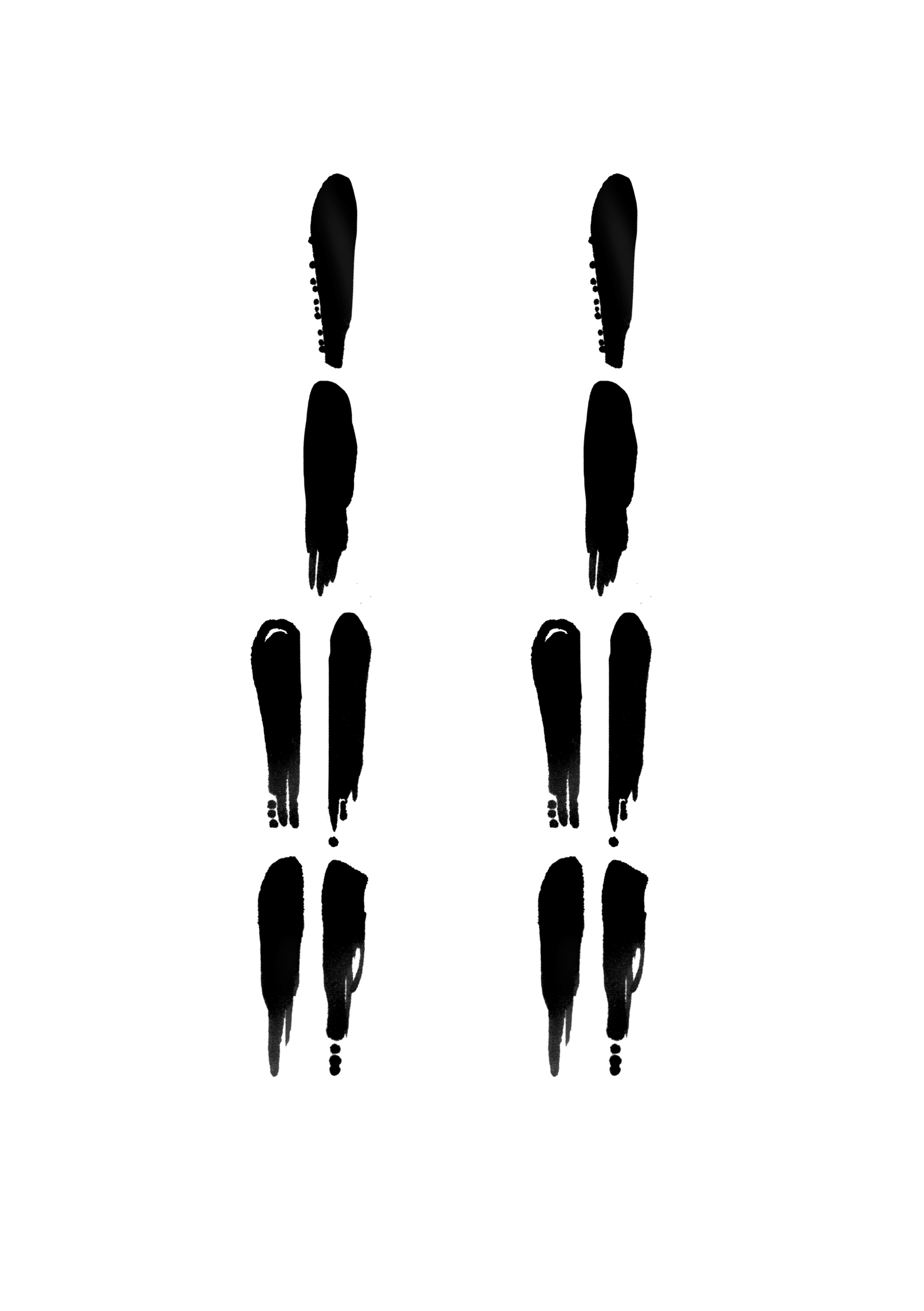
This Academy reads the right column first, then the left. Each row carries a single or double mark.

Where this Odù belongs
Ìròsùn Méjì is the principal, doubled Odù of the Ìròsùn family in the Academy’s study order. It sits beside fifteen mixed combinations. A doubled name identifies the sign’s structure; its teachings unfold through particular verses, stories and the circumstances in which they are interpreted.
Key Òrìṣà and sacred relationships
The figures below are selected for their roles in the accounts discussed here. They offer connected reading paths through the tradition.
-
Babalú Ayé. Babalú Ayé observes the ruler’s abuse of the soldiers and brings it before Olofin. His intervention makes wrongdoing at court visible to a higher authority.
-
Ṣàngó. Ṣàngó faces failing business and feels ashamed of a position unfamiliar to him. He accepts his family’s counsel and Òṣun’s proposal rather than immediately abandoning the town.
-
Òṣun. Òṣun proposes a joint animal-trading business at the marketplace. Her intervention is concrete partnership and recognition of existing skill, not a general promise of wealth.
-
Ọ̀rúnmìlà. Òrúnmìlà is consulted before Ṣàngó leaves and directs him back toward a public meeting place, where an opportunity for renewed work emerges.
Key myths and their meanings
A ruler makes envy a spectacle
A ruler offers a soldier a wish while establishing that his companion will receive more. Unable to enjoy a benefit that another will exceed, the envious soldier asks to lose one eye so the other will lose both. The ruler allows it for amusement. Babalú Ayé reports the abuse, and Olofin overturns the court’s apparent triumph through punishments and an altered distribution of authority.
The soldier’s envy matters, but so does a ruler who constructs a cruel choice and treats suffering as entertainment. A responsible reading criticizes both rather than turning blindness into moral symbolism applied to actual people. The story’s economic question is whether someone can recognize an improvement in their own life without requiring a superior position over another, especially when authority encourages that comparison.
Narrative setting: Spanish Cuban-style soldier account.
A marketplace partnership instead of flight
Ṣàngó’s businesses decline, and shame makes departure seem preferable to remaining. His relatives encourage consultation before he leaves. At the marketplace he encounters Òṣun, who has wanted to speak with him about a joint business. Their shared familiarity with trading animals gives the proposal substance, and the narrative closes with prosperity renewed through their association.
The turn is not simply from misfortune to luck. Family counsel interrupts an isolating decision, and a specific partner offers work that matches existing experience. The account can support reflection on asking for help before shame narrows available choices. Its prosperous ending remains a religious story, not evidence that any partnership will succeed or that poor outcomes indicate failed faith.
Narrative setting: Spanish Cuban-style Ṣàngó account.
The gray-haired decree catches its own makers
Before the divinities come to earth, counsel warns against inflexible rules and advises a relationship with Èṣù. Only Òrúnmìlà follows that part. The earthly divinities then decree that gray hair requires return to heaven. When Òrúnmìlà becomes gray, they prepare for his departure. He consults and hosts a farewell meal. At the entrance, Èṣù makes the arriving divinities’ hair appear gray without their knowledge. After eating, they discover that the rule now applies to them all. They revoke grayness as the criterion for death, and the account explains Òrúnmìlà’s intervention as a change in the conditions of earthly life.
The reversal depends on a sacred relation already established before the rule becomes dangerous to Òrúnmìlà. Èṣù is not merely a clever assistant added after the fact; his earlier recognition matters to how the later boundary can be crossed. The farewell feast also transforms a solitary sentence into a shared condition, making the lawmakers encounter the consequences of their own measure. This complements the earlier soldiers’ story, where a ruler manipulates an unequal wish for entertainment and a higher authority intervenes. In both, rules can injure those subject to them, but the religious mechanisms and reversals differ.
The new episode concerns the divinities’ order and mortality, not a modern legislative record. Contemporary interpretation can ask whether a criterion is adequate to the life it governs, while avoiding the claim that gray hair, age, or bodily difference proves spiritual readiness to die. Its enduring tension is that the rule changes after the makers become exposed, not necessarily because they have first understood the condition of everyone affected.
Narrative witness and setting: Account explicitly headed Revelações de Cromwell Osamaro
Heavenly requests are fulfilled after their memory is lost
Ìrosùn Méjì enters earthly life without completing the preparations advised before birth and encounters severe difficulty. A guardian’s dream sends him back through divination to renew his requests in heaven. At the divine chamber, the obstructing gate presence demands supplies, but he has come prepared to answer each delay. His requests receive a divine blessing, and Èṣù urges a quick return. The obstacle power pursues and wounds him from behind, imposing forgetfulness of heavenly requests on earthly life. He awakens at home without the memory of the journey, yet his affairs later improve. The source connects this forgetting with gestation and the hidden beginning of life.
The account gives human uncertainty a cosmological history. Difficulty does not mean that no heavenly requests exist; the problem is that their conditions and memory are not fully available after earthly arrival. Divination consequently matters as a real relation across that loss of knowledge, not merely as encouragement to trust one’s wishes. The supplies answering the gate presence’s delays also differ from the later blessing: preparedness enables an audience, but does not make the protagonist sovereign over the obstacle power.
He returns marked and forgetful rather than perfectly informed. Compared with Ṣàngó’s market partnership, this is a different response to frustrated livelihood. One story turns toward an encounter with Òṣun and existing skill; the other narrates a return to a pre-earthly relation that remains partly hidden afterward. The religious depth lies in that incompleteness. A contemporary account should not claim to reconstruct a reader’s heavenly requests or infer that bereavement and poverty reveal voluntary mistakes made before birth.
Narrative witness and setting: Account explicitly headed Revelações de Cromwell Osamaro
What was born in this Odù
“Born” can name an explicit traditional origin association or what emerges through a story: a capacity, relationship, practice or order of life. Interpretations drawn from a narrative are labelled below, so their basis remains clear.
Humility
Selected traditional source association.
Humility heads the local origin list. The stories give it practical contours: accepting counsel, refusing cruel comparison, and recognizing that status does not justify turning other people’s needs into amusement.
Firefly
Selected traditional source association.
The firefly is named as an origin association. A later passage relates its light to moonless nights, giving a modest source-specific image of illumination that need not be expanded into an invented proverb.
Mortuary rites
Selected traditional source association.
The list names graves and the ituto rite. These place death and continuity in the sign’s local religious field; no ceremonial procedures or universal claims about funerary practice are given here.
Correlations to life dimensions
These questions bring the selected stories into contemporary life. They are interpretive invitations for study.
Work and resources
Ṣàngó can still use an existing skill after a business reversal. The proposed partnership makes recovery relational and concrete, while the soldier story shows how comparison can destroy the value of an available benefit. The market preserves an opportunity departure would remove.
Reflect: Which skill remains useful despite a recent setback?
Relationships and family
Relatives prevent Ṣàngó’s shame from becoming immediate departure. Their counsel matters because they preserve time to consider another response, rather than merely offering reassurance that his status will return on its own. The proposed delay allows a different future to appear.
Reflect: Who can help you reconsider a decision made in shame?
Character and inner life
The soldier prefers shared injury to unequal benefit. This is an extreme image of a familiar distortion: another person’s gain becomes more intolerable than one’s own loss. It invites examination of comparison without diagnosing a personality.
Reflect: What benefit have you discounted because another person received more?
Community and responsibility
Babalú Ayé refuses to leave abuse inside the court’s own account of entertainment. His reporting makes oversight necessary when those with power create the harmful rules rather than merely failing to enforce good ones. The ruler is responsible for creating the cruel choice.
Reflect: Who can review a rule created by the person benefiting from it?
A deeper reading of the sacred relationships
Divination reaches across forgotten beginnings
The heavenly-request episode locates a life’s wishes before earthly memory, then explains why their full content cannot simply be recalled. The guardian, divine chamber, obstacle presence, and Èṣù each affect the journey; divination is part of the means by which the relation remains accessible despite forgetting. The gray-haired decree likewise connects an earthly event with counsel given before arrival. These are theological accounts of knowledge and responsibility, not simply illustrations of psychological insight. The earlier business episode adds a worldly meeting rather than replacing that cosmology. A careful comparison can preserve both levels: spiritual beginnings may be consequential within the witness, while actual decisions still occur among relatives, markets, skills, and people whose help must be recognized.
A shared condition can reveal a defective measure
The divinities revoke their rule when they all appear gray, while the earlier soldiers suffer under a ruler’s unequal distribution of a wish. Both stories expose the way a formal arrangement can make another’s suffering seem acceptable until its meaning changes. Yet their outcomes are not identical. One involves divine intervention against a cruel court, the other a collective revision within a cosmic order. Ṣàngó’s business reversal adds a less coercive form of revaluation, where shame gives way to partnership. The forgotten-request episode then limits the assumption that every relevant condition is visible. Contemporary reflection can ask what a measure fails to see without claiming that one principle explains the entire sign or every institution.
Incomplete knowledge need not erase agency
Ìrosùn Méjì acts through a guardian’s warning and consultation without retaining the whole heavenly story afterward. Ṣàngó initially sees departure as the answer to shame, yet relatives preserve time for another possibility. The soldiers’ scene gives an extreme case of judgment distorted by comparison, while the gray-haired divinities must revise what they thought was a sufficient rule. These episodes do not portray people as either fully informed or entirely powerless. Their agency develops through encounters, disclosures, and relationships that alter what can be understood. A contemporary reading can therefore ask how to act responsibly under uncertainty, while leaving the witness’s hidden destiny and divine intervention distinct from an assertion that ordinary uncertainty has one supernatural cause.
Questions that deepen the study
Can the heavenly story tell a reader what they chose before birth?
Not by itself. It explains, within this witness, why earthly life may retain a relation to heavenly requests without conscious access to them. The protagonist requires consultation and a guardian’s intervention, and even his successful return does not preserve full memory. A summary cannot therefore become an authority to announce another person’s specific pre-earthly choices. The episode can deepen an account of destiny by showing that it is neither transparent desire nor an entirely self-authored plan. Contemporary reflection may ask how people meet uncertainty, while a personal religious interpretation would require the living tradition’s own forms of consultation rather than a general article claiming access to hidden particulars.
Why does the gray-haired rule change only after the feast?
The feast places every visiting divinity inside the condition they had assigned to one of their number. Their discovery changes the stakes of the rule from an isolated departure to a shared ending. Within the account, Èṣù’s action and Òrúnmìlà’s completed response make that reversal possible. A contemporary reader can notice the moral limitation that recognition arrives through self-exposure, but should not reduce the scene to a trick for winning a policy dispute. Its religious subject is the reordering of an earthly condition established by divinities. Nor does the revised decree authorize a reader to judge when a real person is old enough to die.
What remains useful when a life’s larger meaning is not fully known?
The earlier Ṣàngó episode provides a specific answer through relatives, consultation, and a partner who recognizes existing experience. The heavenly journey provides a different answer through renewed sacred relations that do not yield complete memory. Together they distinguish useful action from total explanation. Someone need not possess the final account of every difficulty to receive counsel or acknowledge help. That is a contemporary interpretation of their juxtaposition, not a promise that one action will solve every hardship. The soldiers’ story also cautions against making another person’s deprivation the measure of one’s progress, especially when uncertainty makes comparison seem easier than attending to a concrete need.
What the four narratives reveal together
The added Osamaro witness gives Ìrosùn Méjì two especially consequential religious dimensions: a divinely established rule can be revised, and a life can remain related to heavenly requests whose memory is lost. These do not replace the earlier court cruelty and market partnership. They place visible social judgment beside a cosmology in which knowledge is partial and sacred relations alter what an earthly life can become. A gray-haired appearance is insufficient to settle the divinities’ departure; forgetting is insufficient to prove the absence of destiny; shame is insufficient to establish that a town offers no further opportunity.
The comparison supports careful attention to the limits of a present judgment. It also preserves epistemic restraint: an article cannot recover a reader’s heavenly requests or make actual suffering evidence of a prebirth failure. The narratives’ spiritual realities and their contemporary implications should remain related without being confused.
Living with this Odù
A continuing life or initiatory relationship
For someone whose received spiritual history includes Ìròsùn Méjì, comparison can either enlarge a life or turn benefit into intolerable rivalry. The soldier’s preference for injury over another’s advantage becomes especially destructive because a ruler makes the contest entertaining. The marketplace account offers another possibility: shame need not end in flight when relatives encourage consultation and Òṣun’s specific proposal gives partnership substance. Neither outcome defines a fixed personality of envy or commercial talent.
The gray-haired decree adds institutional rigidity: a rule looks secure until those enforcing it encounter its consequence themselves. Òrúnmìlà’s relation with Èṣù changes that divine arrangement in the witness. The heavenly-request episode further separates remembered understanding from an active sacred history; later improvement does not depend on retaining a complete conscious narrative of the journey. Across a life, reflection may concern rivalry, partnership, revisable rules, or the limits of memory. The sign does not explain actual disability as punishment or promise prosperity after forgotten preparation. It invites character able to recognize how power organizes comparison, receive a viable relation before leaving, and reconsider a rule whose apparent fairness depends on remaining outside its reach.
A particular consultation and its question
In consultation, Ìròsùn Méjì helps distinguish an injured comparison from an actual lack of opportunity. The soldier already has access to a wish, but the comparative arrangement makes another’s greater benefit intolerable. Ṣàngó’s declining businesses present a different external situation, where a concrete partnership is available but shame narrows attention toward departure. A practitioner cannot infer envy from economic difficulty or assume that staying is always constructive.
The gray-haired decree sharpens the question of rules made by people who imagine themselves exempt. Its reversal through Èṣù and Òrúnmìlà belongs to a sacred cosmological witness, not a simple instruction to manipulate appearances. The heavenly journey adds another distinction between what is remembered and what is religiously consequential. That narrative does not verify an unknown client’s prenatal choice or supply a recovered memory. The actual divinatory context determines which questions matter: how comparison is organized, whether partnership has a real basis, what a rule requires of its makers, or what remains beyond explicit recollection. Consultation offers a situated relation to these possibilities, not a permanent identity or an assurance that hidden preparation will automatically improve the client’s affairs.
Constructive and adverse possibilities
Constructive unfolding may include accepting a benefit without requiring another’s diminishment, considering a substantive partnership before departing, and revising a rule when its human or divine consequence becomes clear. The marketplace encounter includes actual shared knowledge of trade, not merely a wish for companionship.
Adverse unfolding can involve institutions turning envy into spectacle, shame making help appear humiliating, or rules defended only while their makers remain protected. The heavenly-request witness adds difficulty around obstruction and lost memory, but does not make forgetting a universal cause of hardship. Babalú Ayé’s report and Olofin’s response in the court account remain particular religious actions. These contrasts illuminate possibilities without treating bodily injury as an ethical label or declaring the sign invariably difficult. A real consultation’s constructive or adverse direction requires its own interpretation and cannot be read from the name alone.
An illustrative situation in everyday life
Imagine a hypothetical colleague offered a modest promotion while another person receives a larger one. A manager repeatedly compares the two for amusement. The colleague considers rejecting the role merely to prevent the other from benefiting. Ìròsùn Méjì’s court episode helps identify both the inward rivalry and the external arrangement that intensifies it. The marketplace partnership suggests asking whether an actual cooperative opportunity exists beyond the imposed contest. A response might refuse the comparison while evaluating the role on its own terms. This example does not equate disappointment with the soldier’s violent wish or promise that partnership will restore prosperity. It shows why individual envy and an authority’s use of comparison need to be examined together.
Sources and reading context
The first two narrative witnesses
The selected stories are in the Spanish Cuban sequence. Babalú Ayé is indexed as named, without merging him with Soponna or Asójanò. Origin associations are local, and a narrative about blindness is not used to characterize real disability.
Narrative motifs are summarized independently. The life-dimension reflections are contemporary interpretation. How these reference studies are built explains the wider source approach and the distinction between a reference article and personal divination.
Additional named witnesses
-
Cromwell Osamaro. Explicit headings introduce the heavenly works, gray-haired decree, and earthly return to renew requests.
-
Spanish Cuban-style narrative sequence. The soldiers and Ṣàngó partnership are the earlier distinct selections in the compilation.
The obstacle presence is named inconsistently and is not automatically identified with another deity. The bodily-origin account is retained as sacred cosmology, not anatomy. The revised mortality rule and prebirth requests are not used for personal prediction or blame.
Bibliographic identification
- C. Osamaro Ibie. Ifism: The Complete Work of Orunmila. Lagos; multivolume publication beginning 1986. Library catalogue record. Related bibliographic record for the named narrative witness. Exact volume, edition and page of the transmitted account have not been independently matched.
Read the source method and wider scholarly context.
The catalogue links identify published works and their authors. They are separate from proof of an individual episode’s wording or attribution. Contemporary comparisons and the synthesis above are editorial interpretation. The author’s books and Academy companions below provide further study; their sales links are separate from the source references.