
Òwónrín Méjì is a principal Odù in Ifá’s 256-part corpus. Òwónrín Méjì’s selected accounts join artistic power with the unstable obligations of trusted service. Awó Mayere commands spiritual companions through flute music but suffers isolation and seeks support beyond his own ability. Aguema carries Ṣàngó’s messages yet accidentally loses an entrusted jewel and cannot explain himself. Both stories make voice consequential without making it all-powerful: a gifted speaker or messenger remains dependent on recognition, care, and a patient hearing from others.
A question to carry through the study: Where are others hearing your performance while missing your need?
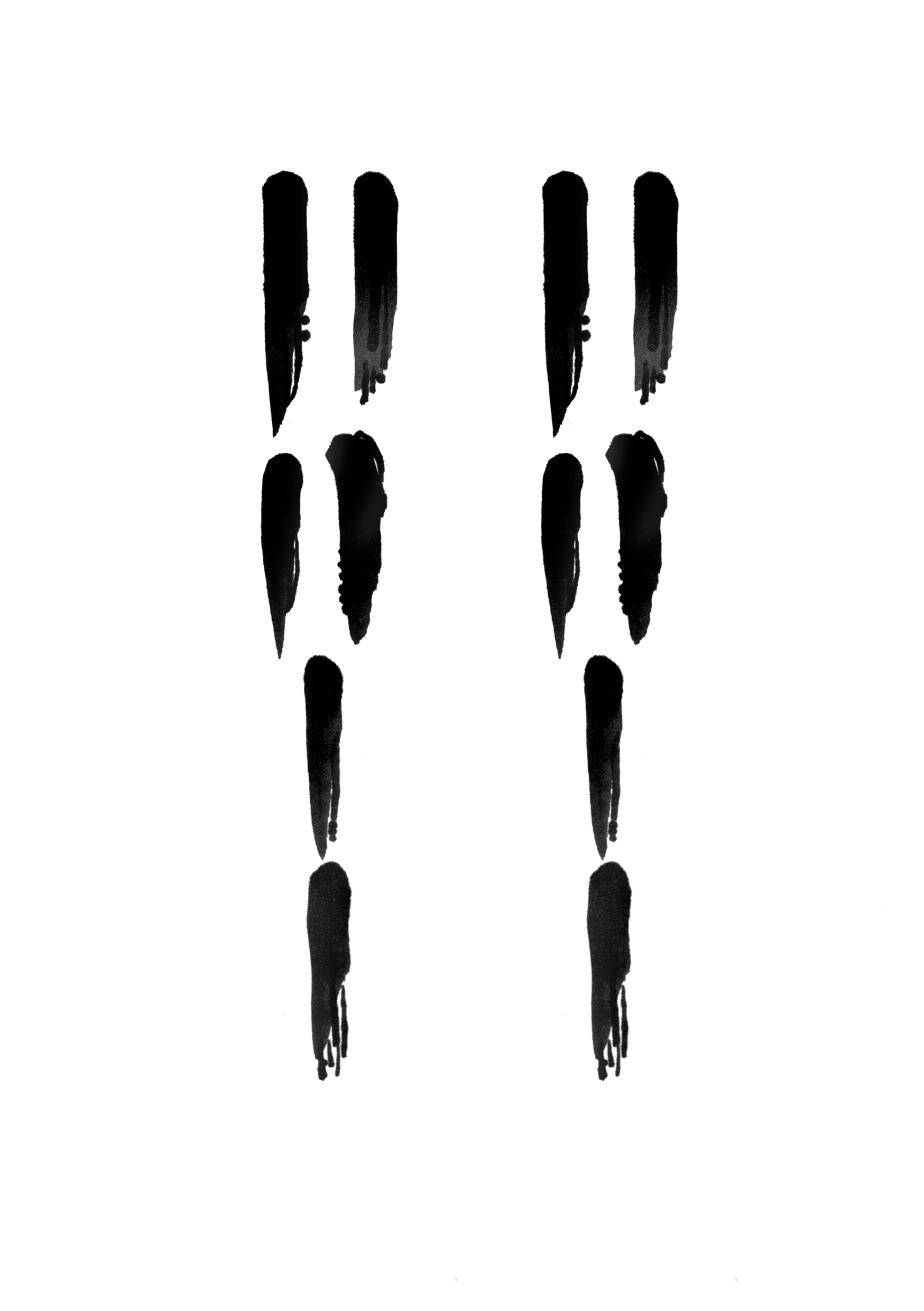
This Academy reads the right column first, then the left. Each row carries a single or double mark.

Where this Odù belongs
Òwónrín Méjì is the principal, doubled Odù of the Òwónrín family in the Academy’s study order. It sits beside fifteen mixed combinations. A doubled name identifies the sign’s structure; its teachings unfold through particular verses, stories and the circumstances in which they are interpreted.
Key Òrìṣà and sacred relationships
The figures below are selected for their roles in the accounts discussed here. They offer connected reading paths through the tradition.
-
Èṣù. Eshu Alawana governs the mouse-like companions associated with Mayere’s land and is called upon within his protection. This is a particular Alawana association, not a universal description of Èṣù’s form.
-
Baba Ẹ̀gún. Obá Yokun is Mayere’s powerful ancestral supporter and identifies himself as his father. His appearance in a dream gives the isolated musician an enduring familial relationship beyond public command.
-
Òsanyìn. Osanyin meets Mayere on his journey and helps the afflicted musician within the narrative. He is also associated with Aguema’s extraordinary capacities in the separate messenger account.
-
Ṣàngó. Ṣàngó entrusts Aguema with messages and gifts but responds violently when the jewel fails to arrive. His authority and reliance on a messenger create the account’s central imbalance.
Key myths and their meanings
The flute player who needs companionship
Mayere comes from heaven and is poorly understood in his earthly land. His flute can direct spiritual companions, yet their possessiveness leaves him profoundly alone. A dream of his father Obá Yokun reassures him of continuing support. Following that encounter, he meets Osanyin and receives help within the story. His celebrated ability to command sound does not prevent the need for someone to attend to his suffering.
The story distinguishes being able to attract or control an audience from being accompanied. The musician’s mastery is not denied, but cannot do every kind of relational work. A responsible reading can discuss isolation and the importance of receiving care while keeping spiritual attacks, dreams, and healing within religious narration. Artistic capacity should not be romanticized as a reason someone must endure loneliness without support.
Narrative setting: Spanish Cuban-style account.
The jewel the messenger cannot deliver
Aguema enjoys exceptional standing as Ṣàngó’s trusted messenger and lives among palms associated with his patron’s secrets. Sent to deliver a jewel, he carries it in his mouth and accidentally swallows it while coughing. He hides rather than completing the delivery. Ṣàngó discovers that the recipient never received it, pursues Aguema, and repeatedly strikes toward his refuge with lightning, producing the account’s palm-and-lightning association.
The failed delivery begins as an accident but becomes harder to resolve through hiding and violent accusation. The messenger cannot make himself understood, while the patron treats failure as grounds for attack. The account can support questions about reporting mistakes and hearing explanations without treating bodily difficulty as moral fault. Its lightning imagery remains sacred origin narrative, not a scientific account of strikes on palms.
Narrative setting: Spanish account of Ṣàngó and Aguema.
Wealth is found among the relations left at home
Òrúnmìlà prepares to travel for divination and is advised to acknowledge his hereditary guardian. He postpones that response until after departure. At his destination no clients come, and hunger forces him to return home. He then completes the response and shares its food with people in his own circle. Those who receive portions give money in return, and he becomes prosperous. The account closes by locating money among one’s own relations and followers. A compilation note distinguishes a broad circle of friends and relatives from the narrower household, making the social location of the reversal an explicit point.
The journey does not fail because travel is inherently wrong or because strangers are incapable of generosity. It fails after a particular relation has been deferred, and the reversal occurs through both its restoration and an exchange with people already connected to Òrúnmìlà. The guardian is therefore not reducible to a metaphor for networking. The narrative joins a sacred obligation with an actual distribution of food and reciprocal gifts. Compared with the earlier flute story, in which an isolated ancestor’s needs reorganize communal attention, this adds the possibility that what is sought far away is already available within neglected relations.
Contemporary interpretation may examine why distant recognition can seem more real than nearby support. It must not become an instruction to monetize every friendship or an assurance that ritual expenditure always returns a profit. The account’s named social circle also deserves precision: the witness’s note broadens it beyond the domestic household rather than equating all help with immediate kinship.
Narrative witness and setting: William Bascom, explicitly attributed divination narrative
Guinea fowl changes where she sleeps after a dangerous visit
Guinea fowl and Leopard are presented as friends. After Leopard insists on seeing her dwelling, Guinea fowl suspects that the visit conceals hostile intent and consults Fá. Wenlé-Méji advises a response and a change in where she sleeps. A decoy occupies the familiar sleeping place while she watches from elsewhere. Leopard enters at night and attacks what he assumes is her body. The concealed thorny object wounds him, and his attempt to lick the injuries makes them fatal. Guinea fowl survives and publicly acknowledges that Fá has freed her from the enemy who approached under friendship.
The narrative distinguishes access from trust. Leopard’s knowledge of the dwelling has been gained through an accepted social relation, so the danger cannot be answered simply by recognizing an openly declared enemy. Consultation makes a different arrangement possible before the attack occurs. The account credits Fá with that protection and places the sign within a specific Fon witness; its names should not be silently replaced by a standardized Yorùbá cast. The earlier swallowed-jewel episode also concerns an apparently hidden intention becoming visible, but through a messenger’s bodily entanglement with Ṣàngó’s power.
Here concealment protects the threatened person instead. Contemporary interpretation can ask when a familiar arrangement has become unsafe and why changing exposure may matter more than arguing about another’s intentions. The story’s lethal reversal remains troubling and particular. It is not a practical invitation to set traps or evidence that an unwelcome visitor in a reader’s life is secretly predatory.
Narrative witness and setting: Bernard Maupoil, Fon/Fá Wenlé-Méji account
What was born in this Odù
“Born” can name an explicit traditional origin association or what emerges through a story: a capacity, relationship, practice or order of life. Interpretations drawn from a narrative are labelled below, so their basis remains clear.
Religious belief
Selected traditional source association.
The explicit origin list places religious belief here. This broad local association can accompany the flute account’s relationship with unseen companions, but does not make the sign the historical origin of religion or define one universal form of belief.
Celebrity
Selected traditional source association.
Celebrity appears separately in the origin list. The stories complicate fame by showing loneliness and dependence behind extraordinary ability, without predicting either fame or isolation for people associated with the sign.
Revolutions
Selected traditional source association.
Revolutions are explicitly named. Their presence can retain a concern with disrupted arrangements and contested power, but the selected accounts do not justify a specific historical event or a universal political doctrine.
Correlations to life dimensions
These questions bring the selected stories into contemporary life. They are interpretive invitations for study.
Work and resources
Aguema’s privileged position depends on trusted delivery. A single failure becomes dangerous when there is no safe way to report an accident, showing why systems of accountability need an intelligible route for admitting what has gone wrong.
Reflect: Can someone report an error to you without fear of retaliation?
Relationships and family
Mayere’s father offers a continuing relationship when command over companions has become isolating. The story can support asking who knows a gifted person beyond the role they perform, without prescribing how an ancestral relationship must be practiced.
Reflect: Who relates to you beyond what you can provide?
Character and inner life
The flute produces mastery but not sufficient comfort. The account invites distinguishing capability from wellbeing, especially when public recognition makes others assume that an accomplished person must already possess everything needed to live well. Mayere’s crying makes the neglected need unmistakably present.
Reflect: What need is hidden by your competence?
Community and responsibility
Ṣàngó’s reaction leaves little room for the messenger’s explanation. Communities organized around powerful patrons need ways to investigate failed communication without making a dependent intermediary solely responsible for every outcome. The intended recipient also loses through the failed delivery.
Reflect: Who can examine a mistake before power assigns blame?
A deeper reading of the sacred relationships
Two witnesses describe real sacred mediation differently
Bascom’s account connects Òrúnmìlà’s deferred acknowledgment of a hereditary guardian with an unsuccessful journey and a prosperous return. Maupoil’s Fon account makes consultation of Fá the means by which Wenlé-Méji discloses a protective change. Both grant religious relations consequential force; neither is adequately represented as an intuitive hero solving a problem alone. Their vocabularies and settings nevertheless differ. Keeping those differences visible is more accurate than treating every name as an interchangeable translation. The compilation establishes these as selected witnesses associated with the sign, not as proof of a single uniform performance shared by every community. Their comparison can deepen religious understanding without dissolving distinct traditions into a composite tale.
A familiar relation can nourish or expose
Òrúnmìlà’s circle supplies a livelihood after his return, whereas Guinea fowl’s apparent friendship supplies Leopard with knowledge useful to an attack. These are not contradictory instructions about whether to trust people. They show why familiarity alone cannot settle the quality of a relation. The earlier flute episode adds a forgotten ancestor whose claim requires renewed communal attention. Across the selections, a relation may need acknowledgment, assessment, or a changed boundary. Contemporary interpretation can ask which of those tasks is actually present. That is more precise than advising universal suspicion or unconditional openness, and it avoids making a sacred account an authority to name hidden enemies in someone else’s life.
The location of a solution may differ from its imagined location
The traveling diviner expects livelihood at his destination but receives it through a return. Guinea fowl does not abandon all knowledge of her home; she alters her exposure within the arrangement Leopard believes he knows. Both reversals depend on a changed relation to place. The earlier ancestor episode similarly gives neglected presence a location within the community’s ongoing life. A contemporary reading can compare how expectations attach to distance, residence, and habitual positions. The accounts do not establish that staying home is always safer or more prosperous. Their narrower contribution is to show that a desired change may require reconsidering where one stands and which relations are being left unattended.
Questions that deepen the study
Does the Bascom account advise everyone to remain in their hometown?
The story concerns a particular journey preceded by deferred counsel. Its reversal occurs when Òrúnmìlà returns, acknowledges his guardian, and shares food with people already connected to him. It does not state that travel is always mistaken. The accompanying note also makes the supporting circle broader than the immediate household. Contemporary interpretation can question an assumption that opportunity must be distant without turning the account into a migration rule. Within the witness, the guardian relationship remains part of what changes the situation. Reducing the episode to a claim that local contacts are commercially useful would omit that religious structure.
Why preserve the names Wenlé-Méji and Fá in the second account?
The source explicitly introduces Maupoil’s Fon material and names the sign and divinatory power within that witness. Retaining those terms makes the provenance visible and prevents an account from appearing to be a verbatim Yorùbá or Cuban narrative. Comparison is still possible: consultation discloses danger and supports a response, as it does in other selected episodes. But comparison does not require erasing the vocabulary through which the story is told. Nor does Portuguese language turn the witness into a Brazilian tradition. An article should identify the actual source setting rather than infer a lineage from the language of the compilation.
What can be learned without identifying a visitor as a hidden enemy?
The narrative allows discussion of exposure, access, and the difference between friendliness and reliable care. Guinea fowl acts after a specific visit and a consultation within the story; a reader does not inherit that divinatory result merely by recognizing a resemblance. Contemporary reflection may ask what information or access a relationship provides and whether a present arrangement remains appropriate. The account’s lethal decoy should not be turned into a practical response. Its religious meaning includes Fá’s protection, while its comparative value includes the possibility of changing a dangerous arrangement without first obtaining the attacker’s agreement about their intentions.
What the four narratives reveal together
The added Òwónrín Méjì witnesses place a nourishing return beside a protective displacement. In Bascom’s account, a neglected sacred relation and an overlooked social circle become the setting of prosperity. In Maupoil’s Fon narrative, consultation reveals that familiar access has become dangerous and supports a change of exposure. The earlier ancestor and swallowed-jewel episodes supply further differences in how hidden relations become consequential. These selections resist a single slogan about trust, travel, or generosity.
They ask what kind of relation is present, what has been deferred, and what a familiar arrangement permits. Religious mediation remains real within each witness: a hereditary guardian is acknowledged, Fá is consulted, and protection is credited to the sign. Contemporary interpretation can explore those questions while preserving distinct vocabularies and refusing to turn an account into a forecast, commercial formula, or identification of a reader’s secret enemy.
Living with this Odù
A continuing life or initiatory relationship
For someone carrying Òwónrín Méjì within a received spiritual history, extraordinary capacity need not contain the conditions of companionship. Mayere can direct spiritual companions through sound while remaining lonely enough to need his father’s reassurance and Osanyin’s help. Aguema’s privileged messenger position gives another difference between standing and wellbeing: an accidental swallowing becomes dangerous through concealment and a patron’s violent response. Bodily difficulty is not itself a moral fault.
Bascom’s returning Òrúnmìlà finds livelihood through a hereditary guardian and a wider circle already connected to him. Maupoil’s Fon Guinea fowl instead changes exposure within an apparently friendly relation, acknowledging Fá’s protection. Together these witnesses resist both unconditional familiarity and permanent suspicion. Across a life, reflection may concern a competence hiding unmet need, a mistake without a safe route of explanation, neglected nearby relations, or an access that no longer serves protection. The person is not fixed as gifted, isolated, or threatened. The sign invites discrimination about what kind of relation is present, while retaining the distinct familial Egun, Osanyin, guardian, and Fon Fá rather than collapsing every unseen agent into one category.
A particular consultation and its question
In consultation, Òwónrín Méjì can distinguish recognition from support and familiarity from trustworthiness. Mayere’s command of sound does not remove the need for someone to hear his suffering. The messenger’s standing does not provide an intelligible route for an accident to be reported. A client’s apparent competence or close connection therefore cannot settle what support actually exists in the present arrangement.
The returning diviner and Guinea fowl introduce opposing movements without contradiction. One finds nourishment through relations left unattended; the other survives by changing a familiar exposure after consultation of Fá. The actual question determines whether acknowledgment, a boundary, or another task is relevant. A practitioner cannot identify a visitor as Leopard merely because the story feels recognizable. Nor can the guardian account prescribe remaining in a hometown or monetizing friendship. Religious mediation retains its force in each witness, with Fon terms preserved in Maupoil’s account. A careful conversation may ask which need public ability conceals, whether a mistake can be explained safely, and what a known arrangement permits. These possibilities belong to a situated result rather than a permanent identity or a forecast of attack, loneliness, or prosperity.
Constructive and adverse possibilities
Constructive unfolding may include companionship able to meet the person beyond their performance, an error heard before blame becomes violence, and a familiar relation assessed for what it actually sustains. Òrúnmìlà’s return involves his guardian and shared food, while Guinea fowl’s changed exposure is explicitly credited to Fá.
Adverse unfolding can involve ability treated as proof of self-sufficiency, a patron’s anger making explanation impossible, or access granted through friendship used for harm. The lethal reversal in the Fon account is not an exemplary way to handle a present visitor. These contrasts do not make staying constructive and leaving adverse, or the reverse. They distinguish recognition, nourishment, and safety within particular relationships. No actual client’s companions are identified, no bodily accident establishes guilt, and no state of a real consultation follows automatically from the sign.
An illustrative situation in everyday life
Imagine a hypothetical musician widely admired for an unusual skill. Invitations grow, yet nobody checks whether he has ordinary companionship or a safe way to admit mistakes. After missing an important delivery, he hides the problem because the patron’s anger feels more certain than any possibility of repair. Mayere and Aguema distinguish giftedness from support and an accident from the danger created by concealment and retaliation. The returning diviner adds a question about nearby relations ignored in pursuit of distant recognition. A response could make explanation possible and restore contact that is not based solely on performance. This illustration claims no client history, identifies no hidden enemy, and does not replace the distinct religious relations through which the stories understand help.
Sources and reading context
The first two narrative witnesses
These selections are Spanish Cuban-style narratives with Palo-related language in the messenger account. Spiritual and bodily claims remain contextual. Alawana, Osanyin, and a named familial Egun are kept distinct rather than collapsed into a generic category of spirits.
Narrative motifs are summarized independently. The life-dimension reflections are contemporary interpretation. How these reference studies are built explains the wider source approach and the distinction between a reference article and personal divination.
Additional named witnesses
-
William Bascom. Explicit heading and adjacent note support the guardian, unsuccessful journey, and gifts from relations account.
-
Bernard Maupoil. Explicit Fon/Fá Wenlé-Méji heading supports the Guinea fowl and Leopard narrative.
These are compilation witnesses attributed to named researchers, not verified performance transcripts or editions. Fon terms are retained. The lethal reversal is not procedural advice, and neither narrative supplies a personal diagnosis or forecast.
Bibliographic identification
-
William Bascom. Ifa Divination: Communication between Gods and Men in West Africa. Bloomington: Indiana University Press, 1969. Library catalogue record. University library record for the named scholar’s Ifá study; citation does not imply a verified page for every narrative summarized here.
-
Bernard Maupoil. La Géomancie à l’ancienne Côte des Esclaves. Paris: Institut d’ethnologie, 1943. Library catalogue record. Historical bibliographic context for the Fon Fá witness; Fon and Yorùbá traditions retain their distinct settings.
Read the source method and wider scholarly context.
The catalogue links identify published works and their authors. They are separate from proof of an individual episode’s wording or attribution. Contemporary comparisons and the synthesis above are editorial interpretation. The author’s books and Academy companions below provide further study; their sales links are separate from the source references.