
Òfún Méjì is a principal Odù in Ifá’s 256-part corpus. The selected Òfún Meji stories concern a household burdened by an indefinite debt arrangement and a farmer whose fields suffer repeated intrusion. One restores a relationship by releasing an obligation; the other changes the signs through which outsiders recognize a place. Both make wisdom practical: protecting wellbeing may require changing an arrangement that seemed established, rather than asserting greater control within it. The large source’s many other traditions remain distinct from these two Cuban accounts.
A question to carry through the study: Which long-standing arrangement needs to change because its continuing cost now exceeds its original purpose?

This Academy reads the right column first, then the left. Each row carries a single or double mark.
Where this Odù belongs
Òfún Méjì is the principal, doubled Odù of the Òfún family in the Academy’s study order. It sits beside fifteen mixed combinations. A doubled name identifies the sign’s structure; its teachings unfold through particular verses, stories and the circumstances in which they are interpreted.
Key Òrìṣà and sacred relationships
The figures below are selected for their roles in the accounts discussed here. They offer connected reading paths through the tradition.
-
Obàtálá. Obàtálá lends money and receives housework in return, but eventually releases Elegbá from the obligation when counsel reveals the arrangement as a form of captivity.
-
Èṣù. Elegbá seeks funds for a dance, promises recurring labor, and becomes exhausted and resentful in the resulting obligation; his release changes the household relationship.
-
Ọ̀rúnmìlà. Òrúnmìlà identifies the household’s captive relationship and counsels the farmer whose crops are repeatedly damaged, making interpretation of a situation central to both plots.
Key myths and their meanings
The loan that becomes an enclosure
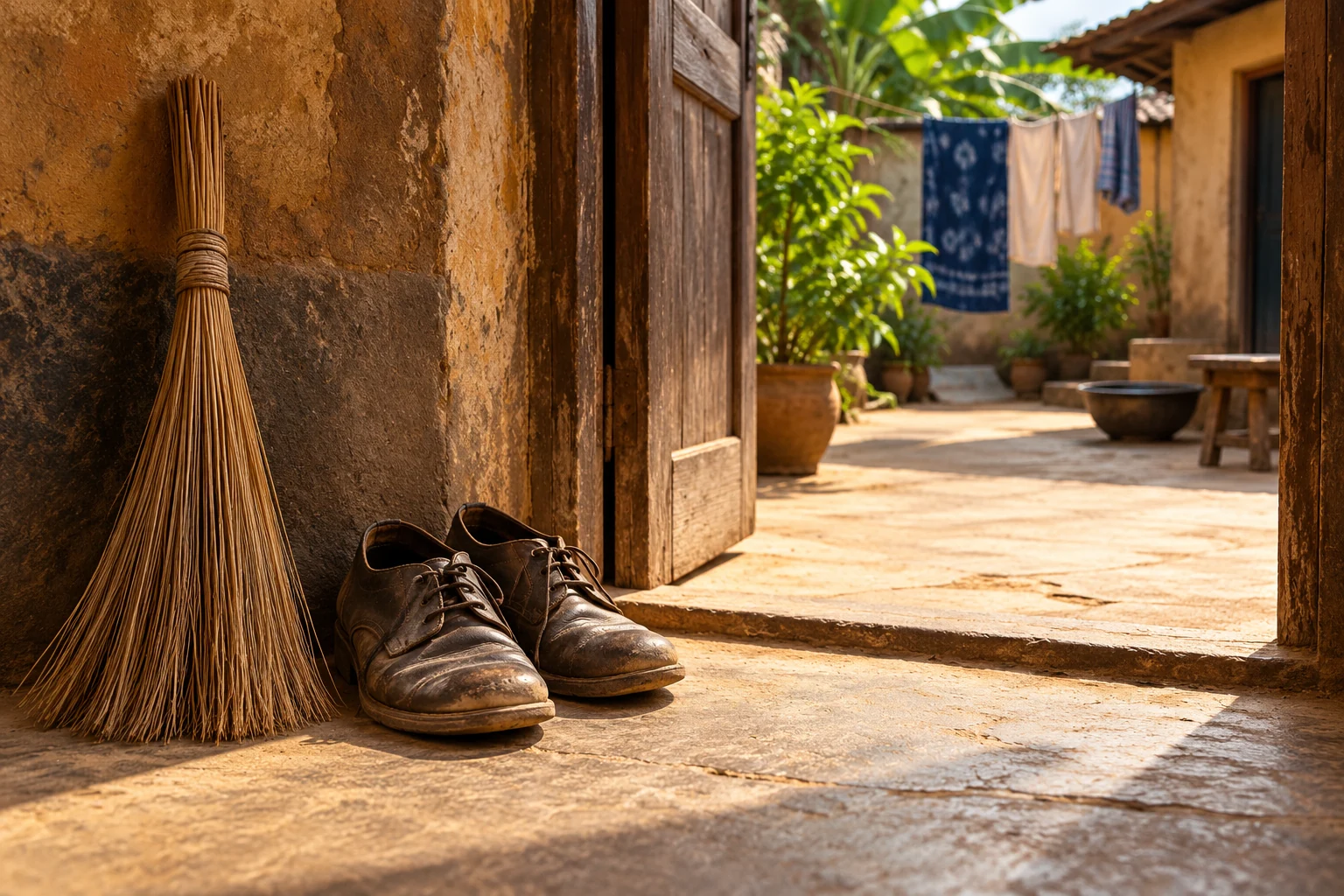
Elegbá wants to attend a dance but lacks money and suitable shoes. He promises Obàtálá daily housework in exchange for a small loan. Exhausted after the celebration, he performs the work unwillingly, and the arrangement continues. When the household deteriorates, Òrúnmìlà describes Elegbá as effectively imprisoned. Obàtálá cancels the debt, gives him another opportunity to attend a celebration, and asks only for occasional contact.
The story distinguishes the initial amount borrowed from the duration and character of its repayment. A small benefit has generated an open-ended obligation that harms the relationship. Release becomes a form of judgment rather than a failure to enforce terms. The source connects this change with recovery from illness, but a responsible reading need not turn that plot detail into a causal health claim about debt, resentment, or household labor.
Narrative setting: Cuban/Lukumí patakín identified in the selected account; no individual narrator is named.
The field outsiders cease to recognize
A farmer living on high ground repeatedly loses crops to hostile visitors who enter and destroy the planting. After seeking Òrúnmìlà’s counsel, he changes the visible presentation around the farm on successive visits. The returning intruders find unfamiliar signs and repeatedly doubt that they have reached the same place. Eventually they abandon the route, and the farmer is able to cultivate without the earlier interruptions.
The method in the plot changes recognition rather than meeting destruction with direct force. Its analytical interest lies in interrupting a repeated pattern: the intruders depend on a stable map of a place and its vulnerability. Later writing can discuss boundaries, changed access, and attention to habits without reproducing the source’s ritual preparations or suggesting that visual symbols provide reliable protection against real violence or theft.
Narrative setting: Cuban/Lukumí patakín identified in the selected account; no individual narrator is named.
A shining head is not necessarily the fitting choice
The Brazilian discussion locates human heads fashioned by Ajalá in a heavenly house associated with Orí and white material. Òrúnmìlà, as witness to births and deaths, directs a prospective life toward that place and counsels a decisive choice before the movement toward earth. Some recipients remain uncertain and ask Ajalá for advice. He points them toward a head whose brightness, size, and rounded appearance seem ideal, but the account warns that such outward perfection can conceal fragility on the journey. The passage does not narrate a named individual’s earthly biography or provide a universal method for discovering another person’s chosen head.
The account places destiny before ordinary public appearance, while also refusing to make an impressive surface a reliable sign of fitness. Orí is an actual sacred head within the described cosmology, not merely a contemporary term for confidence or temperament. Òrúnmìlà’s witnessing role and guidance establish a relationship between knowledge, choice, and coming into earthly life. Ajalá’s misleading recommendation complicates that order without eliminating it: uncertainty makes the recipient vulnerable to an answer that favors appearance. The source’s consequences should remain within the myth rather than become an explanation of anyone’s disability, illness, or difficult life.
A contemporary interpretation may ask how decisions are distorted by visible perfection, but should not replace pre-earthly choice with consumer psychology. The unresolved question concerns freedom inside a prepared field of possible heads. The passage offers counsel and consequence, yet does not explain every relation between chosen destiny, later conduct, support from others, and the conditions a person encounters after birth.
Narrative witness and setting: Brazilian Candomblé discussion in the section attributed to Mãe Stella; the specific Ajalá account is explicitly credited there to Gracinha Rodrigué.
Òṣàlá’s unrecognized journey becomes remembered water
Òṣàlá undertakes a journey despite divinatory warnings and accepts counsel concerning how to travel. Encounters with Èṣù soil his clothes, and later he is mistaken for a thief while caring for a royal horse. Palace servants injure and imprison him without recognizing him. The kingdom declines until Ṣàngó consults, discovers the injustice, and finds his father. Washing, acknowledgment, and an enduring companion help mark the return. The excerpt connects the event with a Brazilian remembrance through the Waters of Òṣàlá. It also retains disagreement about responsibility between the injured figure’s self-attribution and others’ demand that injustice be answered.
The journey joins sacred accountability and public injustice without allowing either to erase the other. Òṣàlá’s refusal of counsel matters within the cosmology, but the servants’ treatment of an unrecognized elder is still named as wrong, and Ṣàngó’s royal duty requires acknowledgment. The later water remembrance is therefore not simply a hygiene metaphor. Within the Brazilian account, it carries respect, shame, restoration, and the memory of suffering into religious life. The figure rendered Aira receives an enduring role of accompaniment, giving repair a continuing relation rather than a single apology.
A contemporary reading can ask how institutions remember harm, while preserving the ritual’s spiritual reality and its local form. The source’s punitive bodily imagery must not become a claim that impairment reveals guilt. Its unresolved tension is that an injured person accepts responsibility for ignoring counsel while another participant insists that harm committed by others also requires an answer; the narrative sustains both positions.
Narrative witness and setting: Brazilian Candomblé retelling of Òṣàlá’s journey to Ọ̀yọ́, with explicit citations to a witness written as Benistes in the supplied excerpt.
What was born in this Odù
“Born” can name an explicit traditional origin association or what emerges through a story: a capacity, relationship, practice or order of life. Interpretations drawn from a narrative are labelled below, so their basis remains clear.
Wisdom
Selected traditional source association.
The beginning list names wisdom as an association of this sign. The selected stories give the category concrete scope through interpretation, proportionate obligation, and pattern interruption; it is not a claim that a person linked to the sign is inherently wiser than others.
Seeds germinating near the parent plant
Selected traditional source association.
The source places nearby fallen fruit and seed germination among the sign’s beginnings. It can support continuity and renewal as symbolic themes while remaining a religious catalog association rather than an explanation of botanical history.
Museums and antiquarians
Selected traditional source association.
The origin list includes the keeping and examination of old objects. This allows a restrained connection with memory and preservation, without inventing an ancient museum institution or assigning all forms of collecting to one Odù.
Correlations to life dimensions
These questions bring the selected stories into contemporary life. They are interpretive invitations for study.
Work and resources
Elegbá’s labor obligation exceeds the scale of the immediate loan, while the farmer’s losses arise from repeated outside access. Both stories ask whether the actual terms of an arrangement preserve the conditions needed for continued work.
Reflect: What obligation is consuming the capacity it was meant to support?
Relationships and family
Obàtálá replaces compulsory service with occasional mutual attention. The change suggests that a relationship may survive more honestly when a debt is released, although the narrative does not require every difficult promise to be cancelled.
Reflect: Would releasing an obligation make a relationship more reciprocal?
Character and inner life
Wisdom appears as the capacity to revise an established interpretation. The lender must see captivity where he previously saw repayment; the farmer must see a predictable route where he previously saw only recurring hostility around the fields.
Reflect: What different description would reveal a possible change?
Community and responsibility
Debt and access both become ethical questions when they prevent another household from sustaining itself. Communities can evaluate obligations and boundaries by their effects on continued participation, rather than by the mere existence of a prior claim.
Reflect: Which accepted rule needs review because of its continuing effects?
A deeper reading of the sacred relationships
Orí and guidance before earthly appearance
The Ajalá account makes a prospective life’s sacred head a matter of heavenly choice under Òrúnmìlà’s guidance. That cosmology should remain distinct from the earlier Cuban stories, in which counsel changes an established household or farm. The comparison shows several scales of religious address: before birth, before a journey, and amid an existing difficulty. None makes a practitioner the owner of another being’s destiny. Contemporary questions about judgment and surface attraction can arise from the head-selection scene, but Orí is not exhausted by those analogies. The witness affirms a real sacred orientation whose relation to appearance is complex, and it leaves many consequences of earthly life outside the narrated choice.
Remembrance can be an ongoing religious relation
The journey excerpt links the Waters of Òṣàlá to a narrated injustice and a return that requires washing, recognition, and accompaniment. That remembrance differs from simply retaining an old object or recounting a moral lesson. It gives the event a continuing place in the life of a religious community. The earlier debt release also changes an ongoing relation, while the farmer’s altered surroundings interrupt repeated intrusion. These are different kinds of continuation: liturgical remembrance, released obligation, and transformed access. A contemporary interpretation can ask what a community does after acknowledging harm, but should not treat the water remembrance as merely a symbolic version of institutional reform or provide its ritual procedure.
Responsibility can have more than one bearer
Òṣàlá acknowledges his own failure to follow counsel, while Aira insists that the injustice committed against him also matters in a kingdom associated with justice. This prevents a simple choice between total self-blame and total innocence as the only available interpretations. The earlier lender releases a constraining debt after counsel, and the Ajalá account complicates advice by presenting a misleading recommendation. Together the stories ask who acts, who advises, who harms, and who repairs. The comparison is analytical, not a universal doctrine of blame. It is especially important not to make later suffering proof of a spiritual failure or to excuse another person’s violence because the injured figure had ignored advice.
Questions that deepen the study
Does the Ajalá account explain why a particular person suffers?
It narrates a sacred choice and warns that an impressive head may be fragile, but it does not identify any living reader’s head or provide a method for inferring destiny from appearance, disability, or hardship. Its cosmology deserves to be understood on its own terms without being turned into an accusation. A contemporary interpretation may question choices made for visible perfection, yet that does not authorize treating a difficult life as evidence of a wrong heavenly selection. The source leaves later conduct, care, and circumstances largely outside the scene. Those limits should remain visible alongside the reality of Orí within the account.
Why does Òṣàlá’s acknowledgment not excuse the servants’ violence?
The excerpt keeps more than one responsibility active. Òṣàlá names his disregard of counsel, but Ṣàngó recognizes an unjust imprisonment and Aira argues that injustice cannot be ignored in the kingdom. The later remembrance also treats the suffering as something the community must carry with respect. A contemporary reading can therefore distinguish accepting one’s own decision from granting others permission to harm. That distinction is supported by the narrative’s disagreement rather than imposed by erasing its theology. The source does not resolve the tension into a modern legal judgment, and its punitive bodily consequences remain religious narration rather than a standard for explaining actual impairment.
What makes the Brazilian witness more than a Portuguese translation?
The excerpt explicitly addresses Candomblé practitioners and connects the journey with a continuing Brazilian religious remembrance. Its named citations also show a situated discussion rather than an anonymous language change. That setting should be distinguished from Portuguese renderings of African authors elsewhere in the compilation. The specific Ajalá story is credited to Gracinha Rodrigué, while the journey cites a name written as Benistes; the surrounding section is attributed to Mãe Stella. These layers should be preserved for bibliographic verification instead of assigning every sentence to one author. The witness’s religious life and cited transmission both contribute to its identifiable Brazilian context.
What the four narratives reveal together
The additional Brazilian witnesses enlarge Òfún Meji through heavenly orientation and communal remembrance, beyond the earlier Cuban household debt and protected farm. Ajalá’s heads place appearance within the difficult relation between choice and sacred destiny; Òṣàlá’s journey makes counsel, injustice, recognition, and ongoing accompaniment part of a remembered religious event. These do not repeat the lender’s released obligation or the farmer’s changed access, though all four concern relations that cannot be sustained by control alone.
Their differences should remain visible. Orí, divination, Èṣù’s activity, and the Waters of Òṣàlá are realities within their respective accounts, not merely illustrations of modern psychology or politics. Contemporary reflection can examine appearance, responsibility, and repair while identifying its applications honestly. The strongest synthesis preserves layered authorship, the disagreement over blame, and the distinction between pre-earthly choice and the many unreported conditions of life afterward.
Living with this Odù
A continuing life or initiatory relationship
For someone whose received life or initiatory Odù is Òfún Méjì, the witnesses make revision of established arrangements a sustained responsibility. Elegbá’s small loan becomes indefinite labor; release preserves a relation that enforcement is damaging. The farmer’s changed surroundings interrupt intrusion rather than simply increasing force within a repeated pattern. Over time, a person can ask whether an obligation still serves its original purpose and whether a familiar description conceals captivity or predictable access.
The Brazilian witnesses add other scales of judgment without becoming the same Cuban accounts. Gracinha Rodrigué’s Ajalá narrative places Orí within pre-earthly choice and complicates outward perfection. Òṣàlá’s journey, in the witness rendered Benistes, joins his own accountability with the injustice others commit and the enduring religious remembrance afterward. Neither beauty nor self-blame supplies a complete explanation of a life. Changing circumstances may require release, protection, a more fitting choice or continuing acknowledgment of harm. Sacred heads, counsel, Èṣù’s actions and the Waters of Òṣàlá retain their religious reality. The sign predicts no illness or defective destiny. Its continuing task is to distinguish responsibility among participants without making suffering proof of guilt.
A particular consultation and its question
In consultation, Òfún Méjì helps separate proportionate obligation from an arrangement that has outgrown its purpose. A practitioner might examine the duration and character of a debt, not only whether an agreement once existed. The farmer’s narrative asks what repeated access makes a pattern possible, without suggesting symbols offer reliable protection against actual violence. These questions need the particular circumstances presented.
The Ajalá account can open a distinct inquiry about impressive appearance and fitness, while Orí remains a sacred head rather than a confidence measure. It cannot explain a client’s disability or difficulty through a presumed pre-earthly mistake. Òṣàlá’s journey adds the possibility of more than one bearer of responsibility: ignoring counsel does not authorize servants’ violence, and acknowledgment may require continuing accompaniment. The Brazilian remembrance should not be converted into an ordinary reform procedure or transferred wholesale to the Cuban stories. A particular result is not permanent identity or a verdict that every old obligation must end. Reflection can clarify what should be released, what must be remembered and whose action requires repair, while the consultation’s actual sacred interpretation determines how these possibilities relate to the question.
Constructive and adverse possibilities
Constructive possibilities include release that restores relationship, altered conditions that interrupt repeated harm and judgment capable of seeing beyond a polished surface. In the journey witness, recognition and accompaniment give injustice an enduring place in religious remembrance rather than erasing it with one apology. Sacred agency remains central in each distinct setting.
Adverse unfolding may involve a small benefit becoming lifelong enclosure, familiarity making intrusion predictable or an attractive appearance being mistaken for a fitting choice. Another danger is using the injured figure’s self-accountability to excuse what others did. Debt release is not a medical cause of recovery for readers, and the Ajalá narrative cannot diagnose anyone’s destiny. These tensions can inform favorable and adverse possibilities without determining the state of an actual reading. Wisdom here includes revising the relation accurately rather than insisting that its original form must continue forever.
An illustrative situation in everyday life
Hypothetically, a relative pays a modest training fee for a younger adult, then expects years of unpaid work without an agreed endpoint. The recipient feels gratitude and increasing confinement, while the helper regards every objection as betrayal. Elegbá’s loan structure distinguishes the original benefit from the expanding terms of repayment. A constructive change might define completion or release the debt while preserving chosen contact. Òṣàlá’s journey adds that the recipient can acknowledge earlier promises without accepting mistreatment as deserved. This hypothetical example concerns proportion and multiple responsibilities. It is not legal advice, a clinical claim about resentment or a suggestion that the source’s religious release can be reproduced to produce a particular health or financial outcome.
Sources and reading context
The first two narrative witnesses
The master source also includes extensive Brazilian material attributed to Mãe Stella and other author sections. These cards select Cuban/Lukumí passages only and do not transfer those named attributions to them. Medical claims, offensive bodily categories, and ritual instructions are excluded.
Narrative motifs are summarized independently. The life-dimension reflections are contemporary interpretation. How these reference studies are built explains the wider source approach and the distinction between a reference article and personal divination.
Additional named witnesses
-
Gracinha Rodrigué, as explicitly cited. The Brazilian discussion credits Gracinha Rodrigué for Ajalá and the heavenly heads. The attached bibliography explicitly lists RODRIGUÉ, Maria das Graças de Santana, Ori Àpéré ó – O Ritual das Águas de Oxalá, Summus, São Paulo, 2001; this is a source bibliographic claim, not independent edition verification.
-
Benistes, spelling in the source. The journey retelling uses the spelling BENISTES. The attached bibliography explicitly lists BENISTE, José, As Águas de Oxalá, 2ª ed., Bertrand Brasil, Rio de Janeiro, 2003, as well as his Dicionário Yoruba-Português, 2011; the entries are source claims requiring external edition verification.
-
Mãe Stella / Maria Stella de Azevedo Santos, as the section is attributed. The surrounding material is attributed to her and situated through Candomblé. The full attachment titles itself Ofún, credits Tradição Oral to Maria Stella de Azevedo Santos, leaves Tradição Escrita blank, reserves edition rights to Assembleia Legislativa do Estado da Bahia, and states printing in Salvador in September 2013. Embedded named citations remain distinct.
-
Cuban/Lukumí compilation witness. The earlier debt-release and farmer-boundary stories retain their separate Cuban attribution.
The Brazilian excerpt has layered attribution and OCR damage. The full attachment supplies explicit Beniste and Rodrigué bibliographic entries and a September 2013 printing statement; those source claims still require independent edition verification. Tradição Escrita has no named credit. Aira is retained as written without forcing an unsupported figure-key equivalence. Bodily punishments and fragile-head consequences are not used to diagnose suffering or assign guilt.
Bibliographic identification
-
Maria das Graças de Santana Rodrigué. Orí Àpéré Ó: O Ritual das Águas de Oxalá. São Paulo: Selo Negro / Grupo Summus, 2001; ISBN 9788587478139. Library catalogue record. Publisher record matches the work named in the transmitted bibliography. The exact page behind the selected account remains to be matched.
-
José Beniste. As Águas de Oxalá. The source bibliography cites Bertrand Brasil, 2nd edition, 2003. The linked university record describes a different edition: Civilização Brasileira, 2025.. Library catalogue record. University publisher catalogue confirms the author and work. The linked 2025 edition is not presented as the edition consulted for the account above.
-
Maria Stella de Azevedo Santos (Mãe Stella de Oxóssi), with Graziela Domini Peixoto. Ofún. Salvador, 2013; Odu Àdájô — Coleção de Destinos, volume 1. Library catalogue record. The Bahia Legislative Assembly confirms Ofún among its editorial publications. The layered authorship and embedded references of the particular telling remain distinct.
Read the source method and wider scholarly context.
The catalogue links identify published works and their authors. They are separate from proof of an individual episode’s wording or attribution. Contemporary comparisons and the synthesis above are editorial interpretation. The author’s books and Academy companions below provide further study; their sales links are separate from the source references.