
Ọ̀ṣẹ́ Méjì is a principal Odù in Ifá’s 256-part corpus. The selected Cuban stories connect unrecognized competence with the humiliation of competitive pride. An enslaved diviner becomes visible when royal need exposes the limits of social rank; a wandering wrestler discovers that public victory does not settle every obligation. Òṣé Meji therefore invites reflection on who is permitted to know, how expertise becomes credible, and why strength without accountable relationships can create dependence rather than security.
A question to carry through the study: Whose ability have you overlooked because their social position made it easy to dismiss them?

This Academy reads the right column first, then the left. Each row carries a single or double mark.
Where this Odù belongs
Ọ̀ṣẹ́ Méjì is the principal, doubled Odù of the Ọ̀ṣẹ́ family in the Academy’s study order. It sits beside fifteen mixed combinations. A doubled name identifies the sign’s structure; its teachings unfold through particular verses, stories and the circumstances in which they are interpreted.
Key Òrìṣà and sacred relationships
The figures below are selected for their roles in the accounts discussed here. They offer connected reading paths through the tradition.
-
Ọ̀rúnmìlà. In the wrestling narrative, Òrúnmìlà neglects the Òrìṣà while pursuing contests; the story returns him to religious obligations through an encounter that physical strength cannot resolve.
-
Èṣù. Èṣù intervenes beside the wrestler and controls the apparent victor’s subsequent predicament, revealing that the outcome of a contest extends beyond the visible fall.
Key myths and their meanings
Expertise beneath imposed rank
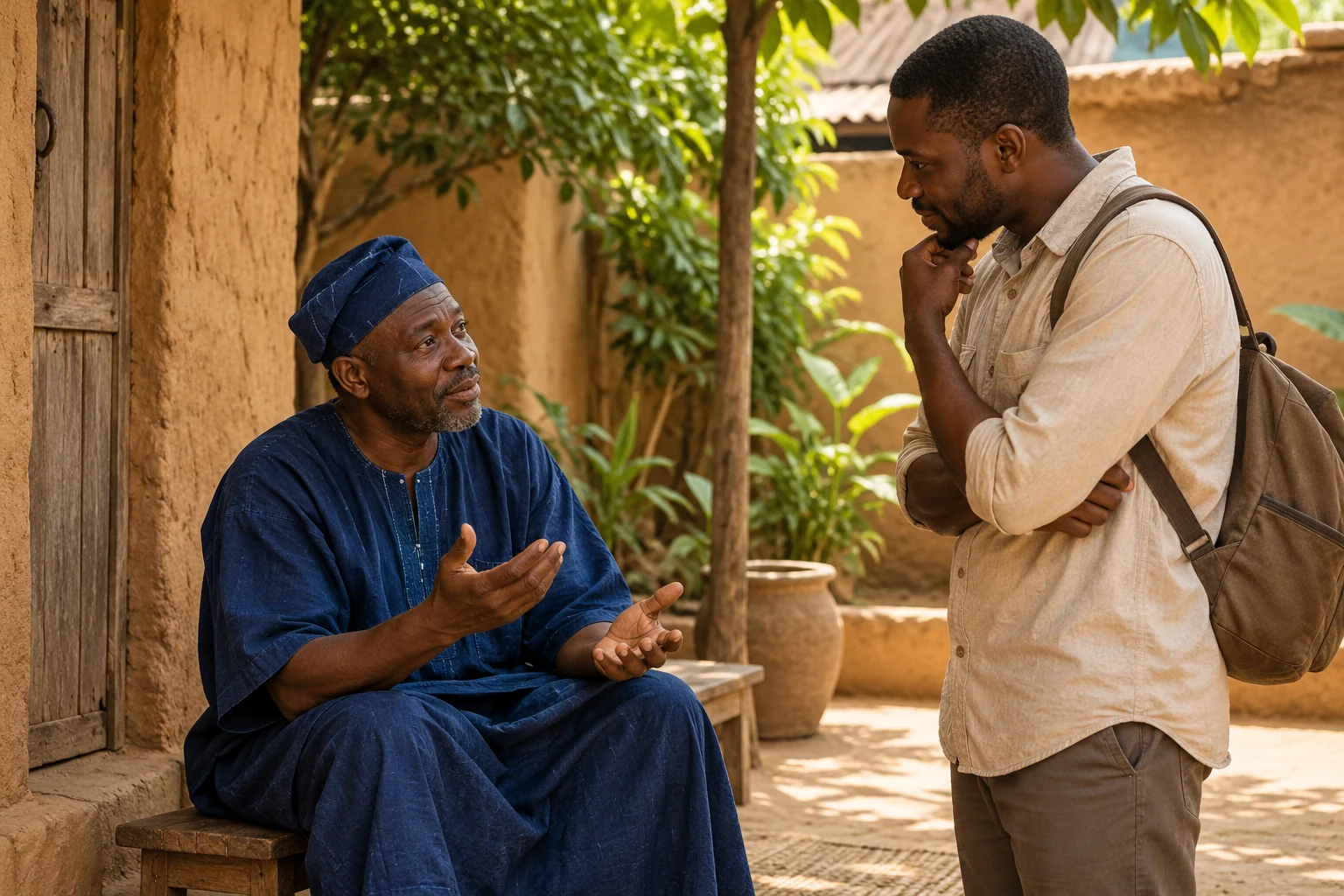
An owner interrupts an enslaved man using the divining chain and initially interprets his activity as a failure to work. The man’s concern involves the ruler’s household. When the ruler verifies the situation and seeks his help, the knowledge previously dismissed in a laboring body receives public recognition. The ending changes his standing through demonstrated religious competence, while leaving the surrounding institution of slavery intact.
The story raises a question about recognition that arrives only when the powerful need something. The diviner’s capacity precedes its public validation: the court does not create his knowledge. We can examine whose work counts as expertise and whose becomes visible only in crisis. It should also resist treating the fortunate ending as a justification of enslavement or as proof that every oppressed person can gain freedom through exceptional service.
Narrative setting: Cuban/Lukumí patakín identified in the selected account; no individual narrator is named.
A victory that requires another kind of help
Òrúnmìlà travels as a wrestler and gives little attention to the Òrìṣà. A stronger opponent appears, and Èṣù advises him to accept being thrown. The opponent wins the visible exchange but cannot recover afterward because Èṣù has created an unseen restraint. He must seek help from the very diviner he defeated. The tale separates sporting dominance from a fuller capacity to act.
The story makes triumph unstable and gives Èṣù a troubling role in exposing that instability. The opponent’s need restores Òrúnmìlà’s significance, but the method involves manipulation rather than a transparent contest. This permits discussion of neglected obligations and the fragility of reputation without presenting sabotage as admirable. A nearby version reverses whether Òrúnmìlà is told to fall, so the variant should remain visible in further study.
Narrative setting: Cuban/Lukumí patakín identified in the selected account; no individual narrator is named.
Money arrives as a dangerous accumulation
A heavenly consultation precedes money’s arrival on earth in the form of cowries. The divinities combine obligations they were told to undertake separately, then confront a large accumulation of wealth. Ògún rejects Òrúnmìlà’s request for further counsel and begins extracting money, but the mass collapses. Other powers meet the same fate. Òrúnmìlà investigates their absence, records what he finds, and approaches the accumulation through another sequence. His gradual removal succeeds. He subsequently returns differing quantities of cowries to the dead figures’ children, which the passage connects with their later divinatory practices.
The episode is unusually interested in process. The divinities’ first collective action does not function as mutual aid because it substitutes one shared undertaking for responsibilities assigned individually; their later imitation of the same failed extraction also fails to become learning. Òrúnmìlà’s difference consists partly in interrupting the sequence and asking what has happened before acting. His success nevertheless leaves an asymmetry: wealth gathers in his house while others receive smaller inheritances. That ending can be examined as a religious explanation of differentiated divinatory authority, rather than accepted as a justification of unequal distribution.
The collapsing money mass makes excess tangible, but it does not establish that wealth itself is corrupt or that financial losses reveal moral failure. The deeper question concerns how an opportunity is organized, whose risk becomes invisible, and whether a successful participant owes something to those harmed by an earlier attempt. Returning cowries gives inheritance and remembrance a place within prosperity.
Narrative witness and setting: Portuguese passage explicitly labeled Cromwell Osamaro in the compilation; the author’s full identity and edition require verification.
A stinging companion shelters the trees
A short verse unit concerns Yèrèpè, translated as nettle, and its close relationship with a forest tree. The plant asks about escaping human captivity and receives counsel within a divinatory encounter. The conclusion describes the difficulty enemies have in approaching either the nettle or the trees to which it clings. Protection consequently extends beyond the initial recipient to its living companions. The text supplies no itinerary, named human antagonist, or explanation of how the relationship began. Its concrete narrative movement runs from exposed dependence through counsel toward a shared boundary around connected plants.
This brief witness changes the meaning of strength introduced by the older wrestling account. The wrestler’s superiority isolates him within repeated contests, whereas the plant’s defensive capacity benefits a companion without requiring that companion to defeat anyone. The relationship also complicates a simple ideal of independence: the nettle clings, and its efficacy is intelligible through contact. A contemporary interpretation may therefore distinguish dependence that diminishes a participant from association that distributes safety. The source’s identification of Yèrèpè as nettle comes through translation, so botanical precision should not be assumed.
Nor should its image establish that the named plant physically protects a house or forest. Its literary force lies in the unexpected extension of a boundary from one being to another. A serious reading can ask who is protected by our capacities and who becomes isolated by them, while leaving unresolved whether an inaccessible boundary can also obstruct beneficial contact and exchange.
Narrative witness and setting: Passage explicitly labeled Ayo Salami, with Yoruba verse and Spanish translation in the supplied compilation.
What was born in this Odù
“Born” can name an explicit traditional origin association or what emerges through a story: a capacity, relationship, practice or order of life. Interpretations drawn from a narrative are labelled below, so their basis remains clear.
Scented preparations
Selected traditional source association.
The origin list connects this sign with perfumes and fragrant ointments. That association can support attention to deliberate care and sensory transformation; it is a local symbolic catalog entry, not a claim about the historical invention of perfumery.
Stringed instruments
Selected traditional source association.
Stringed music appears among the sign’s beginnings. Its significance lies in crafted resonance and coordinated parts, without assigning an undocumented instrument, origin date, or universal musical ownership to the Odù.
Correlations to life dimensions
These questions bring the selected stories into contemporary life. They are interpretive invitations for study.
Work and resources
The enslaved diviner’s skill is initially treated as time stolen from labor. Recognition comes through a ruler’s need, exposing how institutions can mistake imposed status for an accurate measure of knowledge and contribution in the court and its surrounding labor system.
Reflect: Which forms of expertise does your workplace fail to recognize?
Relationships and family
The court’s household creates the occasion for seeking help across a severe status divide. Need may open communication, but a relationship formed through dependency still requires scrutiny about dignity and reciprocal treatment when authority crosses that divide.
Reflect: Does someone receive respect from you only when they are useful?
Character and inner life
The wrestler invests in an identity built on defeating others. The narrative asks what happens when confidence in one talent crowds out other obligations and makes a temporary setback seem like a complete loss of self.
Reflect: What part of your identity becomes fragile when you cannot win?
Community and responsibility
Both stories make public reputation contingent on hidden relations. A community can acknowledge valuable service while still examining coercive structures and manipulative conduct rather than excusing them because an ending appears successful in the king’s court or the wrestler’s circuit.
Reflect: What success in your community deserves a closer ethical examination?
A deeper reading of the sacred relationships
Divination establishes a relationship with living powers
Within the Cromwell-labeled account, money is a heavenly arrival whose preferences and capacity to respond make acquisition a relationship with power, rather than handling an inert commodity. Divination discloses how that relationship should be approached; the difference between separately assigned obligations and a combined substitute is therefore religiously consequential. Òrúnmìlà succeeds through acknowledged dependence on Ifá, not merely superior calculation. The plant verse likewise locates protective transformation after a response to divinatory counsel. These witnesses understand effective action as participation in a disclosed sacred order. Contemporary questions about risk and cooperation can follow from that logic, but should not replace the account’s claim that counsel, offering, and recognition actually alter relations among beings.
Aftermath and the distribution of memory
The money story continues after the spectacular collapse: Òrúnmìlà investigates, separates the cowries associated with different figures, and returns them to the next generation. That continuation matters because disaster is not treated as the disappearance of all obligations. The enslaved diviner similarly receives recognition through others’ needs, but his story says less about what changes for people still enslaved. Juxtaposing the endings raises questions about whose history survives within a successful institution. The returned cowries acknowledge the dead while also explaining differentiated religious practices. A responsible analysis can preserve both aspects without treating the specific quantities as universal ritual rules or as evidence for a historical chronology.
From competitive dominance to protective association
The earlier wrestling episode and the new plant verse offer different scenes of efficacy. Wrestling organizes attention around a visible fall and the reversal of victory; the plants organize it around a relationship that prevents intrusion. Neither model should become a fixed personality assigned to the sign. Their value is comparative: a person may possess a capacity that creates admiration while leaving others less secure, or a less conspicuous capacity that strengthens a shared boundary. The money narrative adds a third possibility, technical and interpretive judgment that changes how a dangerous accumulation is approached. These differences keep strength from collapsing into bodily force, public prestige, or possession of wealth alone.
Questions that deepen the study
Does the money narrative condemn getting rich?
Its most immediate criticism concerns the way the accumulation is approached and the refusal to reconsider a failed method. Òrúnmìlà eventually acquires the wealth, so an interpretation that condemns all prosperity would contradict the ending. The more useful question is what acquisition requires: attention to risk, willingness to investigate, and responsibility toward people absent from the final success. Even that reading leaves an unresolved concentration of wealth in his house. Religious symbolism does not settle modern questions of fair ownership, wages, inheritance, or financial policy. It supplies images with which those questions can be examined rather than a ready-made economic doctrine.
Why compare an enslaved expert with a forest plant?
Both accounts make value visible outside the most obvious hierarchy. The court initially fails to recognize knowledge in someone it treats as laboring property, while the plant verse locates effective protection in a clinging, stinging companion rather than a ruler or victorious fighter. Their situations must remain different: enslavement is a human institution of coercion, not simply another form of biological dependence. The comparison concerns recognition and the effects of association, not equivalence between people and plants. It asks whether the capacity we overlook could help others if dignity and opportunity were not withheld from its bearer.
Can a capacity protect others while still creating limits?
The plant verse implies that the tree benefits from a companion’s difficult boundary. That protection is a relational good within the episode, yet a modern reader can still ask who needs access and who decides what counts as intrusion. The wrestling story likewise shows that an effective intervention may use troubling manipulation, and the money story leaves unequal outcomes after successful acquisition. These tensions prevent efficacy from becoming its own moral proof. A capacity should be assessed by its purpose, its means, and the relationships it changes; the stories do not provide a universal test that removes the need for judgment.
What the four narratives reveal together
The four selected accounts broaden Òṣé Meji beyond a single lesson about victory. The enslaved diviner raises the problem of knowledge denied recognition; the wrestler exposes the instability of visible dominance; the money accumulation makes method and aftermath central; the plant verse imagines protection extending through association. Their differences are productive rather than inconvenient. None requires that every ability produce the same kind of reward, and none authorizes treating a fortunate ending as proof that the surrounding institution is just.
The named witnesses also change scale: the Cromwell-labeled prose develops a long explanation of money and inherited divination, while Salami’s short plant verse leaves much unstated. A later synthesis can let each retain that scale, using the contrasts to ask what strength is for, who is able to recognize it, and how its benefits or burdens travel beyond the person who possesses it.
Living with this Odù
A continuing life or initiatory relationship
For someone whose received life or initiatory Odù is Ọ̀ṣẹ́ Méjì, these witnesses offer a continuing question about how ability enters public recognition. The enslaved diviner knows before the court needs him; his subsequent acknowledgment does not justify the system that confined him. A life shaped through this sign can therefore examine whether respect is being made conditional on exceptional usefulness, both when receiving recognition and when granting it to others. Changed status should enlarge responsibility rather than require gratitude toward coercion.
The wrestler and the dangerous cowrie accumulation introduce another test: a capacity that succeeds in one arena may not suffice in another. Religious obligations and Ifá’s counsel remain active in those plots, so their lesson exceeds better calculation. Over time, a person can learn to interrupt imitation, investigate another participant’s absence and ask what a successful outcome leaves unresolved. Yèrèpè’s companionship adds a quieter model of strength, where protection extends to someone connected with the recipient. The enduring task is to develop capacities that sustain relationships without needing continual victory. Which form of strength is appropriate may change with circumstances; the sign does not predict a single social position or personality.
A particular consultation and its question
In a consultation involving Ọ̀ṣẹ́ Méjì, the actual question determines which contrast deserves attention. A client seeking recognition may need to distinguish genuine lack of evidence from prejudice attached to rank. Another seeking success may be overestimating the reach of a particular talent. The Cuban wrestling variants cannot be combined to decide an unknown person’s next move; Èṣù’s intervention and the differing instruction about falling belong to their actual witnesses.
The money account provides questions about an opportunity’s conditions. Have distinct responsibilities been treated as interchangeable? Has everyone repeated a dangerous approach because someone tried it first? What is owed after success to families affected by earlier loss? Those questions follow a story in which money responds as a sacred power and Òrúnmìlà depends on Ifá, not a modern risk model disguised as divination. The plant witness can also help distinguish an alliance that distributes safety from dependence that confines. No account establishes that a reader is currently threatened, destined to become wealthy or permanently identified by the consultation’s result. Interpretation remains specific to the disclosed situation, with character, community and sacred relation considered together.
Constructive and adverse possibilities
Constructive unfolding can involve knowledge becoming audible across status barriers, a dangerous sequence being interrupted through counsel and a capacity protecting more than its owner. The cowrie aftermath makes remembrance part of prosperity; Yèrèpè’s relation keeps efficacy connected to companionship. These possibilities retain the sources’ religious agency, including Ifá’s guidance and the response of powers encountered.
Adverse unfolding can occur when an institution values the confined person only in crisis, when victory hides neglected obligations or when imitation reproduces another participant’s destruction. Èṣù’s manipulation in the wrestling plot should remain ethically troubling even when it restores Òrúnmìlà’s significance. A favorable ending does not make every means admirable. These are alternative relationships to examine, not a declaration of the state of an actual reading. The question is how recognition, force and aftermath are being organized in the situation disclosed.
An illustrative situation in everyday life
Hypothetically, a maintenance worker notices a dangerous fault that senior staff repeatedly dismiss. When a breakdown occurs, management suddenly seeks the worker’s knowledge and offers public praise. The worker feels both vindicated and angry that respect arrived only through emergency. The enslaved-diviner structure can illuminate recognition withheld by imposed rank, while preserving the much greater coercion of the original setting. A constructive response could include real authority to report future risks and acknowledgment of other overlooked workers. Accepting praise alone might leave the arrangement intact. The cowrie aftermath adds a further question about those already harmed: what repair or remembrance follows success? This example illustrates interpretation; it neither claims a ritual outcome nor suggests exceptional service makes oppression legitimate.
Sources and reading context
The first two narrative witnesses
This study draws on Cuban/Lukumí narratives, including two incompatible details in the wrestling variants. They do not universalize the origin catalog, reproduce ritual instructions, or turn royal household concerns into predictions. The enslavement setting requires explicit historical and ethical care.
Narrative motifs are summarized independently. The life-dimension reflections are contemporary interpretation. How these reference studies are built explains the wider source approach and the distinction between a reference article and personal divination.
Additional named witnesses
-
Cromwell Osamaro, as explicitly labeled. Money’s descent, dangerous accumulation, and the returned cowries are selected from this named Portuguese source block.
-
Ayo Salami. The Yèrèpè and forest-tree verse is selected from this explicitly named Yoruba-and-Spanish source block.
-
Cuban/Lukumí compilation witness. The prior enslaved-diviner and wrestling accounts remain separate comparative witnesses; no named African authorship is transferred to them.
The Cromwell label is reproduced as supplied; a full author name and edition are not established here. Yèrèpè’s translated botanical identity is uncertain. Monetary quantities, religious procedures, bodily claims, and personal predictions are excluded from interpretive conclusions.
Bibliographic identification
-
C. Osamaro Ibie. Ifism: The Complete Work of Orunmila. Lagos; multivolume publication beginning 1986. Library catalogue record. Related bibliographic record for the named narrative witness. Exact volume, edition and page of the transmitted account have not been independently matched.
-
Ayo Salami. Ifá: A Complete Divination. Lagos: NIDD, 2002 catalogue record. Library catalogue record. Bibliographic identification of the named author and work; the edition behind the transmitted account remains to be matched.
Read the source method and wider scholarly context.
The catalogue links identify published works and their authors. They are separate from proof of an individual episode’s wording or attribution. Contemporary comparisons and the synthesis above are editorial interpretation. The author’s books and Academy companions below provide further study; their sales links are separate from the source references.