
Òbàrà Méjì is a principal Odù in Ifá’s 256-part corpus. Obara Meji places material value beside the way people judge its appearance. The rejected gourds connect an overlooked host with unexpected wealth, while the baker episode gives an initially skeptical household a second chance to recognize an opportunity. Hospitality, domestic labor, and the transformation of provisions into lasting livelihood matter more than a promise of miraculous enrichment. The stories also leave different answers about sharing a new fortune.
A question to carry through the study: What apparently modest resource might become useful if your household examined it together?

This Academy reads the right column first, then the left. Each row carries a single or double mark.
Where this Odù belongs
Òbàrà Méjì is the principal, doubled Odù of the Òbàrà family in the Academy’s study order. It sits beside fifteen mixed combinations. A doubled name identifies the sign’s structure; its teachings unfold through particular verses, stories and the circumstances in which they are interpreted.
Key Òrìṣà and sacred relationships
The figures below are selected for their roles in the accounts discussed here. They offer connected reading paths through the tradition.
-
Ọ̀rúnmìlà. His counsel directs Obara toward ancestral responsibility and hospitality rather than the prestigious annual gathering; this places relational obligations before immediate recognition.
-
Òṣun. She discloses the value concealed in the gourds after the household argument, making the wife’s participation central to the discovery.
-
Ṣàngó. In the baker narrative he experiences unemployment and dismisses the gourds, while his wife recognizes their contents and changes the household’s prospects.
Key myths and their meanings
Guests leave the treasure behind
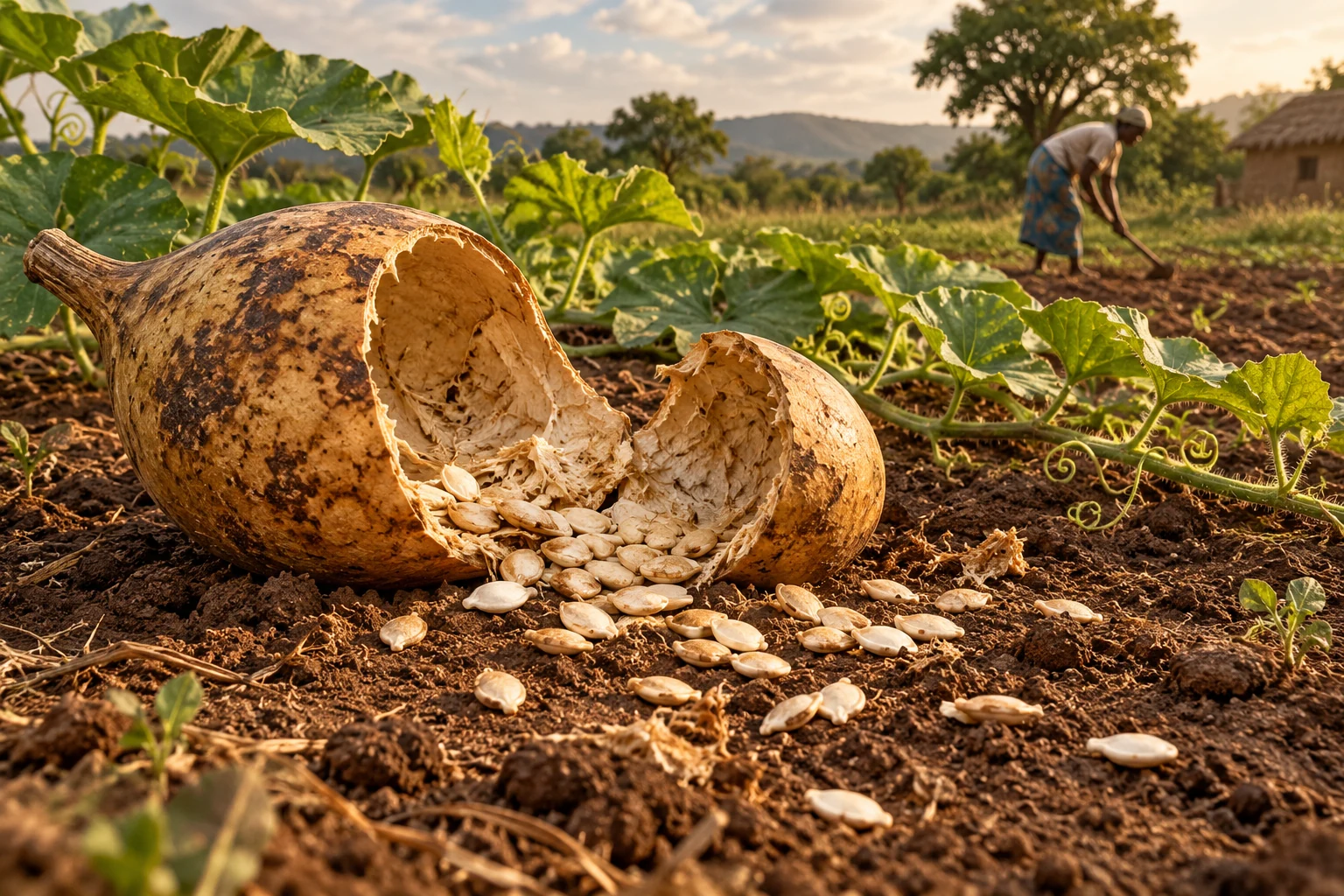
A diviner absent from an annual gathering feeds the colleagues who mock him. They leave him their unwanted gourds, which his household later opens and finds valuable. The contents provide immediate wealth, and the scattered seeds produce a marketable harvest. His changed circumstances surprise the same visitors the following year.
The produce becomes both concealed treasure and a renewable resource. This supports a distinction between receiving a windfall and developing a livelihood. The hospitality occurs before any visible reward, yet the account does not prove that generosity always pays financially. Its sharper concern is how prestige can prevent people from recognizing value or treating an impoverished colleague fairly.
Narrative setting: Cuban/Lukumí patakín in a multilingual source compilation; no individual narrator is established.
The baker’s practical partner
An unemployed baker follows companions to request help and accepts gourds they refuse. He returns home disappointed. His wife, preparing food, discovers the gift’s hidden value while he continues seeking work. The resulting public celebration contrasts with the household’s earlier strain and the friends’ dismissive attitude.
Unlike the host episode, the baker announces that his companions will receive nothing. That difference should remain visible: these are related motifs rather than a single seamless moral. The wife acts through ordinary provisioning, suggesting that the person managing daily scarcity may perceive possibilities overlooked by someone preoccupied with public status or discouraged by unemployment.
Narrative setting: Cuban/Lukumí patakín in a multilingual source compilation; no individual narrator is established.
The productive palm and the admired palm
Two palm sisters consult before entering earthly life. The coconut undertakes the advised sacred commitment and becomes valued for its repeated fruit, while the royal palm is described as admired for beauty but less useful within the narrator’s economy. A frog is then connected with multiplication through a comparable preparation. These examples stand beside Obara Meji’s stated interest in bringing prosperity to impoverished creatures. They form a compact account of different kinds of emergence and recognition. The comparison is not a history of plant domestication, a complete assessment of either palm’s ecological value, or proof that poverty results from an individual’s chosen attitude.
The palms separate public admiration from a continuing capacity to provide. This does not make beauty worthless; it makes visible the particular measure by which this narrator distinguishes two forms of success. The earlier Cuban gourds offer a productive counterpoint: a despised exterior conceals immediate wealth, then seeds support a future harvest. The baker’s wife adds another kind of recognition when ordinary food preparation discovers a resource her husband has dismissed. Together the accounts make value depend on more than visual prestige or a single moment of discovery.
Within the new witness, consultation and sacred commitment belong to why fruitful continuity becomes possible. A contemporary interpretation may ask what a resource contributes over time, while keeping that religious account distinct from an economic theory. The introductory rhetoric about personal effort also needs a limit: the palm contrast cannot explain structural deprivation or make a person’s output the measure of their worth. Its strongest contribution is a specified contrast of provision and admiration.
Narrative witness and setting: Translated excerpt in the multilingual compilation’s expressly attributed Cromwell Osamaro sequence, with Yoruba/Bini-facing material. The compilation’s language is not evidence of a Brazilian tradition.
The heavenly ruler’s illness is a performance
A ruler identified with Death summons diviners to a task whose apparent illness is deliberately staged. Food, drink, and the conditions of the test also mislead, and earlier visitors are confined when they cannot succeed. Obara consults before approaching and receives help from Esu disguised as a seemingly unimportant attendant. That relation reveals the concealed arrangement. After the task is resolved, the ruler still attempts to evade the promised reward, and Obara must recognize and acknowledge his helper again. The narrative gives success several stages: discernment, intervention, a contested payment, and the continuing obligation to share recognition.
The ruler controls the problem, the test, hospitality, and the reward. Ordinary competence cannot make those conditions fair without access to what is being hidden. Esu’s contribution is therefore not simply extra strength; he opens the structure of the encounter and makes another kind of action possible. The reward dispute matters because completed work does not automatically compel a powerful patron to keep a promise. Its misleading containers recall the Cuban gourds, but the mechanisms differ: the visitors discard value, whereas this patron arranges an uneven choice after attempting to withhold compensation.
Obara’s later recognition of Esu prevents the story from becoming a solitary genius narrative. The religious account treats changing appearances and sacred preparation as effective, not as decorative symbols of cleverness. A contemporary analysis may examine fair terms and credit, while declining to turn the staged illness into a clinical lesson or the victory into a promise that death can be overcome by following a procedure.
Narrative witness and setting: Translated excerpt in the multilingual compilation’s expressly attributed Cromwell Osamaro sequence, with Yoruba/Bini-facing material. The compilation’s language is not evidence of a Brazilian tradition.
What was born in this Odù
“Born” can name an explicit traditional origin association or what emerges through a story: a capacity, relationship, practice or order of life. Interpretations drawn from a narrative are labelled below, so their basis remains clear.
Wealth and jewelry
Selected traditional source association.
The origin list links wealth and adornment to this sign. Read alongside the gourds, these are images of value and recognition rather than a forecast that every consultation brings riches.
Teaching and the teaching chain
Selected traditional source association.
The explicit association with teachers makes transmission an additional interpretive strand. It should be distinguished from the stories’ commercial success: knowledge, like a harvest, needs continuity and responsible circulation.
Truth, falsehood, and language
Selected traditional source association.
The source places truthful and deceptive speech together under language. The colleagues’ premature judgments show how social reputation can be built from untested assumptions rather than direct examination.
Correlations to life dimensions
These questions bring the selected stories into contemporary life. They are interpretive invitations for study.
Work and resources
The harvest turns a one-time discovery into trade. Distinguish readily spent assets from resources that can keep supporting a household.
Reflect: Which resource could you cultivate instead of only consume?
Relationships and family
The wife’s questions and practical discovery are integral to the outcome. Household disagreement becomes a site where the meaning of the gift changes.
Reflect: Whose daily labor helps your household recognize what it has?
Character and inner life
The visitors and baker both dismiss the gourds before looking closely. Their reactions make contempt and discouragement separate obstacles to attention.
Reflect: When does disappointment narrow your judgment?
Community and responsibility
The host feeds people who ridicule him. That act can frame dignity and hospitality without turning generosity into a transaction guaranteeing rewards.
Reflect: What welcome can you offer without controlling the return?
A deeper reading of the sacred relationships
Sacred reciprocity and recognition of Esu
Within this witness, divination makes an otherwise concealed field of action intelligible before Obara enters it. His relationship with Esu is established through sacred exchange, renewed through sharing during the ordeal, and acknowledged after the reward. These are stages of a living obligation, not payment for an automatic result. Esu’s changing appearances require discernment: the same assisting presence must be recognized through forms that social rank would make easy to dismiss. The earlier Cuban appearance of Oshun through the household offers a related but distinct religious mediation. A contemporary discussion of credit can follow this sequence, but should not replace the account’s claim that divine persons actively participate in prosperity and its responsibilities.
Several economies of worth remain distinct
The coconut supports continuing provision, the discarded gourds contain a windfall and later a harvest, the baker’s wife turns household work into discovery, and the heavenly ruler resists turning completed work into compensation. These are not interchangeable examples of becoming rich. Some value is renewable, some concealed, some dependent on a person who sees a use, and some withheld through unequal terms. The comparison can therefore ask who produces, who recognizes, and who controls access in each arrangement. That question remains grounded in concrete episodes rather than a generic prosperity theme. It also leaves room for worth that none of these material inventories can adequately measure, especially when the source’s personal-effort rhetoric becomes too broad.
An exterior is evidence with a history
The royal palm is admired, the gourds are mocked, and the ruler’s illness convinces because it is staged. Appearance has real effects even when it does not provide a complete account. These narratives do not require ignoring what is seen; they require asking how a visible sign was produced and what it is qualified to establish. A fruit, vessel, cloth, or bodily performance acquires meaning within a sequence and relation. Some exteriors disclose a real contribution; others direct judgment away from their contents. The editor’s task is not to declare that appearances always lie, but to explain why a particular observer’s inference succeeds or fails in the exact story.
Questions that deepen the study
Do the four accounts make prosperity proof of good character?
No single equation survives their differences. The generous host receives discarded treasure, the skeptical baker benefits through his wife’s practical action, the coconut is praised for provision, and the powerful heavenly ruler tries to cheat a successful visitor. Wealth is not a reliable certificate of virtue inside the stories themselves. Within the religious witness, sacred relations make outcomes intelligible; that does not mean every prosperous figure is ethically exemplary. Contemporary interpretation may value generosity and useful work while still asking how unequal terms shape results. It should also resist making deprivation evidence that someone failed to choose the right spiritual attitude.
Why does the reward’s container recur across different versions?
The container organizes access to contents and gives other people an opportunity to judge value before seeing it. In the Cuban accounts, gourds are dismissed and then opened through household need. In the heavenly test, the patron offers misleading alternatives after resisting payment, and the helper’s knowledge changes the choice. These are different uses of a related image, not proof that every container hides treasure. Their comparative value lies in asking whose evaluation governs acceptance or rejection, and what kind of access would make the judgment sound. A reader’s contemporary reflection can begin there without treating the image as a promise of a nearby windfall.
How can the named African witness enrich the Cuban motifs without replacing them?
It adds a different scale of religious action and a more contested patron relationship. The coconut concerns repeated provision, while the heavenly court tests discernment and acknowledgment through Esu’s changing forms. The Cuban stories give the household and Oshun different roles, and their responses to sharing do not all agree. A careful reference study places those differences beside one another instead of claiming a single original story or universally accepted economic theology. The named attribution supplies one traceable witness, not authority over every community. Comparison becomes deeper precisely when a shared fruit or hospitality image does not erase the cast, terms, and unresolved question of each version.
What the four narratives reveal together
The new witness shifts Obara Meji from receiving unexpected wealth toward the conditions under which value becomes useful and compensation becomes fair. The palm contrast emphasizes continuing provision; the heavenly court emphasizes a manipulated encounter and a helper whose contribution must remain recognized afterward. The earlier gourd accounts retain their domestic discoveries and different attitudes toward sharing. Together the four stories make resources relational through cultivation, interpretation, access, and sacred reciprocity.
That is a comparative reading, not a universal doctrine of wealth. It should also keep two limits visible: usefulness cannot measure all human dignity, and material deprivation cannot be explained by a failure to choose prosperity. Divine persons actively shape the witness’s world, while contemporary questions about credit and fair terms remain an additional layer rather than an alternative explanation that empties the stories of their spiritual reality.
Living with this Odù
A continuing life or initiatory relationship
For someone who has received Òbàrà Méjì in a life or initiatory setting, the selected accounts can make recognition an ongoing responsibility rather than a permanent promise of wealth. The Cuban host continues to welcome colleagues who discount him; the baker's household discovers a resource through work its discouraged provider has failed to value. Across changing circumstances, these tensions ask whether public reputation is preventing a person from learning from ordinary provisioning. A fortunate discovery also creates a second task: sustaining what has arrived rather than confusing possession with a lasting livelihood.
The Ibie witness complicates that field through a patron who controls both the apparent problem and the reward. Preparation and Esu's active assistance matter within the sacred account; success is not solitary cleverness. Long-term character therefore includes recognizing help when the helper's appearance changes and remembering obligations after the crisis has ended. Yet these narratives do not agree about sharing: the baker's refusal cannot be silently turned into the host's hospitality. A received sign invites sustained judgment among these different arrangements. It does not establish that generosity will always be repaid or that an unfavorable outcome proves inadequate faith.
A particular consultation and its question
In an actual consultation, Òbàrà Méjì may help distinguish several questions that otherwise look like one concern about prosperity. Has something useful been dismissed because its appearance carries little prestige? Is a household relying on a contribution that the principal earner does not recognize? Or has a powerful party designed the problem and reward so that competent work alone cannot secure fair treatment? The gourd episodes and the heavenly ruler's staged illness illuminate different external arrangements; their similarity of misleading appearances does not make their mechanisms identical.
The practitioner's task is to relate the identified narrative to the question and the reading's circumstances. Òṣun's disclosure through domestic work in the Cuban material should remain distinct from Esu's changing assistance in the Ibie witness. Both preserve divine agency without providing an automatic explanation for the unknown client's finances. The productive palm adds a temporal distinction: immediate admiration and a continuing ability to provide need not coincide. Reflection can ask which measure of value is currently governing a decision. A result obtained for one undertaking does not make the client permanently identical with a successful host, an excluded baker or a tested diviner.
Constructive and adverse possibilities
Constructive unfolding could involve a household examining a modest gift together, turning a discovery into continuing provision and acknowledging the sacred and human relations that made it possible. The host's dignity precedes visible advantage; the productive palm's value develops through repeated nourishment. Within the Ibie account, consultation and Esu's participation also make an otherwise concealed test navigable.
Adverse unfolding could arise through contempt, discouraged refusal to examine a resource, or a patron's continued effort to evade compensation after receiving the work. Another danger appears after success, when gratitude disappears because the beneficiary now feels independent. These are possible relations within the stories, not a determination that a particular reading is in ìrè or òṣogbo. The baker's exclusion of his companions remains a distinct ending, and prosperity does not resolve every question about its distribution.
An illustrative situation in everyday life
In a hypothetical cooperative, a member is embarrassed to accept surplus equipment that a prestigious group has discarded. Her partner examines it and sees a usable resource, but repair will require shared work and an agreement about ownership. The member is tempted to hide the partner's role when the project begins attracting attention. Reading beside the Cuban gourds distinguishes the initial gift from the labor that makes it sustainable. The staged illness motif adds a different caution if a sponsor controls both the testing criteria and the promised reward. The example does not claim a divine cause or forecast profit; it asks how recognition, preparation and completed obligations can remain visible before and after opportunity arrives.
Sources and reading context
The first two narrative witnesses
These are Cuban narratives, including an explicitly Cuban baker variant. Their shared gourd image does not erase differences in protagonists or sharing. Origin associations are local textual claims, not universal beginnings. The notes support literary and ethical study rather than financial prediction.
Narrative motifs are summarized independently. The life-dimension reflections are contemporary interpretation. How these reference studies are built explains the wider source approach and the distinction between a reference article and personal divination.
Additional named witnesses
- Cromwell Osamaro Ibie. The surrounding sequence is expressly attributed to Cromwell Osamaro. These selected episodes are read through the multilingual compilation’s translated renderings; exact edition and original translation chain remain unverified.
The attribution is explicit and the rendering is Portuguese, not thereby Brazilian. Personal-effort claims and the staged healing task are not generalized into economics or medicine. Exact edition, original language wording, and botanical origin are unverified; no ritual procedure or forecast is supplied.
Bibliographic identification
- C. Osamaro Ibie. Ifism: The Complete Work of Orunmila. Lagos; multivolume publication beginning 1986. Library catalogue record. Related bibliographic record for the named narrative witness. Exact volume, edition and page of the transmitted account have not been independently matched.
Read the source method and wider scholarly context.
The catalogue links identify published works and their authors. They are separate from proof of an individual episode’s wording or attribution. Contemporary comparisons and the synthesis above are editorial interpretation. The author’s books and Academy companions below provide further study; their sales links are separate from the source references.