
Òsá Méjì is a principal Odù in Ifá’s 256-part corpus. The cotton and snake-charmer narratives make envy a force that attacks productive service through indirect means. Cotton is resented for clothing Obatalá; an Awó is targeted because his public generosity wins affection. Neither plot remains private: birds recruit environmental powers, and poisoned gifts reach the plotter’s own children. The selected origin list adds exchange, greetings, and possession, suggesting a social field where contact can sustain a community while also exposing it to manipulation.
A question to carry through the study: Where does resentment of another person’s trusted role threaten the people around the rivalry?

This Academy reads the right column first, then the left. Each row carries a single or double mark.
Where this Odù belongs
Òsá Méjì is the principal, doubled Odù of the Òsá family in the Academy’s study order. It sits beside fifteen mixed combinations. A doubled name identifies the sign’s structure; its teachings unfold through particular verses, stories and the circumstances in which they are interpreted.
Key Òrìṣà and sacred relationships
The figures below are selected for their roles in the accounts discussed here. They offer connected reading paths through the tradition.
-
Obàtálá. Obatalá’s relation to cotton is the reason for the birds’ jealousy; when he learns what has happened, he confirms the plant’s protection rather than accepting the accusations.
-
Ọ̀rúnmìlà. Orunmila identifies the coalition against cotton and advises the action that brings the hidden dispute before Obatalá; an Awó of his tradition is also the target of sibling envy.
-
Èṣù. Eleguá identifies the offering encountered by Obatalá, helping reveal its context; his brief intervention links an unexpected obstruction with the concealed conflict behind it.
Key myths and their meanings
Cotton survives a recruited coalition
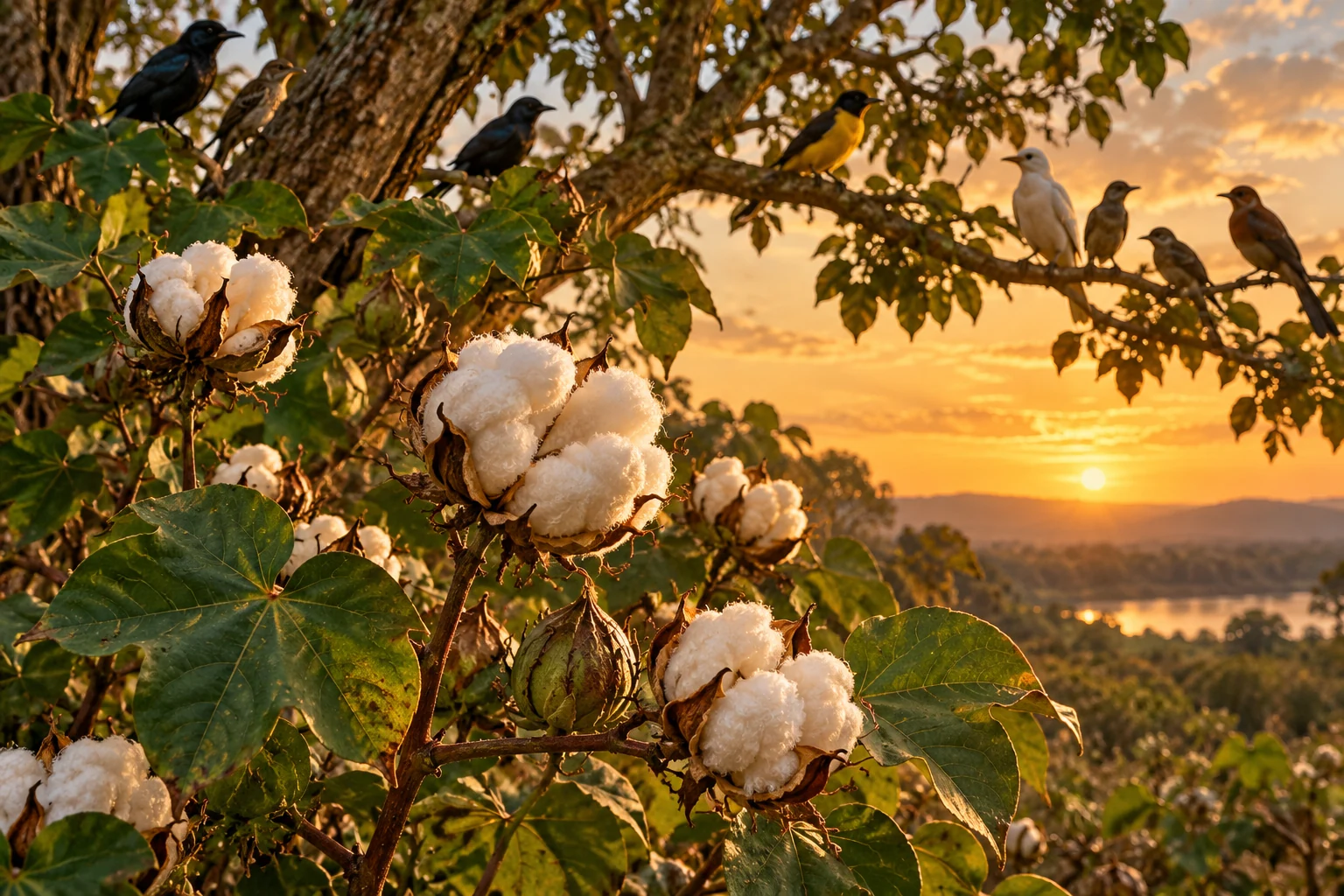
Cotton’s service as Obatalá’s white garment provokes birds who want its privileged place. They solicit the moon, sun, wind, and destructive creatures against the plant, claiming it has become arrogant. Cotton seeks Orunmila’s counsel, and the resulting encounter lets Obatalá hear its case. The story ends with protection against the birds, turning an attack on a useful relationship into confirmation of that relationship.
The birds do not merely dislike cotton: they persuade powerful outsiders to act on an accusation before hearing the accused. This makes coalition-building morally ambivalent. Cotton’s defense depends on making the conflict visible to someone with authority to interrupt it. Its violent conclusion belongs to the narrative’s sacred register and should not be offered as a practical model for dealing with critics or rivals.
Narrative setting: Cuban/Lukumí narrative in the accounts considered here; no individual author established for this passage.
A poisoned gift returns to its maker
Two brothers follow different occupations. One, an Awó trusted by Olofin, is loved by children because he shares food on his daily journey. The other envies him and conceals venomous snakes in a food gift. When the Awó later distributes what he carries, the plotter’s own children are struck. Olofin investigates the accusation against the Awó, and the origin of the gift exposes the brother’s responsibility.
The narrative makes ordinary generosity the route by which concealed malice spreads beyond an intended target. The children’s deaths are not deserved punishment; they display the uncontrolled reach of a hostile act. The Awó’s refusal to demand further beating also interrupts a second cycle of violence. An ethical reading should retain both accountability for the plot and grief for people who did not choose it.
Narrative setting: Cuban/Lukumí narrative in the accounts considered here; no individual author established for this passage.
The mothers receive power after their complaints are heard
The maternal figure arrives in the world alongside male powers associated with warfare and creation, then asks what effective capacity belongs to her. A second complaint concerns men’s mistreatment and dismissal of women. The response grants a world-sustaining power associated with a bird held in a covered calabash, accompanied by an expectation of restraint. The prose framing then gives distinct versions of the effort to temper destructive excess, assigning intervention to Obatalá in one and Orunmila in another. The surrounding performance turns toward a negotiated relationship between the mothers and named people who identify themselves as children of the sign.
This addition prevents feminine power from entering the discussion only as an unexplained threat. The initial complaint places its acquisition within a relationship already marked by unequal acknowledgment. At the same time, the narrator’s later language about controlling excess reflects a perspective that needs to remain visible rather than becoming the final definition of the mothers. The covered calabash joins potency with containment; it does not make that potency unreal. Within the religious account, agreement with powerful beings establishes a livable relation rather than simply expressing a psychological state.
The two tempering versions also resist a single genealogy of protection. Compared with the earlier cotton story, where birds form a hostile coalition, the maternal-bird imagery requires distinction: an editor should not infer that all birds or all feminine sacred powers are equivalent adversaries. The shared concern is how power becomes answerable to relationship, but the speakers, grievances, and proposed settlements differ. Contemporary questions about gendered authority should be identified as interpretation without erasing the account’s sacred participants.
Narrative witness and setting: Yoruba account presented in the Judith Gleason division, beside her discussion of a performance by Awotunde; mediated through Portuguese translation.
Funeral help sets the tree and river against each other
A hunter cannot afford the rites for his father and seeks game across a dark river. A speaking tree explains how he can cross and later claims a portion of the successful hunt. The hunter supplies it and completes the funeral. Another bereaved worker, a woodcutter, is then directed by the river to fell that same tree and finances his mother’s funeral from the sale. The account explains the river’s hostility: the hunter’s killing had disrupted the animals’ earlier tribute to the water, and the animals blamed the river for the slaughter. Assistance to one household thus reorganizes several other beings’ obligations.
The story does not offer a frictionless universe in which every generous exchange benefits all participants. The hunter honors the tree and fulfills a filial duty, yet his success damages the animals’ relation to the river. The woodcutter likewise completes a funeral through an action that is another being’s retaliation. This network makes an important addition to the earlier snake-charmer story, where a hostile gift unexpectedly harms the giver’s children: consequences travel through relationships that the immediate actor does not fully see. Here there is no single hidden villain whose exposure restores the whole.
The tree’s help and appetite, the river’s loss, the animals’ grievance, and both households’ grief remain active. Within the Fon religious narrative, speech and exchange are real capacities of places and beings, not disposable allegories for human economics. Contemporary ecological interpretation can examine uncounted costs, but should preserve that ontological difference. Funeral obligation is also a positive force in the account, even as the means of meeting it produce a conflict that the final celebration cannot resolve.
Narrative witness and setting: Fon Sa-Méji narrative in the explicitly headed Bernard Maupoil division; Portuguese rendering with its own local beings and exchange relations.
What was born in this Odù
“Born” can name an explicit traditional origin association or what emerges through a story: a capacity, relationship, practice or order of life. Interpretations drawn from a narrative are labelled below, so their basis remains clear.
Exchange when money fails
Selected traditional source association.
The origin list associates this sign with exchanging goods after money has run out. It presents a social response to scarcity rather than a verifiable claim about the historical invention of barter.
Human greetings
Selected traditional source association.
Greetings are explicitly included among the origins. In these stories, public relationships and recognition matter; the association supports attention to contact and regard without assigning one universal greeting practice to all lineages.
Òrìṣà possession
Selected traditional source association.
The source associates the sign with a deity’s presence in a person and a period of initiation. These are Cuban religious classifications, not evidence that every tradition gives this sign the same ceremonial authority.
Correlations to life dimensions
These questions bring the selected stories into contemporary life. They are interpretive invitations for study.
Work and resources
The Awó’s trusted service and cotton’s useful work both attract resentment. Their value lies in what they provide, while the attacks attempt to replace evidence of service with accusations about privilege. Cotton’s relationship with Obatalá is a source of useful service.
Reflect: How can the value of this work remain visible during a rivalry?
Relationships and family
The sibling plot harms the aggressor’s own children. Family closeness does not contain the effects of concealed hostility; shared food and routine trust can carry a dispute to people outside the immediate rivalry. The poisoned gift reaches people outside the intended rivalry.
Reflect: Who else could be affected by the way this conflict is pursued?
Character and inner life
Envy here turns another’s recognition into an intolerable personal loss. The stories permit examining that comparison before it becomes a coalition, a concealed act, or an effort to destroy a useful relationship. The birds recruit several powers before cotton’s account is heard.
Reflect: What need of my own is being displaced into resentment?
Community and responsibility
Olofin’s inquiry matters because an accusation initially identifies the wrong perpetrator. The source supports investigation of the chain of action and restraint in punishment, rather than judging solely by the most visible outcome. The accusation omits the earlier preparation of the food gift.
Reflect: What evidence connects the harmful act to its actual source?
A deeper reading of the sacred relationships
Sacred agreement rather than the elimination of power
The Gleason material makes life with the mothers depend on negotiated recognition, restraint, and an acknowledged relationship to the sign’s children. The Fon tale likewise treats the tree and river as beings who can speak, grant access, receive portions, and experience a broken relation. Their powers do not disappear when a person offers a modern moral interpretation. These accounts therefore deepen the earlier divine interventions by showing sacred exchange as an ongoing arrangement rather than a one-time purchase of safety. The two traditions must remain distinct: maternal birds and calabashes are not automatically the same beings as a Fon river and speaking tree. The comparison concerns forms of relationship, not an invented common pantheon or one universal ritual mechanism.
Whose successful ceremony is whose ecological loss
The funeral account allows both human households to be congratulated while the relationship between tree, river, and animals deteriorates. That coexistence is more exact than a general warning about unintended consequences. Each success has a recognizable beneficiary and a material source: game finances one funeral, timber finances another, and the animals’ refusal removes the river’s expected return. The old cotton narrative similarly links one being’s valued service to another group’s resentment, but the Fon story supplies an actual redistribution of resources beyond resentment alone. A contemporary analysis can map the circle of affected beings without presuming that celebration certifies the entire process as just. The missing perspective is not simply another human witness; it includes relationships the story understands as alive.
Framing the feared figure before judging its response
The maternal account begins with a complaint about inadequate standing and mistreatment before describing dangerous capacity. The cotton account, by contrast, identifies birds as jealous instigators from the outset. The snake-charmer story makes the source of hostility a sibling’s envy, while the Fon river responds to the loss of an existing exchange. These are different narrative allocations of motive. An editor who groups all threatening beings under one category of malice would erase those distinctions. The useful lens is how a story gives a grievance a history, whose voice reports that history, and whether the resulting response remains proportionate. It permits analysis of fear without converting a sacred power into either an innocent victim or a simple embodiment of evil.
Questions that deepen the study
Can the mothers be understood only as hostile powers?
The selected Gleason account does not support that reduction. Their power is granted in response to an explicitly narrated grievance and described as sustaining the world, even while the prose also emphasizes dangerous excess. The relation negotiated with the sign’s children further distinguishes recognition from an attempt to annihilate the mothers. An interpretation should keep both capacities in view rather than removing the disturbing side to make the figure comforting or removing the sustaining side to make it monstrous. The framing is still one mediated witness, with its own gendered language and variant interventions. It cannot establish what every Yoruba community means by maternal sacred power.
Why does the speaking tree’s helpfulness not settle the funeral tale?
Because the tree’s assistance changes a wider arrangement that the hunter does not initially know. The animals had an existing obligation to the river; after the hunt they interpret the river as having admitted danger and stop supplying their return. The river then helps the woodcutter destroy the tree. The hunter can sincerely fulfill his promise and filial duty without understanding those consequences. The account therefore provides no single human action that settles every relationship. A contemporary reader can use this to distinguish local gratitude from a complete accounting of effects, while acknowledging that the story treats the affected nonhuman participants as speaking agents rather than merely resources.
What do these witnesses add that the earlier envy stories could not show?
They give conflict causes beyond resentment of another’s recognized position. The mothers ask for a capacity and protest mistreatment; the river loses an established exchange after a successful hunt; the animals object to killing rather than simply wanting the hunter’s place. The earlier cotton and sibling narratives remain useful for describing recruited hostility and concealed gifts, but they do not exhaust what a threatening response may mean. These additions support asking for the history of a grievance before assigning one moral identity to its bearer. Their religious specificity matters: the comparison should not treat a Yoruba performance and a Fon tale as interchangeable evidence for a single settled doctrine.
What the four narratives reveal together
The four selected narratives expand Òsá Méjì through distinct kinds of relationship rather than one generalized category of danger. Cotton’s service provokes a recruited coalition; the brother’s poisoned gift reveals a malice whose reach he cannot control; the maternal account grounds power in grievance and negotiated coexistence; the Fon funeral tale shows reciprocal help generating losses elsewhere in a living landscape. These additions make both ontology and perspective central. The mothers, river, and tree cannot be reduced to modern personality traits, while their reported actions do not become moral commands merely because they are sacred.
Yoruba and Fon witnesses contribute different names, speakers, exchanges, and unresolved outcomes. The resulting reference can explain religious agency and offer contemporary reflection together, provided it marks their boundary. A reader should encounter a rich archive of particular negotiations, not a synthetic universal account in which every bird, threat, gift, and act of remembrance means the same thing.
Living with this Odù
A continuing life or initiatory relationship
For someone who has received Òsá Méjì as a life or initiatory Odù, these witnesses invite sustained attention to how recognition reorganizes a surrounding network. Cotton's valued service attracts an accusation carried by recruited powers; the generous Awó becomes vulnerable through the very route by which he feeds children. Long term responsibility therefore includes making the source and effects of a conflict visible without assuming that every critic is envious. The maternal account supplies that correction: a feared power has a narrated grievance and a claim to effective standing.
Its religious negotiation cannot be replaced by a flattering story of one's personal innocence. The Fon funeral witness widens the configuration again. A household can fulfill an important ancestral duty while its means damage another living relationship. Carrying this sign may consequently involve learning to distinguish gratitude from a complete account of consequences, and protection from retaliation. None of this predicts a uniform life of persecution. It offers questions that can change with circumstance: whose useful place is threatened, whose complaint has not been heard, and who bears costs outside the immediate dispute? The speaking tree, river, mothers and divine mediators retain agency beyond the person's inner interpretation.
A particular consultation and its question
A consultation involving this sign needs the actual question before its several kinds of conflict can be differentiated. Cotton's case directs attention to whether a coalition has accepted an allegation before hearing the accused. The poisoned gift asks a different question: has the most visible distributor been mistaken for the originator of harm? Neither establishes that an unknown client's relatives are hostile. A practitioner can examine chains of action and the difference between an effect, a motive and evidence of responsibility. The Gleason witness then prevents all threatening powers being grouped as malicious birds.
Its mothers ask for recognition before a negotiation of restraint becomes possible. The Fon funeral account adds the possibility that no single villain explains the difficulty: an apparently successful exchange may have disturbed another being's established relation. These distinctions keep consultation from becoming confirmation of whichever enemy story feels most reassuring. Sacred counsel and agreement remain active within the respective accounts; they are not replaced by ordinary fact finding alone. A temporary result may ask how a present network is being understood without identifying the person's lifelong character. The useful reflective task is to clarify whose perspective is missing and what kind of responsibility could meet the actual configuration.
Constructive and adverse possibilities
A constructive unfolding can include cotton's relationship becoming visible to Obatalá, the origin of the gift being investigated, and a limit placed on further violence after wrongdoing is exposed. Recognition of the mothers' grievance permits negotiated coexistence rather than a fantasy of eliminating power. Adverse movement appears when rivalry recruits uninformed allies or hidden malice travels through trusted channels to innocent people. The children harmed by the gift must not be made to deserve the consequence. In the Fon witness, even fulfilled funeral obligations do not certify that every relation has been restored: tree, river and animals remain caught in opposing claims.
Iré and osogbo therefore cannot be assigned by asking whether the human protagonist celebrates an apparent success. A reading must attend to sacred relations and the wider distribution of gain, vulnerability and unresolved loss in its own setting.
An illustrative situation in everyday life
Hypothetically, a community fundraiser succeeds because one volunteer has a trusted public role. A rival tells several donors that the volunteer is exploiting the position, while a separate complaint about unequal access to decisions has real substance. The volunteer feels both injured and tempted to dismiss every objection as envy. Cotton's case helps distinguish recruited accusation from evidence; the maternal witness asks whether a grievance has been silenced by the language of harmony. The Fon funeral structure adds a further question: did the successful fundraiser shift unpaid work onto another group? This is an illustrative interpretation of a network, not evidence that any particular sacred power caused the dispute. A useful response would require several kinds of listening rather than one declaration of innocence.
Sources and reading context
The first two narrative witnesses
These Cuban-labelled narratives contain edited English and Spanish passages. The notes avoid the collection’s synthetic interpretive paragraphs and do not assign a named African author. Origin statements are presented as local religious associations; bodily and medical entries are omitted.
Narrative motifs are summarized independently. The life-dimension reflections are contemporary interpretation. How these reference studies are built explains the wider source approach and the distinction between a reference article and personal divination.
Additional named witnesses
-
Judith Gleason. The maternal-power account and discussion of a performance by Awotunde stand within the explicitly named source division.
-
Bernard Maupoil / Fon Sa-Méji. The compilation explicitly identifies the division and Fon sign-name before the hunter, tree, river, and woodcutter narrative.
-
Cuban/Lukumí-labelled collection. The prior cotton and sibling-gift stories provide comparative motifs without a named individual author.
No source edition or publication page has been verified. Gleason’s explanatory framing, Awotunde’s reported performance, and the Fon narrative are distinct evidentiary layers. No borrowed etymology, ritual preparation, colonial-era diagnosis, or claim that all maternal powers and birds share one identity is retained.
Bibliographic identification
-
Bernard Maupoil. La Géomancie à l’ancienne Côte des Esclaves. Paris: Institut d’ethnologie, 1943. Library catalogue record. Historical bibliographic context for the Fon Fá witness; Fon and Yorùbá traditions retain their distinct settings.
-
Judith Gleason, with Awotunde Aworinde and John Olaniyi Ogundipe. A Recitation of Ifa, Oracle of the Yoruba. New York: Grossman, 1973. Library catalogue record. University catalogue identifies the work and its collaborators. No unverified page or narrator is supplied for the transmitted account.
Read the source method and wider scholarly context.
The catalogue links identify published works and their authors. They are separate from proof of an individual episode’s wording or attribution. Contemporary comparisons and the synthesis above are editorial interpretation. The author’s books and Academy companions below provide further study; their sales links are separate from the source references.