
Some kinds of care ask us to slow down until we can remain beside what cannot be hurried. Nanã Buruku opens that difficult gentleness. Earth, age and mortality belong to her field of study, but so does the capacity to hold. The familiar association with death becomes richer when we ask how a community carries vulnerable life.
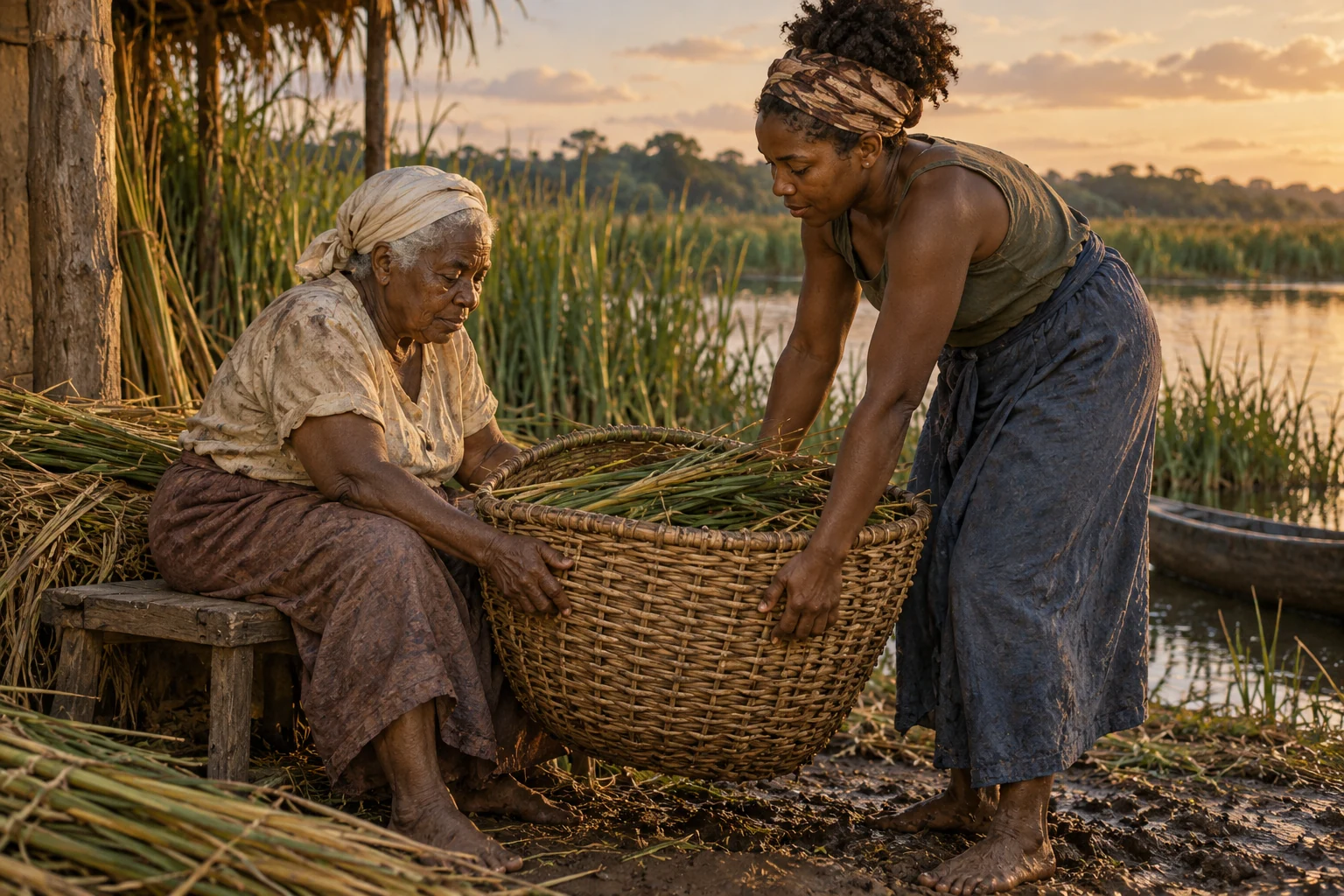
A carrying curve recalls tenderness alongside earth and age.
1. Names, places and religious histories
Nanã Buruku belongs to religious histories involving West African regions and peoples as well as Brazilian Candomblé. The name should not be inserted into a single uncomplicated Yorùbá family tree. Fon, Jeje and Nagô/Ketu relationships require their own contexts, and Brazilian houses preserve particular understandings of her place among other sacred powers.
The spelling Nanã is especially familiar in Brazil. Nana, Nanan and other forms appear in different texts. Variation in spelling is not itself evidence that every description attached to a similar name concerns exactly the same religious setting.
2. A carrying object, rather than an abstract label
The Duke Sacred Arts catalogue’s ibiri documents a Brazilian object associated with Nanã. Its curved, carrying form invites attention to maternal care alongside mud, earth and death. The named object and maker give the reader something more precise than a generic list of colors.
An implement can hold a relationship that looks contradictory only from a distance. Mortality and tenderness need not be opposite themes. The vulnerable body requires care partly because it is not permanent. A mature response to death may therefore include more attention to life, rather than less.
3. Key mythic theme: what the earth lends
Narratives concerning the formation and return of bodies often place earth or mud within a relationship of receiving and giving back. Particular versions connect Nanã with the material from which bodies are formed and the eventual return of that material. The account should be identified before assigning a fixed version to every community.
For contemporary reflection, the image challenges the fantasy of complete ownership over existence. A person’s body is intimate and deserves respect, yet it is also sustained through food, water, care and materials received from a wider world. The dependence is not a humiliation. It is part of the condition through which life becomes possible.
4. Age is not simply the opposite of usefulness
A society organized around speed may value older people only when they can imitate youth. Another may romanticize elders so completely that their actual needs become difficult to see. A serious engagement with age avoids both mistakes. Experience can carry knowledge, and the person carrying it may still need practical care, patience and the right to be imperfect.
The lesson also applies to grief. There is no universal schedule on which loss becomes acceptable. Remaining with another person’s sorrow may require resisting the wish to make the encounter easier by supplying a quick meaning. Presence can be a form of work even when it produces no visible solution.
5. Relationships without collapsed identities
Ṣọ̀pọ̀nná and Asojano lead into distinct accounts concerning affliction and care. Òṣùmàrè provides a study of cycles and continuity. Yewá opens questions of reserve and transition. Family relationships appear in some narratives, but no single diagram should replace learning their religious settings.
Reading Nanã with Obàtálá also makes the relation between material and form visible. Contemporary interpretation can ask what it means to shape a life from something we have received, while preserving the distinction between that reflection and a particular sacred creation account.
6. The carrying form and the body that needs time
The ibiri’s carrying image offers a concrete contrast to a culture that recognizes care mainly through fixing. Sometimes the task is to hold a situation safely enough for a person to endure it. The work can be physically and emotionally demanding even when there is no immediate improvement to display.
For contemporary reflection, consider the difference between remaining beside someone and trying to take charge of their meaning. A comforting explanation may help one person and burden another. The person offering it needs enough humility to notice which is happening.
This does not make silence automatically wiser than speech. A practical question, a clear promise or an offer of relief can matter greatly. The distinction concerns whether the response attends to the vulnerable person or mainly relieves the discomfort of the witness.
7. Inheritance includes unfinished work
Age can hold memory that a community needs, but not every inherited account is complete or harmless. Some family histories leave people unnamed. Some institutions preserve the achievement while forgetting the labor and injuries through which it was made possible.
A mature relation to ancestry can hold gratitude and correction together. The alternative is not a choice between celebrating everything and rejecting everything. It is the patient work of asking what can sustain life now, what needs mourning and what should no longer be passed on unchanged.
The image of return then becomes more than a closed cycle. Material returns, but a living community still decides how to carry what has been received. Continuity can include an act of repair that a previous generation was unable to make.
8. The caregiver’s need for a community
One person cannot become an unlimited container for everyone else’s vulnerability. The language of devotion can conceal this limit when it praises endurance without arranging relief. Care has a material life: time, rest, food, money and the ability to share responsibility.
The contemporary question is whether the community values care enough to sustain its conditions. An admiring statement is welcome, but it cannot perform an exhausted person’s next task. Respect becomes more convincing when it changes the distribution of that task.
9. Religious identity and the scope of this study
Nàná Bùrúkú should be introduced through layered West African and Atlantic histories rather than inserted into a single uncomplicated Yorùbá family tree. The Museu da Língua Portuguesa documents a Fon-language name associated with a primordial maternal ancestry. The Duke catalogue documents a particular Brazilian Candomblé ibiri. These are different kinds of evidence: a linguistic collection record and an account of a material object. Together they help keep language, place, and religious transmission visible without proving that every community organizes the figure identically.
The author’s dedicated portrait develops mud, age, memory, judgment, and return as a connected field. Matter capable of receiving form also receives what has lost its familiar form. This makes creation and mortality related without making grief trivial. The elder mother is neither a harmless grandmother nor an embodiment of death alone. Her severity includes the possibility that origin can fail to receive vulnerable life, while her antiquity raises questions about authority and change. The opening discussion’s emphasis on tenderness should therefore be retained and deepened through this difficulty. A mature reference asks how old knowledge can remain sustaining without becoming an order that forbids new life, and how mortality can make care more exact rather than less urgent.
10. Knowledge that gives the figure depth
10.1 Who provides the substance from which a person is formed?
In the book’s creation motif, a shaping power depends on mud that belongs to Nàná. The scene distinguishes giving form from supplying the material condition of form. Neither can simply claim complete authorship of life. This is a powerful corrective to stories of the entirely self-made person. A life is shaped through choices, but its body, languages, care, and circumstances have been received through relations that precede those choices.
The material is also already involved in return. The same earth that permits embodiment is not permanently alienated from the body formed through it. The book reads this as a continuity between origin and mortality. It should not be presented as a scientific theory or as an argument that individual persons are disposable because matter continues. Its ethical force is nearly the reverse: temporary embodiment makes the conditions of care consequential.
A contemporary question is what people acknowledge when they describe an achievement as wholly theirs. Dependence need not erase effort; it can make responsibility more accurate. The shaping person must still act, but cannot truthfully claim to have created the ground from which action became possible. Nàná’s mud therefore supplies a knowledge lens concerning the debt of embodiment, not merely an attractive image of being grounded.
10.2 Why does old authority conflict with the world of iron?
The author uses Nàná’s conflict with Ògún to stage a difference between an older material order and a younger regime of tools, force, and technique. Its interpretive importance is not literal history reconstructed from myth. It asks whether every new capacity is entitled to reorganize everything that preceded it. Technique can solve problems while concealing the older dependencies that make its success possible. Conversely, age can command reverence while refusing to recognize a necessary change.
This avoids a simple victory of tradition over innovation. The book’s psychological account gives conservatism a double possibility: fidelity to what has endured and rigidity toward what has not yet had time to prove itself. An inherited form can preserve knowledge; it can also protect the authority of those who benefit from its continuation. The question is how one distinguishes these cases through consequences rather than through the labels ancient and modern alone.
This lens also changes how one hears resistance. Some people do not merely find novelty uncomfortable; they experience it as an accusation that the world they carried no longer matters. Recognizing that grief can make a conversation more intelligible without requiring that the future stop. The mythic conflict becomes a way to examine continuity under pressure while keeping actual ritual restrictions within the communities that teach them.
10.3 What can the ibiri make visible about mortality and care?
The Duke catalogue identifies an ibiri made by Antonio Carlos Santos in a Brazilian Candomblé setting. Its account places muddy earth and death beside a carrying, maternal register. This is an object-based anchor for the opening discussion’s concern with tenderness. The material form complicates the assumption that an implement associated with death must express harshness alone. A visible curve, a bundle, and crafted texture can support a different kind of attention from a list of abstract attributes.
The analytical question is not whether every ibiri has one universal symbolic definition. It concerns how an object can hold apparently opposed relationships together. Carrying vulnerable life and receiving life’s return are not necessarily separate moral worlds. Both ask that a body be handled with seriousness. The book’s mud and elder imagery supplies a related interpretive frame, while the catalogue remains evidence about its own object and explanation.
Human labor belongs within this knowledge. A maker is named, materials are gathered and worked, and a religious community recognizes the result. Sacred matter is not simply found already finished. The relationship between inherited form and skilled making offers an example of continuity as active work. It also allows the article to discuss care through an actual object without inventing procedures or claiming that the implement produces a medical effect.
Evidence: Sacred Arts of the Black Atlantic, Duke University, Ibiri the Goddess of Nanã — Specific Brazilian Candomblé ibiri made by Antonio Carlos Santos; maternal interpretation beside death and muddy earth; imported material context.
11. A depth-psychological reading
Interpretive basis: The dedicated chapter in Babá Tilo de Àjàgùnnà’s The Orishas and the Human Soul, especially “Nàná Bùrúkú”, “Before the Òrìṣà Become Archetypes”, “Water, Wind, Dust, Mud, and the Elemental Atmospheres of the Psyche”. The dedicated portrait supplies the author’s mythic and psychological interpretation; introductory and ecological chapters govern distinction between sacred relationship and analytical resonance. Contemporary examples here are contemporary interpretations, not reports of ritual outcomes.
11.1 Memory that gives orientation and memory that forbids a future
The book’s account of memory extends beyond recollection of isolated events. A family can carry expectations, habits of silence, and inherited loyalties without each member knowing their origin. These patterns may preserve hard-earned knowledge. They may also make a changed life feel disloyal. The psychological distinction concerns whether memory supplies orientation or claims the right to decide every present choice.
An illustrative situation is a family whose earlier insecurity made saving and caution essential. A younger member’s decision to pursue unfamiliar work can then be experienced as contempt for the sacrifices that kept the family alive. The older generation may be defending a real memory of risk. The younger person may still have legitimate reasons to choose differently. Calling one side wise and the other selfish would collapse the conflict before understanding it.
Nàná’s portrait helps name the grief beneath some demands for sameness. A person can acknowledge the cost of an earlier world without repeating all its forms. The elder’s contribution may be honored through the capacity to adapt rather than through permanent obedience. Conversely, innovation becomes shallow when it treats inherited knowledge as a nuisance merely because it is old. Mature memory can therefore remain grave and consequential while giving new people room to become more than witnesses to the past. This application develops the book’s distinction between continuity and imprisonment without claiming that a particular family pattern proves an ancestral cause.
11.2 The difficult mother and the wish for an innocent origin
The book’s rejection of Omolu prevents Nàná’s primordial maternity from becoming sentimental. An origin can give life and fail to receive the life it gives. This is psychologically consequential because people often seek a total verdict on a parent or ancestral source: either the origin was good, so hurt must be denied, or the origin was harmful, so every received gift becomes suspect. The narrative permits a more difficult account in which both dependence and injury remain real.
The interpretive task is not to excuse rejection by calling it ancient wisdom. The child’s need retains its force, and the later receiving care associated with Yemọja matters precisely because origin did not suffice. A person may need to acknowledge that someone important could not give what was needed without turning that acknowledgment into a complete explanation of their life. Second care can become real without erasing the first loss.
An illustrative adult tension concerns loyalty to a severe family whose demands still feel like the only available measure of worth. The person may defend the family publicly while feeling inwardly unreceivable whenever they are vulnerable. The book’s archaic maternal field helps ask whether belonging has become conditional on concealing need. Inner development might include accepting support that does not repeat those terms. This is a contemporary reading of a mythic relation, not a diagnosis of devotees or a claim that a sacred mother can be adequately judged by a modern family category.
11.3 Aging between authority, dependence, and loss of speed
The portrait refuses to idealize old age. Years may ripen judgment, but they can also intensify bitterness, repetition, and fear of a changing world. This complexity is important because sentimental reverence can make actual elders difficult to see. A person treated only as a source of wisdom may feel unable to admit confusion or ask for help. A person judged only by speed may lose recognition of capacities that remain valuable.
The book’s slowness can therefore be read as a challenge to a particular measure of usefulness. Some understanding requires duration, repeated observation, and the capacity to remain beside an unresolved condition. These are real contributions even when they produce no immediate visible result. At the same time, the need for care should not be disguised as a lesson others are morally deficient for failing to understand. An elder remains a person with preferences, limitations, and the right to be imperfect.
Mortality sharpens this tension rather than resolving it. Accepting return does not mean welcoming every loss or giving up practical support. It can mean recognizing that a finite life requires a different distribution of attention. Who will carry the difficult tasks, who makes decisions, and how can assistance preserve participation? Nàná’s field invites a more truthful conversation about aging when dignity is held together with dependence, and when neither youth nor seniority is allowed to become an automatic certificate of good judgment.
12. What this relationship means for a person
12.1 In an established devotional or initiatory relationship
For a person with an established relationship involving Nàná, the reference should support the actual tradition rather than silently place every relationship inside one Yorùbá system. The relevant community may preserve Fon, Jeje, Nagô/Ketu, or other specific histories whose differences matter. The book’s portrait acknowledges a layered field; the linguistic museum record and the Brazilian object give independent reasons to retain that plurality. An initiated or devoted person’s obligations cannot be inferred from the age or mud imagery alone.
Reflective study can nevertheless ask concrete questions within an established life. Does honoring elders include listening to their present needs, or only praising an ideal of wisdom? Does fidelity protect an inherited relationship while allowing its living members to speak? Is justice being used to preserve responsibility, or has a remembered injury become a permanent refusal of mercy? The book’s severity becomes useful when it makes conduct more exact rather than certifying a serious personality.
The relation may also change as the devotee ages. Someone who first approaches through ancestry may later confront bodily dependence, care for a dying relative, or the difficulty of releasing a role. The portrait can provide language for these changes without predicting them or prescribing how grief should unfold. Devotion remains a relationship with a sacred presence; psychological reflection concerns how a person lives within the conditions that relationship helps illuminate. The most mature application may be the willingness to preserve what has been received while making room for the new life that preservation is meant to sustain.
12.2 When the figure becomes relevant in consultation
An encounter with Nàná in consultation should not become an automatic forecast of death, a judgment that the person is too old, or an instruction to become more conservative. The meaning belongs to the actual configuration and explanation given. The broad field of memory, embodiment, return, and old authority can become relevant in several ways, but a reference article cannot choose among them for the person.
The book’s method permits a contextual question: what relation to the past is active now? A dispute may concern an inherited obligation, a resistance to change, a need for patient care, or a body whose limits require acknowledgment. These are possibilities for attentive listening, not a menu of ready-made divinatory conclusions. The appearance of a sacred elder power also does not establish a universal initiatory form or permanent personal-head relation.
After the consultation, contemporary reflection can examine the difference between waiting wisely and remaining immobilized. Is slowness allowing an important process to unfold, or protecting a decision nobody wants to make? Is an appeal to tradition preserving knowledge, or making criticism impossible? Is mortality being acknowledged with tenderness, or used to demand resignation from someone who still needs practical support? Such questions connect inward attitudes with material responsibilities. They should be pursued in conversation with the consultation’s actual account, keeping the difference between a sacred encounter, an interpretation, and a personal diagnosis clearly visible.
13. Nature, materials and human knowledge
Mud is the ecological center of the author’s portrait because it holds formation and dissolution together. It is neither stable dry ground nor unrestricted water. Clay’s ability to receive form gives the creation image a material exactness, while return prevents the shaped body from imagining itself independent of that material world. These are theological and psychological readings rather than scientific explanations of life’s origins.
The ibiri adds crafted matter and human labor. The Duke object’s maker and Brazilian context show that a sacred relation can be carried through skilled construction and transmitted forms. The catalogue’s discussion of imported African material also gives a concrete example of Atlantic continuity sustained through material movement. That fact should remain tied to this context rather than becoming a claim about every object associated with Nàná.
Human ecology includes elders, caregivers, bodies requiring assistance, and communities that hold memory. The question of what the earth lends becomes practical when one notices food, shelter, care, and the labor that sustains a life. A contemporary application can ask whether respect for mortality increases responsibility toward vulnerable living people. Return to matter should not become an excuse to treat a person as expendable; it can make the finite period of embodied relation more worthy of attention.
14. Diaspora, comparison and syncretism
The strongest verified cross-context evidence concerns the Fon-language museum record and the Brazilian Candomblé object. These can be brought together without pretending that a linguistic collection item supplies a complete theology or that one Brazilian catalogue entry describes all West African devotion. The book itself differentiates a primordial Nanan Bùlúkú frame from accounts in which Nàná is placed among an Òrìṣà family. Its variation should remain explicit.
A family relationship is not a master key for collapsing traditions. The presence of Omolu, Ọ̀ṣùmàrè, Yewá, or other figures in one narrative may be meaningful within that telling while differing elsewhere. The article should ask who supplies the account and what its specific relationships accomplish. This gives comparison explanatory value beyond a crowded diagram of equivalent names.
No Catholic saint correspondence is verified here. Nor should the elder mother be declared identical to every earth-mother or grandmother figure because age and fertility recur across religions. The psychological comparison carries the same limit. An archaic maternal matrix can illuminate the author’s portrait but cannot replace Fon, Jeje, or Candomblé histories with one universal developmental category. The useful result is a more informed sense of both connection and irreducible particularity.
Evidence: Museu da Língua Portuguesa, Nana Bùrúkù, collection record pacr_aud_380 — Fon-language recording record and museum gloss relating name to maternal divine ancestry; not full ethnography; Sacred Arts of the Black Atlantic, Duke University, Ibiri the Goddess of Nanã — Specific Brazilian Candomblé ibiri made by Antonio Carlos Santos; maternal interpretation beside death and muddy earth; imported material context.
15. Questions for a fuller understanding
15.1 Does reverence for Nàná require treating every old custom as sufficient?
The book’s own light-and-shadow account argues against that conclusion. Continuity can preserve knowledge, while rigidity can make change feel like betrayal. A custom deserves attentive understanding, but its age alone does not settle how it should govern every present situation. Contemporary reflection can ask what the form protects, who bears its cost, and whether it still sustains living relationships. That inquiry is different from casually dismissing inherited knowledge. For an established devotee, actual ritual questions remain with the tradition. The psychological task is to recognize when respect for the past supports the future and when it has become a demand that the future never arrive.
15.2 Can mortality and tenderness belong to the same sacred field?
Yes. The book connects the matter that receives form with the matter to which bodies return. The Duke ibiri account adds a particular maternal reading beside muddy earth and death. Together they permit an interpretation in which finitude makes careful handling of life more serious. Tenderness does not deny mortality, and mortality does not make care pointless. A vulnerable person still needs food, presence, practical support, and respect for their wishes. The article’s contemporary contribution is to keep those responsibilities visible. It should not use a beautiful cycle-of-return image to explain away another person’s grief or imply that loss therefore ought to be easy.
16. Correlations to life dimensions
| Dimension | A question for reflection |
|---|---|
| Care | Can I remain present when help does not produce a quick solution? |
| Aging | Which forms of knowledge disappear when I judge people only by speed? |
| Grief | Am I making room for loss, or demanding that it become convenient? |
| Ecology | What have I received that I cannot truthfully call self-made? |
| Community | Who is carrying vulnerable life, and who is caring for that person? |
17. A personal study of continuity
If Nanã is important in your practice, begin with your house’s account of her names and relationships. There is no need to turn age into rigidity or death into spectacle. Her study can invite a more patient recognition of what sustains a human life: material, memory, relationship and the tenderness through which a community refuses to abandon its vulnerable members.
18. Sources for the expanded interpretation
Interpretive basis: The dedicated chapter in Babá Tilo de Àjàgùnnà’s The Orishas and the Human Soul, especially “Nàná Bùrúkú”, “Before the Òrìṣà Become Archetypes”, “Water, Wind, Dust, Mud, and the Elemental Atmospheres of the Psyche”. The dedicated portrait supplies the author’s mythic and psychological interpretation; introductory and ecological chapters govern distinction between sacred relationship and analytical resonance. Contemporary examples here are contemporary interpretations, not reports of ritual outcomes.
-
Museu da Língua Portuguesa. Nana Bùrúkù, collection record pacr_aud_380. Fon-language recording record and museum gloss relating name to maternal divine ancestry; not full ethnography. Public institutional page, actual descriptive text read; current web edition.
-
Sacred Arts of the Black Atlantic, Duke University. Ibiri the Goddess of Nanã. Specific Brazilian Candomblé ibiri made by Antonio Carlos Santos; maternal interpretation beside death and muddy earth; imported material context. Public institutional page, actual descriptive text read; current web edition.
No full local Fon or Jeje ethnography was read here. Mythic clay, anti-iron, genealogy, and severe maternity are attributed to the author’s synthesis rather than presented as independently universal. No ritual instructions or medical efficacy claimed.