
A divination set can contain a knucklebone, a tooth, a seed, a stone and a manufactured object without making all five things interchangeable. Their differences may be precisely what allows a reader to distinguish people, durations, obstacles and relationships. Bone divination therefore begins with a more interesting question than what bones mean. It asks how this particular collection becomes intelligible to the people who use it, and what authorizes an interpretation of its arrangement.
Bàbálórìṣà and Bàbáláwo Tilo Plöger de Àjàgùnnà's The Afro-American Bones Divination — Kimbanda, Palo & Vodou Traditions supplies the interpretive foundation for this study. It presents methods called Bula I, Bula II and Vititi Kanguam or Kanguame. Here those arrangements are examined as the book's teaching systems. Their presentation together does not establish one historical bone oracle shared by every Kimbanda, Palo and Haitian Vodou community. Keeping that scope clear allows close attention to the book's unusually detailed account of relations among objects.
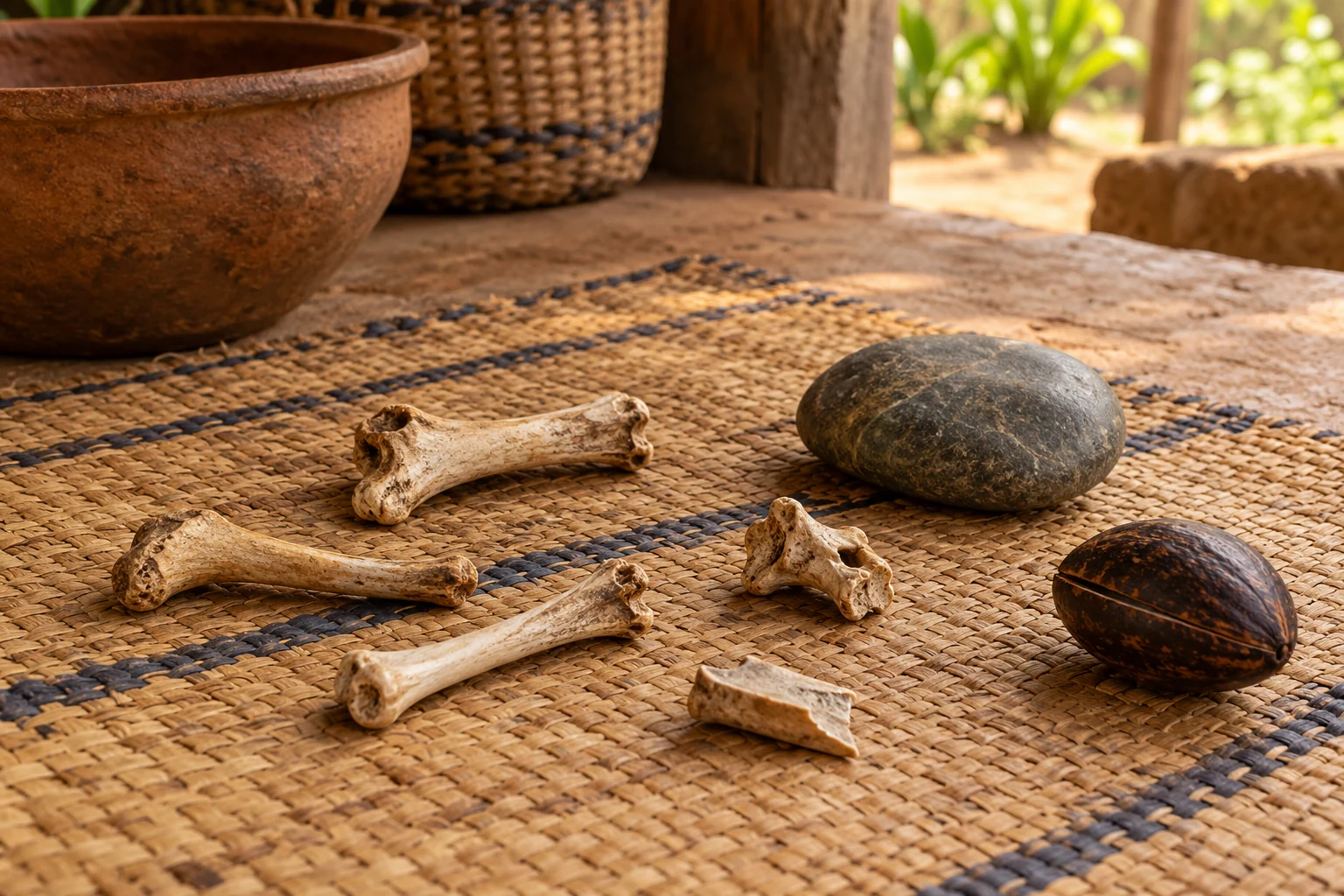
An assemblage has a history
The Science Museum Group holds three carved divination bones attributed to South Africa and dated 1880–1920. The maker is unknown. Another of its records describes a leather bag containing animal vertebrae, pebbles, a hoof, carved bone and a nutshell. These records document different material collections; neither supplies a genealogy connecting its objects to a Brazilian or Cuban house. Their usefulness lies in showing how inadequate the phrase “the African bone oracle” would be for even a small museum sample. Science Museum Group, divination bones and divination bag.
The Smithsonian's catalogue of a divination gourd records an even more heterogeneous collection: bones and teeth accompany seedpods, quartz, wooden pieces, metal implements and tax tags. The catalogue does not let us reconstruct the owner's complete interpretive practice. It does show that a divinatory collection can incorporate objects with different biographies, including things made within colonial administration. The sacred and the everyday need not have occupied separate material worlds. National Museum of African Art, “Divination gourd set.”
These examples change the historical question. Rather than imagining one primordial kit travelling intact across continents, we can investigate selection, inheritance, substitution and local recognition. A familiar object may have entered a set recently while the office that interprets it has a longer history. An old material may receive a new assignment. Continuity might reside in the relationship to a teacher or spirit, in rules for comparing positions, or in a community's recognition of a reader. The age of an individual bone cannot settle those questions.
Four named objects and their unequal work
In Bula I, Tilo names four principal pieces: Thola, Cohado, Scita and Imbay. He gives them different physical profiles and interpretive responsibilities. Thola is short and broad, associated with strength that may remain concealed or available. Cohado is elongated, emphasizing duration and sustained influence. Scita is broken and brings disruption into view. Imbay is smaller and modifies the weight or development of other indications. These are assignments within the published method, not names to impose on another person's set.
The distinction between principal and modifying pieces deserves attention. If every object merely delivered an independent sentence, a reader could make a list and stop. Imbay's modifying role makes the interpretation relational: the question concerns how an influence changes another influence. Likewise, the broken quality of Scita makes interruption materially visible, but it does not identify the exact event being interrupted. A fracture is a feature of the piece. A judgment about someone's life requires the additional interpretive work of a consultation.
Tilo also introduces stones and seeds in the four-bone discussion. His associations distinguish difficulties, benefits arising through the questioner's effort and help attributed to other agencies. That distinction gives the method more texture than a single fortunate–unfortunate scale. Something welcome may depend on effort; another opening may depend on assistance. Something uncomfortable may reveal a task rather than a final defeat. The objects distribute attention among different kinds of causation, instead of providing a single verdict on whether a person is lucky.
This makes an important reading principle visible. Knowing the name of a piece is only the beginning of knowing its function. One must also know whether it represents an actor, a quality, a duration, a modifier or a relationship. The same reader may discuss more than one of these levels. A clear explanation should make the movement between them audible, because “a difficult relationship” and “a particular person is causing difficulty” are substantially different claims.
Direction, distance and crossing
The book gives spatial relations a central place. Orientation can indicate where attention is directed; nearness can connect indications; a crossing can change their relative emphasis. These are not decorative variations around an otherwise fixed message. They are part of the method's grammar. A photograph that preserves only the pieces while losing the questioner's position or the order in which the configuration was examined may preserve an incomplete record of what the reader regarded as relevant.
Crossing is especially revealing because the two objects do not necessarily contribute equally. Tilo distinguishes a stabilizing piece overlaying a troubling one from a troubling piece overlaying a stabilizing one. The conceptual issue is prominence: what contains, obscures or qualifies what? This is closer to a sentence in which word order matters than to a bag of independent keywords. Reversing an arrangement can alter the relationship even when no new piece has appeared.
Consider a hypothetical discussion of a long delayed qualification. “There is an obstacle” tells the student little. A more developed interpretation might ask whether temporary disruption is overwhelming a viable long term project, or whether the apparent stability of the project is concealing an unresolved problem. These are different readings of influence and prominence. Neither follows automatically from possessing a piece called Scita. The example illustrates what relational interpretation can ask; it reports no cast and attributes no message to spirits.
Distance also needs a stated frame. Two objects can be near each other in absolute measurement and far apart relative to the rest of a small arrangement. An explanatory account should therefore identify the relations it actually uses, rather than pretending that an isolated photograph contains an obvious message for every observer. This is one reason competent disagreement cannot be resolved simply by enlarging an image. The governing conventions must be known before the image can be assessed.
What changes in the three plus four method
Bula II expands the vocabulary through three principal bones and four Imbay pieces. The repeated modifiers allow the book to consider degrees, accumulation and combinations. It also organizes interpretation through mineral, vegetal and animal realms. These categories belong to its interpretive architecture. They should not be presented as a universally recognized map of Kimbanda, still less as a shared taxonomy for every religion discussed in the volume.
The three realms let the book approach an issue at different scales of life: foundations and persistence, processes of growth, and embodied or social vitality. The point for comparative study is how a bounded field can alter an object's relevance. A piece does not carry its entire possible meaning into every position with equal force. The arrangement directs a reader toward some questions and away from others. Without this restriction, a large vocabulary could be made to confirm almost any account after the event.
There is also a change of density. Four modifiers provide many opportunities to elaborate a reading, but additional detail does not automatically produce additional certainty. The reader still needs to distinguish what the arrangement establishes within the method from what has been inferred in conversation. A precise account of family conflict, for example, should not quietly transform a general indication of tension into an accusation against a named relative. The interpretive field can become richer while the obligation to explain its reasoning becomes greater.
Some of the book's passages assign masculine and feminine qualities to Thola and Cohado. Their analytical interest lies in attraction, containment, initiative and duration as the author distributes them. They should not be used to force every client's relationships into a heterosexual household or to treat a physical feature as evidence of moral character. A contemporary explanation can preserve the source's categories while making room for the actual people whose lives are under discussion. Specificity includes knowing when a category fits poorly.
The six bone presentation and Palo
The third major method is presented as Vititi Kanguam or Vititi Kanguame, with six pieces, ordering conventions and relations to a field called Bokoroso. It differs from the earlier chapters in more than the number of objects. The book examines how distinguishable faces or markings can be recorded as an ordered result. The comparative interest is the movement between a spatial arrangement and a sequence that can be preserved, revisited and elaborated.
An ordered result and a scene are different kinds of record. In a scene, distance and crossing may matter; in a sequence, which piece counts as first may matter. Converting one into the other is an interpretive operation. It requires a rule, and it can discard information that another method would retain. Thus the six bone account should be understood through its own stated conventions rather than read as a more advanced version of Bula I. Complexity is not a ladder on which every bone practice occupies a lower or higher rung.
Palo's Cuban religious history supplies another distinction. A bone in a casting assemblage, material associated with a prenda or nganga, and a museum specimen cannot be assumed to have the same status. Todd Ramón Ochoa's Society of the Dead follows the particular Palo Briyumba community of Quita Manaquita. Its publisher description and accessible chapter abstracts emphasize relations among the dead, material powers, teachers and praise. They do not establish Tilo's six bone method as the practice of all Palo houses. University of California Press and “Palo Society,” chapter abstract.
That difference is substantial. Calling an object a representation of an ancestor may imply that the ancestor stands elsewhere and the object points toward them. A religious community may describe a consecrated material relation in stronger terms of presence, force or agency. A general article should preserve that possibility without pretending to reveal restricted knowledge. Its job is to prevent a casting manual from silently defining every other encounter with bones in the religious world it discusses.
Kimbanda, Palo and Vodou retain their names
In Tilo's Kimbanda exposition, Exus and Pomba Giras belong to the interpretation's religious surroundings. Their named relationships and the authority of the house matter. They should not be collapsed into the Yorùbá Òrìṣà Èṣù simply because related spellings appear. Nor does a comparative association between an object and Pomba Gira establish that Pomba Gira names one uniform being across Brazil. The book provides a framework for its reader; actual communities retain their own classifications and histories.
Haitian Vodou introduces different offices and relationships. The Pluralism Project describes lwa, their nations, ritual specialists called oungan and manbo, and communication through possession. Duke University's Sacred Arts collection places the asson among the insignia of priestly authority. These sources support the importance of recognized office and a varied material culture. They do not support presenting the four named bones of Bula I as the standard Haitian oracle. Pluralism Project, “Vodou, Serving the Spirits” and Duke, “Haitian Vodou.”
The distinction between the dead and divine or spirit powers also needs local language. “Ancestor” can mean a deceased relative, a religious predecessor, a broader collectivity of the dead or a category used by an author to draw comparisons. Those meanings overlap imperfectly. A lwa should not become a deceased family member by translation; a Palo relation to the dead should not be described through Haitian office titles. Comparison becomes more useful when it lets a reader name these differences without ranking them.
Tobacco shows why material identity is insufficient
The Tobacco Oracle offers a parallel case. Tilo considers smoke as communication, offering, cleansing and an object of interpretation. A cigar can consequently enter a religious occasion without that occasion being a cigar reading. The same distinction applies to bones: the presence of the material does not identify the operation. A material may carry an offering, belong to an established sacred power, mark an office or participate in a divinatory arrangement.
For close reading, separate three questions. What is the object? What is being done with it? What relationship do participants say the action establishes? Answers can diverge even when two photographs look similar. Someone holding tobacco during mediumship and someone interpreting ash may share a material while conducting different kinds of work. Likewise, the description of bones in a sacred vessel cannot be used as proof of a throwing technique. Keeping action distinct from material prevents a misleading expansion of the evidence.
Tilo's later Signs of the Black Atlantic develops this concern through the idea of a situated sign event. Configuration, material, speaker, occasion and recognized authority belong together. Applied to bones, that approach redirects attention from an isolated object dictionary toward the consultation in which an arrangement becomes consequential. It also helps distinguish a research illustration, an author's pedagogical example and a religious record. Each can teach something without borrowing the status of the others.
From an arresting image to usable counsel
A broken piece can attract attention because it makes rupture visible. That power deserves careful handling. In a discussion of separation, a reader might explore the end of a pattern, a promise that needs revision or an interruption that can be repaired. Moving from those possibilities to an announcement of literal death would require an entirely different claim. A dramatic material form is not sufficient evidence for a dramatic assertion about another person's future.
The same care applies to health and accusations. A symbolic account of depletion does not establish a diagnosis, and an indication interpreted as conflict does not prove that another person has attacked the client. One can discuss a warning's religious meaning without converting it into evidence about an absent person's conduct. A useful consultation should leave room for practical verification, ordinary conversation and decisions proportionate to what is actually known. These are responsibilities of interpretation, not rules for casting.
The strongest lesson of the book's object vocabulary is that an apparent obstacle has relations. It may be amplified, qualified, contained or set beside another duration. Reading those relations can interrupt fatalism: a person need not identify their whole life with the most alarming piece in a configuration. But neither should reassurance be automatic. The human work is to understand which difficulty has been named, which response is possible, and what remains uncertain after the explanation.
What a name does and does not preserve
The mixed vocabulary in the book deserves its own attention. Bula, the Portuguese language of Kimbanda, Spanish descriptions of Cuban consultations and Central African derived religious terms meet on the same page. That encounter can help readers compare methods, but it can also create an illusion of easy translation. An approximate English gloss does not establish that the same word has the same history or jurisdiction in another house. Retaining the original term beside an explanation preserves a question that a fluent teacher may later answer more precisely.
A careful study note can therefore distinguish the author's spelling, the function assigned in the chapter and the historical claim attached to the term. Vititi Kanguam and Vititi Kanguame, for example, appear as variants in the supplied text. Recognizing that variation is more useful than silently choosing a spelling and then presenting it as the universally correct name. A term can be perfectly intelligible within one teaching relationship while remaining uncertain in a broader linguistic genealogy. That uncertainty does not prevent analysis of the method actually described; it limits the history that can responsibly be inferred from its name.
There is a further difference between remembering an assignment and recognizing a set. A manufactured substitute might be given the same pedagogical name as an older piece while differing in weight, shape and movement. The substitution may preserve a mnemonic association without preserving the physical relationships a spatial method attends to. A reader studying such a change should ask which properties the method regards as significant. This is a question about understanding adaptation, not a suggestion to assemble or consecrate a substitute.
An accurate description can therefore record more than a list of materials. It can explain which distinctions among pieces are necessary to the published account: broad and elongated profiles, a broken form, principal objects and modifiers. This makes the interpretation more reviewable. A disagreement can then concern a particular assignment or relation rather than the vague impression that one person's objects look more authentic than another's. Material specificity gives critical discussion a firmer place to begin.
Reading further with the right distinctions
Study becomes cumulative when a reader can explain why Bula I, Bula II and Vititi Kanguame are separate presentations, identify which spatial or sequential relations each emphasizes, and distinguish the author's cross tradition argument from historical evidence. The goal is not to memorize every possible statement about every object. It is to understand how a particular interpretive grammar turns a collection into a disciplined encounter with a question.
Continue with Ifá instruments and interpretive authority to compare an object assemblage with a sign and corpus system; sacred signs and divination for the difference between a figure and its occasion; and prediction and divinatory ethics for the responsibilities attached to counsel. The Orí study keeps personal direction in view without reducing a person to a single omen. The Ask Ifá companion can support educational questions and published reading; it does not cast these objects or authorize their use.
Sources and further reading
- Tilo Plöger de Àjàgùnnà, The Afro-American Bones Divination — Kimbanda, Palo & Vodou Traditions. Substantive Bula I, Bula II and Vititi Kanguam/Kanguame sections consulted as the author's interpretive foundation. Matched book.
- Tilo Plöger de Àjàgùnnà, The Tobacco Oracle. Material roles and cosmological discussion consulted; no sign decoder or procedure reproduced. Matched book.
- Tilo Plöger de Àjàgùnnà, Signs of the Black Atlantic and Where the Sacred Takes Hold. Supplied substantive discussions of sign events, presence and religious authority consulted. Books.
- Science Museum Group, South African divination bones and divination bag. Collection records, not reconstructed oral instructions.
- Smithsonian National Museum of African Art, “Divination gourd set”. Indexed catalogue inventory consulted; direct page retrieval failed.
- Todd Ramón Ochoa, Society of the Dead, University of California Press, and “Palo Society”. Publisher description and chapter abstract only; full ethnography not consulted.
- Pluralism Project, “Vodou, Serving the Spirits”; Duke University, “Haitian Vodou”. Institutional contextual accounts.
- DAILY IFÁ Academy. Published teaching collection.