
Ifá, Mérìndínlógún, Obì, bone casting and Tarot are different ways of organizing an encounter with uncertainty. Their differences concern more than the objects a reader holds. They involve the beings addressed, the training of the interpreter, the relation between a sign and a body of knowledge, and what may follow an answer. Ifá is inseparable from Òrúnmìlà and the Odù corpus; a Tarot comparison does not make a card an Odù. A four-piece oracle does not become another four-piece oracle merely because both have distinguishable faces.
This guide compares publicly describable features while leaving the authority of a consultation with its actual religious setting. It draws on Bàbálórìṣà and Bàbáláwo Tilo Plöger de Àjàgùnnà's books on Ifá, Obì, bones, Tarot and geomancy, read as situated teaching and authored interpretation. Where those books extend correspondences across traditions, the correspondence remains a proposal to examine. A useful comparison makes a reader better able to ask whose knowledge is being offered, what a procedure establishes, and which human responsibilities remain after a reading.
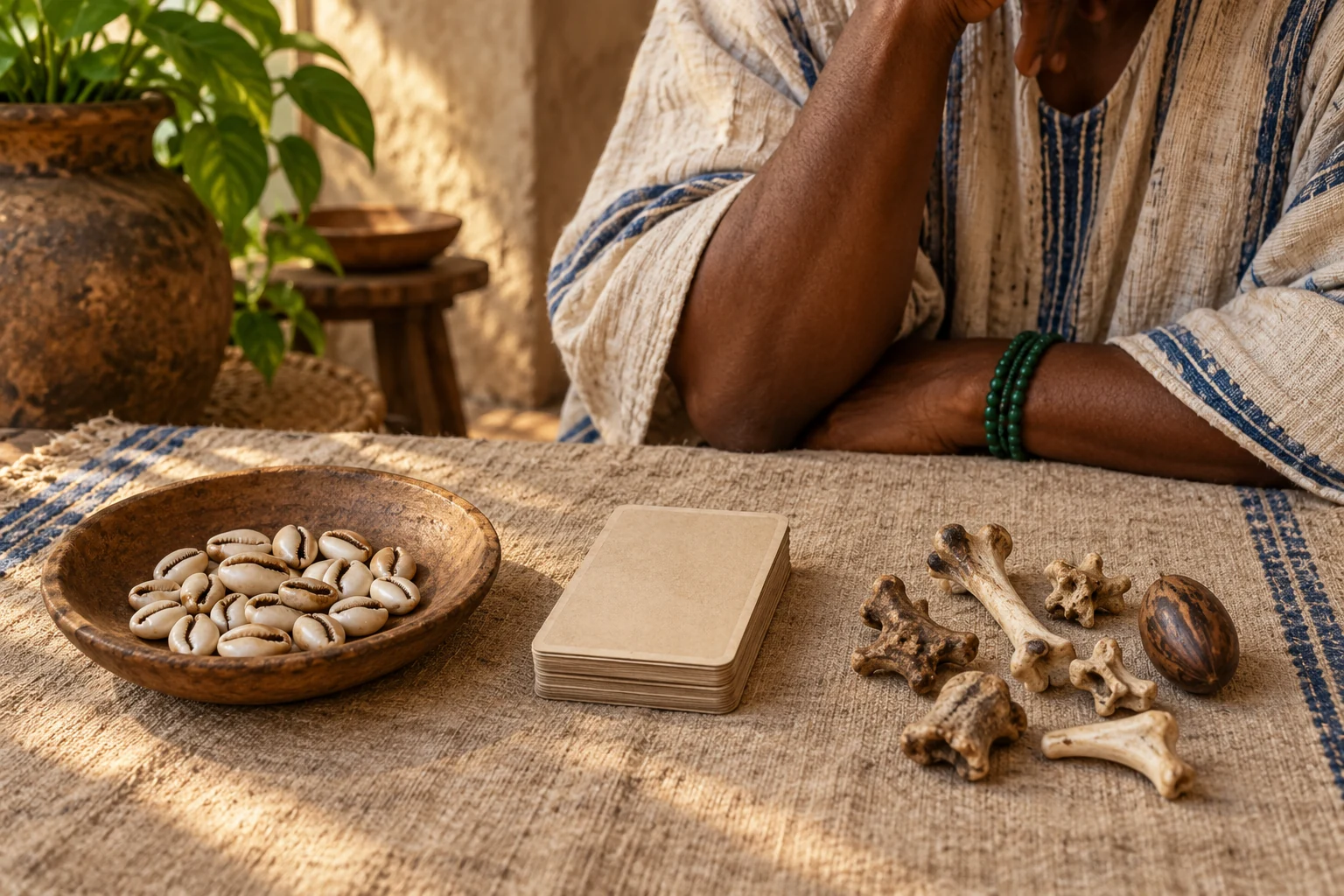
Begin with the question, then identify the method
A person might seek an oracle before moving home, entering a partnership, responding to family conflict, or accepting a religious obligation. These concerns can sound similar across traditions, yet the consultation may put them into very different relationships. One specialist may consult an inherited corpus about the person's situation. Another may address a particular spiritual power through a consecrated instrument. A contemporary card reader may invite reflection through images without claiming to speak for any deity. The client's initial question does not tell us which encounter has taken place.
It helps to distinguish the question the client brings from the question the oracle is actually asked. “Should I take this job?” may open into obligations to dependants, the manner of leaving a previous employer, or the need to make a decision without perfect reassurance. An answer can therefore concern conduct as much as outcome. That observation is an interpretive possibility, not a claim that every diviner uses the same counselling method. A responsible account names the tradition, the practitioner, the instrument and the scope of the answer before describing what it means.
The comparison also needs a scale. An ordinary consultation, a ceremony that discloses an enduring personal sign, a confirmation within another rite, and private symbolic contemplation are different occasions. Calling all four “a reading” can hide their consequences. A person who has studied an Odù in a book has encountered a text. A person who has received counsel under that Odù in a religious ceremony has participated in a relationship with witnesses and obligations. The same title or diagram can appear in both settings without making their status identical.
Ifá: a configuration opens a corpus
Ifá uses recognized configurations associated with the 256 Odù. The diviner interprets through ẹsẹ Ifá, the verses, narratives and precedents transmitted with those categories. UNESCO's heritage account identifies the sign system, the corpus and its specialist transmission together; it does not describe an image that explains itself. This is the essential starting point: obtaining a configuration and knowing which counsel addresses a particular situation are connected tasks, but they are not the same task. UNESCO, “Ifa divination system.”
Two characteristic instruments are the ọ̀pẹ̀lẹ̀, a chain carrying eight elements with distinguishable faces, and ikin, sacred palm nuts. In work with ikin, marks are recorded on an ọ̀pọ́n Ifá, the divination tray. An ìrókè, or tapper, and a vessel for the nuts can also belong to the material ensemble. The Smithsonian's account of a Yorùbá divination cup places these objects within the work of a babaláwo consulting Òrúnmìlà. Their carved beauty belongs to a religious practice rather than supplying its complete instructions. National Museum of African Art, “Divination cup.”
The mathematical finiteness of the configurations can mislead newcomers into expecting a finite dictionary of advice. A category may hold many accounts, each with different agents, problems and responses. Selecting, reciting, explaining and testing relevance require learning. Tilo's Ifá book gives considerable attention to instruments and subsequent clarification; it is most useful here when read beside that distinction. A searchable list of meanings can support study, but it cannot preserve the full occasion, spoken exchange or competence of an actual consultation.
Mérìndínlógún and jogo de búzios
Mérìndínlógún is associated with sixteen cowries and its own divinatory knowledge. Jogo de búzios is the familiar Portuguese expression for cowrie-shell divination in Brazilian religious settings. These terms overlap without making every Brazilian shell method a mechanically identical version of one Yorùbá procedure. Houses transmit particular arrangements of signs, names, supplementary questions, narratives and ritual responsibilities. The word búzios tells a reader that shells matter; it does not establish the entire theology or authorization of the person consulting them.
William Bascom's Sixteen Cowries documents a Yorùbá divination system through Yorùbá texts and English translations. The Indiana University Press description explicitly notes male and female diviners in the diaspora. Only the publisher's description was consulted for that bibliographic point here. Its relevance is precise: cowrie divination has its own substantial literature and practitioners. It should not be introduced as an untrained person's shortcut to becoming a babaláwo. Indiana University Press, Sixteen Cowries.
In Candomblé, the shell consultation may enter questions about orixás, personal obligations and life in a terreiro. Its authority belongs to the house and its religious offices. Shared Odù vocabulary can create genuine bridges to Ifá while retaining differences of repertory and procedure. A shell result should therefore be interpreted through the system that produced it. Readers seeking a closer account can continue with Ifá and búzios: the differences that matter, particularly before transferring an answer table or a claim about initiation from one setting into another.
Obì: a focused conversation with a material history
Obì abàtà is kola used in Yorùbá and related religious contexts. Tilo's dedicated book centers the four-lobed nut and discusses both the exposed faces of its pieces and finer distinctions involving their characteristics and positions. Obì also has a place as an offering and as a means of confirming matters within religious work. These functions are connected: an object offered in relationship is not adequately described as a convenient set of randomizing counters. Its identity, freshness, preparation and authorized use can matter to the community concerned.
In some diaspora settings, forms called obí use coconut rather than fresh kola. That adaptation needs to be named rather than quietly treated as botanical identity. Nor should a reader assume that manufactured pieces, coconut pieces and fresh kola are exchangeable for every occasion. Tilo's book itself distinguishes substitutes from fresh material in particular ritual uses. The descriptive lesson is that availability may shape an instrument without abolishing the obligations attached to a specific rite. The keeper of that rite supplies the relevant decision.
A small number of broad configurations does not guarantee a simple or universal answer table. Naming, confirmation, the exact question and the interpretation of a fall differ. A pattern labelled positive in one presentation may require further qualification in another. Copying a short chart can therefore create false certainty, especially when the source mixes regional vocabularies. The dedicated Obì abàtà study explains these issues without supplying a ritual recipe. A reader can learn what a method does before claiming the right to perform it.
Bones: a family of practices, not one oracle
“Bone divination” names materials and a broad activity, not a single religion. Assemblages may include bones and other objects whose faces, directions, proximity or intersections become significant within a taught method. Tilo's comparative book presents four-bone, combined and six-bone arrangements alongside Kimbanda, Palo and Vodou contexts. Those descriptions establish the scope of his presentation. They do not independently demonstrate that all three religions historically shared one standardized system, one vocabulary, or one rule for interpreting a crossed pair.
The book's treatment of spatial relationships is nevertheless useful for comparison. An item may mean something because of where it falls relative to another item, rather than only because its upper surface has a fixed value. That demands attention to the whole field and to the interpreter's learned assignments. We can ask how a boundary is established, which object refers to which relationship, and whether the same form has different work on another occasion. These are analytical questions, not instructions for constructing a sacred set.
The religious distinctions remain decisive. A Palo specialist works within a Cuban history and particular relations to consecrated powers and the dead; that office cannot be inferred from the possession of bones. Vodou and Kimbanda have their own communities and vocabularies. “Ancestral” should not become a word that dissolves all these identities. If an author proposes a shared interpretive map, the reader should know that it is a comparative framework. A clear label gives the proposal intellectual room without presenting it as inherited authority everywhere.
Tarot: images, history and an authored bridge
Tarot has a documented European card history. The Metropolitan Museum's account distinguishes early playing cards and trump sequences from the later prominence of occult fortune-telling. This history is enough to reject an easy claim that a modern Tarot deck is simply ancient Ifá in another material form. It does not diminish the religious or reflective value that contemporary readers may find in cards. It lets that value be described honestly, without borrowing a history that has not been demonstrated. The Metropolitan Museum of Art, “Before Fortune-Telling.”
Tilo's Tarot Ifá proposes relationships between card figures and Òrìṣà themes. For example, its discussion connects the Fool with Èṣù through beginnings, decisions and crossroads. That is an authored interpretive pairing. Èṣù is a religious being with extensive histories and obligations; the Fool is a card figure whose meanings vary across decks and readers. The proposed meeting can illuminate a question about choice without exhausting either figure. Its usefulness should be judged through the clarity of the comparison, not through a claim that the two identities are interchangeable.
This distinction protects the reader's understanding of what a card session can establish. A Tarot image can prompt questions about desire, fear, timing or self-description. It does not, by that fact, identify someone's received Odù, confirm an initiation, or establish which orixá has been ritually recognized for them. Tilo's own discussion describes the deck as complementary to established religious practice. Reading it that way allows imagination to be productive while keeping a contemporary symbolic method accountable for the claims it actually makes.
Similar patterns do not settle an origin story
Ifá and forms of geomancy invite comparison because single and double marks and finite configurations can look mathematically related. Tilo's geomancy book advances a historical route hypothesis involving Arabic geomancy and African transmission. The hypothesis raises worthwhile questions about contact, trade, learning and adaptation. Shared binary form alone cannot establish a route, date, direction of borrowing, or continuity of meaning. Those claims require historical evidence beyond the visual resemblance of configurations.
Three questions should remain separate. Do two systems have comparable formal structures? Is there documented contact between the people who transmitted them? Can a particular borrowing or transformation be traced? A yes to the first is not automatically a yes to the others. Even demonstrated contact would not prove that every associated narrative, deity or interpretation came from the same source. Religious communities can appropriate an organizing device while transforming its purposes, and they can independently develop similar solutions to recording alternatives.
For contemporary study, a comparison can be valuable even when an origin claim remains unsettled. One might examine how a system distinguishes alternatives or how a finite figure opens a much larger interpretive field. That is formal and philosophical inquiry. It becomes misleading when an author silently turns it into a recovered ancient universal oracle. The Academy's study of signs and divination develops the related distinction between notations, ritual signatures and images that organize sacred space.
What interpretation asks of a human being
Across these comparisons, interpretation has at least three discernible layers: what appeared, what a trained interpreter says it establishes, and how a person responds. These layers do not carry identical certainty. An accurate record of objects or names can coexist with disagreement about their significance. A persuasive interpretation can still be applied badly. Keeping those distinctions visible helps a client ask useful questions without reducing religious knowledge to a demand for a prediction that can be checked immediately.
Consider an explicitly hypothetical person torn between caring for an ageing parent and accepting work abroad. In one setting, a consultation could reveal particular religious obligations; in another, a card discussion might make competing loyalties more visible. Neither situation is adequately captured by saying that “the oracle told them to leave.” The question includes who else will carry the care, whether promises can be kept, and what the person is avoiding. Divination does not make those affected people disappear from the decision.
There is also a difference between receiving an enduring personal sign and consulting about this week's concern. A name repeated in both records does not make their duration or function identical. Additional signs may clarify alternatives, bear witness in a particular method or answer another question. The life Odù and witnesses guide addresses this distinction. It is especially important when someone fears that a warning in a consultation is a permanent description of their character or the whole future of their family.
Why a story can change the question
A narrative associated with a sign can shift attention from the desired outcome to the situation in which a person is acting. A reader might initially identify with a successful protagonist and then notice an impatient demand, an overlooked helper or an obligation postponed. This is a way of reading, not a new verse attributed to tradition. Its value lies in allowing a story to challenge self-description. If every narrative merely confirms that the client is right and everyone else is the obstacle, interpretation has become very narrow.
The same discipline keeps comparisons with Tarot useful. A card image and an Odù narrative may both open a question about hesitation, but they do so through different bodies of knowledge. One need not declare their protagonists identical to compare the human difficulty. Ask what the interpretation makes newly visible and what action becomes more intelligible. A useful answer can deepen responsibility even when it leaves a person with work to do and without a guarantee of the result they hoped to obtain.
What a useful comparison record preserves
A written record should preserve the difference between the instrument and the result. “Cowries” names a material; a named configuration belongs to a procedure; the explanation belongs to a consultation. Recording only the explanation loses how it was reached, while recording only the fall loses the question it answered. For someone studying their own history, it is helpful to retain the date, the responsible specialist, the religious house, the question, the names recorded and the stated scope of the counsel. This is a recommendation for clarity, not a new divinatory method.
Translation deserves equal attention. A word rendered as “good” might concern a favorable orientation, an accepted proposal, or a specific blessing. Those are different statements. A word rendered as “bad” may refer to an obstacle requiring action rather than a judgment on the client's worth. If the interpreter uses a technical term, ask for its meaning in that procedure and retain the term with the explanation. Ordinary English can make advice accessible while concealing distinctions that become important when a person later compares records from different houses.
The comparison becomes especially delicate online, where search results detach a sentence from its occasion. A description of one Odù, one card or one shell count may be repeated as if it were a prediction for everyone who sees it. A more useful reading asks what evidence would connect that general material to this particular person. In a ritual consultation the connection is established through the recognized procedure and its interpretation; in reflective study it remains an invitation to consider a question. Recognizing which connection is present protects both religious practice and the reader's judgment.
Learning without claiming a borrowed office
Good comparative learning increases specificity. A reader should become able to say which instrument was used, which tradition supplied the interpretation, what the occasion was, and which statements are the author's reflections. They should also become comfortable with an honest limit: a public explanation may describe the role of a sacred object without making its reader a custodian. Knowledge can widen through books, collections and conversations while responsibilities remain located in communities that know how to recognize them.
For personal reflection, the Orí study offers a way to think about direction and responsibility without treating destiny as a fixed personality diagnosis. The Odù library supports sustained narrative study, while the Òrìṣà collection follows named divine histories. The Ask Ifá companion can help formulate questions and explore published themes. It cannot perform an authorized oracle, confer initiation or verify a received sign. The distinction is useful rather than restrictive: a study companion can prepare someone to listen carefully when they eventually sit with the people whose religious work they are seeking.
The wider comparison returns us to presence and care. A divinatory answer can lead toward a shrine, a household obligation, an ancestor relationship or further learning; it need not end on a page of meanings. Shrines, Orí and sacred presence follows those relations. The systems considered here deserve attention because they give different forms to consequential questions. Their depth becomes clearer when their names, histories and human keepers remain visible throughout the comparison.
Sources and further reading
- Tilo Plöger de Àjàgùnnà, Odù Ifá Divination, Divination with Obì Abatá, The Afro-American Bones Divination, Tarot Ifá and The Geomancy of Ifá. Supplied texts consulted for instruments, comparative arrangements and the author's interpretive proposals. Browse the books.
- UNESCO, “Ifa divination system”. Institutional overview of signs, corpus and transmission; not validation of every lineage's procedure.
- Smithsonian National Museum of African Art, “Divination cup”. Object record and contextual explanation of Ifá implements.
- William Bascom, Sixteen Cowries, Indiana University Press. Publisher description consulted; full volume not consulted for this article.
- The Metropolitan Museum of Art, “Before Fortune-Telling: The History and Structure of Tarot Cards”. Museum account of card history.
- DAILY IFÁ Academy collection. Related teaching; individual videos are not presumed to cover every comparison above.