
Obì abàtà is sacred kola used in Yorùbá and related religious practices as an offering and a medium of consultation. In the form central to this study, a four-lobed nut provides pieces whose exposed faces, characteristics and relationships are interpreted within a learned procedure. Obì can address a focused question or confirm a matter within religious work. It should not be understood merely as a portable yes-or-no device, because the identity of the material, the being addressed and the authority of the interpreter all belong to the encounter.
Bàbálórìṣà and Bàbáláwo Tilo Plöger de Àjàgùnnà's Divination with Obì Abatá compares African, Brazilian and Cuban contexts and discusses both broad configurations and more detailed spatial readings. Its usefulness does not remove the need to distinguish those contexts. This reference explains what Obì does, why names and answer tables need care, and how its study can illuminate human questions about attention, acceptance and responsibility. It does not give a casting sequence or authorize a reader to undertake religious work on another person's behalf.
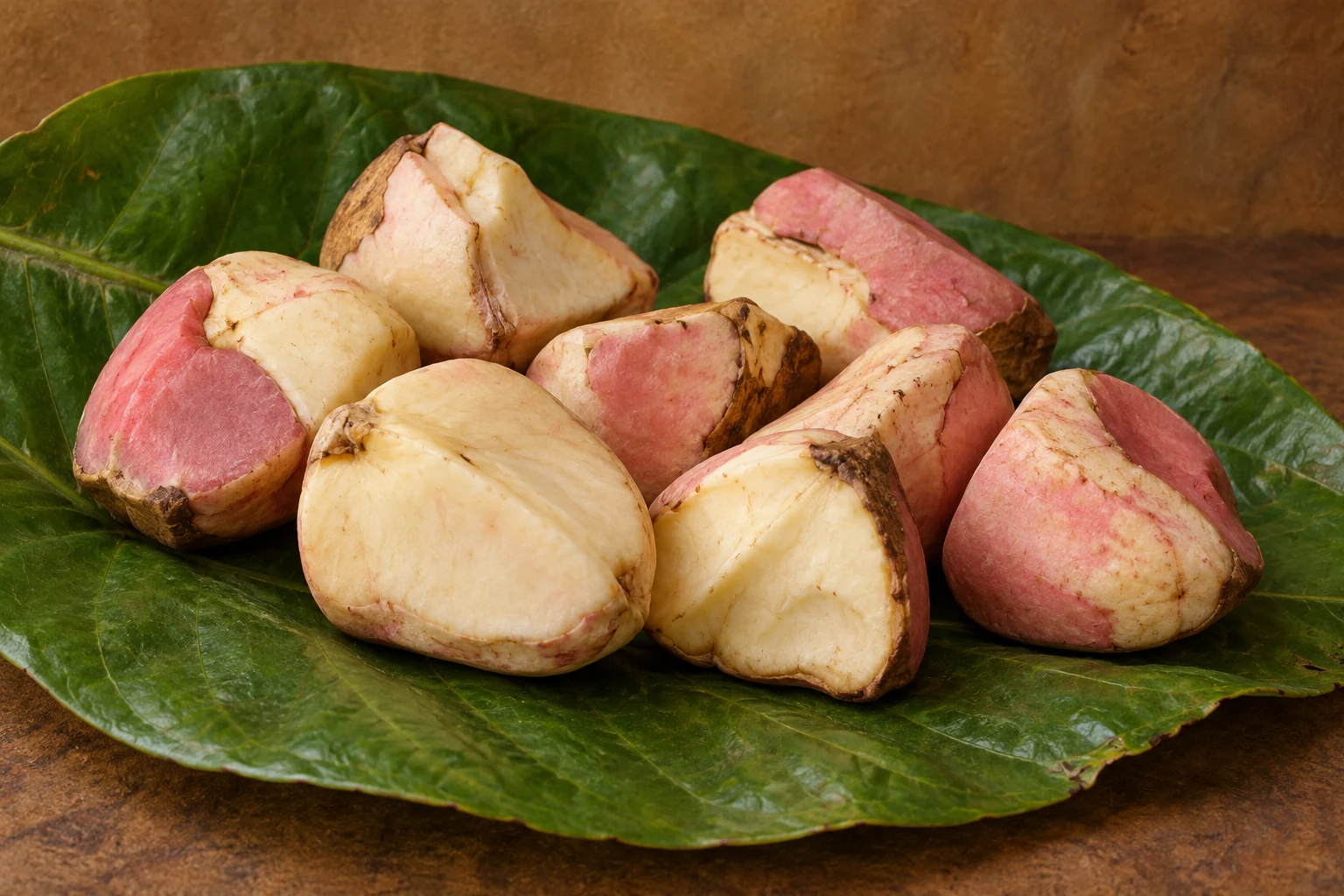
A nut with several kinds of life
The botanical material matters. Tilo identifies Obì abàtà with Cola acuminata, a recognized plant name in Kew's botanical resources. “Kola” is also an ordinary name used across more than one species and context; botanical identification alone cannot determine a material's suitability for a particular rite. The religious term concerns a plant in a relationship of use and recognition. Kew supplies taxonomic context, while the relevant community supplies the explanation of why a certain nut, condition or configuration belongs in its work. Royal Botanic Gardens, Kew, Cola acuminata.
Religious studies scholar Funlayo Easter Wood examines this multiplicity in Objects and Immortals: The Life of Obi in Ifa-Oriṣa Religion. Her dissertation abstract places kola in human exchange and religious relationship, and describes Obì as both a material object and a divinity. Only the abstract and repository record were consulted here. Even at that limited scope, her framing gives a crucial correction: to understand Obì, one must ask how people relate to it, rather than assuming its entire meaning lies in the geometry of a fall. Harvard University repository.
This is why the everyday and the sacred should not be made into sealed compartments. Something that can be shared or handled in ordinary life may also enter a demanding religious relationship. Conversely, seeing kola in a shop does not explain its consecrated use. A reader who learns only a chart encounters one thin layer of a much larger field. Its material familiarity can encourage attention and gratitude; it should not encourage the presumption that religious familiarity has already been acquired.
Why the four-lobed form matters
Tilo's book centers the four-lobed form while acknowledging other kinds and configurations of kola. It discusses distinctions between segments described as masculine and feminine, along with the direction and relation of open pieces. These descriptions show that interpretation can exceed a bare count of exposed faces. They also show why a generic four-counter simulation loses information. If the material carries recognized differences among its parts, treating all four as identical units changes what can be seen and therefore what a taught procedure can establish.
The gendered terminology belongs to a religious classification of material forms. It should not become a claim that every human man must be active, every woman passive, or every relationship organized through a fixed heterosexual template. Tilo's comparative exposition sometimes moves between gender, light and darkness, activity and receptivity. Those are interpretive associations to examine at their stated scope, not clinical facts or permissions to diagnose a client's identity. A careful interpreter distinguishes the classification used in a procedure from assumptions about the person seeking help.
Four pieces can also be described at different levels. A broad account may group outcomes by the number showing a particular face. A finer account may distinguish which pieces those are, where they point and whether another piece interrupts a relation. These levels should not be mixed casually. A pattern described as balanced at one level may require further discernment at another. The apparent simplicity of the instrument is therefore compatible with demanding learning; a small set of objects need not mean a small body of knowledge.
Kola and coconut are a comparison, not one plant
In Cuban and other diaspora settings, the name obí can be used for an oracle employing coconut pieces. A material adaptation may preserve a religious function while changing the object through which it is carried. It is useful to retain both facts: a connection is recognized, and the plants are different. Describing coconut as kola obscures the adaptation. Declaring that adaptation impossible would equally ignore the capacity of communities to establish continuity under new conditions. The applicable judgment belongs to the tradition in question.
Tilo also describes manufactured pieces combining coconut shell and cowrie elements. He distinguishes these aids from fresh Obì in particular uses. A durable representation can be convenient for demonstration, travel or study, yet convenience does not establish that it is accepted for every offering or ceremony. What is being represented, what has been omitted and what the particular house recognizes are separate questions. A public article can explain that difference without specifying how a reader should manufacture or consecrate a substitute.
Material substitution has a human history. Access to plants, movement across borders, storage and the availability of knowledgeable suppliers affect religious life. These pressures do not make every change arbitrary. They make the role of custodians more important, because someone must know which continuities can be maintained and which functions require the original material. For readers outside an established house, the responsible response to difficulty obtaining kola is a question to the relevant teacher, not an improvised claim that all four-piece sets are spiritually equivalent.
What is a confirmation asking?
An Obì consultation may ask whether a proposed offering or an action within religious work is accepted. It can also form part of a broader relationship with Òrìṣà, Orí or ancestors, according to the practice concerned. “Accepted” is therefore an answer to a particular matter addressed to a particular presence. It is not necessarily a statement that the client is spiritually superior or that every future action is approved. The object of the question must remain attached to the answer if that answer is to be understood later.
Confirmation can be confused with reassurance. A person might want proof that nothing will go wrong, that they have never made a mistake, or that an absent person secretly agrees with them. Those desires do not automatically form appropriate questions for a religious procedure. The discipline lies partly in learning what is actually being asked. Has a specific action been completed? Is another step needed within this rite? Is the question about an obligation the client can understand and accept? These are different from demanding unlimited certainty.
The broader human lesson is not that uncertainty disappears when a small oracle answers. It is that a question can become more exact. An ordinary person can apply that lesson reflectively by distinguishing intention from action and approval from outcome. Such reflection is not itself an Obì consultation. It helps explain why precision matters when approaching one: a clear answer to an unclear question may leave a person with very little usable understanding, however strong their first feeling of reassurance.
Five broad outcomes do not make a universal table
Introductory accounts often group four-piece falls into five broad classes, ranging from all exposed faces of one kind to none. Names including Aláàfíà, Etawa, Ejife or Eyife, Òkànràn and Òyèkú appear in diaspora teaching, with variation in spelling, meaning and the need for further confirmation. A public reader should resist converting that familiar vocabulary into a single answer key valid in every setting. Similar names can be carried through different local histories, and a translation such as “yes” may conceal significant conditions.
Tilo's introductory table itself needs to be read cautiously: its treatment of the two-open configuration should not be exported as a settled pan-traditional rule. The book also develops finer distinctions that cannot be recovered from a five-row summary. The productive response is to preserve the question of lineage and procedure, rather than choosing whichever short table produces the answer a reader prefers. A source-led introduction can explain why a chart is incomplete without reproducing disputed instructions as if publication alone resolved the matter.
This has practical consequences for records. A person should retain the term used by the responsible practitioner and their explanation of its meaning on that occasion. If further confirmation was part of the method, the confirmed result matters. A detached photograph cannot necessarily show the question, the status of an intermediate fall or the rule that concluded the inquiry. Those absences should remain absences. Neither a later reader nor an app should invent the missing procedural history in order to make a record appear complete.
Why a count can lose information
A simple mathematical comparison clarifies the difference between broad classes and finer configurations. If four distinguishable positions each admit two values, sixteen arrangements are possible. Group them only by how many have one value, and they collapse into five classes. Several different arrangements then share a count. This is a statement about classification, not a casting rule. It shows why two descriptions can agree about the number of open pieces while preserving different amounts of information about their relationships.
Religious interpretation adds dimensions that mathematics cannot supply by itself. The pieces may have recognized differences, the field may have an orientation, and the question may require a particular kind of confirmation. None of those meanings follows simply from the arithmetic. Conversely, acknowledging them does not make counting irrelevant. It places counting within the wider method that determines which distinctions matter. The student learns to ask what information a summary retained and what it discarded before treating that summary as a complete record of an encounter.
Spatial interpretation requires a taught orientation
Tilo's detailed exposition pays attention to direction, obstruction, overlap and the relative position of pieces. These features make his treatment more than a binary exercise. A piece can stand in a meaningful relation to another piece or to a defined field. The relevant orientation must therefore be known before interpretation begins. Rotating a photograph, reversing a diagram or translating “right” without saying whose right it is can alter the record being interpreted. Visual accuracy and religious competence are connected, but neither can substitute for the other.
The same principle applies to symbolic geography. A board's upper and lower areas may acquire a taught significance, but that does not prove every divination board everywhere uses identical cardinal, elemental or ancestral assignments. Tilo presents a particular interpretive arrangement. It should be attributed as such rather than used to declare that a direction naturally and universally means departure, return or danger. An assigned relation can be coherent within a system without being a property of space independent of the system.
For a student, this is an invitation to slow observation. First describe what is visible; then identify the recognized relation; then ask what the tradition says that relation establishes. Jumping straight from appearance to a dramatic personal claim removes the steps that make interpretation accountable. The study of signs and divination develops this distinction further. It applies to a ritual signature as much as to a fall of pieces: seeing a meaningful form is only the beginning of learning what makes it meaningful.
Obì, Ifá and cowries have different scopes
Obì may be used within a religious environment that also employs Ifá or cowrie divination. Sharing that environment does not make the instruments interchangeable. Ifá's Odù configurations are connected to a large transmitted corpus, while Mérìndínlógún and Brazilian shell practices have their own procedures and repertories. Obì can have an indispensable confirming role without being expected to perform every task assigned to another oracle. A distinction of scope is not a judgment that one sacred instrument has less dignity.
Some modern explanations map Obì outcomes onto principal Odù categories. Tilo discusses such a coding approach. That comparison must not be mistaken for proof that an ordinary Obì fall establishes a person's initiation Odù or reproduces a complete Ifá consultation. Mapping one set of forms to another is a methodological act. Its authority and purpose need explanation. The Ifá and búzios comparison illustrates why a shared material or name does not determine an entire divinatory procedure.
An enduring personal sign also differs from a response to a focused question. Someone may hear the name Òyèkú in more than one context without having received the same kind of statement each time. In particular, a difficult or closed response should not be turned into a lifelong verdict through a name alone. The guide to life Odù and witnesses follows the importance of ceremony, function and duration. Keeping those facts intact protects religious meaning and helps the person receiving counsel understand its actual reach.
The head, the shrine and the relation being tended
Obì's role in tending Orí places it beside questions of personal direction and responsibility. Orí is not simply an orixá personality label. A museum example of an ilé-orí shows a shrine through which a person cultivates a relationship with the inner head, with kola among the materials named in its care. The record is evidence for a particular material and religious context, not a universal prescription for constructing a shrine. The Metropolitan Museum of Art, “Ilé-orí shrine with ìbọrí.”
The Orí reference study offers a fuller path into that subject. Here the relevant distinction is between an answer received and the life that must respond. A confirmation cannot live a person's promises, repair every relationship or exercise judgment for them. Attention to the head need not become a demand for isolated self-sufficiency either. Priests, relatives, a religious house and people affected by a choice may all belong to the person's responsibility. Inner direction and social belonging can develop together.
That point also changes the way one approaches a shrine. The question is not only which materials are present, but who keeps the relationship and what obligations their care expresses. An offering and a confirmation belong to that continuing work. Readers can follow shrines and sacred presence for the comparison with ancestors, Vodun and Kongo settings. There is no need to give every tradition a translated Orí in order to recognize that sacred relationships require human attention, memory and maintenance.
Listening beyond the visible fall
Obì is also present in performance contexts. Joseph Akin Osunniyi's study of bàtá musicians in Oyo describes kola divination as a means by which musicians seek spiritual direction in their work. The article's abstract reports interviews and participant observation; the full article was not consulted here. Its scope is specific, and it usefully counters the assumption that divination occurs only in a private client session. It can enter the preparation and understanding of a shared artistic and religious event. Journal of African Arts and Culture.
That setting invites a broader question about attention. A photograph can preserve pieces, but not necessarily the names spoken, the rhythm of an occasion, the participants' obligations or what experienced listeners recognized. Wood's dissertation abstract likewise calls attention to movement and hearing in religious knowing. These are scholarly invitations to take embodied knowledge seriously, not proof that any sensation authorizes an interpretation. An unfamiliar observer should be curious about what knowledgeable participants attend to before declaring what the experience means.
There is a useful personal analogy here, clearly offered as reflection: people often think they have listened when they have merely extracted a verdict. A conversation about acceptance may also concern whether an action was approached carefully, whether a promise was understood or whether responsibility was displaced onto someone else. Studying Obì can make those questions visible without turning ordinary reflection into a ritual claim. The aim is a fuller quality of attention, proportionate to what a person actually knows and has undertaken.
A hypothetical question about a promise
Imagine, explicitly hypothetically, a person who has promised to support a family celebration and is now unsure they can attend. They are tempted to seek a spiritual answer before admitting the difficulty to their relatives. An established religious relationship might provide a legitimate context for consultation, but no general chart can decide the matter for them. There are already concrete facts to face: what was promised, who is depending on them, what changed and what alternatives can be offered. Religious discernment does not require those facts to vanish.
If they consult an authorized practitioner, the useful record would preserve the actual question and response, together with any obligations explained. If they only read about Obì, they can still reflect on their wish for an external answer. Are they seeking guidance, permission to avoid an awkward conversation, or reassurance that their relatives will not be disappointed? Those motives can coexist. Recognizing them does not invalidate religious seeking; it makes a person more able to bring an honest question and hear an answer that may require action.
The Ask Ifá companion can help clarify a question or explore the published themes discussed here. It cannot cast an authorized Obì oracle, identify a received Odù, establish ritual acceptance or confer initiation. Obì's apparent smallness is part of what makes the subject demanding: a few material pieces can belong to a considerable relationship. Learning to respect that relationship is a substantial beginning, even before a seeker is ready to take on any further religious responsibility.
Sources and further reading
- Tilo Plöger de Àjàgùnnà, Divination with Obì Abatá. Supplied text consulted, including material distinctions, broad configurations, spatial interpretations and proposed Odù coding. These are read as situated teaching; disputed answer equivalences are not reproduced as universal rules. Find the book.
- Funlayo Easter Wood, Objects and Immortals: The Life of Obi in Ifa-Oriṣa Religion, Harvard University dissertation, 2017. Abstract and repository record consulted, not the full dissertation.
- Joseph Akin Osunniyi, “Kola Nut Divination in Bata Drumming Performances in Oyo, Nigeria”, Journal of African Arts and Culture, 2025. Abstract consulted, not full article.
- Royal Botanic Gardens, Kew, Cola acuminata. Taxonomic search record consulted; botanical identification does not establish ritual suitability.
- The Metropolitan Museum of Art, “Ilé-orí shrine with ìbọrí”. A specific object record and curatorial interpretation.
- DAILY IFÁ Academy collection. Further study across the collection.