
Ifá and jogo de búzios are related religious fields, but they are not two names for one interchangeable oracle. Classical Ifá works through Òrúnmìlà, recognized Odù configurations and a transmitted corpus interpreted by trained specialists. Mérìndínlógún, associated with sixteen cowries, has its own configurations and divinatory literature. Jogo de búzios is a broader Portuguese name for shell divination, especially familiar in Candomblé. A connection through Yorùbá religious history does not erase differences between these systems or between the houses that carry them.
The distinction matters when someone asks which oracle can identify an orixá, explain a recurring difficulty, disclose a personal sign, or guide a ritual decision. The answer depends on the religious setting and the scope of a consultation. It cannot be settled by calling one instrument stronger or the other simpler. This article examines instruments, specialists, signs and consequences, drawing particularly on Bàbálórìṣà and Bàbáláwo Tilo Plöger de Àjàgùnnà's Ifá writing and comparative work. It offers orientation for readers seeking a real conversation with a religious house, not a method for conducting either oracle.
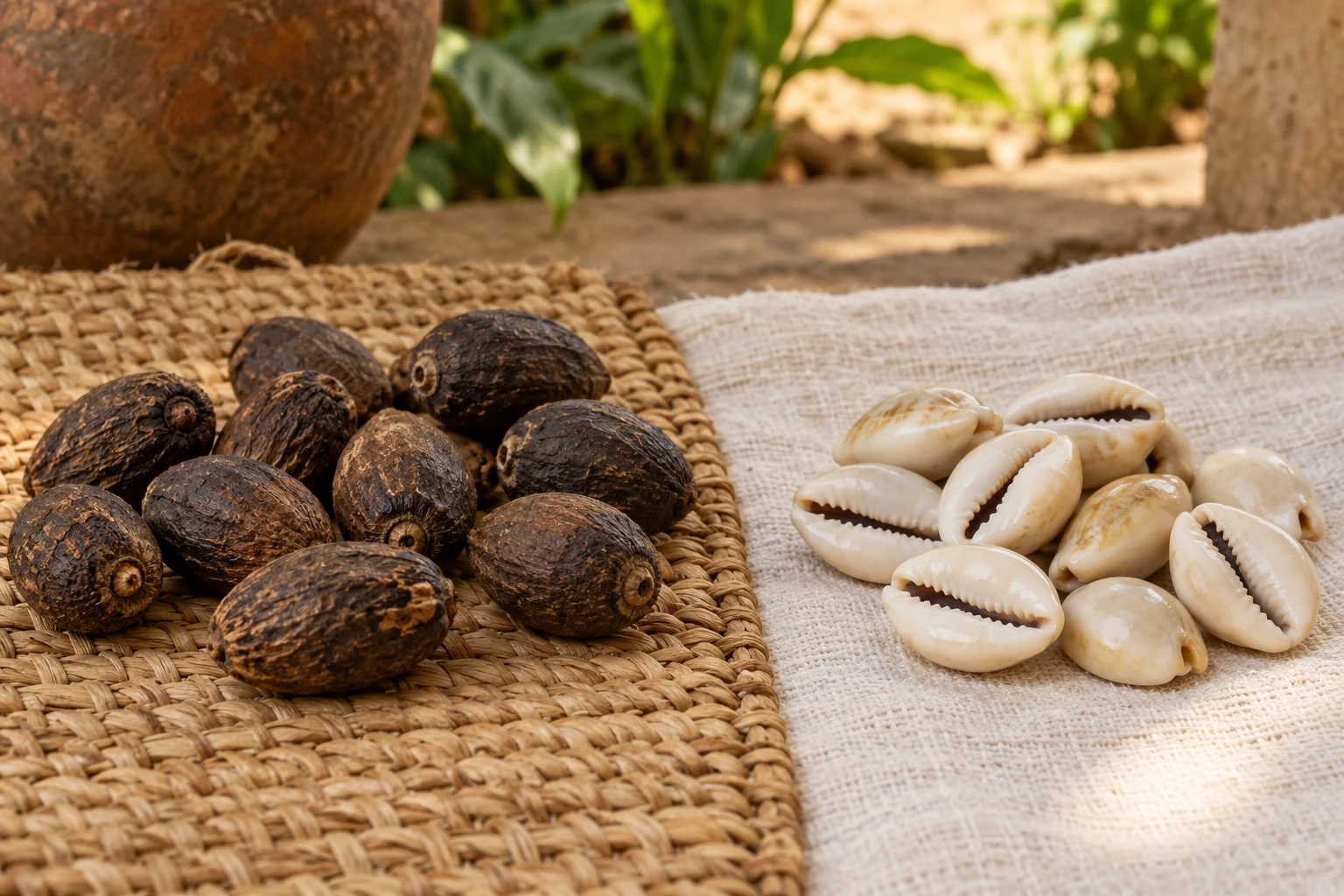
What the names tell us
Ifá can name a divination system and its body of knowledge in relation to Òrúnmìlà. The name brings together a religious understanding of wisdom, particular procedures and the Odù corpus. UNESCO's account identifies signs and transmitted verses as central features. It therefore supports an account of Ifá that includes learned interpretation, rather than treating the visible instrument as the whole system. It does not prescribe the exact order of every consultation in Africa or the diaspora. UNESCO, “Ifa divination system.”
Mérìndínlógún, also written Merindilogun without tone marks, points to a sixteen-cowrie oracle. Portuguese jogo de búzios literally places the shells in the name of the activity. In everyday use, that expression can encompass house-specific practices whose theological explanations and detailed procedures differ. A Brazilian practitioner may work in a Ketu Candomblé setting, another nation of Candomblé, or a different religious environment. Learning the name of the instrument should begin a question about that environment rather than end it.
The words Odù and orixá likewise travel without always retaining precisely the same practical distribution. An Odù name found in two systems establishes a linguistic and religious connection worth investigating. It does not establish that their numerical ordering, associated stories, follow-up questions or permissions coincide. A clear comparison retains the actual terms used by a practitioner, asks how they operate in that house, and resists translating every difference into a defect or a corruption of an imagined single standard.
The instruments create different kinds of record
Characteristic Ifá instruments include the ọ̀pẹ̀lẹ̀, a divination chain with eight two-faced elements, and ikin, sacred palm nuts. With ikin, the diviner records a configuration on a tray. The instrument does not supply an illustrated story: a recognized arrangement leads into an Odù and its associated knowledge. The Smithsonian's divination-cup record situates palm nuts, containers, trays and tappers within the work of a babaláwo. The ensemble makes visible the relation between sacred materials and a specialist's practice. National Museum of African Art, “Divination cup.”
In a sixteen-cowrie system, the fall of the shells is read through the relevant procedure and its recognized categories. A count can matter, and subsequent throws may qualify or develop an answer. That description remains deliberately general because a comparative reference should not pretend to teach a complete ceremony. What matters for the present distinction is that sixteen loose shells and a chain of eight elements do different technical work. Both may bring a diviner into a larger narrative field, while reaching it through different procedures.
Materials alone are insufficient for identification. Tilo's Ifá book also describes a cowrie technique attributed to Balogun Awolalu Onisegun Ifase of Ode Remo, using repeated parity outcomes to construct an Ifá configuration. That is a specifically attributed method in the book. It should not be silently equated with the ordinary sixteen-cowrie oracle simply because the objects are cowries. This example is particularly instructive: to understand a result, we need to know the operation performed, not merely what a photograph shows in someone's hands.
An Odù is more than a keyword
In Ifá, an Odù is a recognized category connected with many ẹsẹ Ifá. The category is not exhausted by a phrase such as “success through patience” or “danger in relationships.” A narrative may describe people who face a difficulty, receive counsel and respond with greater or lesser understanding. The interpreter must work with that narrative knowledge and the occasion of consultation. A short English summary can be useful for orientation, but it is an inadequate substitute for the circumstances and interpretive reasoning that make counsel relevant.
Cowrie divination also deserves to be understood through its substantial literature. William Bascom's Sixteen Cowries presents Yorùbá texts with English translations of the sixteen-cowrie system. The publisher's description was consulted here, rather than the full volume. That limited evidence is still enough to make an essential bibliographic correction: cowrie interpretation is not merely counting shells and consulting a generic list. There are texts, interpreters and a history of transmission to study. Indiana University Press, Sixteen Cowries.
Shared names can encourage a reader to move too quickly from one collection into another. A story filed under an Odù in an Ifá book does not automatically become the correct text for a shell consultation bearing a related name. Nor does an internet list establish what a Candomblé house taught in a particular case. A useful question is how the practitioner explains the connection: which material was inherited, which version is being used, and what role that version has in this consultation.
Who interprets, and who recognizes that authority?
Babaláwo is a familiar title for an Ifá specialist. Some lineages recognize women specialists under titles including ìyánífá; the distribution of offices and permissions must be described in its actual setting. Initiation, further training, acknowledged competence and the right to conduct a particular ceremony are related but distinguishable matters. Receiving a ceremony does not immediately supply an entire corpus of memorized verses or experience in interpreting difficult human situations. The amount and form of learning involved should remain visible in any explanation of priestly work.
In Candomblé Ketu, iyalorixá and babalorixá name senior religious offices, commonly rendered mãe-de-santo and pai-de-santo. Duke University's Sacred Arts project places these titles in its account of Brazilian Candomblé. That context does not make them alternative spellings of babaláwo. A person may hold more than one recognized religious role, but each role has a history, a community and particular responsibilities. One title cannot serve as automatic evidence of qualification in all the others. Duke University, “Brazilian Candomblé and Umbanda.”
For a newcomer, authority is therefore a relational question: who taught this person, which house recognizes their work, and what do they say they are authorized to do? These questions need not be hostile or intrusive. They help someone understand the kind of religious relationship being proposed. A photograph with sacred objects, a confident vocabulary or a large collection of diagrams cannot answer them by itself. Equally, the absence of public display does not prove a lack of knowledge; some competence is recognized through long participation in a community.
Brazil has its own religious histories
Candomblé is not simply an African rite transplanted unchanged, and it is not one uniform practice throughout Brazil. Ketu, Jeje and Angola identify significant differences of religious inheritance, language and divine names, with further variation among houses. A comparative explanation should avoid treating every shell consultation as if it necessarily belonged to a single Ketu theology. The study of Candomblé nations provides a wider orientation to that diversity and to the limits of using orixá vocabulary everywhere.
Modern African and transatlantic Ifá networks also encounter Brazilian houses whose shell practices have their own continuity. These encounters can create fruitful learning and disagreement. The existence of a more recently established Ifá institution does not by itself decide the authority of a longstanding Candomblé house; the age of a claimed root does not settle every present dispute. Tilo's Where the Sacred Takes Hold is helpful in directing attention to the actual keepers of relationships, rather than presuming one title controls every neighboring shrine.
This history gives a reader a practical task. Ask which religious relationship a proposed consultation would create. Is the person being advised as a visitor, a member of a terreiro, an initiate, or someone considering further obligations? Different positions can entail different expectations. A public reference article cannot adjudicate every disagreement between houses. It can make those relationships legible, so that someone does not mistake an invitation to study another tradition for a declaration that their existing community has no knowledge or standing.
Cuba needs its own comparison
Lukumí or Ocha and Cuban Ifá share a social and historical landscape while retaining distinctions of office and ritual work. Harvard's Pluralism Project identifies ritual communication with oricha as central to Lukumí life. Its brief entry supplies broad context, not a comprehensive account of divinatory jurisdiction. Cuban terms such as diloggún, Mano de Orula, Itá, Toyale and Testigos therefore need explanation within Cuban practices, rather than being distributed indiscriminately across every Yorùbá or Brazilian setting. Harvard Pluralism Project, “Lucumi.”
In particular, the principal-sign-and-two-witnesses arrangement familiar in Cuban accounts should not become the assumed form of every Ifá consultation worldwide. A principal sign can have different status depending on whether it belongs to an ordinary consultation, an initiation or another ceremony. Further signs can be witnesses, responses to alternatives or part of a separate phase. The number of names on a record is insufficient to identify their function. The life Odù and witnesses study examines why preserving those distinctions matters.
Neither should a claim about one Ocha house's shell procedure be generalized to all Candomblé houses. Atlantic connections are real, but Brazil and Cuba have different institutions, histories and internal debates. The comparison becomes stronger when it identifies a bridge and then follows what changed across it. The goal is not to decide which community is a more authentic copy of another. It is to understand what a particular community has inherited, developed and continued to recognize as religiously binding.
Orientation is not a permanent verdict
Terms such as iré and ibi, and Cuban forms such as osogbo or osorbo, concern orientation, blessing, obstruction or adverse conditions within particular procedures. They should not be treated as a universal pair of labels mechanically fixed by an Odù name. Tilo's comparative report shows why the initial sign and subsequent clarification must be distinguished. A narrative may contain a warning while a consultation has a favorable orientation; a favorable possibility can still call for careful conduct. The applicable relationship comes from the procedure and its interpretation.
Ìbò, the objects associated with choosing or clarifying alternatives, also require context. The same material can have different assigned work in different questions or systems. A stone is not universally “yes,” and a shell is not universally “no.” A comparative article should describe the existence of clarification without circulating an allegedly universal answer key. What the object represents, how the answer is selected and which question is being resolved are all part of the relevant method. Detached from those facts, a chart can mislead more efficiently than prose.
For the person receiving counsel, the human implication is substantial. A warning about a condition need not be a judgment that they are a bad person or destined to fail. Likewise, a blessing should not be read as permission to disregard other people or abandon ordinary responsibilities. Ask what the statement concerns, how long its scope was said to extend and what response was actually advised. These are questions about understanding received counsel, not an invitation to reinterpret a priest's answer into whatever is most reassuring.
Religious identity is not a personality test
People often arrive at these subjects through the question “Which orixá is mine?” In some communities that question has a precise ritual place; in popular culture it can become a collection of personality traits. Liking rivers does not, by itself, establish a ritual relationship with Ọ̀ṣun, and being decisive does not make someone a child of Ògún. An association can be meaningful as reflection while remaining insufficient as religious identification. A consultation and its house-specific responsibilities must be described on their own terms.
Orí adds another essential distinction. A person's inner head and destiny should not be collapsed into a temperament assigned to an orixá. Tilo's comparative writing emphasizes that personal direction, divine relationship and community obligations can coexist without becoming one entity. The Orí reference study offers a fuller discussion. This distinction allows a person to consider habits and choices without believing that a sacred affiliation excuses every behaviour or supplies a finished explanation of who they can become.
Consider an explicitly hypothetical seeker who receives conflicting online answers about an orixá and then visits a terreiro. The most useful next conversation is not a contest between search results and the priest. It concerns what the house recognizes, which procedure was actually performed, what the seeker was told and what remains undecided. If a previous consultation belongs to another system, its origin should be preserved. Combining all the results into one dramatic destiny profile can obscure the religious facts and increase the seeker's anxiety.
An instrument can travel before its knowledge arrives
The Horniman Museum records a jogo de búzios set associated with the Brazilian diaspora in Italy. Its account distinguishes the prepared material set from the religious learning and ceremony its former holder did not complete. The case is valuable precisely because the objects look complete. Their presence could easily invite an outsider to assume that the holder had acquired the corresponding office. The museum instead preserves a difference between possession of the ensemble and recognition as someone able to interpret it. Horniman Museum, object 2017.34.7.2.
That distinction applies beyond museums. Diaspora life can move materials, books and teachers at different speeds. A person may have access to an instrument before finding sustained instruction, or may retain knowledge while losing access to familiar materials. Neither circumstance is adequately described through the objects alone. For a seeker, the practical question is which relationship of learning is available and recognized. An instrument can support that relationship, but cannot complete it by arriving in the post.
What a consultation can ask of you
An oracle's answer may concern an offering, an obligation, a change of conduct, further discernment or a relationship requiring attention. Different traditions understand and establish those responses differently. Public discussion should acknowledge that ritual consequence is part of religious life without turning it into a set of instructions for strangers. The client needs a clear explanation from the responsible practitioner about what was prescribed, who is competent to conduct it, and what responsibilities the client is accepting. Consent requires intelligibility, not mastery of every technical detail.
There are also ordinary questions that remain humanly unavoidable. What promises have been made? Who bears the cost of a decision? Does a proposed response fit the actual concern brought to the consultation? These questions do not reduce divination to secular advice; they recognize that religious counsel enters a life already shared with others. A person who seeks guidance about a relationship cannot erase the other person's agency. A person seeking certainty about work still needs to understand the commitments they may be making.
The Personal Exploration companion can help organize these questions and reflect on published themes before or after a conversation. It cannot conduct Ifá or jogo de búzios, verify a received Odù, confer initiation or overrule a house's ritual record. Used within that scope, study supports better listening. It becomes possible to ask for clarification without pretending that a general explanation of a sign carries the same authority as the consultation in which it appeared.
Language also deserves patience. Yorùbá tone marks, Brazilian spellings and Cuban pronunciations can help identify transmission, but spelling alone does not settle a procedural disagreement. Preserve the name a practitioner used, then ask what they meant by it. Correcting an accent cannot recover a missing question or explain an undocumented position in a consultation.
A comparison that preserves both traditions
The most reliable distinction is therefore a combination of instrument, corpus, office, occasion and consequence. Two consultations may share a name or a concern while differing on several other dimensions. One person may be qualified in both systems, yet their qualification should be explained rather than presumed. A respected book may compare both, yet its proposed correspondences still need attribution. These distinctions are small acts of precision with large consequences for how a seeker understands the help being offered.
For wider orientation, the comparison of divination systems places Ifá and cowries beside Obì, bones and Tarot. None of these systems becomes clearer through a simple ladder from primitive to advanced. Technical complexity, breadth of literature and religious jurisdiction are different questions. A small instrument can belong to a demanding religious relationship, and a large catalogue of meanings can be used without much understanding. The relevant question is how knowledge is transmitted and responsibly brought to a particular person.
Ifá and jogo de búzios meet through deep histories of Yorùbá and Atlantic religion. Their differences remain part of that inheritance. Learning those differences gives a reader more than correct vocabulary: it makes room for the people who actually carry the knowledge, the houses that sustain it and the client who must understand what has been said. The next step is a better situated conversation, with the actual method named and the responsibilities of everyone involved made as clear as possible.
Sources and further reading
- Tilo Plöger de Àjàgùnnà, Odù Ifá Divination; comparative report on personal Odù and supplementary signs; Where the Sacred Takes Hold. Supplied texts consulted. House-specific descriptions and authored comparisons are retained at that scope. Related books.
- UNESCO, “Ifa divination system”. Broad institutional account, not a procedural standard for every house.
- Smithsonian National Museum of African Art, “Divination cup”. Context for Ifá implements.
- William Bascom, Sixteen Cowries, Indiana University Press. Publisher description consulted; full book not consulted here.
- Duke University, “Brazilian Candomblé and Umbanda”. Religious and institutional context.
- Harvard Pluralism Project, “Lucumi”. Concise contextual entry, not evidence for every Cuban divinatory procedure.
- Horniman Museum, object 2017.34.7.2. Collection account of a diaspora divination set and its interrupted intended use; not a general account of every Italian or Brazilian house.
- DAILY IFÁ Academy collection. Further teaching in the wider collection.