
A book can preserve the wording of a particular telling, make it available across distance, and give a reader time to return to a difficult passage. It cannot, by itself, reproduce the occasion of speech or the relationship through which someone learns to understand and use that telling. Reading Ifá well begins by recognizing both achievements: what the page makes possible, and what it asks us to seek beyond it.
This matters when two books present different versions of a narrative, when an English explanation seems much simpler than the Yorùbá beside it, or when a sentence circulating online has lost its source. The useful question is precise: what kind of record is this, and what can it establish?
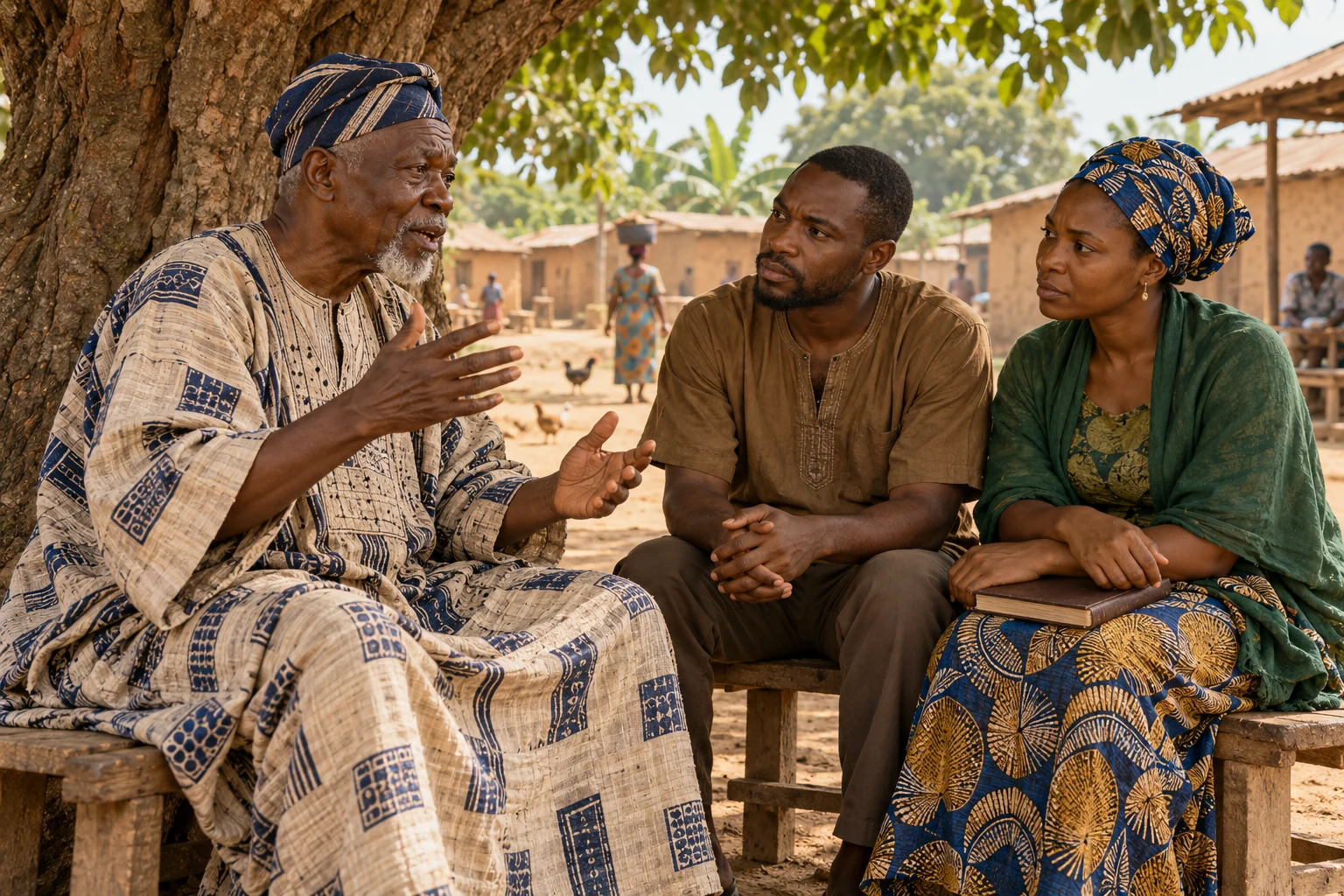
A page preserves a particular encounter with the tradition
UNESCO describes Ifá as an extensive corpus organized through 256 Odù, with verses called ẹsẹ transmitted among practitioners and recited in poetic language. Its account connects this literature with history, language, beliefs and social life. That description provides a starting point for reading: an individual printed selection belongs within a much larger transmitted repertoire. It does not exhaust an Odù simply because it occupies a chapter carrying that name. [1]
Consider what happens when a reader opens a collected edition. The volume has a beginning and an end. Its contents page gives the impression of an ordered whole. The headings and numbered entries make each selection easy to find. Those are valuable editorial achievements, but the physical completeness of a book is different from completeness of knowledge.
The distinction has immediate consequences. A missing narrative may lie outside an editor’s selection. A short entry may be a summary. A passage may have been translated from a previous publication rather than transcribed from speech. Before treating absence as evidence that something does not belong to Ifá, a reader needs to know what the collection set out to include.
The same care applies to the word “original.” It can mean the Yorùbá text printed opposite a translation, the earliest edition available to an editor, or a particular recorded telling. These are different claims. A responsible edition should make clear which one it is making. A reader can ask that question without demanding that every publication settle the entire history of its material.
Printing has a purpose—and a point of view
The movement into print has never been only a matter of changing the surface on which words appear. In his study “‘Writing’ and ‘Reference’ in Ifá Divination Chants,” Adélékè Adéẹ̀kọ́ discusses the missionary context surrounding E. M. Lijadu’s work and Bishop C. Phillips’s 1897 response. Publishing Ifá narratives could serve a project of Christian comparison and conversion, even while their intellectual seriousness was being acknowledged. [2, pp. 283–285]
That history suggests a practical reading habit: look at the introduction as well as the narratives. Who wanted this collection to exist? Whom was it meant to persuade or teach? What did its editor consider worthy of explanation, and what was assumed to be already understood?
These questions do not require dismissing a source because its author had commitments. They make those commitments available for consideration. A book written for religious instruction, a linguistic study and a comparative argument can all contain valuable material. The reader should be able to see what each is trying to do.
A beautifully presented modern edition also has a point of view. Its headings, illustrations, glossary and selected extracts guide attention. A chapter titled around a single virtue, for example, encourages a different first reading from one arranged around a named witness. That is an observation about editorial presentation, not a claim that one arrangement is always wrong. The question is whether the presentation helps readers understand the limits of what they are seeing.
Keep the text, translation and commentary distinguishable
A particularly useful feature of a bilingual edition is the possibility of returning from the translation to the language it translates. The Bibliothèque nationale de France records Wande Abimbola’s Ifa divination poetry, published by NOK in 1977, as an edition with Yorùbá text and facing English translation. Its catalogue identifies the roles of translator, editor and writer of the introduction. This bibliographic record establishes the edition’s arrangement; it does not verify the wording of any individual verse. [3]
Those distinct editorial roles offer a useful model for the reader’s own notes. Keep three kinds of material visible:
| What you are reading | What to ask |
|---|---|
| The presented source text | Which telling or earlier edition does this reproduce? |
| The translation | Who translated it, and what explanations accompany difficult choices? |
| The commentary | Where does the writer begin interpreting, comparing or applying the passage? |
A translation necessarily makes choices. A reader who does not know Yorùbá can still pay attention to how those choices are shown. Are names retained? Is a term translated consistently? Are explanations placed in notes, brackets or separate paragraphs? Does an editor say when a passage has been abbreviated?
An elegant English sentence may communicate an argument clearly while leaving a verbal relationship unexplained. A very literal rendering may preserve a visible connection while sounding awkward. Neither fluency nor awkwardness settles the question of fidelity. What helps is an account of the decision: what was retained, what needed explanation, and where uncertainty remains.
The boundary becomes especially important when a passage is quoted again. An editor’s explanation can gradually become attached to the narrative as though it were part of the transmitted wording. Preventing that confusion is straightforward in principle: retain the distinction when taking notes and when sharing an extract. Identify a paraphrase as a paraphrase. Give a commentator credit for a reading without turning that reading into an anonymous traditional statement.
A difference deserves examination before a verdict
Imagine finding two printed tellings that seem related, but one is shorter and their English conclusions differ. This is a hypothetical reading problem, not a newly supplied Ifá narrative. Before choosing a winner, establish what is actually being compared.
Are both texts translations from Yorùbá? Is one a retelling of the other? Are they attributed to different speakers? Does one omit the opening or closing? Are the editions describing the same religious setting? If the answers are unavailable, the comparison remains incomplete.
Adéẹ̀kọ́’s article examines the relationship between divination signs, narratives and interpretation. His analysis challenges a simple assumption that recognizing a sign yields a single self-explanatory verbal message. [2] For the reader of books, the consequence is to resist treating a familiar heading as sufficient evidence that two passages must be identical.
This does not mean every difference is a legitimate variant. A dropped line, a damaged character or a mistake in a name may be a transcription or production error. Calling everything “variation” would make careful editing impossible. The task is to distinguish a documented alternative telling from a copying problem, and both from an uncertainty that cannot yet be resolved.
Keep the evidence intact while checking. Record the book, edition and page. If comparing digital copies, return to the page image when available; extracted text may not preserve the typography. If a teacher or editor explains a difference, retain the scope of the explanation. “This is how this passage is taught here” makes a more useful record than an unsupported claim about every community.
The reader’s notebook can preserve the missing distinctions
A small source note often does more for understanding than a large collection of unattributed quotations. For each passage worth returning to, record the title and edition, page or stable section, language, translator, and any named source of the telling. Add the religious or geographical setting only where the source actually supplies it.
Then separate what the passage says from what it makes you think. A useful notebook might have a short quotation with a precise reference, a paraphrase in your own words, and a question for further study. The question can remain open. Leaving it open is more honest than completing the record with a plausible detail from memory.
This also makes comparison more productive. Instead of accumulating statements that appear to contradict one another, you can see whether the apparent conflict lies in wording, translation, explanation or application. Sometimes the texts answer different questions. Sometimes there is a real disagreement worth preserving. Either result is more informative than blending the passages until the disagreement disappears.
For a closer discussion of narrative movement within a verse, see Reading Ẹsẹ Ifá: Names, Narrative Structure, and Context. The present question concerns what an edition lets us know about the text we are reading. Narrative interpretation begins on firmer ground when that record is clear.
Access to a text and learning with someone are different achievements
A book offers particular freedoms. A reader can pause without interrupting, compare passages that would be difficult to hold in memory, and return years later to the same page. A good index can make an unexpected connection visible. A translation can begin a serious relationship with material that would otherwise remain inaccessible.
Learning with a knowledgeable person offers a different possibility: a question can receive an answer suited to what the learner has misunderstood. A teacher can hear a pronunciation, ask what a student thinks a passage means, or explain why a general statement does not settle a particular case. A printed explanation can anticipate some questions, but it cannot know which one its present reader needs to ask.
The relationship between documentation and teaching is also visible in UNESCO’s historical safeguarding project for Ifá. Its description joined the collection of material and improved documentation with intergenerational and peer transmission through a school. This is a record of a project, not evidence about the current operation of any school. Its value here is the combination of preservation and teaching within the same stated purpose. [4]
Readers do not need to devalue books in order to respect that relationship. They can use a book to prepare better questions. Which word is uncertain? Which explanation seems to depend on an occasion the edition does not describe? What would need to be heard rather than inferred from an English spelling?
The related study Àyàngalú: The Drum’s Voice and the People Who Learn to Hear approaches skilled listening through another cultural setting. It offers a companion perspective on the work that connects an available sound or object with an understanding listener.
Reading across traditions requires an extra line in the notes
An English-speaking reader may encounter Yorùbá Ifá materials alongside Cuban Lucumí publications and Brazilian Candomblé studies. A shared name or a recognizable religious relationship is a reason to investigate. It is not enough to establish that two texts have the same purpose, authority or setting.
For that reason, record what a source calls itself. Keep local names and titles visible when citing it. If a publication translates an earlier work, distinguish the language of the edition from the location of the material it presents. A Portuguese text does not establish Brazilian provenance simply by being in Portuguese.
These are disciplines of attribution. They allow a comparison to remain specific: this writer, this edition, this account, this setting. They also leave room for relationships that deserve a fuller investigation. Precision need not make the tradition smaller. It makes the terms of a conversation easier to see.
Return to the page with a better question
At the end of a reading session, try asking what the book has enabled you to notice. Perhaps a distinction between a narrative and its commentary has become clear. Perhaps a source note has identified a translation that needs checking. Perhaps the most useful result is a question that can now be put to a teacher without asking them to reconstruct an entire anonymous quotation.
The page has done valuable work in each case. It has made attention repeatable. What matters next is how the reader carries that attention into comparison, conversation and further learning.
An edition earns trust by showing its decisions clearly. A reader answers that care by keeping the text’s provenance and limits visible. That is one way a book can take its place within a living tradition: as something precise enough to return to, and open enough to lead beyond itself.
Continue exploring Ifá, Òrìṣà and the work of interpretation in the DAILY IFÁ newsletter.
Sources and reading notes
- UNESCO, “Ifa divination system”. Institutional overview used for the corpus, recitation and transmission context.
- Adélékè Adéẹ̀kọ́, “‘Writing’ and ‘Reference’ in Ifá Divination Chants”, Oral Tradition 25/2 (2010), 283–303. Relevant discussion of print history and the relation of signs to narratives; historical claims here are attributed to this study.
- Bibliothèque nationale de France, catalogue record for Ifa divination poetry, translated and edited, with an introduction, by Wande Abimbola, NOK, 1977. Used only for bibliographic information and the facing-text arrangement; no verse from this book is reproduced or purportedly verified here.
- UNESCO, “Safeguarding of the Ifa Divination system”. Historical project description connecting documentation and teaching.
The reading methods and hypothetical comparison above are editorial proposals. They are not presented as a universal rule of initiation, a newly translated verse or a report of the author’s personal experience.