
A drum can be heard as sound and still not be understood as speech. Àyàngalú opens a study of the knowledge carried through rhythm, praise and the work of trained musicians. The subject is larger than an instrument’s symbolism. It includes the relationships that allow a community to hear what is being said.
The drum points to trained voice and inherited musical knowledge.
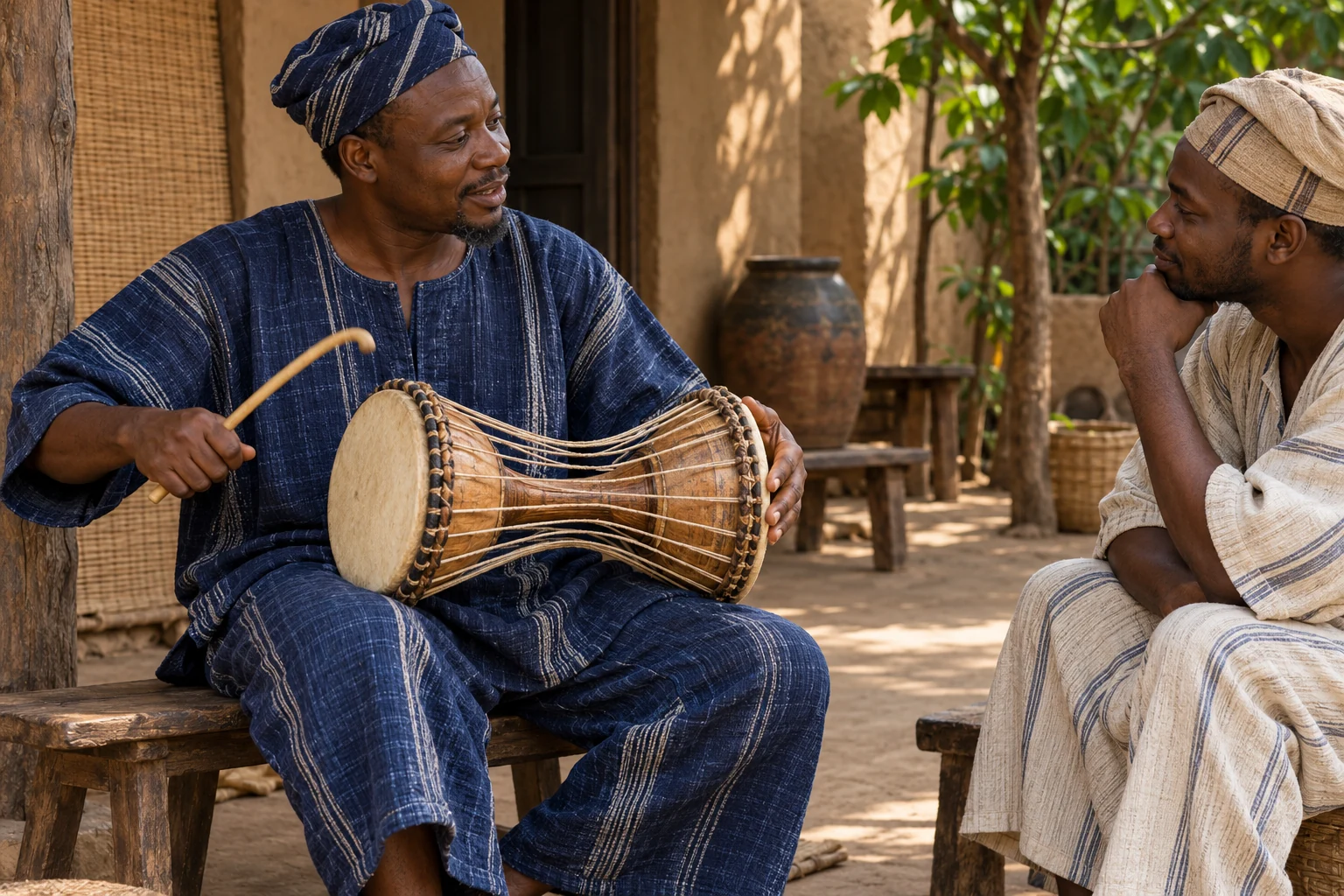
1. Sacred presence, ancestry and musical lineage
Àyàn and Àyàngalú are encountered through accounts of drumming, sacred authority and musicians’ lineages. Original ethnomusicological research discusses the relationship among deity, ancestor and voice in the instrument. Eluyefa’s research provides further context for Yorùbá musical knowledge.
Origin accounts and gendered descriptions vary. A short reference should not turn those differences into one invented birth story. It can instead show why a musical lineage might understand its work as a relation with an inherited presence rather than a skill possessed by an isolated individual.
2. Key theme: the instrument does not speak by itself
The physical drum is one condition of the event. Training, language, repertoire, listening and the setting in which a rhythm is heard also matter. Reducing the subject to a mysterious object can make the musician’s disciplined knowledge disappear.
The contemporary question applies to many forms of transmission. A recording can preserve sound without preserving everything needed to understand it. A written text can preserve words while losing the tone and relationships through which they were first received. Access is valuable, but it is not the same as completed learning.
3. Voice and responsibility
To sound another person’s praise or a community’s remembered history is to take responsibility for how a name enters public life. Music can honor, call, correct and organize attention. It is not made less intellectually demanding because meaning arrives through the body and ear rather than a printed page.
For a modern reader, this challenges an easy division between thought and performance. A musician may be interpreting a relation in real time, making judgments about timing, audience and the significance of the occasion. Listening carefully includes respect for that work and the people who taught it.
4. Religious identity and the scope of this study
Àyàn and Àyàngalú concern a religious and ancestral field of drumming, skilled musicianship and voice. Bode Omojola's public chapter summary describes Àyànàgalú through deity, spirit in the drum and ancestral progenitor of drummers, with the Àyàn name prefix carrying that relationship into musical lineages. This is a specified scholarly account, not a basis for imposing one origin story or gender description on every community. Fámúlẹ̀'s research adds the indispensable performance setting: drums can function as speech surrogates through trained human action and shared linguistic understanding.
The book has no dedicated Àyàngalú chapter. Its crafted matter, sacred pattern and introductory method provide a broader framework for considering the relation between instrument, repetition, embodied knowledge and community. Contemporary psychological interpretation can ask how a person learns to carry a voice that exceeds private expression without losing responsibility for the way it is sounded. That differs from reducing the deity to creativity or treating every percussionist as a devotee. The subject remains religious presence and musical ancestry within particular practices. An expanded article should therefore keep the musician's labor visible, distinguish hearing from understanding and explore why transmission requires relationships as well as preservation of a sound.
5. Knowledge that gives the figure depth
5.1 How does a drum become intelligible speech?
A drum does not become intelligible speech through material shape alone. Fámúlẹ̀ explains how skilled drummers produce patterns that substitute for language and can be understood by listeners who possess the relevant knowledge. That provides a concrete account of performance as interpretation. The musician must know repertoire, context and the relation between what is being sounded and who is present. The article should not imply that every drum has the same capacities or that an untrained listener can recover every message simply by feeling moved.
The contemporary extension is a distinction between access to a medium and participation in a language. A recording may preserve sound while omitting the circumstances through which it was heard as praise, correction or address. Written notation can capture structure without reproducing the whole social event. None of this diminishes recordings or writing; it shows what further learning they can invite. Àyàn's field is therefore valuable for questioning the hierarchy that treats embodied skill as less intellectual than explanation. A performer can be making precise judgments in real time, with consequences for the people whose names and histories are carried. Listening well includes respect for that judgment, not only enjoyment of the audible result or fascination with an instrument's appearance.
Evidence: Bode Omojola / Boydell and Brewer, Cambridge Core, Yorùbá Drumming: Performance Practice and the Politics of Identity, in Yorùbá Music in the Twentieth Century — Public chapter summary identifies Àyànàgalú as deity, drum spirit and ancestral progenitor; Àyàn name prefix and drummers religious relationship; Oláwọlé Fámúlẹ̀ / University of Florida Center for African Studies, Èdè Àyàn: The Language of Àyàn in Yorùbá Art and Ritual of Egúngún — Research on Òkèigbó Egúngún emphasizes drummers, speech surrogate, differentiated ensembles and context; material instrument and ritual roles remain specific.
5.2 What does musical ancestry transmit?
Omojola's account links the deity's name with musical ancestry. That relation gives lineage a practical dimension: people inherit not only a label but a field of work, repertoire, expectations and responsibility. The public summary does not establish that every person with an Àyàn name is a practicing ritual specialist or that family inheritance removes the need for training. The distinction is important. An inherited position can open a path while leaving the work of learning unfinished. Contemporary analysis can ask how someone receives a valued tradition without mistaking entitlement for competence.
The reverse problem also matters: a learner may develop great skill while remaining answerable to teachers and contexts that public recognition tends to erase. The book's relational conception of personhood offers a framework for both tensions. A voice can be individual and inherited at once. Originality does not require pretending that no one taught the performer, and gratitude does not require denying personal judgment. Àyàn's religious field makes those relations visible in a form that cannot be reduced to solitary talent. We can deepen its existing emphasis on transmission by asking what actually passes between generations: sound, language, discipline, permission, memory and a way of responding to the occasion before the musician.
Evidence: Bode Omojola / Boydell and Brewer, Cambridge Core, Yorùbá Drumming: Performance Practice and the Politics of Identity, in Yorùbá Music in the Twentieth Century — Public chapter summary identifies Àyànàgalú as deity, drum spirit and ancestral progenitor; Àyàn name prefix and drummers religious relationship; Oláwọlé Fámúlẹ̀ / University of Florida Center for African Studies, Èdè Àyàn: The Language of Àyàn in Yorùbá Art and Ritual of Egúngún — Research on Òkèigbó Egúngún emphasizes drummers, speech surrogate, differentiated ensembles and context; material instrument and ritual roles remain specific.
5.3 Why differentiate ensembles and occasions?
Fámúlẹ̀ distinguishes ensembles and ritual contexts instead of treating Yorùbá drums as one interchangeable category. His Òkèigbó Egúngún case study gives a particular setting in which music and visual performance must be understood together. This is an important knowledge lesson: extracting a masquerade costume or instrument from its event can make the religious world look like a collection of objects, while its meaning depended on coordinated action. The article should not reproduce a procedural catalogue or claim that one town's organization describes all traditions. What it can show is how different roles become mutually intelligible in performance.
A drummer listens to movement and occasion while also shaping what happens next. The relationship is reciprocal rather than a simple division between active musician and passive audience. Contemporary interpretation can apply this to collective work. Coordination is not always achieved by a central voice issuing instructions; skilled participants may answer changes before they become explicit statements. That responsiveness depends on training and trust, not magical instinct attributed to ancestry. Àyàn's field therefore joins discipline with spontaneity. The strongest performance can be alive precisely because the participants know enough structure to respond without mechanically repeating it. Preservation and improvisation need not be enemies when both remain accountable to the occasion.
Evidence: Bode Omojola / Boydell and Brewer, Cambridge Core, Yorùbá Drumming: Performance Practice and the Politics of Identity, in Yorùbá Music in the Twentieth Century — Public chapter summary identifies Àyànàgalú as deity, drum spirit and ancestral progenitor; Àyàn name prefix and drummers religious relationship; Oláwọlé Fámúlẹ̀ / University of Florida Center for African Studies, Èdè Àyàn: The Language of Àyàn in Yorùbá Art and Ritual of Egúngún — Research on Òkèigbó Egúngún emphasizes drummers, speech surrogate, differentiated ensembles and context; material instrument and ritual roles remain specific.
6. A depth-psychological reading
Interpretive basis: A contemporary application of the wider interpretive framework in Babá Tilo de Àjàgùnnà’s The Orishas and the Human Soul, especially “Before the Òrìṣà Become Archetypes”, “Metals, Tools, Fire, Cloth, Stones, and the Crafted Body of Power”, “Numbers, Colors, Directions, Thresholds, and the Grammar of Sacred Pattern”. No dedicated Àyàngalú chapter. Crafted matter and repetition supply broader method; figure specific religious/music facts come from Omojola and Fámúlẹ̀. Psychology is contemporary application.
6.1 Depth psychology: voice without inflation
A depth psychological lens can examine the difference between having a voice and seeking constant proof that it has been heard. The musical field makes this tension concrete because sound can command attention without necessarily conveying meaning. An illustrative performer may increase volume or display when feeling insecure, even though the occasion asks for precision and listening. The inner question is whether expression serves a relation or has become an effort to abolish uncertainty about one's worth. The book's crafted matter and pattern chapters offer a framework: an instrument carries shaped intention, and repeated structure makes meaning available.
Applied to Àyàn, those ideas suggest that a voice develops through discipline as well as release. This is contemporary interpretation rather than a claim about drummers' personalities. Another person may hold back so completely that inherited skill never becomes an audible contribution. Their challenge is not restraint but permission to occupy a moment. The same symbol can illuminate these different needs because the situation determines what expression is doing. Maturity involves a range of response: sounding clearly, pausing, supporting another voice and accepting that significance need not appear as personal prominence. Àyàn's field becomes psychologically rich when it includes the silence that makes an utterance receivable, rather than treating voice as the uninterrupted expansion of self.
6.2 Relational development: hearing the shared moment
A relational lens considers timing as attention to another body and another capacity to receive. In performance, an appropriate response is not only correct in content; it must arrive within a shared event. Fámúlẹ̀'s account of drumming alongside Egúngún provides a specific setting for considering that mutuality. The book's sacred pattern framework supplies an interpretive language of sequence, repetition and threshold. In a contemporary conversation, someone may offer a true observation at a moment when the other person cannot yet use it. Their insistence that truth excuses all timing can conceal a refusal to listen.
Conversely, indefinite postponement can prevent necessary speech. Àyàn's field opens a question about how responsiveness develops without becoming endless accommodation. The person must hear the occasion while retaining responsibility for what needs to be said. This is not a claim that musical practice clinically improves attachment or a report about every ritual encounter. It is an original analysis of a relational structure made visible through performance. Communication becomes fuller when participants can alternate between leading and following, signaling and receiving. A shared rhythm does not require identical experience.
It creates enough coordination for different actions to enter a meaningful relation. The inner task is to remain present to that difference instead of forcing every encounter to follow one's private tempo.
6.3 Collective systems: authorship and inherited voice
A collective systems lens can examine who carries a tradition's voice and who receives credit for it. A celebrated performance may depend on teachers, instrument makers, family labor, listeners and a repertoire accumulated through generations. Omojola's ancestral framing and Fámúlẹ̀'s contextual research both resist an account of genius emerging alone. The contemporary psychological tension concerns loyalty and authorship. A musician can feel compelled to reproduce every inherited surface to avoid betraying teachers, or can deny inheritance in order to appear original. Neither response fully acknowledges the relation.
The book's broader method allows individual development within communal belonging. An illustrative family of skilled workers might struggle when a younger member changes medium while retaining careful attention to language and occasion. The question is which commitments are being preserved and which changes require negotiation. This should not become an outsider's license to determine permissible ritual innovation. Its purpose is to make the person's own account of continuity more exact. Authority also matters: if inherited knowledge is commercially used, those who supplied it should not disappear from recognition.
Transmission is ethical as well as technical. Àyàn's field can therefore illuminate how a voice remains answerable to a lineage without being denied the capacity to respond to a new moment. A living inheritance requires people capable of listening, remembering and judging, not merely repeating sound.
7. What this relationship means for a person
7.1 In an established devotional or initiatory relationship
For someone with an established devotional or musical lineage relationship involving Àyàn, the tradition is carried through more than admiration for drums. Omojola's account locates religious regard within the work of drummers, while Fámúlẹ̀ shows how roles depend on specific language and performance settings. Public prose should not invent a universal personal head initiation or assume that every musical family shares identical obligations. The relevant relationship is the one recognized by accountable teachers and community. The book's framework can deepen reflection within that relation by asking how skill, humility and responsibility develop together.
Can a performer acknowledge dependence on earlier teaching while exercising judgment in the present? Does public praise make listening harder? Is the inherited voice carried in ways that honor the people addressed? These questions can accompany many stages of learning, from apprenticeship to teaching, without prescribing a single religious sequence. Established relationship may also include caring for the material and social conditions of performance: instruments, rehearsal, access to elders and opportunities for younger learners. These are contemporary ethical emphases, not a reconstruction of protected rites.
The inner dimension concerns how a person becomes capable of carrying more than private self expression without disappearing into a role. A released recording can offer a valuable encounter, but it cannot grant every ceremonial competence. Sustained relation remains particular, embodied and accountable, while symbolic interpretation helps articulate why disciplined listening is part of the responsibility of having a voice.
7.2 When the figure becomes relevant in consultation
When Àyàn becomes relevant in consultation, this study should begin with the actual consultation's framework rather than assume that a musical symbol has a universal meaning. The encounter may concern transmission, voice, timing or responsibility, but only the particular reading establishes what matters. An illustrative person may have knowledge they never communicate because they fear occupying attention. Another may speak constantly and hear little. Àyàn's field could illuminate a need for audible participation in the first case and more disciplined listening in the second. Treating both as a message to express yourself would erase the difference.
The book's method distinguishes psychological resonance from ritual affiliation, so encountering Àyàn does not automatically identify the person's head or establish them as a drummer within a religious lineage. Nor does it authorize the use of a sacred repertoire merely because its sound has been heard online. Reflective inquiry can ask whose voice is being carried, who can understand it and what training or relationship is missing. Some answers may concern ordinary communication; others may require a qualified musical or religious teacher. A public article supplies neither a divination procedure nor a substitute apprenticeship.
Its contribution is to make the interpretive field more exact. Voice is not only release from silence; it is a way of entering a shared world in which timing, memory and the recipient's capacity to hear become part of one's responsibility.
8. Nature, materials and human knowledge
Àyàn's material ecology includes worked wood, animal skin, tension, tools and the human skill through which an instrument becomes capable of meaningful sound. Specific drums and ensembles differ, so the article should not turn one material description into a universal blueprint. Fámúlẹ̀'s contextual study also makes language and bodily movement part of the ecology: an instrument's use depends on listeners, performers and occasion. The book's crafted matter framework helps keep natural material and human making in relation. Wood is transformed, but its use does not erase the labor and living sources that made the object possible.
An original ethical application can ask how musicians honor makers and maintain instruments as part of sustaining transmission. It can also consider the economics of learning. A tradition needs time, teaching and workable conditions for people to practice; recording a repertoire does not secure all of those. Sacred pattern adds another dimension through repeated forms that stabilize memory while permitting skilled response. These relations teach more than an unsourced table assigning colors, animals and numbers to Àyàngalú. The figure's specificity emerges from a living network of language, material, ancestry and performance, in which meaning must be sounded and heard rather than merely possessed as an object.
9. Diaspora, comparison and syncretism
Àyàn's presence across musical and religious contexts should not be mistaken for proof that all drum spirits are identical. The inspected scholarly sources establish a Yorùbá field and particular accounts of ancestry and performance. They do not verify a general Catholic saint correspondence or a universal equivalence with every diaspora musical power. Such claims should remain absent unless a community specific source is supplied. Comparison with other sacred musical traditions can illuminate the relation among instrument, spirit and performer while retaining distinct languages, repertoires and initiation systems.
The same care applies to contemporary uses in concerts, recordings or cultural festivals. A new presentation can carry meaningful inheritance without reproducing every ceremonial relation, and religious continuity cannot be judged solely by whether the medium looks traditional. Omojola's attention to changing identities offers a reason to study such negotiations, but the publicly inspected summary should not be cited as proof of details hidden in the full chapter. We can teach the distinction between musical influence, historical transmission and religious identity. A listener who hears resemblance has discovered a question, not completed the comparison. Preserving that question allows Àyàn to remain a particular sacred and ancestral presence rather than a universal name for inspiration or rhythm wherever it appears.
Evidence: Bode Omojola / Boydell and Brewer, Cambridge Core, Yorùbá Drumming: Performance Practice and the Politics of Identity, in Yorùbá Music in the Twentieth Century — Public chapter summary identifies Àyànàgalú as deity, drum spirit and ancestral progenitor; Àyàn name prefix and drummers religious relationship; Oláwọlé Fámúlẹ̀ / University of Florida Center for African Studies, Èdè Àyàn: The Language of Àyàn in Yorùbá Art and Ritual of Egúngún — Research on Òkèigbó Egúngún emphasizes drummers, speech surrogate, differentiated ensembles and context; material instrument and ritual roles remain specific.
10. Questions for a fuller understanding
10.1 Does audio preserve every relation?
Does a recording preserve the whole relationship carried by a performance? It can preserve valuable sound and become a route into learning. It may not preserve the occasion, language, role or responsibilities through which that sound was understood. Fámúlẹ̀'s contextual research makes those relations visible. The contemporary lesson is to treat access as a beginning rather than a certificate of competence. A listener can enjoy and respect a recording while seeking instruction about its setting. This does not make technology hostile to tradition. It clarifies what further participation requires. Àyàn's field becomes especially useful when it restores the labor of musicians and teachers to something that otherwise appears as an easily available audio object, separate from the people who made understanding possible.
10.2 How can discipline support individuality?
How can discipline support an individual voice? Discipline develops the range of choices a person can make within an occasion. It need not force every performance into mechanical repetition. The book's pattern framework suggests that stable forms can hold memory, allowing attention to move toward timing and relation. Applied contemporarily to Àyàn, that means a learner may become more responsive as knowledge grows. Their individuality appears through responsible judgment, rather than rejection of everything inherited. This is an interpretive claim, not a guarantee about learning outcomes or a license to alter protected repertoire. The relevant community determines ceremonial authority. The psychological question is whether skill helps a person participate more truthfully, including the ability to support another voice and know when silence is part of the music.
11. Correlations to life dimensions
| Dimension | A question for reflection |
|---|---|
| Learning | What knowledge do I need in order to hear more than the surface sound? |
| Heritage | Whose disciplined work keeps a transmitted form meaningful? |
| Communication | Does preserving the medium also preserve the relationship it carries? |
| Recognition | Have I treated embodied skill as less intelligent than written explanation? |
12. Continue through listening
Agẹmọ provides a different study of mediation; Ọ̀rúnmìlà opens oral knowledge and interpretation. The author’s listening channels offer a contemporary route into prayer and music, but a released recording should not be mistaken for training in every ceremonial role. Religious use retains its own lineage and setting.
13. Sources for the expanded interpretation
Interpretive basis: A contemporary application of the wider interpretive framework in Babá Tilo de Àjàgùnnà’s The Orishas and the Human Soul, especially “Before the Òrìṣà Become Archetypes”, “Metals, Tools, Fire, Cloth, Stones, and the Crafted Body of Power”, “Numbers, Colors, Directions, Thresholds, and the Grammar of Sacred Pattern”. No dedicated Àyàngalú chapter. Crafted matter and repetition supply broader method; figure specific religious/music facts come from Omojola and Fámúlẹ̀. Psychology is contemporary application.
-
Bode Omojola / Boydell and Brewer, Cambridge Core. Yorùbá Drumming: Performance Practice and the Politics of Identity, in Yorùbá Music in the Twentieth Century. Public chapter summary identifies Àyànàgalú as deity, drum spirit and ancestral progenitor; Àyàn name prefix and drummers religious relationship. 2014 print chapter pp.16–45; public summary inspected, not full chapter access.
-
Oláwọlé Fámúlẹ̀ / University of Florida Center for African Studies. Èdè Àyàn: The Language of Àyàn in Yorùbá Art and Ritual of Egúngún. Research on Òkèigbó Egúngún emphasizes drummers, speech surrogate, differentiated ensembles and context; material instrument and ritual roles remain specific. Public institutional record or research text inspected; claim scope stated.
Omojola public chapter summary is not full text access. Origin and gender descriptions vary; no single birth narrative imposed. No universal initiation, clinical rhythm claim or saint correspondence verified.