
A visitor may notice the white before noticing the work. Freshly washed cloth, a head carefully covered, a skirt prepared for movement: these can seem like the visual background to a Candomblé celebration. Yet somebody chose, washed, repaired, ironed, stored and helped arrange each piece. Clothes participate in religious life through that labor, through the bodies they accompany and through the distinctions a house recognizes. Their beauty becomes more meaningful when we ask what they allow people to do and how they make care visible.
This study follows the principally Ketu account in Bàbálórìṣà and Bàbáláwo Tilo Plöger de Àjàgùnnà’s The Sacred Candomblé, alongside historical research on Bahian dress and institutional documentation of weaving. White clothing, ojá, pano-da-costa, camisu, calçolão and bata do not compose one compulsory uniform for every nation or house. They belong to related but locally organized histories. A garment may acknowledge an Òrìṣà, a moment of vulnerability, a person’s seniority or the practical demands of an office. Its meaning depends on those relationships.[1]
White prepares a body to participate
In the book’s Ketu discussion, white honors Obàtálá (Oxalá in Brazilian usage) and gathers associations with creation, composure, cleanliness and renewal. It also accompanies the care of newly initiated people. This makes white more than a background color. A garment can help give a bodily form to a period in which a person is being received and supported differently. The color belongs to that religious account, rather than to a universal claim that every white object has the same spiritual effect.
White also brings maintenance into view. Cloth becomes soiled; hems wear; a carefully prepared garment can require attention again after one long evening. An interpretation that celebrates purity while overlooking washing misses an important part of the material’s life. Cleanliness is sustained by repeated action. Here an apparently simple appearance can gather hours of work, much of it performed outside public view. Religious beauty therefore concerns the organization of time as well as the selection of fabric.
The emphasis on simplicity in The Sacred Candomblé is particularly useful. It directs attention away from competitive display toward participation and the honoring of Òrìṣà. This is an ethical orientation in the author’s account, not evidence that every house rejects elaborate human dress in the same way. It asks what a garment is doing in a particular setting. A person can be beautifully dressed while remaining attentive to others; another can turn even modest clothing into a demand for admiration.
Likewise, white should not become an improvised measure of somebody’s moral worth. A stain does not disclose character, and expensive immaculate cloth does not prove devotion. The spiritual associations of a color do not remove the economic circumstances of the person wearing it. A humane reading includes access to spare garments, washing facilities, time and help. If a community values careful presentation, the question of how its members can support that care belongs within the value itself.
The book also describes variation beyond its Ketu emphasis. Its examples remind us that Jeje and Angola settings cannot be read through an assumed universal white base. These traditions have their own relationships with Voduns and Inquices, and different houses make particular decisions about dress. A visitor who treats one familiar image as the standard for all Candomblé may misread another house before hearing its account. The study of Candomblé nations supplies the necessary historical and religious distinctions.
Ojá brings the head into a field of care
An ojá is a strip of cloth associated, among other uses, with covering and adorning the head. In the book’s discussion, this covering relates to the care of Orí. The head is not merely a place where identity is displayed. It is addressed through religious attention, obligations and relationships. Covering it can therefore have a different significance from choosing an accessory to finish an outfit. Cloth participates in an account of the person’s spiritual direction.[1]
The study of Orí helps explain why. Orí is central to questions of personhood and the path of a life. A head covering cannot tell an observer everything about that path, yet it can signal that the head is being treated within a particular order of care. This is a useful correction to the impulse to read religious clothing as a personality test. The meaningful question concerns what is being honored and sustained, not what kind of person a fold supposedly proves the wearer to be.
The word ojá also appears in connection with drums, trees, entrances and the dress of manifested Òrìṣà. The recurrence matters. Cloth can mark care and distinction in more than one bodily or architectural setting. It need not mean the same thing on a person’s head and around an atabaque. Rather, the different uses show that the relationship between fabric and sacred attention is wider than fashion. Material can help articulate the places where a house recognizes presence and responsibility.
Readers sometimes seek a reliable diagram explaining every tip, fold or “ear” of a head tie. The Sacred Candomblé records rules of this kind in particular contexts, but also acknowledges variation in who may wear an ojá and when. A generalized diagram would promise more certainty than the evidence supports. Even where a house teaches a distinction between garments associated with male and female Òrìṣà, that distinction does not automatically describe the wearer’s gender or personal identity. Religious categories need their own explanation.
Practical care also matters. A head covering accompanies movement, heat, long attendance and sometimes assistance from another person. The person helping must be attentive to comfort as well as appearance. Such ordinary details do not diminish the covering’s sacred meaning. They show how reverence meets a living body. A garment that acknowledges spiritual care should be considered alongside the wearer’s ability to breathe comfortably, move safely and participate without unnecessary embarrassment.
Pano-da-costa carries an Atlantic and a local history
Pano-da-costa is commonly translated as “cloth from the coast.” The name points toward African connections, but the cloth’s Brazilian history is also a history of particular women, makers and uses. In the author’s account it can cover, protect and distinguish, with its manner of wearing shaped by house, occasion and status. It may appear at the shoulder, across the body or around the waist. No single position provides a complete explanation of its wearer.[1]
A valuable historical source is Heloïsa Alberto Torres’s 1950 study of Bahian women’s dress, republished in Cadernos Pagu in 2004. Torres examined eighteen cloths closely in museum collections and studied additional examples in two Salvador candomblés. Her investigation treated materials, construction and ways of wearing as evidence. It placed Bahian dress within a history of change rather than a motionless African survival. Her period vocabulary and broader social assumptions require critical reading, but her close attention to actual cloth offers a durable methodological lesson: examine the object before accepting a picturesque story about it.[2]
The material record makes “African heritage” more demanding and more interesting. Heritage is not simply an origin attached to a finished product. It includes technical decisions, the availability of thread, the joining of woven parts, the experience of makers and the decisions of people who wear the cloth. A living connection can persist through such decisions without every garment being identical to an earlier African example. Continuity may require skilled work precisely because circumstances have changed.
The IPAC volume Pano da Costa documents a particularly concrete chain of transmission. A project developed in 1984 brought weaving instruction to Ilê Axé Opô Afonjá in Salvador, with Mestre Abdias do Sacramento Nobre and his daughter Maria de Lourdes Nobre. A documented course followed in 1986. The 2009 publication preserves discussion of that teaching and the craft’s continued practice. This is a history with named teachers and learners, rather than an anonymous assertion that traditional knowledge somehow survives by itself.[3]
That record changes what it means to admire the cloth. The wearer’s religious life matters, and so does the maker’s knowledge. A visitor who praises “authenticity” while overlooking the person maintaining a loom has recognized only part of the relationship. Technical competence belongs within the history of sacred material culture. It deserves names, time, payment and opportunities to teach. The visual object may endure after a maker’s death, but its future depends on people capable of making and understanding it again.
A cloth can also move between public, everyday and specifically religious settings without each use granting the same recognition. A commercially available pano-da-costa is not an initiation certificate. Conversely, public visibility does not empty a garment of sacred significance for those who wear it. The key distinction concerns relationships and occasions. This lets us discuss a widely recognized Bahian form without assuming that every person who wears it has the same office, the same Òrìṣà or the same place within a house.
A wardrobe makes a range of movements possible
The vocabulary of Candomblé dress becomes clearer when garments are understood through what they do. The book describes camisu as a long blouse associated with women’s dress, often in cotton and sometimes worked with lace or embroidery. Calçolão refers to loose shorts that can accompany daily participation and ceremonial dress. A bata has its own place in some accounts of seniority. These names identify a material repertoire whose pieces are combined according to the house and occasion.[1]
The repertoire includes practical intelligence. A person must be able to sit, bend, stand, assist someone, carry objects and dance. Layers can conceal, protect, frame and support movement. The finished appearance therefore embodies decisions about bodily activity. A picture captures one instant; a garment must work across an evening. Paying attention to that difference helps readers see dress as part of skilled participation rather than as a display arranged solely for an audience.
This is especially important when Òrìṣà are manifested. Clothes and regalia participate in making a presence recognizable within a house’s forms of song, rhythm and movement. The person assisting with dress must understand more than the visual arrangement. The study of ogãs and ekedis explains the importance of roles that sustain another person’s embodied religious participation. An ekedi’s care can be crucial even when the audience’s attention settles on the figure dancing in the center.
The Sacred Candomblé distinguishes everyday garments, clothes associated with stages of initiation and more elaborate dress for Òrìṣà. These distinctions should not be collapsed into an opposition between an ordinary “costume” and a spectacular sacred version. Daily clothing can already participate in religious life. Conversely, brilliance alone does not establish sacred authority. A garment’s significance comes through the use and recognition it receives, whether its fabric appears plain or richly worked.
The same care is needed with descriptions of bodily shaping or gendered appearance. Religious dress can present an Òrìṣà through a body whose personal gender does not supply a simple explanation of the manifested presence. An outside viewer should not turn tailoring into a claim about the wearer’s sexuality, identity or private life. The appropriate level of interpretation is the occasion and the relationship recognized by the house. That approach leaves room for complexity without making a human being into a puzzle to be solved.
The book’s account of Casa Branca do Engenho Velho supplies a useful named example. It describes Ajoiês there in a modest dress with beads and a pano-da-costa, rather than assuming that every ekedi wears the same Baiana ensemble. Elsewhere it describes ekedis participating in more elaborate forms of dress. These examples are the author’s presentation of house differences, not a current inspection of each house’s rules. Their value is precisely that they interrupt a single ideal image. Recognizable service can be dressed differently in different communities.
The towel carried by an assistant also deserves attention. It is easy to overlook because it appears useful rather than spectacular. Yet readiness to attend to another person’s face and comfort makes usefulness itself expressive. The towel reminds us that cloth can serve an Òrìṣà through assistance as well as through regalia. A wardrobe includes the pieces that make care possible, even when they do not become the focus of public admiration.
Seniority can be visible without becoming a ranking of worth
In some house accounts, the use of a bata or a particular way of arranging cloth acknowledges seniority. The book also records houses that limit such distinctions. This variation is instructive. Candomblé recognizes differences of time, office, obligation and learning, but the material expression of those differences is not identical everywhere. A visible distinction can carry a responsibility in one setting and be inappropriate in another. The house remains essential to interpretation.[1]
For a senior person, recognition should raise the question of what one can now carry for others. Time in religion has a collective dimension: being available, teaching carefully, knowing when to defer, and protecting a younger person from avoidable humiliation. Cloth can acknowledge that standing, but cannot perform those responsibilities in the wearer’s place. The study of Candomblé seniority follows the relationship between elapsed years, fulfilled obligations and the recognition of religious maturity.
For a newcomer, a distinction of dress can make a social world legible. It can indicate whom to approach and when to seek guidance. Yet confidence in a visual code should remain proportionate to actual knowledge. One cannot infer competence, kindness or ethical reliability from the presence of an impressive garment. A respectful observer can recognize that a house acknowledges someone’s standing while continuing to judge how that person treats others. Authority becomes more credible when its signs are accompanied by care.
The economics of dress belongs here too. A person’s responsibilities may expand while their income remains limited. Elaborate clothing can express devotion and collective pride, but pressure to compete can also burden people. The author’s emphasis on simplicity creates room to ask how beauty can be shared without turning purchasing power into spiritual prestige. Lending help with sewing, maintaining common garments or sharing practical knowledge may support religious participation as meaningfully as financing a striking public appearance.
Garments keep the memory of hands
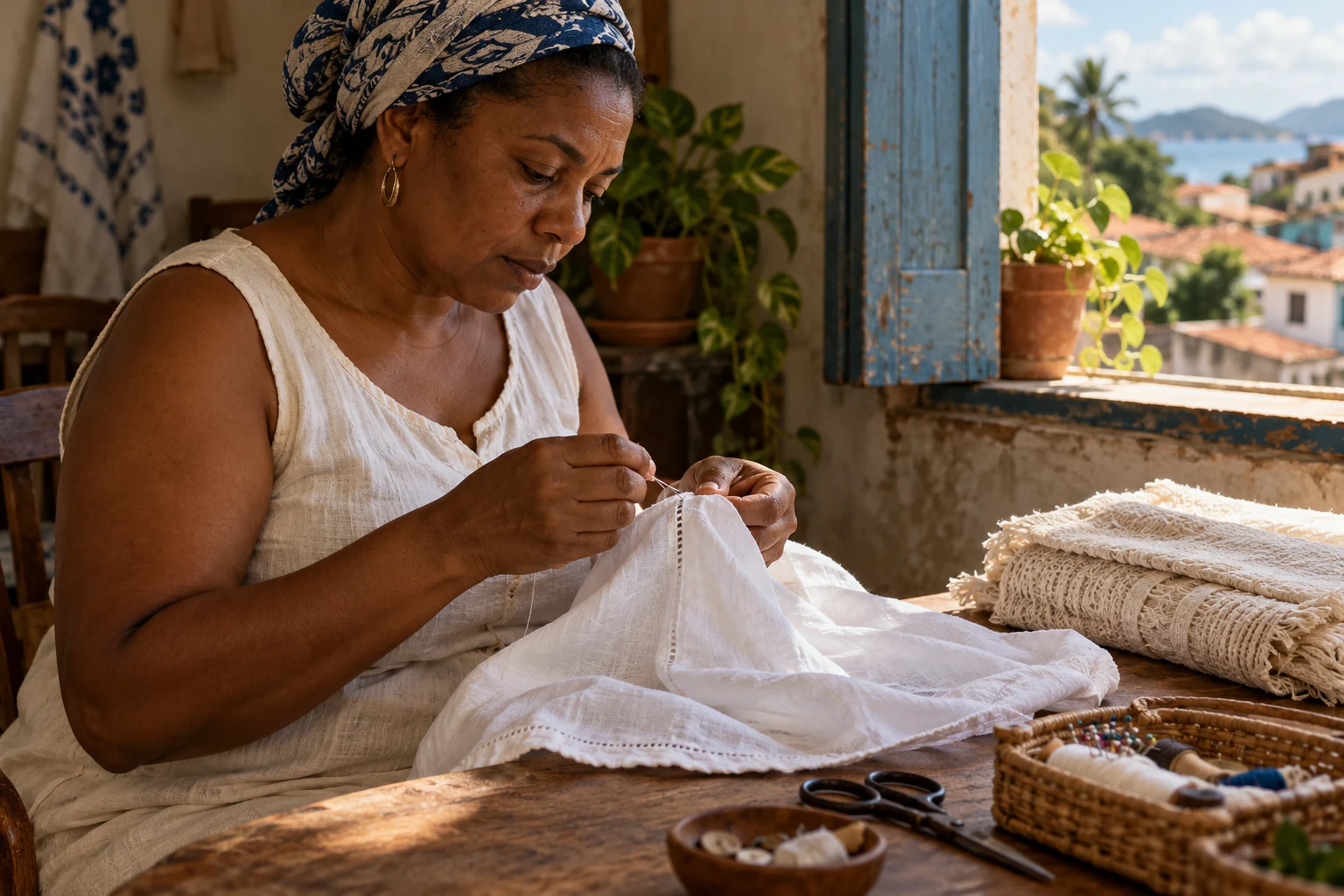
Once a celebration ends, the clothes return to work of another kind. Fabric must be aired, cleaned, dried, folded and stored; a loosened seam may need repair. This continuing care offers a different measure of religious attention from the public moment. It asks who remains available when there is no audience. What looks effortless in the barracão may depend on a household’s careful planning and a network of people willing to help.
There is knowledge in this maintenance. Someone learns which garment can bear repeated washing, which piece needs mending and how an older person prefers things arranged. These forms of memory are embodied and practical. They are not lesser because they are difficult to turn into a grand explanation. Religious life needs people who can remember a detail at the right moment. A house’s material continuity is sustained through many such acts, carried by people whose names may never appear in a photograph caption.
That is also why garments can be emotionally charged. A piece may recall the person who sewed it, the relative who helped pay for it or the elder who corrected its arrangement. Those histories should be learned from the people concerned, rather than invented by an admirer. The important interpretive possibility is that material can hold relationships across time. Repair may preserve something more than a useful textile; it can sustain an object’s place within a living network of remembrance.
A thoughtful visitor can honor this world through ordinary restraint. Learn the house’s expectations before arriving; accept guidance about where to sit or move; ask before taking photographs; avoid touching another person’s head, clothing or regalia out of curiosity. These are practices of attention, not an attempt to become initiated through etiquette. They recognize that visible beauty belongs to people and relationships with boundaries. Admiration becomes more generous when it leaves the wearer in charge of access to their own body.
Clothing in Candomblé brings belonging into contact with the everyday vulnerability of cloth and skin. White must be maintained, the head must be cared for, a woven piece must be taught and a dancing body must be assisted. These relationships give the wardrobe its depth. The question is never exhausted by identifying a garment correctly. It continues toward the hands that made it, the life it accompanies and the community capable of recognizing what it means.
Sources
- Tilo Plöger de Àjàgùnnà, The Sacred Candomblé — Principles, Organization, Rituals, and Terms of Brazilian Candomblé. Published interpretive foundation; substantive sections on white clothing, ojá, pano-da-costa, camisu, calçolão and bata consulted. Detailed folding prescriptions, blanket gender rules and unsupported origin claims excluded.
- Heloïsa Alberto Torres, “Alguns aspectos da indumentária da crioula baiana”, 1950 study republished in Cadernos Pagu 23 (2004). Introduction and sections on the examination, manufacture and wearing of cloth consulted as a historical primary study, with its period assumptions kept distinct from present interpretation.
- IPAC and Fundação Pedro Calmon, Pano da Costa, Cadernos do IPAC 1, Salvador, 2009. Institutional documentation and introductory account of the Mestre Abdias project and weaving instruction consulted; no universal liturgical dress rules inferred.
Continue in the DAILY IFÁ Academy. Personal Exploration offers educational reflection on recognition, service and the responsibilities attached to belonging.