
Candomblé is an Afro-Brazilian religion formed through the lives and religious work of Africans and their descendants in Brazil. Its history includes devotion to Òrìṣà, voduns, and inquices; the creation of enduring religious houses; and the teaching of people who could carry those relationships forward. It has no single founding moment that explains every nation or terreiro. Salvador and the surrounding Recôncavo of Bahia are central to its institutional history, but Brazil's African religious histories extend beyond that region and beyond the houses most frequently photographed.
To ask where Candomblé began is therefore to ask several questions. Where did particular religious inheritances come from? Under what conditions could people maintain them? When did a recognizable house, with land, leadership, an initiatory family, and a continuing calendar, take shape? These questions overlap without having identical answers. A shrine's remembered ancestor, a historian's earliest document, and a community's anniversary may each preserve something significant. None alone supplies a birthday for the whole religion.
African inheritances under the conditions of slavery
The Atlantic slave trade brought people with different languages, political histories, forms of kinship, and religious responsibilities into Brazilian slavery. “African religion” is consequently too broad a label for what they carried. Yorùbá-speaking peoples, Gbe-speaking populations, and peoples from West Central Africa belong to the historical background, but these categories themselves contain differences. Present national borders do not map neatly onto the older communities from which captives were taken.
Enslavement attacked the conditions that made religious life possible. Separation could remove a person from elders, family ground, known plants, and places where an office had been recognized. Yet people were more than carriers of disconnected beliefs. They remembered songs, recognized specialists, formed relationships, and made decisions under severe constraint. A history attentive to their agency asks how they rebuilt the social settings in which inherited knowledge could act.
Candomblé should thus be understood as Brazilian without making its African inheritances incidental. Its Brazilian formation names the historical achievement of people rebuilding religious life after forced displacement. “Adaptation” can sound effortless; here it often meant finding land, money, trustworthy companions, and room to worship within an unequal society. The resulting institutions were neither copies assembled outside history nor empty inventions without predecessors.
Before the famous terreiros: the problem of calundu
African-derived ritual life in colonial Brazil preceded the best-known nineteenth-century Candomblé houses. The word calundu appears in historical records for varied practices involving divination, healing, music, and relations with spiritual beings. It should not be treated as the name of one standardized denomination. Alexandre Almeida Marcussi's research places the Angolan-born practitioner Luzia Pinta, active in Sabará, within a wider and heterogeneous colonial field. His work also warns against applying everything known about her to every calundu practitioner. Marcussi, Cativeiro e cura.
This earlier history matters because otherwise the story begins only when a durable temple becomes visible. Houses, ceremonies, and networks of assistance existed before the institutional arrangements that later became especially prominent. Calling them all “early Candomblé” can erase their particularity, however. Historical relationship does not require identity: one religious formation can precede another without already containing every later office, name, or obligation.
The archive itself needs interpretation. Many colonial religious practitioners became visible to posterity because someone denounced or prosecuted them. A hostile observer's account of movement or speech is not a transparent description of a person's religious understanding. We can learn from such records while identifying whose language organizes the account, what questions the authorities asked, and what the practitioner was allowed to say. Surviving documentation measures the reach of an archive as well as the extent of a religious world.
Why the nineteenth-century house changed the picture
An enduring terreiro joins more than ceremonies under one roof. It holds places, remembered founders, recognized leaders, responsibilities to divine beings, and people learning how to belong. When these relations persist across generations, religious knowledge gains a continuing address. A person can return, a novice can be taught, and a successor can inherit duties that began before their own lifetime.
Bàbálórìṣà and Bàbáláwo Tilo Plöger de Àjàgùnnà's The Sacred Candomblé makes organization and community central to understanding this development. Its principal perspective is Ketu, and its account becomes most useful when read at that scale rather than extended to every Brazilian religious setting. It directs attention away from a collection of isolated ritual techniques and toward a house whose members must maintain an ongoing life together. The companion study of the terreiro as a community develops that institutional dimension.
A permanent address did not mean complete security. Land could be expensive or vulnerable, neighbors could object, and public visibility could create both support and danger. Nor did every religious family possess the same kind of property. What mattered was the capacity to sustain relationships over time. The history of a house includes the work of accommodation, residence, food preparation, repair, and training alongside the festival that visitors remember.
Casa Branca and the limits of a single origin story
Ilê Axé Iyá Nassô Oká, commonly called Casa Branca do Engenho Velho, is indispensable to understanding Bahian Candomblé. Its remembered connections with the Barroquinha district and its formative women belong to the histories of several major religious communities. Yet its prominence should not turn into the claim that all African-derived worship in Brazil began there, or that every Candomblé house descends from one event.
Even familiar nation labels invite historical investigation. In the publicly accessible abstract of her 2021 article, Lisa Earl Castillo argues that early Casa Branca leadership was strongly associated with Ọ̀yọ́, and suggests that “Ketu” acquired meaning within a heterogeneous Bahian Yorùbá-speaking environment. This is a historian's argument about a specific formation, not an instruction to living houses to rename themselves. Only the abstract was consulted for that argument here. Castillo, “The ‘Ketu Nation’ of Brazilian Candomblé in Historical Context”.
The question is productive because it separates a living religious identity from a simplistic ancestry chart. A house can be Ketu without every founder having been born in the African kingdom of Kétu. Its religious identity is carried through transmission, recognized descent, language, and practice. Historical complexity does not make that identity fraudulent; it makes the human work through which it endured more visible. The study of Ketu, Jeje, and Angola explains this distinction further.
Gantois: a history with named people
The history of Ilê Iyá Omi Axé Iyamassé, the Gantois, illustrates what changes when research follows people rather than repeating a tidy succession diagram. Castillo reconstructs the lives of Maria Júlia da Conceição and her husband, Francisco Nazareth d'Etra, using oral accounts, ethnography, and documents. Maria Júlia was Nagô; Francisco was Jeje. The household's religious history therefore cannot be represented adequately as a sealed ethnic compartment. Castillo, “O terreiro do Gantois,” 2017.
The chronology also deserves care. An influential account placed Gantois's separation from Casa Branca after Marcelina da Silva's death. Castillo brings an 1868 newspaper reference to Maria Júlia's house alongside the documented date of Marcelina's death in 1885, showing that the familiar sequence cannot stand as written. Mãe Menininha's memory of a shared earlier origin also has a place in this discussion. Documents can correct dates without deciding every religious relationship for the descendants who inherit it.
This kind of history restores texture. A founder was also a widow, a spouse, a parent, or someone negotiating limited resources. Religious leadership did not suspend those conditions. When we remember a house only through its eventual fame, we can miss the uncertainty under which people sustained its beginning. The institution's endurance becomes more intelligible when its founders are allowed ordinary human needs as well as recognized religious standing.
Jeje contributions are part of the formation itself
A history centered exclusively on Òrìṣà worship can leave vodun traditions appearing as a later addition. Luis Nicolau Parés offers a different account. The publisher's description of The Formation of Candomblé: Vodun History and Ritual in Brazil explicitly foregrounds the formative role of Jeje religious practices and their Atlantic history. The description was consulted here as an orientation to his argument, rather than treated as access to the entire book. University of North Carolina Press.
Bogum in Salvador and Seja Hundé, also associated with the name Roça do Ventura, in Cachoeira give Jeje history actual places. In Where the Sacred Takes Hold, Babá Tilo reads their histories alongside Ketu and Congo-Angola houses while retaining different lines of succession and memory. This approach is valuable because “influence” can otherwise become a vague word that acknowledges a contribution without identifying a community capable of speaking for it.
To recognize Jeje contributions is not to announce that every Òrìṣà is secretly a vodun or that every house follows one blended liturgy. Historical relationships include borrowing, collaboration, marriage, visiting, rivalry, and distinct teaching. Those relations can be significant precisely because the people involved do not become interchangeable. A shared city is a field of encounter, not evidence that every religious family has identical obligations.
Congo-Angola histories require their own ground
Congo-Angola Candomblé also belongs within the history as a living formation. Bate Folha, or Manso Banduquenqué, offers a concrete example. An official Brazilian government account identifies it as a Congo-Angola terreiro founded in 1916 by Manoel Bernardino da Paixão. Erivaldo Sales Nunes's doctoral research follows the house between 1916 and 1946, giving this history a specific founder, place, and period. Official historical identification; Nunes, UFBA thesis.
The example helps resist a persistent narrowing of the subject. If the most familiar published vocabulary is Ketu, a reader may mistake all other names for translations of Ketu offices and divine beings. Inquices belong to Angola religious settings with their own Brazilian histories and Central African inheritances. Describing those inheritances requires more than replacing “orixá” in an otherwise unchanged paragraph.
“Bantu” also requires precision. It is a broad linguistic classification, not the name of one people, language, or religion. Kikongo and Kimbundu are distinct languages; neither is a generic substitute for everything called Angola in Brazil. A house's ritual language can preserve and transform several inheritances. The respectful historical question is how its own people transmit that language and explain its authority, rather than how closely outsiders can force it into one dictionary.
Catholic relationships and the changing meaning of syncretism
Syncretism names a difficult part of this history. Catholic institutions, festivals, images, and forms of public belonging have mattered to Afro-Brazilian religious life, but the relationship cannot be reduced everywhere to one disguised deity hiding behind one saint. People could negotiate coercion, participate in brotherhoods, inherit family devotions, and understand religious relationships in ways that a simple substitution chart misses.
Babá Tilo's The Sacred Candomblé records disagreement about whether Catholic associations should be retained. His own preference for clearer African religious differentiation belongs to an authorial and devotional position. It should be read alongside the fact that communities have histories of their own. A change in public self-description can express religious self-determination; maintaining an inherited observance can also carry serious meaning for the people concerned.
There is therefore no neutral historical shortcut in declaring one period “mixed” and another “pure.” Both reform and continuity involve choices made by religious authorities under particular conditions. A historian can ask what changed, who advocated the change, and how members responded. An article can report those judgments without claiming the authority to settle a house's liturgy. The distinction preserves the difference between explaining a religious debate and governing it.
Public recognition and the continued work of keeping a place
Casa Branca's federal heritage recognition in 1984 was a major landmark. IPHAN identifies it as the first Candomblé terreiro protected by the institution in Salvador. Such recognition made buildings, trees, sacred objects, and grounds legible within a national preservation framework. It did not create the house's sacred authority, which its community already carried. IPHAN, Casa Branca heritage context.
Heritage also introduces practical questions. What is being protected when a living religion occupies the ground? A building may require repair, a tree may have a religious history, and a public celebration may depend on space that a planning document sees as vacant. The community's relationship with a place cannot be exhausted by an inventory, though an inventory can help defend it. Preservation works best when the people who keep that life are treated as continuing participants.
Public visibility likewise has more than one effect. Sacred music, dress, and food can become celebrated as Brazilian culture while the people responsible for their religious life still have to defend recognition and space. Admiration for a festival is not equivalent to respect for a terreiro's decisions. Historical understanding asks readers to retain the makers, custodians, and communities when a religious form travels into a museum, performance, photograph, or popular song.
Oral history carries more than dates
Religious memory is not simply a substitute used until written evidence arrives. An account of a founder may explain why a particular elder is greeted first, why a house honors certain ancestors, or why a responsibility belongs to one family. Those meanings can remain important even when the chronology requires correction. A birth register can establish a date while remaining silent about the religious relationship that made a person consequential to descendants.
The reverse caution also matters. A cherished account does not make every historical detail equally secure. House memories may differ; an explanation preserved by one generation may draw together events that happened farther apart. Respectful scholarship neither dismisses oral accounts as unreliable by definition nor turns them into evidence for whatever broad claim an outsider prefers. It asks who remembers the account, when it was recorded, and what the account is explaining in that community.
This produces a more interesting relationship between researchers and custodians. The historian can bring overlooked documents into the conversation; the community can identify religious names and relationships that the documents conceal. Neither role has to absorb the other. A researcher does not become the ritual successor by correcting a date, and a successor need not become an archivist to possess responsibilities inherited from an elder. Their different forms of knowledge can meet without pretending to be identical.
Why ordinary work belongs in religious history
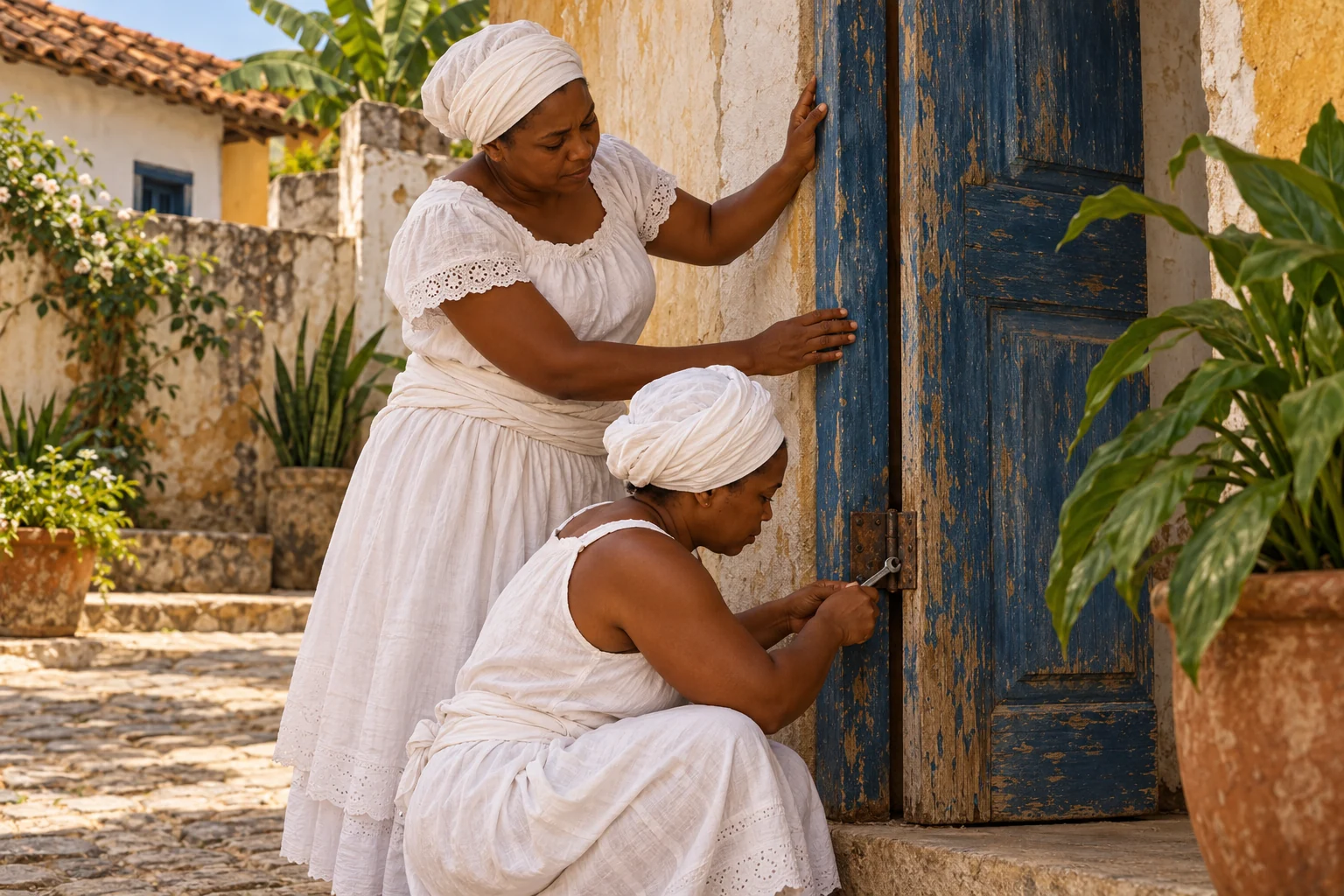
Histories organized around celebrated priestesses, dramatic ceremonies, and public recognition can leave everyday maintenance almost invisible. Yet the durability of a house depends on tasks that may never receive a newspaper report. Someone keeps a room usable, teaches a younger person, remembers an obligation, or arranges transport for a feast. These acts connect one public moment with the next. Without them, the institution would exist only as a series of isolated appearances.
Babá Tilo's emphasis on a continuing religious family makes this labor central. Transmission includes learning how to notice what needs doing and how to act without treating every task as a claim to status. An elder's knowledge can be present in the way work is organized as well as in an explanation spoken aloud. A younger member learns something about the house by discovering whom others consult when a problem arises.
There is a historical consequence. People whose names appear infrequently in surviving documents may have done indispensable work. We should not invent their biographies to repair the absence, but we can avoid assuming that archival visibility measures religious importance. A complete account of a terreiro would need the public leader and the less visible people whose attention made leadership sustainable. The history is a collective achievement even where only some of its participants can now be named.
How should we read Candomblé's history now?
Begin with the scale of the claim. A study of Gantois can establish something about Gantois; a history of Jeje institutions can unsettle a broad account without supplying every detail about Angola. A public artifact record may identify an object's maker or materials, while saying little about the private obligations surrounding its use. Strong historical writing lets each source do the work it can actually support.
Then keep living transmission in view. Initiation, seniority, teaching, and care explain how inherited responsibilities continue to have people attached to them. Orixás, Orí, and trance show why history cannot stop at an inventory of beliefs. The religion includes experiences and relationships whose interpretation is learned within communities. Scholarship can clarify their histories while remaining attentive to the limits of an outsider's account.
For a reader, the human importance is substantial. Candomblé's history offers a way to think about continuity that includes rupture without romanticizing it. People created durable belonging under conditions that threatened to disperse them. They did so through identifiable decisions, disputed memories, ordinary work, and relations understood as sacred. Learning that history means remembering more than survival: it means recognizing the institutions and people through whom a religious world became inhabitable again.
Sources and further reading
- Tilo Plöger de Àjàgùnnà, The Sacred Candomblé. Authorial religious source, principally Ketu; selected substantive historical, nation, and community sections consulted.
- Tilo Plöger de Àjàgùnnà, Where the Sacred Takes Hold. Supplied source; selected discussions of Bahian house histories and their documented scholarship consulted.
- Alexandre Almeida Marcussi, Cativeiro e cura, 2015. Opening methodological discussion consulted; colonial calundus and Luzia Pinta.
- Lisa Earl Castillo, “The ‘Ketu Nation’ of Brazilian Candomblé in Historical Context”, 2021. Abstract consulted only.
- Lisa Earl Castillo, “O terreiro do Gantois: redes sociais e etnografia histórica no século XIX”, 2017. Historical article consulted.
- Luis Nicolau Parés, The Formation of Candomblé, 2013. Publisher description consulted for the book's argument.
- Erivaldo Sales Nunes, UFBA doctoral thesis on Bate Folha, 1916–1946, 2017. Institutional research identification and abstract consulted.
- IPHAN, Casa Branca heritage context. Institutional account of protection, not a source of private ritual authority.