
Ogãs and ekedis carry Candomblé responsibilities that depend on their remaining attentive while others enter Òrìṣà trance. Their work includes sacred music, accompaniment, the care of clothing and materials, and other duties conferred within a house. The absence of trance is part of their recognized religious path. It does not mean that they stand outside the sacred encounter or occupy an unfinished version of someone else's vocation.
The names themselves require care. Ogã is a broad designation for male offices in many Ketu accounts, with particular titles for different responsibilities. Ekedi, also written equede and in other forms, identifies a female office whose work includes attending to manifested Òrìṣà and their initiates. Other nations and houses use names such as ajoiê, iarobá, makota, kambondo, and runtó in their own arrangements. A rough correspondence helps orient a reader; the actual office belongs to the community that recognizes it.
Bàbálórìṣà and Bàbáláwo Tilo Plöger de Àjàgùnnà's The Sacred Candomblé provides the main interpretive foundation for this study, predominantly from a Ketu perspective. His insistence on the importance of non-trance offices invites a change of attention. Instead of asking only who receives the most visible manifestation, we can ask who makes its occurrence, accompaniment, and conclusion possible. That question brings skilled religious labor into view.
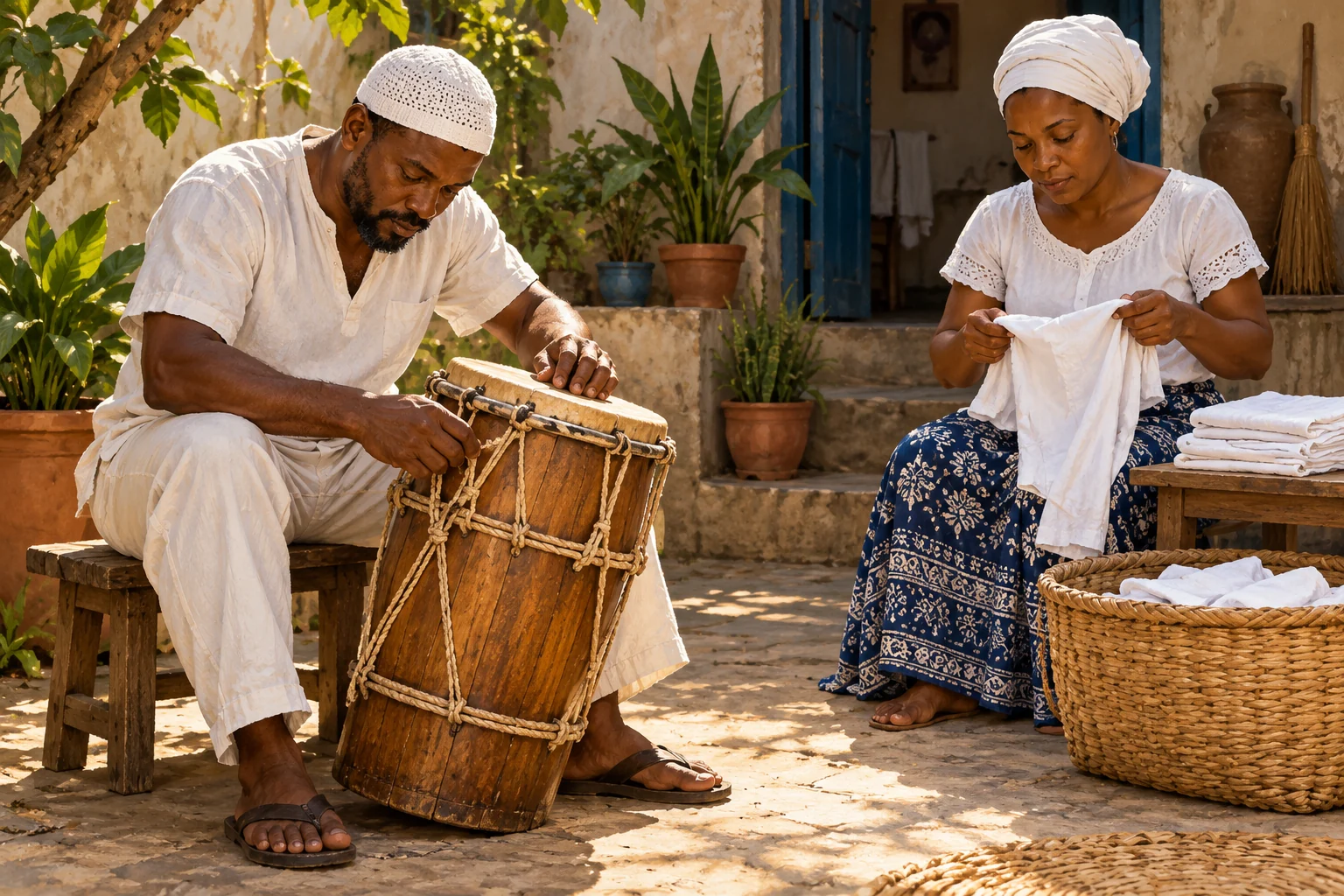
Non-trance is an affirmative responsibility
The phrase non-trance can sound like a definition built around something missing. In these offices it identifies a form of presence that the ceremony requires. A person needs to hear a change in the music, see what is happening around a dancer, and respond to another officeholder. Attention must remain available across several relationships at once.
This is more than a practical backup arrangement. In the religious understanding Babá Tilo presents, the ogã and ekedi have their own relationship with the Òrìṣà. Their work can call, honor, guide, or attend to divine presence without making their own bodies the site of Òrìṣà trance. The sacred relationship is expressed through what they are entrusted to do.
That distinction matters for beginners who arrive expecting an extraordinary experience to prove that they belong. A vocation is not adequately tested by comparing the intensity of people's sensations. Someone may be prepared for a responsibility that becomes most valuable when other people stop noticing it. The ceremony's steadiness can be evidence of excellent work rather than an absence of religious depth.
The public vocabulary also needs precision. In Ketu discussions, rodar no santo refers to entering Òrìṣà trance. That should not be collapsed into every use of incorporation in Umbanda or into the experience of every spiritual guide. The study of orixás, Orí, and trance distinguishes those relationships. Here the important point is the specific work carried by people whose offices require another form of attention.
Ogã is broader than drummer
The atabaques make the ogã especially visible to visitors, but ogã cannot simply be translated as drummer. Babá Tilo's account names a range of duties associated with music, sacred materials, and the responsibilities of particular Òrìṣà. The title tells us that a person holds a recognized religious position. A more specific name and the house's explanation tell us what that position involves.
Alagbê is associated with leading the atabaques in Ketu usage. Axogum refers to a responsibility connected with animal offerings. Other titles identify care for particular sacred places or belongings. These are not interchangeable jobs that every ogã automatically performs. Holding one responsibility does not confer the preparation required for all the others.
The difference resembles the distinction between being entrusted with an institution's keys and knowing every activity that happens inside it, but the religious responsibility goes further. Knowledge concerns obligations to divine beings and relationships received from elders. An office is conferred and sustained within that history. A technical skill acquired elsewhere may be useful without being sufficient.
This prevents two opposite mistakes. We should not assume that someone with a general title knows nothing beyond the most public task. Nor should we infer unlimited ritual competence from the title. Respect becomes more accurate when it acknowledges what the person actually carries. The study of named house offices places these responsibilities within the broader organization.
Alagbê: music that listens
The alagbê's leading responsibility for the atabaques makes the relation between skill and judgment particularly clear. Babá Tilo describes the rum, rumpi, and lê, with the rum carrying a directing part. A visitor can hear three drums, yet miss the conversation among musical parts, movement, songs, and those responsible for the ceremony. The leader is listening as well as producing sound.
Musical competence here includes knowing what belongs where. A rhythm detached from its place in the ceremony can become a display of technique. Within the house, timing and responsiveness matter. The musician must recognize the unfolding occasion and work with its other participants. Knowing many patterns is different from knowing which action the present relationship requires.
Nina Graeff's research at Ilê Obá Sileké in Berlin gives a concrete example of musical teaching. Her account names Ogã Paulo d'Ogum and Babalorixá Muralesimbé among those guiding learners. She describes repeated practice through which songs become embodied, with correction continuing over time. This is a situated ethnography of apprenticeship, rather than a universal rule that meaning or accuracy never matters. Graeff's article.
The interpretive lesson is that a song can be known at several depths. A person may recognize its melody, pronounce its words, recall the occasion on which it is used, and sense when others are ready to follow. Those capacities grow together without being identical. A religious musician must work within relationships that a recording cannot fully reproduce.
The drum itself also belongs to the house's sacred care. It is not merely equipment brought in when entertainment is needed. The musician's responsibility concerns the instrument as part of the religious setting, including its authorized use. Public appreciation of the music is compatible with acknowledging that the full relationship exceeds the visitor's hearing.
Axogum and the distinction between knowledge and procedure
Axogum names a responsibility that public descriptions often either sensationalize or omit. In Babá Tilo's Ketu account, it concerns animal offerings and requires particular preparation. Naming the office is important because it shows that the house does not treat every consequential action as something anyone may improvise. Responsibility is differentiated and entrusted.
An explanatory article does not need to reproduce a ritual procedure to recognize that knowledge. The questions relevant here are organizational: who has been prepared, who authorizes the work, and how does the responsibility relate to the rest of the house? These questions acknowledge the seriousness of the office without converting sacred action into a public recipe.
The same principle applies to other ogã responsibilities. An outsider may observe someone caring for an object and assume the action is simple because the visible movement is simple. Yet judgment can concern what should be touched, when, by whom, and for what purpose. The visible gesture is only one part of the knowledge.
Giving the office its proper name also allows more honest discussion. A religious community can explain that a specialized responsibility exists and identify who carries it without making every detail available. Public understanding and ritual privacy need not be enemies. Precision helps distinguish information that enables respectful encounter from information detached from its obligations.
Ekedis attend to persons and manifestations
The ekedi's work brings care close to the body. Babá Tilo describes accompaniment, the care of clothing, attention during dance, and responsibility around the person's return from trance. These are skilled acts within the religious event. They cannot be reduced to tidying a costume or waiting nearby with a cloth.
The work involves noticing. A garment may need attention before it interferes with movement. A path through the room may need clearing. The person in trance, the manifested Òrìṣà, other dancers, musicians, and the house's leadership belong to the same field of responsibility. Attending well means seeing a relationship while it is changing, rather than checking a list once and considering the task complete.
The cloth or towel often associated with an ekedi is therefore a practical object carrying the history of practiced care. Its presence does not tell us the whole office. A visitor who recognizes the accessory while overlooking the woman's judgment has noticed the most easily photographed part. The expertise lies in how and when she acts.
Ekedis also transmit knowledge. Familiarity with garments, songs, movement, and people can place them in a teaching relationship with novices and other members. Care in the moment and education over time are connected. The person who guides someone through an unfamiliar situation may also be the person who later helps them understand what happened and what they must learn next.
Ekedy Sinha: a named educator
Gersonice Ekedy Sinha Azevedo Brandão gives this office a particularly clear public voice. An article coauthored with Fernando Batista dos Santos presents her memories and reflections within Ilê Axé Iyá Nassô Oká, Casa Branca, in Salvador. Its accessible abstract identifies her as an educator and a reference for songs, dances, and rituals. Brandão and Batista dos Santos, 2020.
The fact that she is a named coauthor matters. An ekedi need not appear only as a function described by someone standing elsewhere. Her account belongs within the body of knowledge through which readers encounter the tradition. Identifying her authorship is a small corrective to a habit of remembering the observer's name while leaving the religious specialist anonymous.
Andrea Natividade Montenegro and André Luis Nascimento dos Santos directly challenge that invisibility in their essay “Cadê a mãe?” Its published abstract addresses the undervaluing of ekedes, ajoiês, iarobás, and makotas in ethnographic narratives, including their importance beyond narrowly ceremonial work. Montenegro and Santos.
These sources invite a demanding interpretation of assistance. If teaching, coordinating, remembering, and sustaining relationships are called merely helping, their intellectual and political importance can disappear. Naming the work more accurately does not require inventing a new hierarchy. It requires allowing responsibilities already present in the community to become visible in the account.
Confirmation is not an automatic badge
Babá Tilo distinguishes the calling or public recognition of an ogã from subsequent confirmation. Ogã suspenso refers to a person publicly selected or raised toward that responsibility in relevant house practices. The distinction matters because recognition of a path and completion of the preparation associated with it are not the same event. A title heard in conversation may carry a history still unfolding.
Ekedis likewise undergo their own preparation and confirmation within the house. Their path should not be measured as a shortened or deficient version of the iaô's path. Different responsibilities can require different ritual arrangements and forms of learning. Describing those differences does not establish a competition over who has undergone more.
Babá Tilo uses language of people born for an office and of consecration making that responsibility active. Read as a religious understanding, this joins vocation to recognition. It does not eliminate learning. A person understood as called still needs teaching, relationships, and the practical experience through which the office can be carried competently.
The calendar alone cannot resolve status. Nor can a reader decide someone's preparation from photographs of a ceremony. The distinction between calling, confirmation, learning, and everyday responsibility belongs to the house's own account. For broader context, the initiation study explains how consecration enters a continuing religious life.
Children reveal that age and office differ
Christiane Rocha Falcão's research at Ilê Axé Omin Mafé follows children with ritual authority. She describes Júnior, an eleven-year-old ogã, and interactions that make his recognized responsibility visible alongside his ordinary childhood. The case shows that biological age and religious standing do not form one simple scale. It does not establish that every child ogã has the same preparation or duties. Falcão, 2021.
The distinction is easy to misunderstand. Recognizing a child's religious responsibility does not make the child an adult in every setting. The same person may be trusted in a ceremonial relationship and still need ordinary care, rest, education, and protection. An office identifies a particular authority; it does not dissolve every other relationship around its holder.
This also changes how adults understand respect. Someone younger may know what a particular moment requires. Listening can involve setting aside assumptions based on chronological age or professional prestige. That is different from abandoning judgment. It means recognizing the context in which knowledge and responsibility have been conferred.
The example sharpens the meaning of hierarchy. If standing is read only as personal superiority, a child's office becomes puzzling or theatrical. If it is read through entrusted relationships, the arrangement becomes more intelligible. What matters is the responsibility being acknowledged here and the conditions under which it applies.
Gender and title need precise description
Many established descriptions assign ogã offices to men and ekedi offices to women. Babá Tilo discusses these assignments through his interpretation of religious polarities. That account should not be presented as a biological explanation that settles every contemporary house's practice. A named tradition's requirements, an author's theological interpretation, and a claim about human capability are different kinds of statement.
The differences matter when people discuss who plays drums or takes care of clothing. Performing a task does not automatically confer a particular title. Conversely, observing a departure from a familiar arrangement does not entitle an outsider to declare the house illegitimate. The relevant question concerns how that community understands its authorizations and obligations.
Respectful public writing can state the established pattern while leaving people visible. It can also acknowledge that practice and debate are not identical across Brazil and transnational houses. There is no need to manufacture a universal resolution in order to explain the offices. Precision is more helpful than either erasing gendered histories or treating them as timeless facts about every person.
Care can change the form of participation
Emília Guimarães Mota's account of Casa de Oya in Goiânia offers a concrete contemporary test. Writing as both researcher and ekedi, she describes how pandemic restrictions altered participation in 2020. The close bodily work she ordinarily undertook could not continue in its usual form. Her own office made the cost of distance especially palpable. Mota's first-person study.
The example reveals something that a static list of duties cannot. An office is carried under conditions: people's health, the possibility of gathering, available hands, and the actual setting. When those conditions change, maintaining responsibility may require changing the action. Familiar gestures cannot by themselves decide what care now demands.
Babá Tilo returns to this relational problem in Where the Sacred Takes Hold. The sacred encounter depends on people who can continue caring for one another, including when the usual form becomes difficult. That is a stronger interpretation of devotion than measuring it only by uninterrupted outward performance. The office endures through judgment as well as repetition.
The difference between helping and taking over
A visitor may see a need and sincerely want to act. Yet assistance is most useful when it fits the responsibility already being carried. Reaching into a garment arrangement or approaching a sacred instrument without guidance can interrupt someone who has already understood the situation. The relevant skill is sometimes the ability to wait, make room, and respond when asked.
This is not passivity. Watching the room carefully and following a recognized officeholder's direction can be an active contribution. It keeps the movement of several people coordinated and allows the person responsible to concentrate. The same principle applies to learning: a novice can become increasingly useful without pretending that usefulness confers an office.
Experienced ogãs and ekedis also have a teaching responsibility in such moments. Clear guidance helps a newcomer understand why waiting matters. A correction can preserve the ceremony while making future assistance more competent. The quality of the encounter depends on both the beginner's willingness to listen and the elder's ability to guide without turning uncertainty into humiliation.
Recognizing the work after the music ends
The ceremony's end does not erase its responsibilities. Instruments, garments, spaces, and people still need attention. Teaching continues between festivals, and experienced officeholders must make room for others to learn. A public event can conceal the duration of work that surrounds it. Recognizing ogãs and ekedis means recognizing that longer commitment.
For visitors, this changes where gratitude is directed. The person offering guidance at the edge of the room may carry knowledge indispensable to the evening. The musician or accompanying woman need not become a spectacle in order to deserve respect. Acknowledgment begins by using the name the house gives the responsibility and listening to the person who holds it.
For students, the question becomes more practical and more personal: what kind of attention can I learn to carry reliably? That question does not assign an office or determine a vocation. It opens a thoughtful reading of service, where religious depth appears through competence, patience, and the ability to remain available to others. The Academy collection provides further study alongside the books below.
Sources and further reading
- Tilo Plöger de Àjàgùnnà, The Sacred Candomblé. Ogã, ekedi, organization, confirmation, clothing, and seniority sections consulted; principally Ketu.
- Tilo Plöger de Àjàgùnnà, Where the Sacred Takes Hold. Selected substantive discussions of embodied care and distinct offices consulted.
- Nina Graeff, “Singing by and with heart”, Orfeu 3, no. 2 (2018): 44–71. Substantive apprenticeship sections consulted in the journal's open article reproduction.
- Fernando Batista dos Santos and Gersonice Ekedy Sinha Azevedo Brandão, “Ekedy Sinha: memórias e reflexões sobre o ser e o fazer no Candomblé baiano”, 2020. Abstract and author identification consulted; full autobiographical text not accessed.
- Andrea Natividade Montenegro and André Luis Nascimento dos Santos, “Cadê a mãe?”, Opará 7, no. 11. Abstract and publication record consulted; issue labeled 2019, online publication 2020.
- Christiane Rocha Falcão, “A idade do santo”, 2021. Substantive ethnographic sections consulted; the named child's circumstances are not generalized.
- Emília Guimarães Mota, “Omolu quer todo mundo no Olubaje”, Equatorial 9, no. 16 (2022). First-person sections on ekedi duties and altered bodily participation consulted.