
A Candomblé house is organized through responsibilities that have names. Iyalorixá, babalorixá, alagbê, iabassê, ekedi, and other titles identify different forms of entrusted work. Knowing those names helps us recognize the people who make a religious house possible. Understanding an office, however, requires more than translating its title. We need to know what its holder cares for, who recognizes that responsibility, and how it relates to the other responsibilities of this particular house.
The principal interpretive foundation here is Bàbálórìṣà and Bàbáláwo Tilo Plöger de Àjàgùnnà's The Sacred Candomblé. Its account of organization is predominantly Ketu oriented. The following discussion uses that framework while preserving distinctions among Ketu, Jeje, and Angola settings. It is a public orientation to offices, rather than a complete constitution for every terreiro. A named house's own usage remains essential, especially where the same title can carry different duties.
The structure becomes easier to understand when we think about a ceremony that must actually happen. Someone leads the house, someone knows the songs, someone attends to clothing, someone oversees sacred food, and someone understands the leaves required for religious work. These responsibilities meet in one event without becoming one skill. The organization of the house gives that interdependence a durable form.
Leadership: iyalorixá and babalorixá
Iyalorixá and babalorixá are familiar Ketu titles for priestly leadership, often rendered mother or father of the Òrìṣà. Portuguese forms such as ialorixá, mãe de santo, and pai de santo also occur. Their significance is relational: the office joins care for divine relationships to responsibility for the people initiated or received within the religious family. It cannot be understood simply as the top position in a workplace.
The leader's work includes guiding initiation, maintaining the house's sacred responsibilities, discerning appropriate religious action, coordinating other officeholders, and teaching. These activities require different judgments. Knowing what must be prepared is one matter; knowing who is ready to undertake it is another. Leadership includes recognizing where another person's specialized knowledge is necessary. Delegation can express competence because the house contains more work than one person can responsibly carry alone.
Babá Tilo gives particular weight to continuity. A leader receives an inheritance and must prepare people capable of carrying it forward. A successful celebration today does not answer what will happen after an elder becomes ill or dies. Teaching, the distribution of duties, and the recognition of future responsibilities belong to the office's long view. The religious family must be able to remember more than its present leader's personal preferences.
The language of fatherhood or motherhood also carries human expectations. A person bringing an intimate concern to a religious leader is making trust available. Discretion matters because knowledge acquired through that relationship is not an unrestricted possession. Warmth and authority can coexist, but neither automatically supplies the other. The title names a responsibility whose quality appears through sustained conduct.
A second responsibility is not a second person in every house
Iyá kekere, often written iaquequerê or iyá quequerê, is associated with the mãe pequena, the little mother. Babá kekere supplies a corresponding masculine title in relevant settings. Such offices can assist priestly leadership and support initiates, but their exact reach depends on the house. A person helping during a particular initiation and a person holding a continuing responsibility across the whole community are not necessarily occupying identical positions.
Iyá egbé, the mother of the community, is another important title in descriptions of house organization. It directs attention toward the collective: relationships, arrangements, and the practical steadiness of the group. Calling someone an administrator gives a partial translation. It leaves out the religious trust that can make her advice significant and the knowledge of people needed to recognize a difficulty before it disrupts an occasion.
These offices should not be forced into one universal succession chart. Babá Tilo describes circumstances in which different senior figures assume temporary responsibilities. That makes local recognition more important, not less. An officeholder's usual responsibility, an emergency arrangement, and the eventual succession to priestly leadership are separate questions. A visitor cannot determine the answer by finding a matching title online.
An additional distinction concerns trance. The fact that an office involves care or assistance does not establish that its holder is an ekedi. Christiane Rocha Falcão's research at Ilê Axé Omin Mafé in Sergipe explicitly identifies several important offices, including iaquequerê and iabassé, among people who enter trance. Her account is a useful corrective to any list that gathers every named female responsibility under one non-trance category. Falcão's study.
Iabassê: responsibility for sacred food
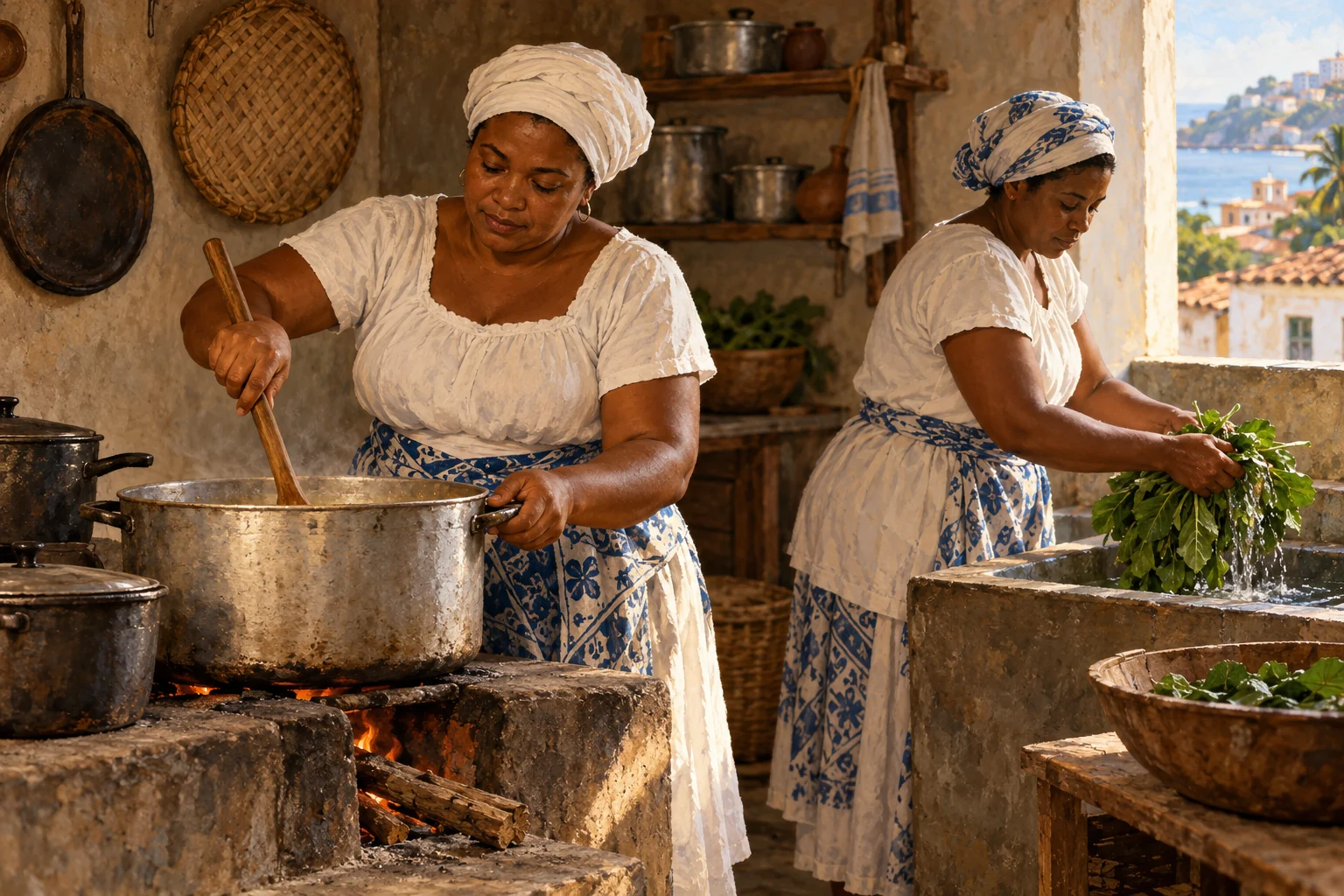
Iabassê, also encountered as iyá bassé or iyábasé, names a responsibility associated with sacred food. Babá Tilo emphasizes the knowledge involved in preparing and presenting food within the house's religious life. This is not adequately described as being a good cook. Ingredients, destinations, timing, materials, and the circumstances of an offering belong to a learned responsibility.
The office also shows why sacred and practical work cannot always be separated by appearance. A bowl may look ordinary to a visitor while its intended use requires particular knowledge. Conversely, feeding the people who have worked through a long day is a substantial act of care even when it is not the same responsibility as preparing an offering. The house needs both kinds of work and clarity about their relationship.
A useful question is therefore who holds responsibility for a preparation, rather than who happens to be holding the spoon. Other members may help under guidance. Assistance does not erase the officeholder's judgment or transfer her authority to everyone present. The study of the sacred kitchen and iabassê follows this distinction through food, learning, and the coordination of hands.
The title also draws our attention to overlooked expertise. Much knowledge is easiest to notice when something goes wrong. When every preparation arrives appropriately, an observer may see only a smooth occasion. The apparent ease is partly the result of anticipation. Recognizing an office means recognizing the judgment that makes avoidable problems disappear from public view.
Clothing, songs, and the specificity of smaller titles
Iyá laxó appears in Babá Tilo's account in relation to the care of clothing, including washing, ironing, and starching ritual garments. The title makes visible work that can otherwise be treated as anonymous domestic labor. Cloth is part of how persons and divine presences are presented and recognized. Caring for it requires knowledge of use, condition, and the particular responsibilities attached to it.
Other titles refer to distinct liturgical responsibilities. Iyá morô is associated in this Ketu account with the ipadê; iyá efum with initiatory painting. Their public names tell us that the house differentiates kinds of knowledge. They do not turn the details of those practices into instructions for the reader. The existence of a named task and the right to perform it are different things.
Lists can create a misleading impression that every established house contains every title. A small house may divide its work among fewer people, while an older and larger one can sustain greater specialization. The absence of a publicly named office does not prove that its associated work is absent. Nor does an impressive number of titles establish that the work is well taught.
For the learner, the advantage of retaining precise names is that questions become more exact. Instead of asking why one woman is always busy, the learner can discover whether she holds a particular responsibility. Instead of assuming everyone who sings leads the singing, the learner can notice how the house authorizes musical direction. Vocabulary becomes useful when it changes what we are able to see.
Leaves and the babalossaim
Babalossaim, babalossâim, and related forms identify a specialist associated with Ossaim and the religious knowledge of leaves. Babá Tilo also uses babalewê. His account gives this work a broad reach: recognizing plants, caring for their availability, understanding their religious associations, and knowing their place in the house's preparations. The office involves relationships with living materials, rather than ownership of a memorized list.
A plant name alone cannot carry that responsibility. Different plants can share a common name; a named species can grow under different conditions. More fundamentally, the house's religious use involves teachings and authorizations that a botanical label does not establish. Recognizing the specialist means recognizing the difference between identifying a leaf and being entrusted with its liturgical employment.
The familiar association of Ossaim with leaves should also not become a shortcut for every Afro-Brazilian herbal practice. Jeje and Angola settings have their own divine relationships and vocabularies. Babá Tilo's comparisons orient the reader, but the names cannot be substituted mechanically. A specialist's actual house and tradition tell us what the responsibility includes.
The human implication is particularly clear when a community moves. The knowledge needed to sustain religious life includes how to ask about unfamiliar conditions without pretending they are familiar. A title cannot make plants appear in a new climate. Experience, teaching, and consultation must meet the material world in which the house now lives. The office carries that practical difficulty as well as its sacred significance.
Ogãs and ekedis: distinct forms of attention
Ogã names a family of important male offices in many Ketu descriptions. Sacred percussion is the most publicly recognizable example, but the term is broader than drummer. Alagbê identifies a leading responsibility for the atabaques; axogum is associated with animal offerings. Those duties require different kinds of preparation and cannot be inferred merely from someone being addressed as ogã.
Ekedi or equede identifies a female non-trance office, with work that includes attending to manifested Òrìṣà and the initiated persons whose bodies are involved. Clothing, movement, accompaniment, and the transitions around a manifestation require practiced attention. The ekedi is not simply present in case assistance is needed. Her recognized responsibility helps make the ceremonial encounter possible.
Babá Tilo presents these as substantial religious paths. Their holders remain attentive while others enter trance. This distinction concerns a distribution of work, not a scale of spiritual worth. A ceremony needs people capable of responding to what is happening across the room as well as people through whom an Òrìṣà manifests. The separate study of ogãs and ekedis explores their preparation and different forms of expertise.
The point becomes sharper when we avoid the language of extras. The person accompanying a manifestation is part of the religious event. The musician is not an atmosphere provider. If either responsibility is treated as peripheral, the observer has misunderstood what allows the central moment to occur. Visibility and indispensability do not always coincide.
Jeje and Angola names require their own setting
Pejigã and runtó appear in Jeje accounts of house responsibilities. In Babá Tilo's presentation, pejigã involves care connected with the peji, while runtó refers to sacred percussion. These names belong within Jeje histories and relationships; describing them merely as alternative spellings of Ketu offices makes the comparison too thin. A correspondence can orient a beginner without settling the meaning of an office.
Angola settings include titles built around tata and mameto, with forms such as tata de inquice and mameto de inquice for priestly leadership. Kambondo and makota occur in discussions of other important responsibilities. Orthography varies, and an English reader should resist treating every variation as either a separate office or an error. Living usage develops through particular religious communities.
The most responsible comparison names its purpose. If we are helping a visitor recognize who is directing a ceremony, a broad correspondence may be useful. If we are explaining initiation, seniority, succession, or what knowledge a person holds, the same broad correspondence may conceal precisely what matters. The study of Ketu, Jeje, and Angola provides the historical frame for asking better questions.
Names also carry respect. Calling a leader by the title her house uses acknowledges the tradition through which she became responsible for others. Insisting on a more familiar Ketu term can make another nation's vocabulary appear optional. Learning the local name is a modest but consequential way of allowing the community to describe itself.
A diviner is not automatically a babaláwo
Divination adds an especially important distinction. A babalorixá or iyalorixá may consult jogo de búzios within a Candomblé house. That does not automatically make the person a babaláwo in an Ifá lineage. The word babalaô has Brazilian histories, while the office of bàbáláwo has particular initiatory and scholarly responsibilities in the traditions that confer it. Shared religious vocabulary does not settle equivalence.
Babá Tilo discusses babalaôs and oluôs as differentiated responsibilities. Read as a Brazilian organizational account, this helps identify his concern with the interpretation of oracular knowledge. It should not be turned into a universal map of Nigerian Ifá offices or a claim that cowrie consultation and Ifá are the same system. One must identify the oracle, the training, the lineage, and the authority actually involved.
The Ifá and jogo de búzios comparison explains the distinction more fully. For organization, its practical consequence is simple: an office must be described through what its holder has received and is recognized to do. Translation cannot grant a second initiation. An impressive title cannot supply knowledge of a different instrument or corpus.
This is also a matter of fairness. Equating every respected Brazilian diviner with a Nigerian Ifá office can erase the diviner's own Candomblé formation. Conversely, absorbing every Ifá office into a generic category of priesthood obscures years of particular learning. Accurate distinctions give each responsibility its actual depth.
Seniority, confirmation, and succession
Seniority and office intersect without being identical. An ebômi has a position in an initiatory history; that designation does not by itself identify every responsibility the person may hold. A named office also does not tell us everything about its holder's chronological age. Years lived, obligations fulfilled, knowledge acquired, and responsibilities conferred must be considered together.
Babá Tilo associates the cuia and related terms with the transmission of authority to carry priestly responsibilities and, where appropriate, establish a house. The important public point is transmission: a person receives responsibility from others within a religious history. Completing time does not automatically entitle every initiate to found a terreiro. The community must recognize the path and preparation concerned.
Succession brings these distinctions into a difficult human setting. After a leader dies, people may share grief while holding different memories of what was intended. Practical arrangements must continue, and sacred obligations cannot be reduced to a civil inheritance dispute. Naming the relevant officeholders helps us understand who is already carrying which responsibilities, without allowing an outsider to decide who should succeed.
An office also creates an obligation to teach beyond oneself. If only one person knows where something is kept, how it is cared for, and when another specialist is needed, the house becomes fragile. Responsible transmission preserves distinctions while widening the circle of competent care. Continuity requires people who can be trusted to remember, act, and eventually guide others.
The office and the person who temporarily carries it
An office has a history that exceeds one holder, while the holder brings a particular temperament, capacity, and set of relationships. Confusing these two levels creates trouble in both directions. Someone may be admired personally and still need assistance with a task. Another person may perform a demanding responsibility well without attracting much affection or public attention. The religious structure needs ways of recognizing the work through these differences.
Babá Tilo discusses appointment and the possibility of responsibilities being withdrawn through the house's religious discernment. His larger point is that titles should not become decorations detached from service. A conferred responsibility must continue to be carried. Public writing cannot assess a particular person's fitness, but it can explain why appointment is more than an honor that requires nothing afterward.
The distinction also matters when people move between houses. A person arrives with a history deserving acknowledgment; the new community also has existing responsibilities and relationships. Recognition needs an encounter between those histories. Neither forgetting the person's formation nor assuming unrestricted authority in an unfamiliar setting does justice to the people involved. The office must become intelligible in the place where its work will occur.
Reading authority through responsibility
The strongest way to read this organization is to follow the work. Who must notice the condition of a garment? Who knows the next musical cue? Who is answerable when an initiate needs guidance? Who can explain the boundary of their own responsibility? These questions reveal a structure more accurately than a ladder of impressive titles.
Hierarchy can provide clear direction and protect specialized knowledge. Its human credibility also depends on how officeholders carry obligations toward people with less experience. Babá Tilo's insistence that an office represents service invites an exacting interpretation: authority should deepen attention, teaching, and accountability. The name matters because others rely on the work it promises.
Readers can continue with the Academy collection and the matched books below. Study helps make an encounter intelligible. Recognition of an office still belongs to the religious relationships that confer it.
Sources and further reading
- Tilo Plöger de Àjàgùnnà, The Sacred Candomblé. Substantive organization, leadership, specialist, ogã, ekedi, and greeting discussions consulted; principally Ketu. Broad title equivalences are critically scoped here.
- Tilo Plöger de Àjàgùnnà, Where the Sacred Takes Hold. Selected discussions of distinct offices, embodied care, and religious transmission consulted.
- Christiane Rocha Falcão, “A idade do santo. Crianças e autoridade ritual no candomblé”, Horizontes Antropológicos 27, no. 60 (2021): 379–403. Substantive ethnographic sections consulted for the distinction between offices and trance categories at Ilê Axé Omin Mafé.