
A public Candomblé celebration may begin for a visitor when the drums become audible. For the people responsible for the house, it has already begun in shopping, planning, washing, preparing and coordinating. Much of that work passes through the kitchen. Someone must know what is needed, who can prepare it, what belongs to a particular occasion and how the people doing the work will themselves be fed. The kitchen makes the dependence behind public beauty unmistakable: a religious community cannot live by admiration alone.
Bàbálórìṣà and Bàbáláwo Tilo Plöger de Àjàgùnnà’s The Sacred Candomblé provides the principally Ketu interpretive foundation for this study. Its account distinguishes food for Òrìṣà, other liturgical purposes and the nourishment of the community, while recognizing different arrangements among houses. Iabassê, ajeum, axé, quizila and the names of sacred dishes belong within those relationships. Understanding them does not require a recipe or access to protected procedures. It requires attention to the forms of knowledge, authority and care through which food becomes part of religious life.[1]
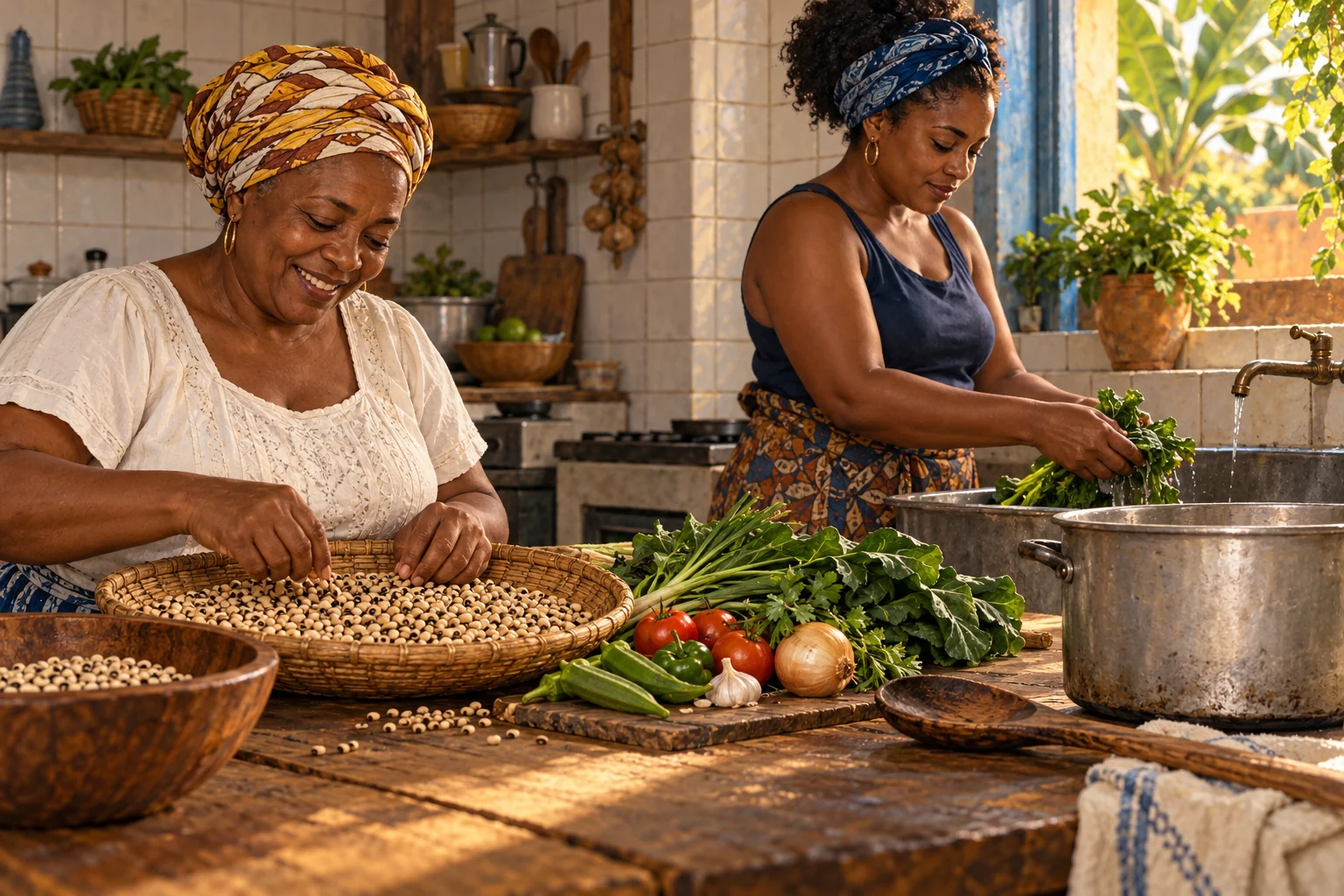
A kitchen can be a place of religious authority
Iabassê, also written iyabassé and in other variants, names an office associated with responsibility for sacred food. In the book’s discussion, this is acquired through learning, practice, trust and recognition within a house. It is not simply an affectionate description of whoever enjoys cooking most. The office concerns knowledge of religious distinctions and the ability to carry them into sustained work. A meal has an addressee, an occasion and a place in a wider sequence of obligations.[1]
The distinction makes the office intellectually demanding. A person must remember more than ingredients. The responsibilities include recognizing context, knowing when to ask, understanding the authority under which work is being done and maintaining attention while other tasks compete for time. This is practical intelligence, but it is not merely instinct. Skills that are difficult to learn from a list can require extensive judgment. Their everyday appearance should not hide the education necessary to perform them well.
The author describes the office through women’s religious service and the kitchen’s association with nurture and abundance. That emphasis deserves respect without being turned into an unsupported law that every task in every Candomblé kitchen is performed only by women. The book itself notes that priests and priestesses may undertake food preparation. A house’s offices, practical division of work and recognized authority need to be described together. A symbolic association with the feminine does not settle every question about an actual person’s responsibilities.
Nor does holding the office necessarily mean working without help. Assistants may learn particular tasks over time under the house’s guidance. The important issue is who bears responsibility and how knowledge is transmitted. A title can acknowledge expertise while depending on the labor of others. Appreciating the iabassê therefore includes recognizing the wider organization of the kitchen: those who obtain supplies, wash, clean, carry, serve, store and remain available when the work takes longer than expected.
The study of Candomblé offices places this responsibility within the house’s larger structure. The kitchen is a particularly clear reminder that religious authority can be exercised through nourishment and exact attention. Public speech and visible leadership are not its only forms. Someone whose work remains largely outside the visitor’s view may carry knowledge without which the celebration cannot proceed. The office asks us to broaden our understanding of what spiritual competence looks like.
Food is addressed within a relationship
In The Sacred Candomblé, feeding Òrìṣà concerns exchange, continuity and the strengthening of relationships. Food is not an arbitrary token placed before a general idea of divinity. Named presences have particular histories and associations; houses learn how to honor them. The language of feeding makes dependence tangible. A relationship is sustained through acts that require materials, time and attention, and those acts belong within a community capable of recognizing their significance.[1]
This perspective helps explain why an ingredient list cannot become an adequate ritual guide. The same visible food can appear in different contexts with different meanings. Purpose, authority, preparation, address and destination all matter. An observer may recognize a dish and remain unable to explain its role on that occasion. There is no contradiction here. Recognizing the letters of a sentence does not mean understanding who is speaking to whom or what the words undertake.
The book uses adimu for a category of offerings described in distinction from animal sacrifice. It also discusses “dry food” as liturgical terminology. Readers should not assume that “dry” means literally lacking moisture or that the category supplies a universal classification across every related tradition. The term belongs within the author’s account of offerings. Its usefulness is to make visible the range of material forms through which a relationship may be addressed, rather than to provide a shortcut around house knowledge.
Ajeum concerns eating and, in Candomblé settings, often draws attention to the shared meal. Yet not every food prepared in a sacred kitchen is automatically served to visitors, and not every communal dish has the same liturgical status. The author distinguishes contexts of sharing from other ritual purposes. This distinction is essential. Hospitality and sacred offering are connected within a house’s life, but understanding that connection requires knowing which food is being discussed and what the community recognizes it as.
A visitor’s meal can still be religiously significant without becoming identical to an offering. Feeding people makes attendance possible, creates time together and expresses the house’s willingness to receive guests. It also returns care to those who have worked. A meal can teach belonging through ordinary gestures: someone notices who has not eaten, makes room for an elder or ensures that an assistant can leave their post briefly. The sacred kitchen’s human horizon includes these quiet forms of attention.
Named foods preserve a field of memory
Acaçá, amalá, axoxó, omolocum and doburu appear in the book’s discussion of foods associated with Òrìṣà. The names point toward distinctive forms rather than an undifferentiated category called “offering.” Acaçá is associated with a maize preparation, amalá with Ṣàngó in the account presented, axoxó with Ọ̀ṣọ́ọ̀sì, omolocum with Òṣun and doburu with Omolu. These are orientation points in this Brazilian discussion, not a complete menu or a rule for every quality and occasion.[1]
The distinctions invite a better kind of curiosity. Instead of asking only which dish belongs to which Òrìṣà, we can ask how a house remembers that relationship, who teaches its significance and how a person learns to recognize the occasion. A name may gather stories, sensory memories and previous acts of service. The result is a religious vocabulary that cannot be reduced to a shopping list. Learning the word begins a conversation about relationships rather than ending it.
Dendê, called epô pupá in the book’s vocabulary, is especially prominent in discussions of Candomblé food. The author relates palm oil to active or warming associations and distinguishes it from substances associated with Òrìṣà Funfun. These are religious classifications. They should not be presented as nutritional judgments or as a reason to diagnose a person’s body from their Òrìṣà. A symbolic account of warmth and calm operates in a different register from information about food safety or a medical condition.
Water, honey and salt also carry associations in the book. Water concerns renewal and life; honey can suggest sweetness; salt participates in accounts of vitality and distinction. None of these meanings makes a substance universally appropriate. A house’s knowledge includes relationships and incompatibilities that a generic positive description would miss. The phrase “sweetness is good” does not establish that honey belongs in every offering, just as calling water life-giving does not explain all the religious differences between waters.
This is where the word quizila becomes important. In the author’s discussion it concerns interdictions or incompatibilities that may be associated with an Òrìṣà, a person, a house or a period following an obligation. Such distinctions belong to a religious relationship and need appropriate guidance. They should not be turned into a public chart claiming that everyone associated with a named Òrìṣà must avoid an identical diet. Individual and collective circumstances remain part of the explanation.
Quizila should also not be confused with a medical diagnosis. A religious interdiction, an allergy, a food preference and a physiological intolerance are different kinds of statement, even when they affect the same meal. Respectful care can attend to each without collapsing them. A person should be able to communicate what they can eat without being pressed to reveal private religious information. The kitchen’s attentiveness is strongest when distinctions help care for actual people rather than becoming occasions for public interrogation.
Apprenticeship happens while work is being done
Marcos Júnior Santos de Alvarenga’s study of a kitchen in the Federal District shifts attention from great public rites to daily religious learning. Writing as both a researcher and a recently initiated member of the house, he follows how work, teaching and social relationships meet in that space. One interlocutor compares the kitchen with a library. His account also records fatigue and the repetition of washing dishes. Learning and demanding labor coexist; the metaphor does not make the workload disappear.[2]
The comparison is useful because a kitchen holds organized knowledge while differing from a shelf of texts. Instruction may arrive when a question becomes practically relevant. A senior person notices a mistake, explains a distinction or responds to uncertainty while another task continues. Knowledge is inseparable from timing and relationship. Someone learns what to attend to, not only what to remember. This kind of education can make small actions important without turning every ordinary gesture into an esoteric secret.
At the same time, calling work educational should not become a way to avoid asking whether teaching is actually occurring. A person can spend hours at a sink without being included in meaningful instruction. The human responsibility of a teaching house includes the difference between making use of someone’s labor and helping that person learn. Patience is a virtue, but endless postponement is not automatically pedagogy. Trust grows when the relationship between service, guidance and increased responsibility becomes intelligible over time.
The study of Candomblé seniority helps explain the place of religious time in that process. Seniority can acknowledge obligations, experience and recognized capacity. In a kitchen it should also raise a concrete question: can a more experienced person guide others without confusing expertise with impatience? A correction can protect the work and preserve the learner’s dignity. Exactness and kindness are not competing goals; together they make sustained apprenticeship possible.
A kitchen also teaches coordination. Someone must notice which tasks depend on others, when space is becoming crowded and when a tired person needs relief. These skills are rarely the focus of a dramatic description of religion. Yet they shape whether a group can continue to work together. Knowledge that cannot organize cooperation remains incomplete in a setting where food and people must arrive at the right moment. Religious seriousness includes the practical ability to make room for another person’s contribution.
The kitchen has boundaries because work has addressees
The book emphasizes that not everyone enters every sacred kitchen or undertakes every task. Some houses distinguish separate kitchens or areas for different purposes; others manage distinctions within more limited space. Access concerns knowledge, trust and the work taking place. A kitchen should therefore not be treated as the informal public area of a terreiro merely because kitchens elsewhere are places where visitors gather freely. Its familiarity can conceal a different order of responsibility.[1]
The study of Candomblé spaces places that boundary alongside barracão, roncó and sacred rooms. These spaces depend on one another. Food supports people in seclusion; communal meals support those working through long observances; a public celebration depends on preparations outside the hall. The kitchen is part of the house’s religious geography. Respecting its boundary recognizes that work has an occasion and an addressee, including moments when additional spectators would make it harder to proceed.
For a visitor, offering help can be generous, but accepting the answer matters just as much. A person may be welcomed to carry chairs or wash ordinary dishes while not being asked to prepare sacred food. That difference need not be interpreted as rejection. It can acknowledge the responsibilities of those undertaking the work. Useful assistance begins with the actual needs of the house. Enthusiasm becomes care when it remains willing to be directed toward a less conspicuous task.
Boundaries can also protect concentration. A kitchen may need quiet at a particular moment, or simply enough room for people to move safely. Religious attention and practical organization can reinforce one another. We need not reduce every rule to convenience, nor imagine that every useful rule conceals an extraordinary mechanism. The people responsible know what the occasion requires. An observer’s task is to understand the relationship between their guidance and the work, rather than to invent explanations from outside it.
A kitchen travels through people, senses and markets
Giovanna Capponi’s ethnography compares Pai Mauro’s Ilé Axé Alaketu Airá in Arborio, northern Italy, with its Brazilian religious connections, including Pai Odé’s house in Juquitiba. In Arborio she found familiar meals for participants alongside a refrigerator list of sacred foods. Some materials came from African and Asian shops in nearby cities. Her study connects food learning with memory and the senses. The case shows how an established relationship can require new practical arrangements after crossing an ocean.[3]
Where the Sacred Takes Hold develops the human question in that comparison: how can a house honor what it has received while sustaining people under different conditions? Work leave, markets, language and distance become part of the problem. A recipe written in another country cannot solve it alone. Someone has to recognize what a material is, understand the particular obligation and remain answerable to the lineage through which that knowledge was received.[4]
The case also keeps adaptation from becoming an empty slogan. Saying that “traditions change” does not explain who can authorize a change, what must remain recognizable or what a person needs afterward. Saying that “tradition must be preserved” does not bring an unavailable material into a kitchen. The religious work concerns judgment within a continuing relationship. It asks people to face the practical situation while acknowledging the obligations that prevent convenience from becoming the only criterion.
Taste can make that learning personal. What feels ordinary to one person may be unfamiliar to another; a smell can recall a home or announce that a new skill must be acquired. These sensory differences do not prove that one person belongs more deeply than another. They show how belonging can require attention to experiences that cannot be acquired by reading alone. Shared work can gradually make the unfamiliar recognizable, provided the learner is received with patience.
The transnational example also reveals a wider material interdependence. A religious community’s ability to gather can depend on markets and transport networks maintained by people outside its membership. Recognizing those dependencies expands the meaning of gratitude. The kitchen gathers a world of cultivation, trade, travel, labor and teaching into a small working space. Its sacred character does not remove it from that world. It makes the quality of its relationships within the world more consequential.
Nourishment requires attention to the people who provide it
Ajeum makes a community visible as people who can sit and eat together. Yet the meal can also conceal an unequal distribution of work. Someone who serves everyone may eat last or barely pause at all. A serious theology of nourishment should have room to notice this. If feeding sustains relationships, then care for the cook and assistants belongs within the same account. Gratitude must include rest, adequate help and recognition of the expertise being given.
The work also has a future. An experienced iabassê cannot remain responsible indefinitely without learners who are allowed to grow. Preserving knowledge includes creating time to teach, accepting that beginners need correction and recognizing increasing competence. A community that depends on one person’s exhaustion has a fragile continuity. The office becomes stronger when its authority includes the possibility of transmission, so that care can continue beyond the lifetime or availability of its present holder.
For readers outside a house, the lesson can remain concrete without imitating liturgy. Notice who feeds a gathering, who plans the meal and who cleans afterward. Ask whether gratitude reaches those people and whether help is offered in a form they actually need. This reflection does not turn an ordinary kitchen into a Candomblé sacred kitchen. It allows the religious account to sharpen attention to a familiar ethical problem: the people sustaining a community are often the easiest people to overlook.
The sacred kitchen joins precision with hospitality, authority with service and memory with repeated work. Iabassê names a recognized responsibility within that field; ajeum brings people into its human horizon. Food matters because relationships require more than declarations. They need time, materials, judgment and somebody willing to remain attentive. To understand the kitchen is to recognize how a house makes nourishment durable enough to be received, shared and taught again.
Sources
- Tilo Plöger de Àjàgùnnà, The Sacred Candomblé — Principles, Organization, Rituals, and Terms of Brazilian Candomblé. Published interpretive foundation; substantive sections on the kitchen, food, ajeum, iabassê, named dishes, material associations and quizila consulted. Ritual recipes, animal procedures, fixed dietary charts and clinical interpretations excluded.
- Marcos Júnior Santos de Alvarenga, “O Candomblé começa na cozinha: alimentação, aprendizado e transformação”, Habitus 16(2), pp. 275–292 (2018 issue; published online 2019). Published article, introduction and sections on kitchen apprenticeship and labor consulted. One Federal District fieldwork setting, not a universal house organization.
- Giovanna Capponi, “Candomblé rituals and food practices in Italy and Brazil: an ethnographic comparison”, Antropolítica 48 (2020), pp. 119–141. Publisher metadata and selected full-text sections of the publicly available published article consulted for Arborio/Juquitiba, the refrigerator list, markets and sensory learning. Protected and animal procedures not reproduced.
- Tilo Plöger de Àjàgùnnà, Where the Sacred Takes Hold. Published interpretive foundation; substantive comparative chapter on religious thresholds, food and transnational continuity consulted. Its discussion is distinguished from Capponi’s primary fieldwork.
Continue in the DAILY IFÁ Academy. Use Personal Exploration for educational reflection on nourishment, gratitude and shared responsibility.