
A Candomblé house is easier to misunderstand when we begin with a floor plan. Boxes marked “hall,” “kitchen” and “bedroom” can suggest a familiar building whose rooms happen to contain unfamiliar objects. A terreiro, however, is formed through relationships among people, Òrìṣà, ancestors, materials and land. Its spaces acquire significance through consecration, use, care and remembered events. A door can distinguish kinds of access; a tree can be part of a sacred relationship; the ground can belong to the continuing life of the house.
This study follows the principally Ketu account in Bàbálórìṣà and Bàbáláwo Tilo Plöger de Àjàgùnnà’s The Sacred Candomblé, with a named ethnographic example and institutional heritage documentation. It explains barracão, roncó, cumeeira and related spaces without proposing a universal architectural template. Houses differ in nation, lineage, size, resources and history. Their layouts can change while important relationships endure. The useful question is how a particular place sustains religious life, including what it asks of the people who enter it.[1]
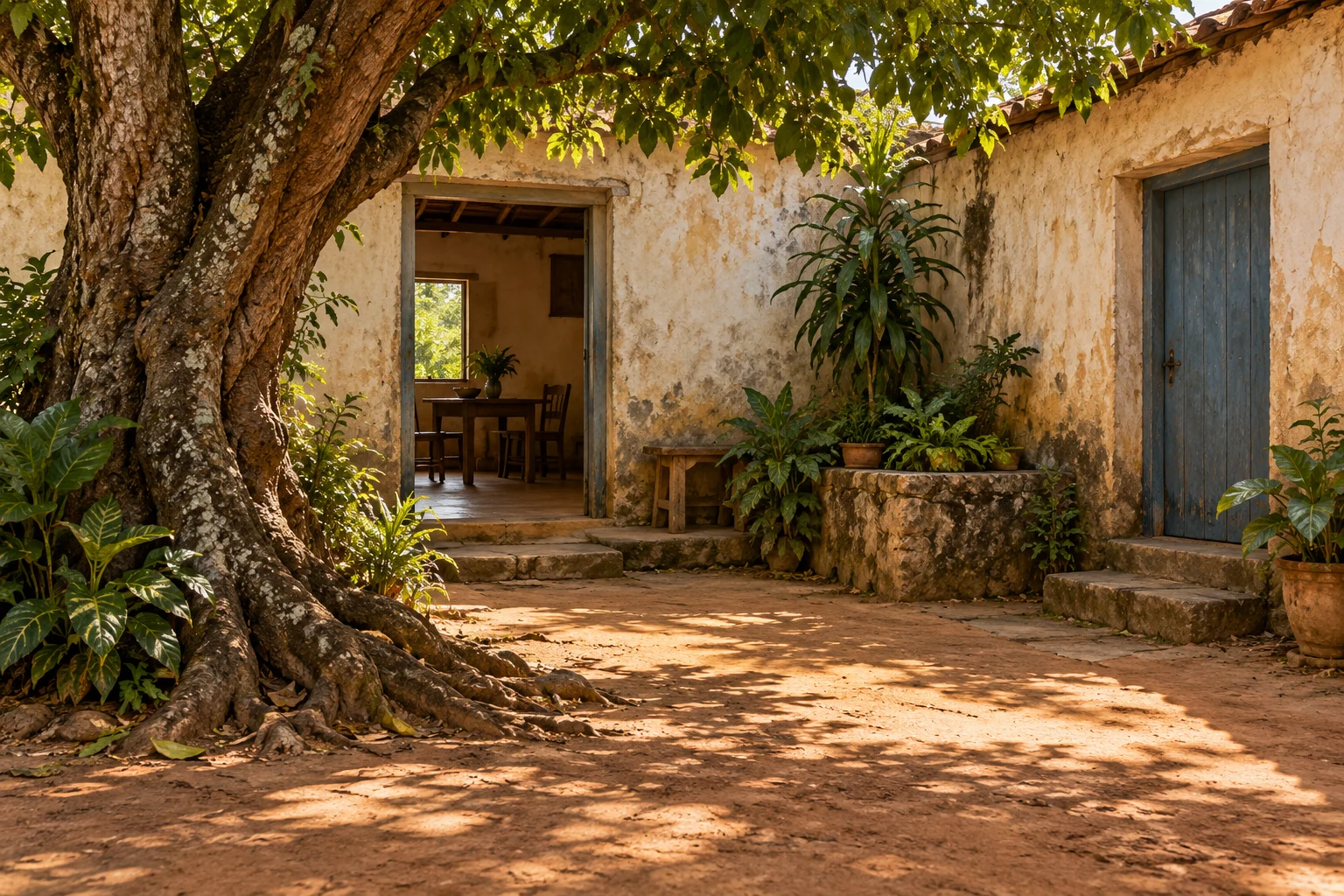
Terreiro names a place and a company
Terreiro, casa de santo, roça and ilê axé can draw attention to different aspects of a religious place. In the author’s discussion, ilê axé emphasizes a house of axé, while roça evokes the land and its possibilities. These expressions need not designate identical kinds of property. They can describe a large established compound or a community developing within more limited conditions. Their human center is the continuing company of people able to care for what has been entrusted to them.[1]
Axé is indispensable to this account. It concerns the capacity of relationships, beings and materials to sustain religious action and life. It is also used in naming a house, its people or its received way of practicing. A terreiro cannot therefore be understood as a neutral container into which religious activity is occasionally poured. The place belongs to the relationships taking shape there. Maintenance, offerings, instruction and presence are part of that continuity, rather than separate additions to an otherwise complete building.
The double meaning changes how we think about permanence. A well-built structure can outlast a period of neglect, but religious continuity requires people who remember obligations and know whom to approach. Conversely, a community may sustain relationships while struggling to repair a roof or obtain more space. Material security matters enormously; it does not replace religious knowledge. The strength of a house concerns their combination: durable places, recognized care and people capable of carrying responsibilities into another generation.
The study of the terreiro community follows the family and institutional relationships behind that continuity. Here the focus is spatial: those relationships are organized through passages, rooms, places to rest and places to gather. A newcomer learns the house by learning how to move within it. This is a practical education in belonging. One begins to understand that different places require different kinds of attention, and that familiarity does not erase every boundary.
The barracão makes public presence possible
Barracão usually names the principal hall associated with public festivities and collective religious activity. It may be the part of the terreiro most familiar to visitors. Drums, song, circling movement, seating and the reception of guests shape what happens there. The hall’s apparent openness can be deceptive, however, if openness is taken to mean that every place and action is available to anyone. Public participation is still organized by a house’s religious order.[1]
A hall needs room for bodies in motion and for those who assist them. An Òrìṣà’s manifested presence is recognized through more than a single individual’s movement. Musicians, singers, ekedis, elders and participants sustain an occasion together. The space must allow these relationships to work. Watching only the center can conceal the expertise at the edges: someone notices a change, creates room, offers support or quietly directs a visitor away from an obstructed passage.
Seating also makes relationships visible. A place may be reserved because a person has an office, because a guest has been formally received, or simply because someone needs appropriate support. The observer should resist turning every difference into a moral ranking. An arrangement can acknowledge particular duties without declaring that one human life is worth more than another. The important question is what responsibility or hospitality the arrangement expresses, and how people are actually treated within it.
Nor does the hall explain the entire event. Food has been prepared elsewhere; garments have been arranged; private obligations may have preceded the gathering. A public celebration can be the visible crest of a much longer period of work. Understanding the barracão as part of a whole house prevents the familiar mistake of calling only the most spectacular moment “the ritual.” Sacred life continues in quieter spaces before the audience arrives and after it leaves.
This perspective gives visitors a useful discipline. Follow the house’s guidance about where to sit, stand and move. A seemingly empty space may need to remain available; a doorway may connect work areas; proximity to the drums may carry expectations that a newcomer does not know. Attentive participation does not require pretending to understand everything. It begins by allowing those responsible for the occasion to organize the room and by treating their directions as meaningful.
Roncó protects a period of becoming
The roncó is associated with seclusion and initiation. The book also uses names including rondêmi and discusses related terminology across traditions. Its account treats the place as a setting for religious birth, care and transition. The room is more than a private bedroom. It supports a period in which a person’s ordinary arrangements of time, contact and attention are changed within a recognized religious process. The metaphor of a womb emphasizes reception and sustained care.[1]
That metaphor should lead us toward the labor of attending to a person. Someone must be available; meals and rest must be organized; questions arise; instruction needs appropriate timing. The room’s significance cannot be understood solely through what an outsider is forbidden to see. Privacy also makes a kind of care possible. A person passing through an important transition need not remain continuously exposed to guests, casual conversation or the expectation of explaining themselves.
Roles such as mãe-criadeira, mãe-pequena and pai-pequeno appear in the book’s account of support around initiation. Their precise responsibilities vary by house. The terms nevertheless make something important visible: the leading priest or priestess does not necessarily perform every act of daily care alone. A person’s transition may depend on a larger network of trusted people. The seclusion room belongs within that organization of attention, rather than within a solitary encounter between initiate and leader.
The study of Candomblé initiation develops that process without turning it into a set of procedures. Spatially, the crucial point is that a protected room marks a difference in availability. The person inside is not simply absent from ordinary life; they are present within another set of relationships. Respecting the boundary acknowledges the work taking place there. It also prevents curiosity from becoming an additional demand on somebody who is being cared for.
Privacy does not remove a person’s dignity or their need for trustworthy care. A serious account can respect house boundaries while recognizing that authority must remain answerable to the wellbeing of those concerned. The room is sacred because important relationships are tended there, not because the idea of a closed door cancels every human question. The language of birth and nurture makes that responsibility clearer: someone is receiving a vulnerable life and undertaking obligations toward it.
A sabaji, where that term is used, may serve different functions related to preparation and dressing. It should not simply be treated as a second name for the roncó. A changing or preparation space and a room of seclusion can be adjacent while retaining distinct purposes. The difference reminds us that a building’s intimate areas are differentiated too. “Backstage” is an insufficient description for a set of spaces whose uses are understood through religious roles and occasions.
Cumeeira connects structure, foundation and continuity
Cumeeira is a Portuguese architectural word associated with the upper ridge of a roof. In the religious account presented by The Sacred Candomblé, it concerns a powerful point in the life of the house and a relation between upper space, ground and sacred foundation. The vocabulary begins with a recognizable building element but develops a religious significance. It would be misleading to identify the Portuguese term itself as a Yorùbá word.[1]
The book interprets this relation through Òrun and Ayé, spiritual and earthly dimensions. It also emphasizes lineage: the establishment of a new house does not begin with a founder acting without predecessors. Religious elders and the connections through which the founder was received matter to the new community. The cumeeira can therefore be discussed as part of a house’s continuity and belonging, without exposing the protected work through which any particular house establishes its foundations.
“Foundation” becomes an especially rich word here. In ordinary architecture it names what carries weight and permits a structure to stand. In religious language it can also concern the knowledge and relationships that enable a house to continue. The two senses are not identical, yet neither should be dismissed as an ornamental metaphor for the other. The religious house is a material place whose stability matters to people, and a living order whose care involves more than engineering.
The connection between upper space and ground also corrects an overly visual account of sacred architecture. Visitors tend to notice what is decorated at eye level. A house’s account may direct attention elsewhere, including to places that remain concealed. Visibility is therefore a poor measure of significance. What organizes a room may not be the object that photographs best. The practical lesson is to resist assuming that the most conspicuous feature contains the whole religious center of a place.
The cumeeira should not become an invitation to reproduce a foundation from a diagram. Knowing an architectural term or understanding a broad cosmological relation does not supply the recognition, knowledge and responsibilities necessary to found a house. The subject concerns continuity among houses as well as the life within one property. Learning can make that continuity intelligible while leaving specific liturgical work with those responsible for it.
A named house shows why plans vary
Daniele Ferreira Evangelista’s 2015 study follows the founding of Mãe Carla’s house in Maricá, Rio de Janeiro state. Her account joins material construction, religious relationships and the creation of a legal association. It describes a hall, distinct sacred rooms, guest accommodation, kitchen and more secluded spaces. Separate areas also acknowledge the house’s Candomblé and Umbanda activities. This is one ethnographic case, not a blueprint for every terreiro. Its importance lies in showing that spatial distinctions are made through actual histories, resources and commitments.[2]
A named case changes the force of comparison. Instead of asking whether a small house resembles an ideal picture, we can ask what its arrangements make possible and which relationships they acknowledge. A hillside, an existing home or the cost of construction can affect a plan. Such circumstances do not determine the religious meaning by themselves. They become part of the problem a community must answer through decisions about where and how its obligations can be sustained.
The same applies to money. Walls, bathrooms, safe wiring, storage and accommodation require resources. Speaking about axé does not make these expenses disappear. A house may need years to develop its built environment, while continuing to care for those already received. The author’s account recognizes gradual development. Understanding that process allows readers to appreciate practical effort without inventing a rule that grand scale proves greater sacred power or that limited means invalidate a community’s life.
Sacred rooms are residences of relationship
Quartos de santo, ilê Òrìṣà and other locally used names refer to spaces associated with the care of sacred presences and their material settlements. In the book’s discussion, some houses have separate places for different Òrìṣà, while others organize space more collectively. An igbá or assentamento belongs within a maintained relationship. A visitor should therefore avoid treating a sacred room as a display cabinet whose objects are available for close inspection or touch.[1]
The study of shrines and presence considers this distinction in greater depth. Material is central, but its significance is not exhausted by inventory. A vessel’s religious life can involve a particular person, a house’s lineage, periodic obligations and people entrusted with care. Moving the object conceptually into a museum case can remove those relationships from view. The sacred room is part of the ongoing life of a house, even when no public event is taking place.
Entrances have their own significance. The author discusses Exu through passage and communication, and Ògún through protection, in relation to the reception and boundaries of the house. These associations help explain why arriving is itself meaningful. They should not be converted into a requirement that every house places identical rooms in an identical sequence. The named presences and their relationships matter more than a visitor’s expectation that every gate will reproduce a familiar picture.
Places connected with ancestors require equal care in terminology. The book describes protected ancestral spaces in some established houses. Such a space should not be assumed to reproduce every feature of an Egúngún institution elsewhere. Ancestors, Òrìṣà and other presences are related within particular religious histories; their distinctions remain meaningful. A floor plan that labels every nonpublic sacred space “ancestor room” would conceal precisely the knowledge it claims to make accessible.
Trees, water and ground are part of the house
The religious place extends beyond enclosed rooms. The book discusses sacred trees, gardens, leaves and water as part of a terreiro’s life. These materials are not merely landscaping surrounding the “real” temple. Their care can be integral to the house’s relationships. Iroko and other named sacred presences show why a tree may need to be approached through a religious account rather than assessed only for shade, beauty or botanical interest.[1]
This does not mean that every Brazilian sacred tree is botanically identical to an African tree bearing a related religious name. As with bird names, living religious correspondences require careful separation from species identification. Nor should a proposed history of a central tree become a universal architectural origin story. What can be said confidently within the author’s interpretation is that trees, land and built spaces can form a connected religious place. Each relation still has a particular history.
The documentation of Casa Branca, Ilê Axé Iyá Nassô Oká, in IPHAN’s digital archive offers an institutional example. The heritage record names buildings, trees and principal sacred objects together as part of the recognized place. Archival photographs distinguish the barracão and ilê iaô. The record supports a broad but consequential point: the place cannot be adequately represented by preserving a hall while treating the surrounding living territory as irrelevant. The catalogue is evidence of the record’s scope, not access to the house’s protected foundations.[3]
Water likewise makes the connection between religious care and ordinary infrastructure tangible. A house needs water for people’s daily life as well as within its liturgical relationships. Access, cleanliness and reliable storage matter. Recognizing sacred meanings should sharpen attention to those material conditions. It allows the reader to see environmental care as a practical concern for a community’s continued life, while leaving specific religious uses and distinctions to the people who maintain them.
A place survives through repeated return
A terreiro’s geography is learned over time. The new visitor may know only the hall; the committed participant gradually learns where work is done, when quiet is needed and whom to ask before entering. This learning is a change in relationship, not simply the acquisition of a more complete map. Even a very familiar place can retain areas and occasions to which a person has no access. Belonging includes knowing how to honor those distinctions.
The building also changes with the lives around it. An elder may need better access, a growing community may need more rest space, a leaking roof may interrupt plans. Responding to these needs is part of sustaining religious life. A sacred place cannot be cared for solely by insisting that it remain visually unchanged. Its continuity includes the capacity to accommodate living people while maintaining the relationships and boundaries through which the house knows itself.
Barracão, roncó, cumeeira, kitchen, sacred rooms and living ground together make an account of interdependence. The hall needs preparation elsewhere; seclusion needs attendants; a foundation needs continuity; a garden needs hands. No single room performs the whole work of the house. To understand the place is to begin seeing how these dependencies are sustained. A visitor leaves with a fuller knowledge when the architecture leads back to the people and presences who make return meaningful.
Sources
- Tilo Plöger de Àjàgùnnà, The Sacred Candomblé — Principles, Organization, Rituals, and Terms of Brazilian Candomblé. Published interpretive foundation; substantive sections on the terreiro, cumeeira, roncó, sacred rooms, gardens and water consulted. Universal layout claims, protected foundation details and speculative architectural origins excluded.
- Daniele Ferreira Evangelista, “Fundando um axé: reflexões sobre o processo de construção de um terreiro de candomblé”, Religião & Sociedade 35(1), 2015. Published introduction and named Maricá ethnographic sections consulted for interconnected material, spiritual and juridical dimensions and one situated spatial example.
- IPHAN, Casa Branca archival collection. Institutional catalogue descriptions of the protected ensemble and photographs consulted. Archival record only; the full protection dossier was not read, and no present access arrangements are asserted.
Explore the sacred kitchen and continue in the DAILY IFÁ Academy.