
A terreiro is a Candomblé religious house and the community that sustains it. It joins sacred places, divine relationships, remembered elders, recognized offices, and people learning how to live with their obligations. It can also be called a casa de santo, roça, or ilê axé in relevant settings. These names are not a guarantee of one architectural plan. What gives the house continuity is the relationship between its ground, its religious inheritance, and the people who keep it active.
The public festival is one visible part of that life. Long before visitors arrive, members prepare spaces, organize food, care for sacred responsibilities, and coordinate their work. After the last dance, the house still requires attention. Understanding the terreiro therefore means looking beyond a spectacular moment toward the daily relationships that let it happen. Bàbálórìṣà and Bàbáláwo Tilo Plöger de Àjàgùnnà's principally Ketu-focused The Sacred Candomblé makes this enduring community a central starting point for religious understanding.
A home with more than one kind of relationship
Calling a terreiro a home conveys something important, provided it does not imply that every member lives on the property. Some houses include residences; many members travel between their ordinary households and the religious house. Their belonging can still be deep. A person returns because others recognize them, because duties await them, and because relationships established there continue between visits.
The house also exceeds the people presently gathered. Founders and deceased elders can remain part of its remembered religious inheritance. Assentamentos and other sacred places hold continuing responsibilities. An individual's participation takes place within something already inhabited by history. The newcomer does not arrive at an empty room waiting to be filled with personal spiritual preferences.
This is why religious belonging can change the meaning of time. A visitor may think in terms of attending an event; a member may be thinking about preparing for it, fulfilling an earlier obligation, and teaching someone who will eventually take on more responsibility. The same evening sits inside different durations. The history of Candomblé gives those longer relationships a historical frame.
Axé is understood through care and transmission
Axé is commonly explained as sacred power or the capacity that enables life and action. Those translations orient the reader without exhausting the word. In Babá Tilo's account, axé is connected with people, plants, food, sacred materials, and the continuing obligations of the house. It is not simply a private sensation that someone possesses independently of everyone else.
This emphasis changes how ordinary work appears. Cleaning a space or preparing for a ceremony need not stand outside religious life as a practical inconvenience. These actions help sustain the conditions in which sacred relationships are maintained. Their meaning depends on the house's teaching and on the responsibilities of the people involved; it cannot be inferred solely from what an observer sees them holding.
Axé should therefore not be converted into a measurable substance or a vague synonym for enthusiasm. A lively gathering is not automatically evidence that every obligation has been fulfilled. Nor can an outsider rank houses by the intensity of a personal feeling. The concept points toward a religious account of efficacy, continuity, and shared responsibility, whose practical expression must be learned in a setting.
Sacred ground is more than a building
A terreiro may include a public hall, kitchens, residences, gardens, trees, and spaces with restricted access. The relationships among these places matter. A room's significance is not determined only by its size or decoration, and a planted area may hold more religious importance than a visitor can recognize. Babá Tilo describes the house as a whole whose parts sustain different responsibilities.
The existence of restricted places does not make the entire community secret. Public explanation and controlled access can coexist. A visitor may be welcomed to a celebration while remaining outside rooms whose care belongs to particular members. That boundary concerns relationships and authorization; entering physically is not the same thing as understanding or being entitled to participate.
Historic preservation also reveals this broader sense of ground. IPHAN's description of Casa Branca includes buildings, trees, and principal sacred objects within the protected site. Such an inventory helps recognize that a religious place exceeds a façade. It still cannot replace the community's account of what those places require. IPHAN's Casa Branca collection record.
A family made through religious relationships
Família de santo names kinship made through religious belonging. Mother, father, child, and sibling can identify relationships established and recognized within the house. These terms do not merely borrow affectionate language from domestic life. They can express responsibility, remembered teaching, seniority, and the continuity of an initiatory family.
Religious kinship and biological kinship may overlap without becoming identical. A house can include several generations of a biological family alongside people who are unrelated by descent. A child's age, an adult's professional standing, and a person's religious seniority can point in different directions. Learning the house means learning which relationship matters in a particular interaction.
The human promise is that belonging need not depend exclusively on the family into which someone was born. The human difficulty is that every enduring relationship also needs work. Affection does not remove disagreements, uneven resources, or disappointment. Calling the terreiro a family becomes more meaningful when it includes the labor of listening, correction, and repair, rather than promising an imagined household without conflict.
Seniority is a responsibility as well as recognition
Religious seniority is not simply chronological age. It concerns a person's place in an initiatory history, fulfilled obligations, learning, and recognition by others. Terms such as iaô and ebômi orient readers toward differences in that history, particularly in Ketu descriptions. They should not be treated as badges that can be assigned from a calendar alone.
For someone accustomed to formal courses, the connection between time and knowledge may initially seem frustrating. An elder can know things that have never been presented as a lesson. Repeated work has taught them how to notice timing, recognize a problem, and judge whose assistance is needed. The knowledge is partly visible in the quality of their attention.
Recognition also places demands on the elder. Having greater standing means being trusted with people and responsibilities, including situations in which a beginner cannot yet judge what is happening. Authority becomes credible through how that trust is carried. An account that celebrates obedience while ignoring the duty to teach and care would give only one side of the relationship.
Offices distribute the work of the house
An ialorixá or babalorixá is commonly identified as the priestess or priest leading a Ketu religious house. Leadership does not mean personally undertaking every task. Other offices carry specific knowledge and responsibilities. Babá Tilo discusses ogãs, ekedis or equedes, and elders whose work allows the whole community to function. Terms and arrangements differ across nations and houses.
Music supplies one clear example. An alagbê, in Ketu usage, can hold a leading responsibility for sacred percussion. Knowing how to play an instrument is only part of that office. The musician attends to a ceremony, its people, and the relationships unfolding within it. The community recognizes a trained religious responsibility, not simply a performer hired to provide atmosphere.
Ekedis make another essential dimension visible: attending to an embodied manifestation and to the initiated person. Their importance is not diminished by their own absence of Òrìṣà trance. In Babá Tilo's account, non-trance offices and trance-bearing paths sustain different parts of the house's religious life. The study of orixás, Orí, and trance explains why visibility and spiritual importance cannot be equated.
What work happens before a festival?
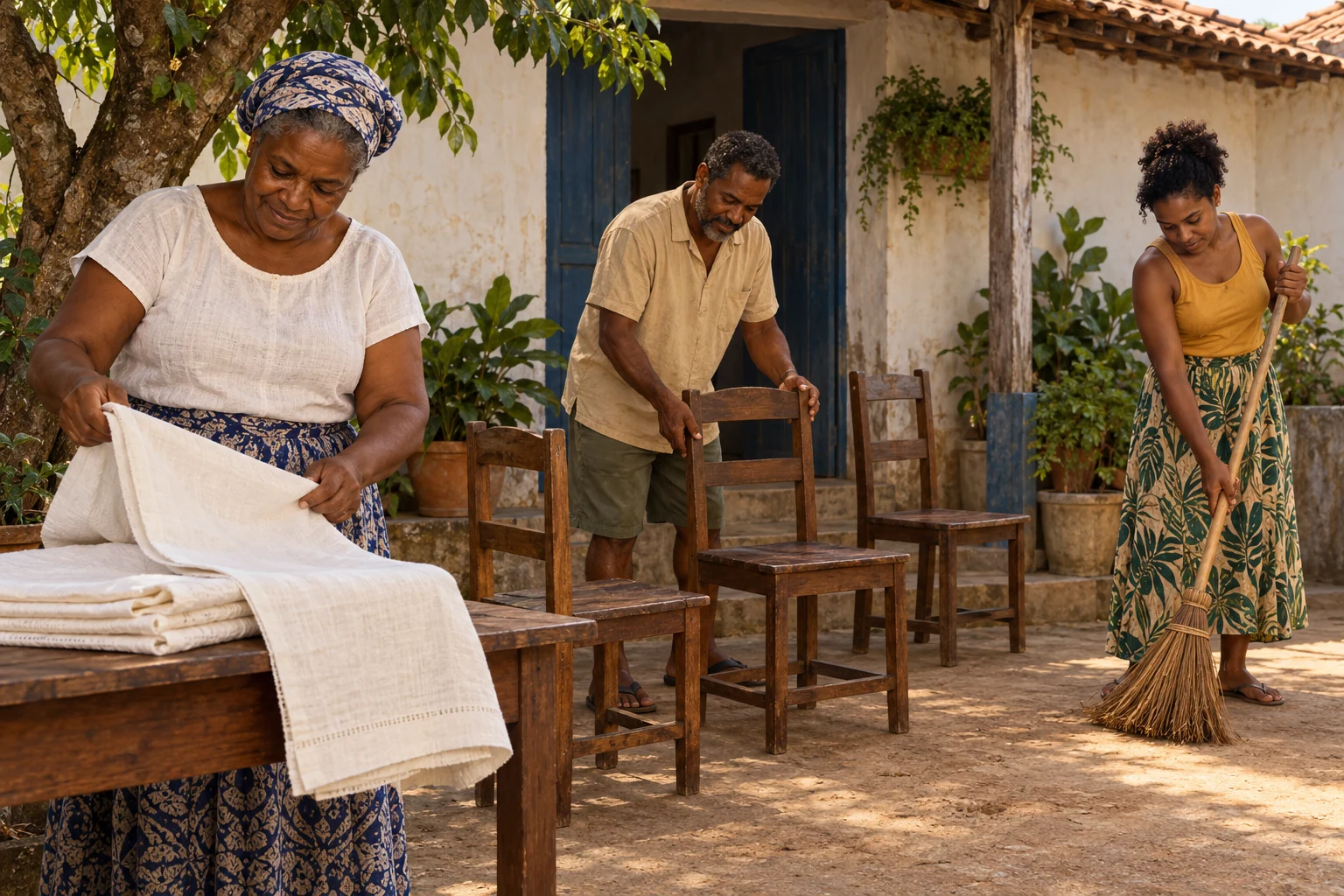
Before visitors see the prepared hall, someone has arranged materials, coordinated people, and made the place usable. There may be transport to organize, clothing to care for, food to prepare, and spaces to clean. Some work belongs to designated offices; some can be shared under guidance. The same action can require different levels of authorization depending on its context.
This produces a practical education in interdependence. A person who finishes one task may discover that another person's work cannot begin until it is done. Reliability becomes more valuable than self-display. Learning to ask where assistance is needed can be part of entering the community, alongside learning names or narratives that look more obviously religious in a book.
The public occasion also depends on people with jobs, families, limited money, and uneven capacity to travel. An honest account of the terreiro includes those constraints. Religious commitment is made through actual lives, not through an unlimited supply of free time. Planning and understanding each other's circumstances help turn a shared ideal of service into something the members can sustain.
Food joins sacred obligation and hospitality
Food in a terreiro has more than one role. There are responsibilities associated with particular religious preparations, and there is the work of feeding the people gathered. The distinction does not make one kind of labor meaningful and the other trivial. Hospitality gives visitors and members a material experience of being received.
A meal also makes dependencies visible. Ingredients must be obtained, knowledge transmitted, utensils maintained, and work coordinated. An inexperienced member may learn first by observing and helping where invited. The presence of a kitchen does not turn every recipe into public information, nor does enjoying a dish confer authority over its sacred preparation.
For a reader, the important interpretive point is that care has substance. It requires time, food, and hands. A community's language of welcome becomes tangible when someone notices whether another person has eaten or needs a place to rest. That observation is a reflection on the meaning of hospitality, not a claim that every house organizes meals in the same way. The house's own customs remain decisive.
Oral learning includes trained perception
Oral transmission is often imagined as a set of facts held in memory instead of written down. That is only part of the story. In a terreiro, learning can involve how to stand with others, when to speak, whom to consult, and how to recognize an appropriate action. The lesson may emerge through doing something repeatedly with a more experienced person.
Babá Tilo emphasizes acclimation before initiation: becoming familiar with the community, music, values, and religious life. A beginner's understanding can change as the same situation returns. Something that first looked like a restriction may later appear as a way of coordinating care; a gesture that seemed incidental may turn out to acknowledge a relationship.
Books remain valuable in this process. They offer vocabulary and help a reader formulate better questions. Their limits become clearer when knowledge includes timing and responsiveness. Reading about a responsibility cannot establish that a person knows how to carry it under actual conditions. The initiation study describes how formal consecration belongs within this longer education rather than replacing it.
Privacy can protect relationships
Not every form of religious knowledge is offered in the same setting. Some explanations are public; others belong within particular levels of training or office. The boundary should not automatically be interpreted as a marketing device promising a hidden prize. Knowledge can be restricted because it comes with responsibilities to people, sacred places, or divine beings.
The reader can respect this without romanticizing everything inaccessible. A person considering a commitment still needs intelligible information about what they are agreeing to, what practical demands are foreseeable, and whom they can approach with concerns. Keeping ritual detail private does not require making the human terms of a relationship impossible to discuss.
This distinction is useful well beyond religion. Confidentiality and accountability can coexist when the community is clear about what each protects. A visitor does not need access to every sacred room to understand an expectation about attendance or consent. Conversely, an explanation of attendance does not disclose a rite. Thoughtful boundaries give relationships definition while preserving room for responsible questions.
Authority must remain attentive to people
A religious family includes asymmetries of knowledge and standing. These can support careful teaching, but they also make the quality of attention important. The person who knows more has greater capacity to shape how a beginner understands an experience. That capacity deserves seriousness rather than either automatic suspicion or uncritical admiration.
A helpful distinction is between religious interpretation and claims about every aspect of a person's life. An elder may be qualified to explain a house's obligations without thereby becoming the sole authority over a member's work, healthcare, or personal relationships. The scope of the commitment should be discussable. This is an ethical reading of responsibility, not a uniform constitutional rule attributed to all terreiros.
Clara Flaksman's research also cautions against imposing ready-made psychological labels on practitioners' concerns. In her published abstract, she describes revising an initial interpretation of suspicion toward the language of prevention. Her point supports careful listening to religious categories; it does not establish that any feared harm is objectively present. Flaksman, “Guilt and care in the candomblé of Bahia”.
Contemporary care can require changed participation
Emília Guimarães Mota writes as both a researcher and an ekedi of Casa de Oya, a Ketu house in Goiânia. Her account of 2020 describes members negotiating pandemic restrictions and an Olubajé understood through the house's consultation as requested by Omolu. Attendance and preparation were altered; mask-making and food assistance also formed part of the house's response. This is a situated account of care under constraint. Mota, 2022.
The example matters without becoming a universal model. A community can take its sacred relationships seriously while changing how people gather under particular conditions. The decision involves elders, practical resources, and the different circumstances of members. Devotion is not proved solely by reproducing the outward form of an earlier occasion.
It also makes the cost of adaptation visible. Someone accustomed to helping closely may suddenly have to remain at a distance. A person can belong and still feel temporarily excluded from familiar work. That tension gives “community” a concrete meaning: the people must keep interpreting what care requires when the usual forms of proximity become difficult. The relationship continues through judgment, not through appearance alone.
Visiting is an encounter with an existing community
A visitor enters a place whose life began before their arrival and will continue after they leave. The most useful first action is to learn how the host receives guests. Expectations about clothing, photography, seating, greetings, and movement should come from the house. An internet etiquette list cannot anticipate every nation, event, or local arrangement.
Permission to attend does not automatically include permission to record or publish. A photograph may detach a person's body or a sacred moment from the relationships that give it meaning. Asking the host's guidance is therefore a practical form of respect. The answer can vary by occasion without being inconsistent: a public celebration and a restricted responsibility are different settings.
Visitors can also notice labor without claiming it. Acknowledge the people offering directions, preparing food, or keeping order. They are part of the religious occasion even if they are absent from the most striking image. The nation study helps a guest understand why the host's own vocabulary and instructions matter more than a generalized account of “what Candomblé does.”
Belonging is learned through repeated attention
One visit can be moving without answering whether a house is the right long-term setting for a person. Familiarity grows through recurring encounters: seeing how people teach, how they respond when someone is tired, and how they discuss an obligation that cannot be met immediately. The less dramatic moments can reveal how the community understands its own ideals.
As a hypothetical example, imagine a newcomer who volunteers for a festival but later discovers a conflict with work. The meaningful question is not whether enthusiasm can erase the conflict. It is how the newcomer communicates, how the house adjusts, and what expectations become clearer. The example describes no particular client or house; it shows why reliability depends on conversation as well as intention.
Babá Tilo's emphasis on a spiritual family can be read through this ordinary texture. Belonging involves being recognized, becoming useful, and accepting that learning will continue. It need not turn every mistake into a verdict on spiritual worth. A durable relationship has room for correction because its purpose extends beyond proving oneself on a single evening.
What the terreiro asks us to understand
The terreiro holds together things modern descriptions often separate: place and memory, authority and care, music and work, an individual's path and a collective inheritance. That combination explains why neither a belief checklist nor an account of an altered state can describe the whole institution. Each gives only one view of a life made through relationships.
The human meaning is not that every community automatically heals every wound. It is that some forms of understanding become possible through sustained participation with other people. A member learns that responsibility has faces and names. An elder's teaching, a meal offered, and a carefully maintained space can make religious belonging tangible without reducing its sacred claims to social benefits.
For further study, keep that fullness in view. Read about the beings the house honors, its public history, and the people who maintain its ground. Use the Òrìṣà collection to deepen particular questions while returning to the community that gives a relationship its lived form. The terreiro is where inherited knowledge becomes work someone can undertake, care someone can receive, and a future someone can help sustain.
Sources and further reading
- Tilo Plöger de Àjàgùnnà, The Sacred Candomblé. Selected sections on axé, space, family, offices, seniority, and learning consulted; principally Ketu.
- Tilo Plöger de Àjàgùnnà, Where the Sacred Takes Hold. Supplied source consulted for care, material relationships, and the limits of generalized accounts.
- IPHAN, Casa Branca heritage collection. Institutional record identifying protected grounds, buildings, trees, and sacred objects.
- Emília Guimarães Mota, “Omolu quer todo mundo no Olubaje”: o cotidiano de um terreiro goiano durante a pandemia, 2022. Full article consulted; one researcher's account as an ekedi and member of Casa de Oya.
- Clara Flaksman, “Guilt and care in the candomblé of Bahia”, 2018. Abstract consulted only; caution about psychological interpretation.