
The mestres and mestras of Jurema are spiritual presences whose knowledge, histories, and relationships are central to many Catimbó-Jurema communities. Mestre means master or teacher; mestra is the feminine form. These titles can also honor living religious specialists. Understanding the setting is therefore essential: a respected human teacher and a spiritual master may share a title without occupying the same position.
Familiar names include Maria do Acais, Mestre Carlos, Manuel or Manoel Cadete, Mestra Iracema, Mestra Angélica, Malunguinho, and Zé Pilintra, also written Zé Pelintra. A name is a beginning, not a complete identity card. The same figure can be described differently across communities, and a religious life story is not automatically an independently documented biography. This article introduces names found in Bàbálórìṣà and Bàbáláwo Tilo Plöger de Àjàgùnnà’s The Sacred Catimbó — Jurema Sagrada, with particular care for the earlier writers, living custodians, and contemporary researchers whose contributions remain part of the account.
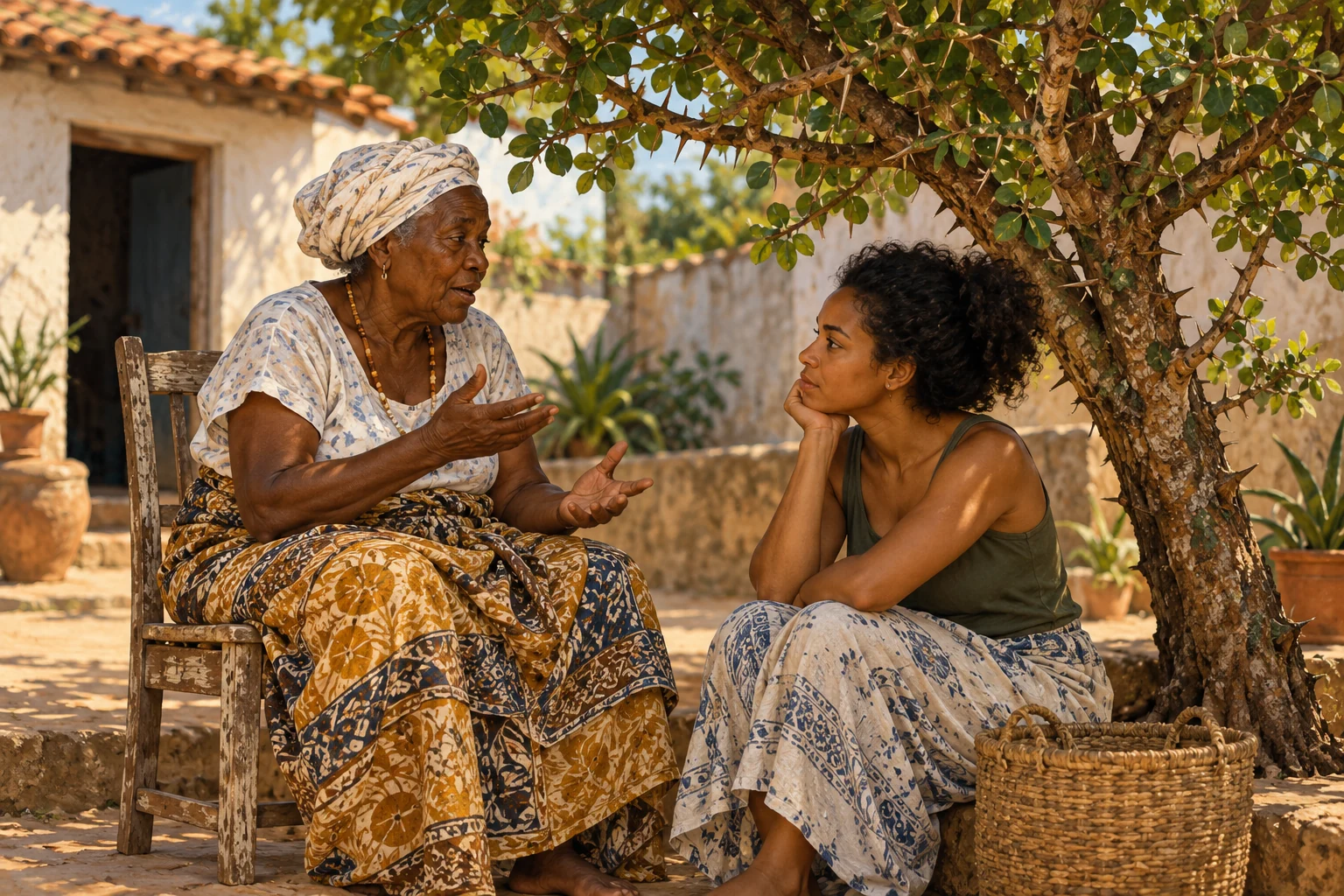
What makes a mestre a mestre?
In many accounts assembled by Babá Tilo, mestres and mestras possess ciência: religious knowledge inseparable from the capacity and responsibility to work. Their significance emerges through service, songs, mediumship, sacred places, and relationships maintained by practitioners. Describing them only as powerful spirits misses the question that makes their authority matter: powerful in what relationship, recognized by whom, and for what purpose?
The book frequently relates spiritual masters to people remembered as knowledgeable practitioners during earthly life. It also includes stories in which contact with Jurema and the manner of death or enchantment explain a master’s position. These accounts should be read within their particular religious vocabulary. They do not establish one universal theory of what happens after death or how every master comes into being. (The Sacred Catimbó)
The title consequently invites attention to knowledge carried through a life, rather than admiration for force alone. As an authored interpretation, one can hear in it a question about maturity: what distinguishes having an ability from knowing how to use it responsibly? That question helps a reader understand why a tradition values apprenticeship and recognition, while leaving practitioners’ spiritual explanations intact.
Human teacher, spiritual presence, remembered ancestor
These positions can overlap without becoming identical. A living juremeiro may lead a house, receive a mestre, preserve an elder’s teachings, and speak about that elder’s place in the enchanted world. Each statement concerns a different relationship. Flattening them into a general idea of “ancestor worship” makes the structure less intelligible, especially where a community distinguishes biological kinship, religious descent, and spiritual affinity.
The distinction also protects human credit. When a woman preserves songs or teaches disciples, her work should not vanish behind the statement that a spirit transmitted everything. Religious accounts may give spiritual beings primary authority, but the people who remembered, organized, cared, and taught remain identifiable participants in transmission. Conversely, describing only human labor can fail to convey what practitioners believe makes the work possible.
A useful introductory approach therefore keeps the layers together. Ask who is speaking, whose presence is being described, and what kind of relationship the title names. The broader introduction to Catimbó and Jurema supplies the terminology; the names below show how that terminology becomes more specific and more demanding.
Maria do Acais and a family’s remembered authority
Maria do Acais is particularly important because the name connects a remembered spiritual authority with the Acais family history in Alhandra, Paraíba. Babá Tilo’s account distinguishes two women: Maria Gonçalves de Barros and Maria Eugênia Gonçalves de Barros. It relates them to Inácio Gonçalves de Barros through different family positions. Collapsing these women into one exceptionally long biography obscures the very transmission the account is trying to preserve.
The book also discusses testimony attributed to Maria das Dores da Silva Guimarães, known as Dona Dora or Dorinha, in material drawn from Marcos Alexandre dos Santos Albuquerque. Her remembering of songs, objects, relatives, and religious work makes the human labor of continuity visible. These are attributed family and fieldwork accounts, not direct interviews conducted for this article. Acais and Acaes are useful spelling variants for further research.
The significance is greater than genealogical tidiness. A familiar name can come to stand for a whole tradition, while the women whose individual lives helped sustain it become indistinct. Careful naming restores difference without weakening collective memory. It lets readers ask how a person’s authority continues after death without assuming that every detail circulating under her name concerns the same historical woman.
Mestre Inácio: why relationships matter more than a label
Inácio Gonçalves de Barros appears in the book’s Alhandra family material as an elder connected with Indigenous authority and the transmission associated with Acais. Elsewhere, older accounts of Mestre Carlos name a father called Inácio de Oliveira. A reader should not silently merge these figures merely because both are called Mestre Inácio. Similar titles and given names are insufficient evidence of identity.
This is a small but revealing difficulty in religious reference writing. Lists promise efficiency, yet their compressed format can hide uncertainty. Restoring the full name, the place, and the source often turns an apparently simple entry into two distinct questions. That complication is useful. It prevents one source’s sacred narrative from being made to validate another source’s genealogy.
For practitioners, the significance of a remembered mestre may be clear through the songs, teachers, and relationships of their own setting. A public article serves a different audience and must explain those coordinates. The point is not to demand a civil certificate before respecting a spiritual presence. It is to distinguish devotional recognition from a historian’s claim that two differently named people were the same person.
Mestre Carlos: power, youth, and unfinished learning
Mestre Carlos is prominent in the older Catimbó material reproduced and discussed by Babá Tilo. In the narrative associated with Câmara Cascudo’s Meleagro, he is linked with his father, Inácio de Oliveira, and with an encounter undertaken before he possessed sufficient knowledge. The account is a religious story about a master’s origin. It should not be presented as a verified report of a child’s death or used to frighten readers into obedience.
What does the story make available for reflection? One possible reading concerns the difference between access and competence. Being near preparations, words, or objects does not establish the ability to assume responsibility for what follows. The narrative gives this difference a dramatic form. That is an interpretation offered here, not a claim that every community teaches the same lesson or recounts Carlos in the same way.
Older descriptions also assign Carlos personal traits and specialties. These details tell us how a figure was described in a particular body of collected material. They do not justify announcing that he appears identically through every medium. A living relationship with a master cannot be established by matching a performance to a short online profile.
Manuel Cadete and the geography carried by a name
Mestre Manuel Cadete, also encountered as Manoel Cadete, appears in the book’s older collected material with the title Rei do Vajucá. Vajucá thus enters the account through a relationship between a named mestre and an enchanted place. This is more informative than placing him in a generic catalog of guides, but it still requires attribution to the account in which the relationship is recorded.
A city or kingdom name can express belonging, authority, and a route through religious memory. It is not necessarily a coordinate that every juremeiro locates in the same standardized diagram. The book itself presents more than one way of arranging the enchanted world. Extracting one name from one arrangement and inserting it into another can create an apparent certainty that neither source provides.
For the reader, Cadete’s example suggests a useful habit: keep the name, title, and place together while preserving the source. That habit supports deeper study later. It also slows the tendency to treat sacred geography as a decorative fantasy landscape in which names can be moved around without consequence for the relationships they identify.
Mestra Iracema and Mestra Anabar
In the Meleagro material assembled by Babá Tilo, Iracema is described as a prestigious mestra connected with Tanema or Itanema. The variation should remain visible. The same material recounts the seizure and destruction by police of an image associated with Cabocla Iracema. That episode is available here through an earlier writer’s account reproduced in the book, rather than through independent inspection of a police archive.
Mestra Anabar also appears in the older collection. The writer associates her with an Indigenous identity and tentatively speculates about a geographic origin for her name. The speculation should remain speculation. A similar sounding island name is not proof of the entity’s birthplace, and turning the suggestion into a settled fact would produce a misleading biography.
These examples teach different forms of care. Iracema’s account asks us to notice the vulnerability of material religious presences under repression. Anabar’s asks us to separate a recorded name from an outsider’s conjecture. Both remind the reader that an earlier collector’s access, assumptions, and limits are part of the evidence, even when the collected name remains meaningful in religious life.
Mestra Angélica and the language of care
Mestra Angélica appears in the book’s historical repertoire in association with Caité and with care concerning women. The source assigns therapeutic specialties to several masters and mestras. In a contemporary introduction, these should be reported as religious attributions, without converting them into claims that a particular entity, plant, or ritual produces a medically established result.
The distinction is especially important because a human concern can be spiritually meaningful and practically urgent at the same time. Pregnancy, bodily uncertainty, caregiving, and the fear of not being heard are not abstract themes for the people living through them. An account of a caring spiritual presence can express recognition of those concerns without providing a clinical instruction.
As interpretation, Angélica’s place in this repertoire invites attention to whose suffering a religious world makes visible. Care is not only a promise of dramatic intervention; it can also include companionship, patient listening, and the recognition that a vulnerable person belongs within a network of concern. The religious identity of the mestra remains larger than this interpretation, and contemporary clinical decisions require their own appropriate support.
Paulina, Ritinha, Severina, and women’s remembered worlds
The book’s discussion of mestras includes Paulina, Juvina, Ritinha, Severina, and Júlia Galega. Its descriptions connect some figures with streets, neighborhoods, desire, conflict, and lives judged harshly by respectable society. Such material can be read without repeating the source’s stigmatizing language as a neutral characterization of women. A religious presence is poorly understood when reduced to a sexual stereotype.
Equally, mestras should not become a single flattering emblem of liberation. Their differences matter, as do the places and forms of work associated with them. The public question is how these accounts grant authority to women whose knowledge may have been disregarded elsewhere. It is an interpretive question about recognition, not evidence that every devotee shares one political or psychological explanation.
Luiz Assunção’s “Senhoras mestras da Jurema”, consulted through its abstract, places mestras and mestres at the center of Northeastern Jurema and identifies everyday concerns within their work. Its title’s attention to celebration, prestige, and performance is also a useful prompt to study how authority becomes publicly recognizable, rather than treating a mestra’s identity as a static list of traits.
Malunguinho: historical memory and sacred presence
Malunguinho brings together a historical field of quilombola resistance and a religious field of guardianship, passage, and protection. Babá Tilo’s discussion connects him with Catucá and with the memory of João Batista, while assembling different accounts of his spiritual manifestations. A quilombo was a community formed through resistance to slavery; describing it through the hostile categories of slaveholding authorities would reproduce the perspective against which its people struggled.
The bridge between historical leader and sacred presence needs careful wording. It does not mean that every devotional episode is documented in the same manner as a political event. Stories about concealment, protection, knowledge, and the opening of paths can express a community’s memory of freedom without providing a literal transcript of nineteenth century actions.
Practitioner and researcher Alexandre L’omi L’odò’s Juremologia centers qualified voices from Jurema communities in Recife and its metropolitan region. The repository abstract was consulted here, not the complete dissertation. His place in this discussion matters: practitioners are also authors of knowledge about the tradition, rather than anonymous witnesses supplying material for someone else’s interpretation.
Zé Pilintra, Zé Pelintra, and changing settings
Zé Pilintra is widely encountered beyond Jurema, especially in Umbanda and the religious worlds associated with malandros. The spellings Zé Pilintra and Zé Pelintra are both useful search terms. The book also preserves older orthographic forms in its assembled material. Variation in spelling is not sufficient evidence that separate entities are involved, just as a shared spelling does not prove that every account describes an identical manifestation.
The major interpretive challenge is to avoid allowing the best known contemporary image to erase other settings. A white suit, a streetwise persona, or a familiar public statue cannot by itself explain the figure’s place in a Jurema house. One needs the religious relationships, songs, local histories, and categories through which that house recognizes him. The study of malandros offers a companion perspective rather than a replacement identity.
The broader Jurema and Umbanda comparison explains why movement between settings does not require sameness. A figure can connect religious worlds while acquiring different emphases within them. That is a reason to learn more about the encounter, not a reason to announce that the difference between the traditions has disappeared.
Other names worth learning carefully
The older repertoire discussed by Babá Tilo also includes Mestre Xaramundi, with Xaramundo as a variant, Mestre Bom Florar or Bom-Florá, Mestre Pequeno, and Mestre João Pinavaruçu. These names should be approached as entries into particular collected accounts. The book connects some with places, plants, animal imagery, or particular spiritual capacities. It does not supply independently verified modern biographies for every figure.
Learning names carefully means resisting two opposite shortcuts. One is to treat every detail as literal history. The other is to dismiss everything lacking a civil record as meaningless invention. Religious narratives can preserve relationships, moral tensions, remembered landscapes, and forms of authority that deserve study in their own right. Their value does not depend on pretending that all evidence has the same character.
A short reference article cannot establish which figures are recognized in any particular community today. Nor can it tell a reader that feeling drawn to a name proves a mediumistic relationship. The useful result is a better question to take into study: where is this name recognized, how is that recognition transmitted, and who can explain its responsibilities?
Recognition is more than performance
Babá Tilo’s collected material describes recognizable voices, gestures, preferences, and manners of appearing. These observations belong to historical and devotional accounts. They should not become a checklist for diagnosing whether an incorporation is authentic. A spectator can recognize a familiar gesture without understanding the relationships through which a community evaluates mediumship.
This distinction has an ordinary human implication. Charisma can attract attention quickly, while reliability becomes visible slowly. Whatever a reader believes about spiritual presence, it remains sensible to notice how people handle consent, confidentiality, disagreement, and consequences. A claimed relationship with a powerful master does not remove human accountability for conduct within a community.
The mediumship study develops this issue in another setting. For Jurema, the introductory principle is to leave recognition with the community and its qualified authorities while retaining clarity about ordinary ethical boundaries. Respect for religious knowledge is compatible with asking what participation involves and how concerns can be raised.
The same care should extend to the names of living people in older reports. A person described as an elder at the time of fieldwork should not automatically be described as living today. Nor should a recorded title be used to announce a current office without checking. Religious memory survives through change: successors assume responsibilities, houses move, and families remember the same event differently. Good reference writing makes those limits visible without treating them as an embarrassment. It allows testimony to retain its date and setting, and allows present communities to speak for the present.
What the names ask of a reader
The mestres and mestras cannot be understood adequately as colorful characters detached from the people who serve them. Their names carry relationships between land, memory, suffering, instruction, and continued religious life. Taking that seriously means crediting the living custodians alongside the spiritual presences they recognize, and retaining uncertainty where a source provides an incomplete account.
For personal reflection, a reader might ask what it means to become worthy of trust, whose knowledge has been overlooked, or how care can continue across generations. These are interpretive questions offered here; they are not a divination identifying one’s master. They provide a human point of contact without claiming entry into a relationship that has not been established.
The Toré and Jurema study further shows why a shared term does not make every Indigenous and urban account identical. Let each name lead toward a particular setting. The reward of patient study is not possession of a larger list, but a more accurate understanding of the people and obligations through which the names remain alive.
Sources and further reading
- Tilo Plöger de Àjàgùnnà, The Sacred Catimbó — Jurema Sagrada. Meaningful sections on Acais, guides, mestras, Malunguinho, Zé Pilintra, and the older named repertoire were consulted. Descriptions drawn from Meleagro are identified as historical collected accounts, not independently verified entity biographies.
- Luiz Assunção, “Senhoras mestras da Jurema: festa, prestígio, performance”, 2024. Abstract consulted.
- Alexandre L’omi L’odò, Juremologia: uma busca etnográfica para sistematização de princípios da cosmovisão da Jurema Sagrada, UNICAP, 2017. Repository abstract consulted; useful for the scope and practitioner centered method, not a substitute for reading the full dissertation.
- Marcus Vinícius Barreto, “Jurema,” USP Enciclopédia de Antropologia, 2019. Background orientation to terminology and research history.