
Catimbó and Jurema Sagrada name related religious worlds rooted in Northeastern Brazil, especially in Indigenous and Afro-Indigenous histories. The words overlap, but their meaning depends on who uses them. Jurema can identify a plant, a sacred preparation, an enchanted cosmos, or a religious tradition. Catimbó has named regional practices centered on spiritual masters and mestras; it has also been used as an accusation against them. Understanding this difference is the first step toward understanding the religion.
A reader looking for a simple definition therefore needs two kinds of attention: attention to shared religious features, and attention to the people who give those features their meaning. A tree, a song, a medium, and a place may belong to one connected world without becoming interchangeable objects. This article follows that relationship through language, memory, spiritual authority, and everyday religious service. It draws on Bàbálórìṣà and Bàbáláwo Tilo Plöger de Àjàgùnnà’s The Sacred Catimbó — Jurema Sagrada, read as an authored religious perspective, alongside specifically identified scholarly and institutional sources.
What does Jurema mean?
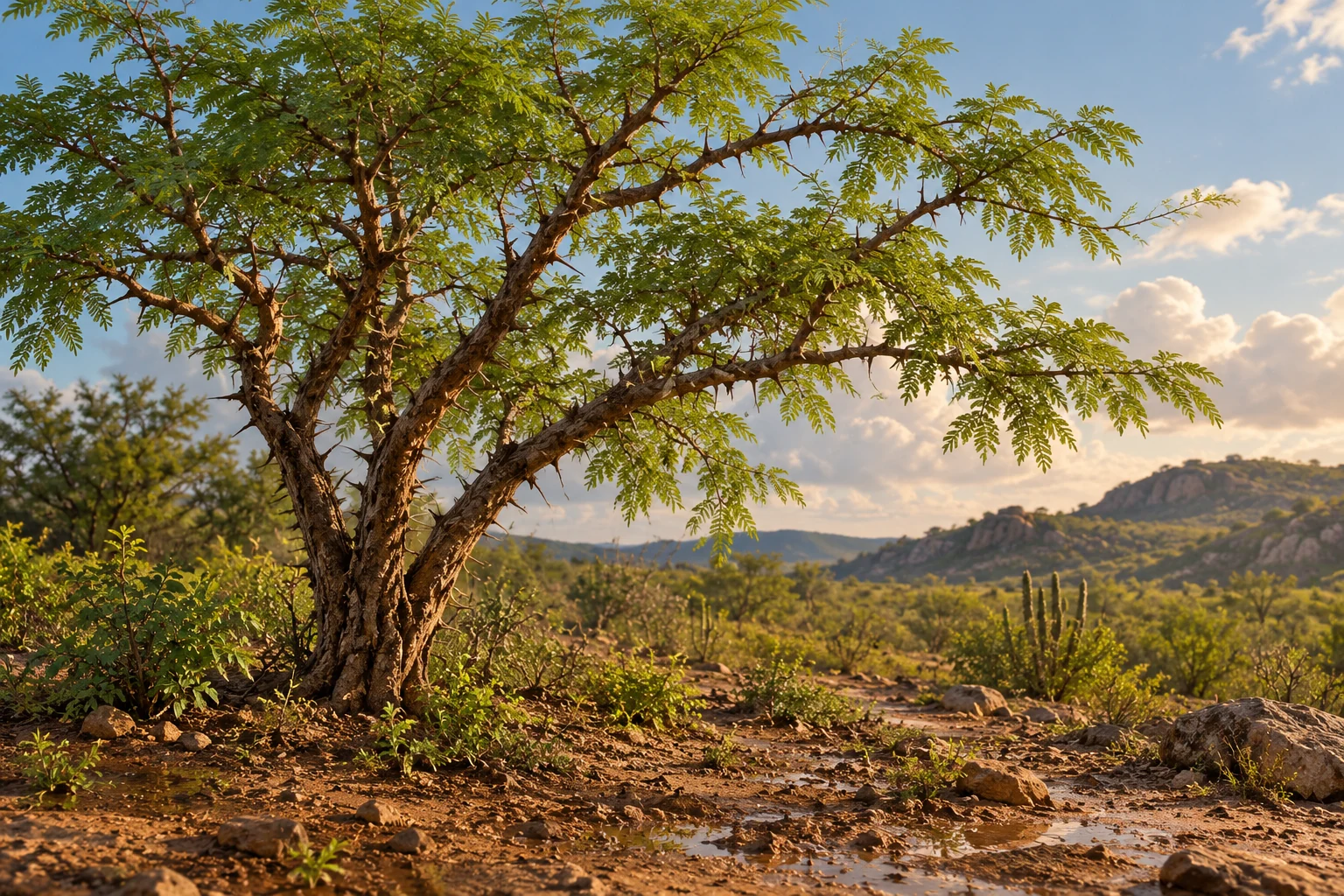
The word has several layers. In botanical discussion it can refer to different plants, including Mimosa tenuiflora. In ritual language it may refer to a sacred drink, although practices and ingredients vary. In religious discourse it may designate the power, knowledge, cities, and beings associated with Jurema, as well as the tradition through which people enter relationships with them. Marcus Vinícius Barreto’s University of São Paulo encyclopedia entry gives a useful orientation to these overlapping uses.
These meanings should be distinguished without cutting them apart. When a juremeira speaks about Jurema, she may be speaking simultaneously about a material presence and a relationship extending beyond ordinary visibility. The mistake would be to insist that only the botanical meaning is real, or to treat the actual plant as a dispensable illustration of an abstract philosophy. The word’s range is part of its religious importance.
For a beginner, the most useful question is specific: what is being named in this sentence? A tree growing in a sacred place, an occasion of worship, and an enchanted city require different explanations. Recognizing their relationship becomes easier after each has been understood on its own terms.
Why is Catimbó a difficult name?
Catimbó appears in dictionaries, folklore, police records, scholarship, and practitioners’ speech with different implications. Some people reclaim it as the name of a tradition. Others prefer Jurema or Jurema Sagrada because Catimbó has been attached to suspicion, harmful magic, or religious inferiority. The unaccented spelling, Catimbo, is common in English searches, but Catimbó is the Portuguese form.
Babá Tilo collects several proposed origins for the word and shows how uncertain the etymology remains. His discussion also preserves Mestre Zinho’s association of Catimbó with the cachimbo, the pipe. That testimony matters as a practitioner’s understanding; it does not settle every linguistic question. A dramatic translation found online should therefore be treated as a proposal unless supported by specialist evidence. (The Sacred Catimbó)
The practical consequence is simple. Use the name a community uses for itself, and recognize that an older source may employ the same word with a different intention. Calling an accusation a definition can reproduce the hostility that made the accusation useful in the first place.
An Indigenous foundation with several histories
Jurema’s Indigenous foundation is essential to the account. It is also essential to avoid turning “Indigenous” into the name of one religion shared by every people in Brazil. Atikum, Kapinawá, Kariri-Xocó, and other communities have their own histories, authorities, places, and terms. A description of one setting cannot stand in for them all.
Babá Tilo’s book juxtaposes different Indigenous accounts rather than providing one continuous local ethnography. Its sections on Atikum and Kapinawá preserve particular encounters reported by Marcos Alexandre dos Santos Albuquerque. Its Kariri-Xocó material emphasizes guarded knowledge and the importance of a sacred place. Read together, these accounts show why an introductory article must preserve differences in access and belonging, instead of compiling every reported detail into a universal ceremony.
For readers who arrive through African and diaspora religions, this foundation changes the direction of study. Jurema does not require an Ifá explanation to become intelligible. Its encounters with African religious histories are significant, but those encounters do not make Indigenous knowledge an early stage waiting to be completed by another system. The companion study on Toré and Indigenous Jurema follows this distinction more closely.
What can history actually establish?
The depth of a tradition’s sacred ancestry and the dates of surviving documents answer different questions. A community may understand Jurema through ancestral continuity, while a historian asks when a particular practice becomes visible in a particular archive. Neither question is answered responsibly by guessing a founding year.
Colonial documentation is especially difficult because officials and religious authorities often recorded what they intended to suppress. A hostile description can establish that people were accused of something; it cannot automatically provide an accurate account of what those people believed. Later folklorists also wrote within assumptions about race, civilization, superstition, and religious hierarchy. Their collections preserve valuable names and songs, while their judgments require criticism.
The book itself acknowledges the limitations of older descriptions even while using them extensively. That admission should guide its reading. A recorded name is useful evidence of a religious vocabulary; an old writer’s dismissal of the people who used it is not a neutral description. The USP overview identifies this problem in the history of research, including the older classification of Jurema as inferior forms of spiritism.
Alhandra, Acais, and the importance of place
Alhandra in Paraíba and the Acais tradition have a prominent place in Jurema memory. The book discusses Inácio Gonçalves de Barros and the women remembered as Maria do Acais, while preserving the distinction between relatives who bore that name. These accounts connect religious authority with family memory, transmission, and the material landscape. They should not be compressed into a claim that one identifiable person invented all Jurema.
Acais also shows why sacred geography is more than a list of destinations. A place can hold the memory of instruction, the presence of a tree, an elder’s reputation, and a community’s account of how religious work became possible. Losing access to such a place affects more than convenience. It can interrupt the relationships through which knowledge remains recognizable.
Luiz Carvalho de Assunção’s research on Acais in Natal, consulted here through its abstract, examines how juremeiros draw on Acais to articulate tradition and difference. That focus helps a reader distinguish a place’s religious authority from a simplistic claim of exclusive historical origin.
Mestres and mestras: the people of the religious world
The mestres and mestras are central spiritual presences in many Catimbó-Jurema settings. The masculine and feminine titles mean masters and female masters or teachers. Their religious sense exceeds a job title: they identify beings whose knowledge, histories, and relationships enable particular forms of work. Some accounts remember people who practiced Jurema in life; other narratives place greater emphasis on enchantment and the manner of passage into the spiritual world.
The book names familiar figures such as Mestre Carlos, Mestre Manuel Cadete, Mestra Iracema, Mestra Angélica, and Zé Pilintra. These are not interchangeable examples of an anonymous “spirit guide.” A name can carry a place, a song, a characteristic way of appearing, and relationships with specific practitioners. Nor does familiarity with the name confer the ability to identify or receive its bearer.
The study of mestres and mestras explores several names and the limits of their biographies. Here the introductory point is relational: one learns who a master is through the religious setting that recognizes and serves that presence, rather than through an isolated list of attributes.
Cities, kingdoms, and the meaning of ciência
Cidades and reinos, cities and kingdoms, describe dimensions of Jurema’s enchanted geography. Babá Tilo discusses several arrangements and connects spiritual cities with masters, trees, and ritual relationships. Readers should resist turning these materials into a single mandatory chart. An arrangement reported in one account can be meaningful without governing every community.
Ciência, literally science or knowledge, is equally important. In this context it should not be confused with a modern laboratory claim. It can name a cultivated religious understanding, a capacity to work, or a relationship with mysteries that cannot be separated from preparation and responsibility. Translating it simply as secret information misses the person who has learned how to carry that knowledge.
Luís Felipe Cardoso Mont’mor’s UFPB dissertation abstract describes multiple understandings of enchanted cities and kingdoms across named Paraíba houses. Only the abstract was consulted here. It supports caution about uniformity, not a reconstruction of the dissertation’s full ethnography. The enchanted world is better approached as a field of relationships than as a tourist map whose every border has already been fixed.
Songs and material presences
Songs, maracás, pipes, sacred vessels, trees, and the arrangement of ritual space appear throughout the book. Their importance is not exhausted by describing what they look like. A maracá can organize movement and attention; a sung line can identify a master and make a relationship audible; a tree may be inseparable from a remembered spiritual presence. The precise arrangement belongs to the setting in which these relationships are maintained.
A line, linha, may mean a song or invocation in historical Catimbó descriptions. Elsewhere, especially in Umbanda writing, line can mean a much larger organization of spiritual work. Confusing these uses produces false comparisons. A translation needs the surrounding sentence, the historical moment, and the community’s vocabulary.
The presence of an object also does not tell an outsider how to use it. Seeing a pipe in a photograph establishes neither a preparation nor a ritual authorization. Meaning grows through instruction, repetition, and the responsibilities attached to the object. The public description of these relationships can be rich without reproducing a restricted procedure.
Is Jurema the same as Umbanda?
Some Jurema communities intersect closely with Umbanda, and Jurema may be practiced within houses that also cultivate Umbanda or orixá traditions. Other communities insist on Jurema’s distinct authority. These positions cannot be resolved by declaring either that there has been no encounter or that every encounter erased the distinction.
Babá Tilo’s own emphasis is clear: he argues for Catimbó’s independent religious integrity and sometimes criticizes forms he regards as excessively shaped by Umbanda. That is his religious judgment, which deserves attribution. It should not be quietly converted into a universal verdict on urban practitioners. A community’s account of its own work remains necessary, including when it differs from the book’s preference.
The dedicated article on Jurema and Umbanda considers these encounters. Beginners can meanwhile distinguish shared participation from identical theology. The same person may serve more than one religious relationship; the relationships still have different obligations. A common name, a familiar song, or a similar gathering does not settle their identity.
Care, consultation, and ordinary human difficulties
The book repeatedly places religious work beside the problems of daily life: strained relationships, uncertainty about work, fear, grief, and the wish for relief. Such concerns help explain why knowledge is valued as something capable of serving people, rather than only as a subject to describe. Accounts of healing belong to this religious understanding of care. They do not establish a clinical result or a promise that every difficulty will be removed.
The human significance can be discussed without claiming to explain away spiritual experience. A person who has felt unheard may find it meaningful to speak within a setting where suffering is given time, language, and witnesses. That is an interpretive observation about attention and belonging. Practitioners may understand the encounter primarily as a relationship with a mestre or mestra, and their explanation should remain audible.
There is also an ethical question inside the wish for help. Does counsel increase a person’s capacity to act responsibly, or does it make fear the basis of dependency? The question does not require a verdict on supernatural reality. It asks how the people involved handle vulnerability, authority, and the practical consequences of advice.
How should a visitor approach a community?
Begin by learning how the community identifies its work and which occasions are open. A public gathering may allow observation while reserving other activities for participants or initiated members. Permission to attend is specific; it does not imply permission to photograph people, record songs, handle objects, or publish a description of everything encountered.
Preparation also includes modest expectations. A first visit may involve waiting, listening, or learning where to sit. These apparently small instructions can matter because a religious gathering is coordinated through relationships that a newcomer does not yet understand. Asking respectfully is more useful than interpreting unfamiliar conduct immediately through a book or another religion.
If a proposed commitment is unclear, seek an explanation of its responsibilities, boundaries, and practical implications. The presence of mystery does not make every ordinary question improper. At the same time, an elder can explain why something is restricted without disclosing it. Respectful learning allows both meaningful questions and meaningful limits.
Reading the tradition without collecting it
A serious reader should keep a few distinctions visible: history and sacred narrative; public description and ritual competence; an author’s interpretation and a community’s own account. These distinctions are forms of care. They prevent a powerful story from becoming an unsupported date, a song from becoming an online recipe, or a living community from disappearing behind a generalized label.
Babá Tilo’s book is valuable partly because it insists that religious experience and transmission cannot be replaced by a book. Taking that claim seriously means reading it as an invitation to deeper attention, not as possession of the tradition. His comparisons and judgments remain his own, and the practitioners and researchers whose work he draws upon retain their names and intellectual labor.
For readers of DAILY IFÁ, comparison can begin with the broad question of how people become responsible for received knowledge. The study of Orí offers another setting for reflection on responsibility and direction. It does not supply a hidden Jurema doctrine. The encounter is most fruitful when each tradition can answer in its own vocabulary.
What does “symbolic” leave unexplained?
It is tempting to call the tree, city, or vessel a symbol and believe the explanation is finished. Symbol can be a useful word, provided it does not mean an empty substitute for something absent. In the relationships described by Babá Tilo, material presences can take part in religious life: they are cared for, approached, remembered, and connected with particular beings. Their meaning depends on what people do with and around them, across time.
A useful interpretive distinction is between recognizing a resemblance and entering a relationship. An outsider might notice that a tree joins roots, trunk, and branches, and compare it with another tradition’s image of connection. A participant may be responsible for a specific tree linked with a specific master. The comparison can illuminate an idea; it cannot assume the participant’s position. Keeping that difference visible makes explanation more accurate and makes respect less abstract.
The difference between availability and belonging
Public knowledge makes a tradition more accessible to readers, but availability is not the same as belonging. Reading a master’s name, learning the meaning of a term, or recognizing a ritual object can support an informed conversation. None of those actions creates the relationships through which responsibility is recognized in a community.
This difference matters for the reader who feels a strong attraction to Jurema. Attraction need not be dismissed, and it need not be declared a spiritual appointment. It can become a reason to read carefully, hear more than one account, and learn how people distinguish curiosity from commitment. Patient interest allows a relationship to develop without deciding its destination in advance. The human task is to remain teachable while retaining the capacity to ask clear questions about what one is being invited to undertake.
A sacred landscape and a public future
The contemporary public life of Jurema includes work to protect communities, memory, and sacred places. IPHAN reported receiving a request for federal registration in September 2025. That report describes a request and a technical process, not completed federal registration. It also records practitioners’ concern about religious racism, land pressures, and environmental destruction. (IPHAN)
The implication reaches beyond official recognition. A religious world carried through trees, songs, elders, and places needs conditions in which those relationships can continue. Admiration for an enchanted forest has little substance if living custodians are ignored when access to that forest is threatened. Studying Jurema responsibly therefore includes attention to who is speaking, who is credited, and who can remain where the tradition’s memory is held.
A beginner does not need to master every name before beginning to listen well. Start with the setting, learn the terms in context, and allow the people who carry the tradition to complicate the first definition. That patience makes room for Jurema as a living religious world rather than a collection of fascinating fragments.
Sources and further reading
- Tilo Plöger de Àjàgùnnà, The Sacred Catimbó — Jurema Sagrada. Source for the author’s perspective and attributed discussions of terminology, Acais, guides, ritual objects, and transmission; not independent verification of every historical claim it assembles.
- Marcus Vinícius Barreto, “Jurema,” Enciclopédia de Antropologia, USP, 2019. Entry consulted for terminology and the history of scholarship.
- Luiz Carvalho de Assunção, “A tradição do Acais na Jurema natalense: memória, identidade, política”, 2014. Abstract consulted; no claim to have read the complete article.
- Luís Felipe Cardoso Mont’mor, Os planos encantados da Jurema, UFPB, 2017. Repository abstract consulted.
- IPHAN, “Iphan recebe pedido de registro da Jurema Sagrada”, September 9, 2025. Institutional report on the request, not proof of completed federal registration.