
An image of Saint Barbara can enter more than one Afro-Atlantic religious world. In Brazilian accounts she is frequently associated with Ọya; in Cuban Ocha she is associated with Changó. The shared image does not make Ọya and Changó interchangeable. It records different histories of recognition, protection, devotion and interpretation. Syncretism becomes useful when it helps us follow those histories. It becomes misleading when it turns them into a universal chart of equivalent gods.
This comparison concerns selected Catholic associations in Brazilian Candomblé and Umbanda, Cuban Lukumí or Ocha, and Haitian Vodou. It does not present an exhaustive pantheon. Haitian lwa retain their own names and religious relationships; they are not renamed Òrìṣà. Bàbálórìṣà and Bàbáláwo Tilo Plöger de Àjàgùnnà's The Sacred Candomblé supplies the principal interpretive starting point, while Where the Sacred Takes Hold emphasizes that a shared name or object must be understood through the people who sustain its presence.
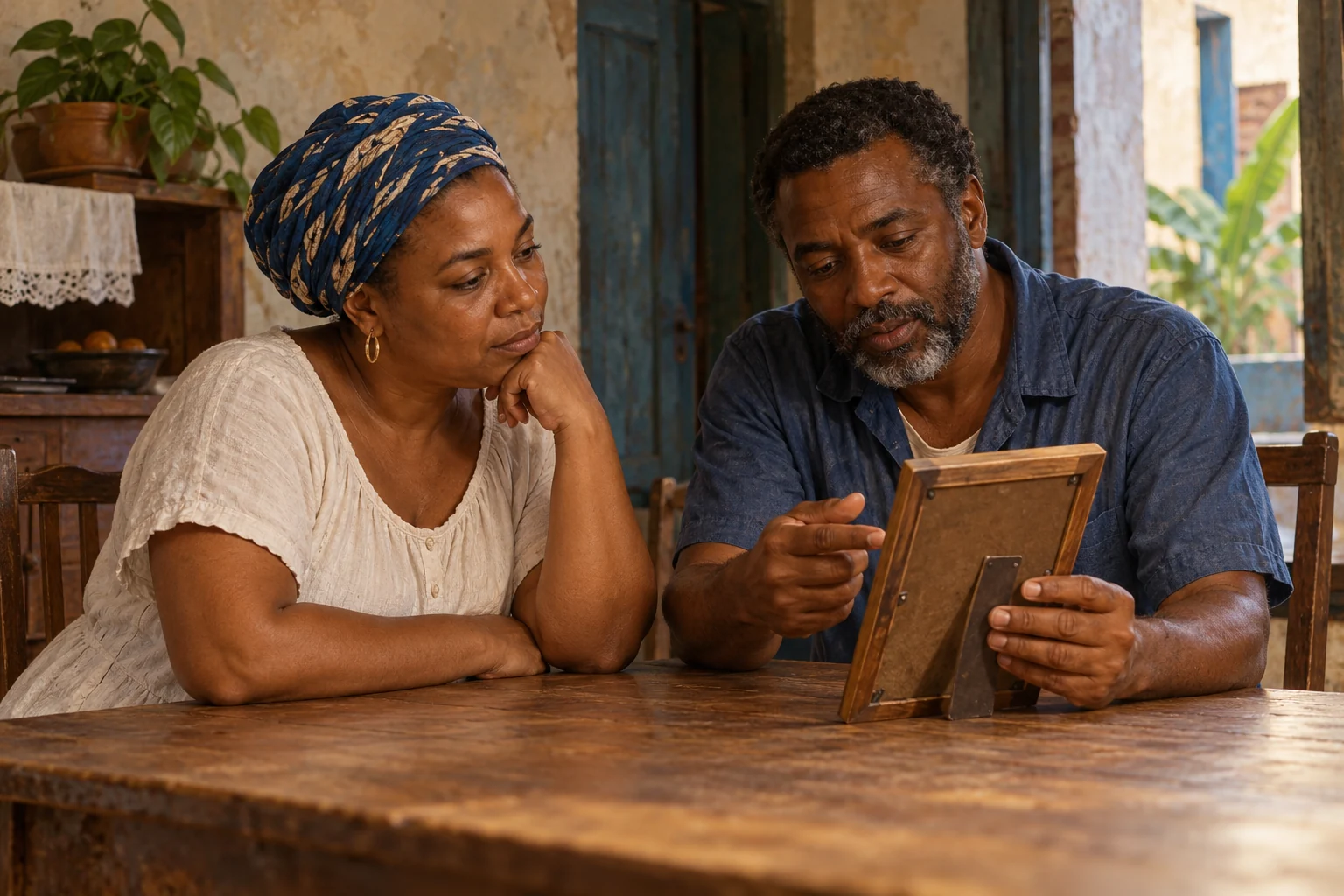
What a correspondence actually tells us
“Associated with” is a more useful beginning than an equals sign. It can describe an image used to represent a power, celebrations observed near one another, overlapping devotions, a narrative connection, or an identification meaningful to particular practitioners. These are different relationships. A photograph may document the presence of a saint's print without disclosing which of those relationships the household recognizes.
The distinction matters for ordinary reading. A visitor might recognize Mary and conclude that an altar is simply Catholic. Another might recognize an Òrìṣà association and conclude that Mary has no significance for anyone present. Both judgments move too quickly. The people responsible for the space may combine, distinguish or alternate forms of devotion in ways that an image alone cannot settle.
A correspondence therefore needs a subject, a place and a source. Who makes the association? In which religious setting? What does the evidence document: a collected object, a household altar, a festival, an interview, or a general scholarly summary? These questions add substance to comparison. They allow the reader to distinguish a well-supported example from a claim about every adherent across a country.
A selected table of documented associations
The table records associations in the cited sources. Its rows are examples rather than instructions for identifying an altar or organizing worship. The Brazilian entries retain alternatives where the source records them; they do not assign one fixed Catholic counterpart to an Òrìṣà throughout Brazil.
| Setting and source scope | Named sacred figure | Documented Catholic association | What the evidence supports |
|---|---|---|---|
| Brazil; Reginaldo Prandi's comparative Candomblé table | Ògún | Santo Antônio; São Jorge | Two recorded associations, rather than one compulsory national pairing |
| Brazil; the same scholarly table | Oxóssi or Odê | São Jorge; São Sebastião | Regional and religious variation must remain visible |
| Brazil; the same table | Oiá or Iansã | Santa Bárbara | A Brazilian association that must not be transferred automatically to Cuba |
| Cuba; University of Oslo Historical Museum's Santería exhibition | Changó | Santa Bárbara | A Cuban association of the thunder divinity with the saint |
| Cuba; University of California, Santa Cruz's documented El Cobre household altar | Ochún | Virgen de la Caridad del Cobre | An association visible within a particular eclectic household arrangement |
| Cuba; the same altar | Yemayá | Virgen de Regla | A documented placement beside other Catholic and Afro-Cuban figures |
| Haiti; Amina Simeon's flag, Allen Memorial Art Museum | Ogou, a lwa | Saint James Matamoros, also encountered as Saint Jacques or Sen Jak | A named artist's image adapted from a Catholic lithograph |
| Haiti; Duke University's collected chromolithograph | Èzili Dantò, a lwa | Black Madonna of Częstochowa; the catalogue also notes Madonna Salvatoris | More than one Catholic image can enter the representation of one lwa |
Brazilian associations are documented in Prandi's 1995 study. The Cuban examples come from the Historical Museum and UC Santa Cruz's altar documentation. The Haitian objects have individual records at Oberlin and Duke.
Coercion belongs inside the history
These associations formed in societies structured by enslavement, colonial domination and unequal religious power. Catholic institutions and symbols had public authority that African religious practices often lacked. A story about harmless cultural mixing misses that imbalance. People did not encounter every religious possibility under conditions of equal freedom, and survival could require concealing or translating practices before hostile observers.
Babá Tilo places protective adaptation at the center of his explanation. That emphasis helps readers understand why a Catholic image could offer a publicly legible surface while another religious relationship remained active. It also gives historical weight to apparently ordinary choices of language. Expressions such as fazer o santo carry histories in which Portuguese Catholic vocabulary became part of a Brazilian religious world.
Protection, however, is an explanation of an important process, not evidence that every person who honored a saint was pretending. Devotion can become sincere through inherited family practice, attachment to a festival, gratitude or a relationship with a particular image. A descendant may retain a connection for reasons different from those of an ancestor. Recognizing that possibility gives people historical agency instead of making every later choice merely a disguise inherited from slavery.
Why Brazil cannot have one permanent decoder
The Brazilian examples already defeat the idea of a fixed chart. São Jorge appears in the documented associations of both Ògún and Ọ̀ṣọ́ọ̀sì. The same Òrìṣà can also have more than one Catholic association. A reader who treats each image as a unique code will therefore produce confident errors before leaving the first country in the comparison.
Religious setting matters as much as geography. Candomblé and Umbanda have related histories, but their houses do not necessarily organize Catholic imagery in the same way. The saint section in The Sacred Candomblé explicitly discusses Brazilian Umbanda at that point in the book. Its placement inside a larger Candomblé volume does not turn every entry into a rule for every Candomblé nation.
The practical reading habit is simple: carry the heading with the information. If a source says “in Brazilian Umbanda,” retain that scope when making notes or repeating the claim. If it gives several names, retain the alternatives. Religious knowledge becomes less accurate when a convenient summary quietly loses the place and community to which it belonged. The Candomblé nations study explains why Ketu, Jeje and Angola also need more than one generalized Brazilian vocabulary.
Saint Barbara changes the comparison
Saint Barbara provides a particularly useful test. The saint is associated with Ọya in the Brazilian material and with Changó in the Cuban material. Someone beginning with Cuba could mistakenly “correct” the Brazilian association; someone beginning with Brazil could make the reverse mistake. Each would be treating familiarity as a universal religious rule.
Instead, the comparison invites attention to what a community recognizes in an image and how that recognition develops. A saint's visual attributes, stories, protection and feast can become meaningful in relation to a sacred figure without requiring agreement on every other feature. An association need not preserve the same gender or narrative identity on both sides. It is a relationship made intelligible within a tradition.
This example also changes the meaning of resemblance. Similarity is something to investigate, not a conclusion that settles the history. A red garment, a sword or a thunder association cannot independently demonstrate the origin of a particular pairing. Several connections may become significant together. Explaining them responsibly requires the source that actually documents the community, rather than an attractive story invented from the image after the fact.
Cuban names retain their religious setting
Lukumí and Ocha name Cuban religious worlds in which oricha relationships, initiation, houses and divinatory authorities have their own organization. Brazilian spellings such as Oxum and Yemanjá help readers recognize related histories, while Ochún and Yemayá preserve the Cuban forms used in the sources here. Neither set of names should be treated as an error awaiting correction by the other.
The UC Santa Cruz example is especially instructive because the photographed house altar is described as Espiritismo, combining Afro-Cuban, Catholic and other elements. Its named placements document actual coexistence. They do not establish that every Ocha household arranges its sacred life in the same way. Even accurate associations become misleading if the religious identity of the observed setting disappears in the retelling.
For a reader, the altar offers a more interesting question than “Which figure wins?” Several relationships may inhabit one person's religious life. The arrangement can ask how ancestors, saints, orichas and other presences are distinguished, approached or remembered. Its complexity belongs to a lived setting. Comparison should help us hear that complexity rather than reducing the household to an inconsistent version of a textbook category.
Haitian lwa need their own names
Ogou and Èzili Dantò belong here as Haitian lwa. Connections across the Atlantic do not turn Vodou into Candomblé with French or Kreyòl labels. A lwa's service, songs, manifestations and relations are learned within Vodou communities. The comparison can acknowledge historical connections while leaving the authority to describe those relationships with the people who serve them.
Oberlin's flag is valuable because its maker is named: Amina Simeon. Duke's chromolithograph is valuable because it documents a particular form of representation. These objects keep human making in view. The saint image becomes a material presence that an artist, collector and community can understand in different but overlapping ways. The object is evidence of religious and artistic work, not a self-explanatory entry in an international pantheon.
The Haitian rows also illustrate two different kinds of specificity. A named flag can focus an association through a particular composition, while a catalogue may record alternative images for one lwa. Neither warrants constructing a single line that identifies Èzili with Òṣun, Ochún or every appearance of Mary. A comparison can place these figures beside one another without making a claim of identity among them.
An image can travel while obligations stay particular
Printed pictures are portable. A devotional image can cross borders, enter a shop, arrive as a gift or become part of an artist's work. Its movement may be easier to document than the religious knowledge through which it is received. Availability matters, but an available image does not come with one inevitable interpretation attached to its paper.
This is where Where the Sacred Takes Hold offers a productive interpretive discipline. The book asks readers to attend to the relationship maintained through a thing: who cares for it, which presence is addressed, and whose history gives it a place. Those questions prevent an image from being mistaken for the entirety of a shrine or an object from being treated as interchangeable with every similar object.
Imagine a clearly hypothetical situation in which two households possess copies of the same print. One keeps it as a family Catholic devotion; another places it within service to a lwa. The paper likeness is real. So is the difference in prayers, custodianship and obligations. Understanding either setting requires more than recognizing the picture. That example explains a method of reading; it does not identify the meaning of any unexamined household altar.
Sanfancón widens the Atlantic picture
Catholic and African connections do not exhaust the histories of religious exchange in Cuba. Duke's collected Sanfancón statue provides another specific example. Its catalogue connects a Chinese figure known through names including Guan Yu with Cuban religious use and, subsequently, with Santa Bárbara and Changó. The object complicates any picture of Afro-Cuban religion formed through only two sealed cultural sources. Duke University.
The example is useful precisely because it is particular. It does not prove that every Cuban house uses Sanfancón or that any foreign image can be substituted into a shrine. It records a relationship developed through actual encounters. To explain it only as a mixture of visual features would leave out the people who made the connection religiously meaningful.
Its presence also changes how continuity is understood. A tradition can carry inherited authority while encountering new materials and neighbors. Innovation need not mean that everything has become arbitrary. The question is how a community recognizes, interprets and sustains a connection within its own religious life, and what evidence allows an observer to describe that process.
An object's biography differs from a deity's biography
A collected image has several histories. It was made somewhere, circulated through particular hands, entered a collection and received a catalogue description. These events can be documented without claiming that the object reveals the entire religious biography of the figure represented. Provenance and theology answer different questions, even when they illuminate one another.
This distinction is helpful when reading a museum entry beside a book. A catalogue can establish that a named artist made a particular flag or that an object was identified with a particular sacred figure. A broader text may explain the figure's religious relationships. Neither source should be silently expanded to supply details it does not document. The strength of an object record is its connection to something specific.
For personal study, keep the object's name and the sacred figure's name in separate places in the notes. Then record the association the source actually makes between them. This small discipline prevents a photograph from becoming an invented ritual witness. It also protects the maker's contribution: an artist's decisions deserve recognition as decisions made within a history, rather than disappearing behind an anonymous label such as traditional African image.
Religious belonging exceeds an inventory of images
An altar can tell us something about a person's religious life, but it cannot supply a complete membership record. A person may inherit an image, keep a family promise, attend a public feast or belong to a house whose responsibilities are not visible in the photograph. These relationships need not all have the same weight or status.
The interpretive consequence is that labels should follow explanation. Calling someone Catholic, an Òrìṣà devotee or a Vodou practitioner may be accurate in a given account. Assigning the label solely because one recognizes a picture substitutes an observer's classification for the person's religious history. It can also manufacture a contradiction where the person understands several relationships as compatible.
Listening to self-description does not require abandoning careful comparison. It makes the comparison better grounded. We can ask which obligations belong to the household, which to a religious community and which to a remembered relative. Those questions reveal how people organize their lives. An inventory records what can be seen; an account of belonging also needs the relationships through which those things have become important.
Calendars join people without explaining everything
A shared date can create opportunities for gathering, public celebration and recognition. It can also preserve the memory of a religious association after other practices have changed. Yet the calendar is a different kind of evidence from an image, and neither should be used as an automatic substitute for the other.
The Brazilian material in Babá Tilo's book moves among days of the week, feast days and saint associations. A careful reader keeps those categories distinct. A date attached to an Umbanda celebration does not establish an identical Candomblé obligation; a Catholic feast does not prove that every devotee interprets the saint the same way. Local announcements tell the visitor what a particular house is actually celebrating.
The human value of a calendar lies partly in repeated encounter. People return, remember absent relatives, prepare food and reconnect across generations. Such actions help explain why an association can endure beyond the circumstance in which it first became useful. A meaningful inherited occasion can be retained, transformed or set aside. Its continuing presence deserves explanation through the community's life rather than dismissal as an accidental leftover.
Refusing an association is also a religious position
People can emphasize distinct African names and traditions or decline Catholic imagery in their practice. Others retain inherited Catholic relationships. The reader's task is to understand the stated position and the reasons given for it. Neither preference grants an outsider authority to rank every house's religious integrity from a distance.
Babá Tilo gives substantial importance to distinguishing Òrìṣà from their Catholic representations. His interpretation supports a precise vocabulary and challenges the assumption that an Òrìṣà is simply a saint under another name. The interpretive point is valuable even where a practitioner would give a stronger religious place to the Catholic relationship than his account does.
For families, disagreement can be emotionally charged because images hold memories as well as classifications. Removing a picture may feel like clarification to one person and rejection of a grandmother to another. That hypothetical tension is understandable without deciding the religious question for them. It suggests a better conversation: explain what the image means, who is responsible for it and what change is proposed. Careful distinction can coexist with respect for the people who inherited a different practice.
How to compare without appropriating authority
A useful comparison begins with a bounded statement: this named source documents this association in this setting. It then asks what can be learned by placing another documented setting beside it. The movement is from evidence to interpretation. It does not start with a universal system and force each community into a predetermined slot.
For study notes, preserve the local sacred name, the religious tradition, the place, the kind of evidence and any recorded alternatives. Mark an artist's object as an artist's object, a household as a household, and a scholar's table as a scholarly summary. These distinctions make a small set of notes more useful than a long chart whose certainty exceeds its sources.
The same approach changes how a visitor behaves. Recognizing a saint does not authorize handling a sacred object, correcting a host or announcing which power must be present. A respectful question can invite an explanation if the community chooses to offer one. Public information provides an entrance to understanding; the community retains its responsibilities, and the observer retains the obligation to distinguish learning from authority.
Religious connection has a human scale
Syncretism is often discussed as a relationship between vast systems: Africa and Europe, Catholicism and African religion, continuity and change. Those scales matter, but they can hide the person who keeps an inherited image, makes a flag, leads a house or explains a festival to a child. The association continues through actions undertaken by actual people.
That perspective makes comparison more demanding and more rewarding. It asks us to see adaptation as work, memory as something maintained and a sacred name as more than a category. It also allows disagreement and change to belong within religious life. A community can inherit a relationship and still discuss how to carry it forward.
Continue with the history of Candomblé for its Brazilian institutions, or the study of orixá qualities for distinctions within divine names. The study of sacred presence develops the relationship between objects, custodians and enduring obligations. For sustained reading, The Sacred Candomblé and Where the Sacred Takes Hold belong beside the Academy collection, with each tradition's own terms kept visible throughout.
Sources and further reading
- Tilo Plöger de Àjàgùnnà, The Sacred Candomblé. Supplied substantive sections on Catholic representations, initiation language, orixá differentiation and the explicitly Umbanda saint table consulted. Interpretive foundation; its tables are not reproduced as universal rules.
- Tilo Plöger de Àjàgùnnà, Where the Sacred Takes Hold. Supplied text consulted for situated sacred relationships, material presence and distinctions among Atlantic traditions.
- Reginaldo Prandi, “Deuses africanos no Brasil contemporâneo (introdução sociológica ao candomblé de hoje)”, Horizontes Antropológicos 1(3), 1995, pp. 10–30. Full text and correspondence table consulted; selected associations retained without extending the table's categories into universal equivalents.
- University of Oslo Historical Museum, “The gods of Santería”. Institutional exhibition text consulted for Changó and Santa Bárbara; other broad personality claims and calendar details are not adopted.
- University of California, Santa Cruz, El Cobre household altar documentation. Object and placement description consulted; the observed altar is explicitly identified as eclectic Espiritismo.
- Allen Memorial Art Museum, Oberlin College, Amina Simeon, Ogou Vodou Flag. Collection record consulted for the named artist, Catholic image and lwa association.
- Duke University, “Chromolithograph of the Haitian Goddess Èzili Dantò/Dantor”, The Sacred Arts of the Black Atlantic. Collection interpretation consulted for documented Catholic representations of a Haitian lwa.
- Duke University, “Sanfancón (Changó) statue”, The Sacred Arts of the Black Atlantic. Collection record consulted for a specific Chinese-Cuban connection and the limits of a two-source account of religious exchange.