
A recipe can explain how to make a fritter. It cannot, by itself, explain what it means to earn a living by making that food, to learn the work from another woman, or to carry a religious inheritance into a public place. Acarajé brings those questions together. Understanding the craft of the baianas de acarajé means paying attention to the person behind the tabuleiro—the tray or stand from which the food is sold—as well as to what the customer eats.
This is a study of that public craft and its conditions of continuity. Our companion article on the sacred kitchen of Candomblé follows responsibilities within a religious house. Here the question moves outward: how do inherited knowledge, women’s work and a livelihood meet in the street?
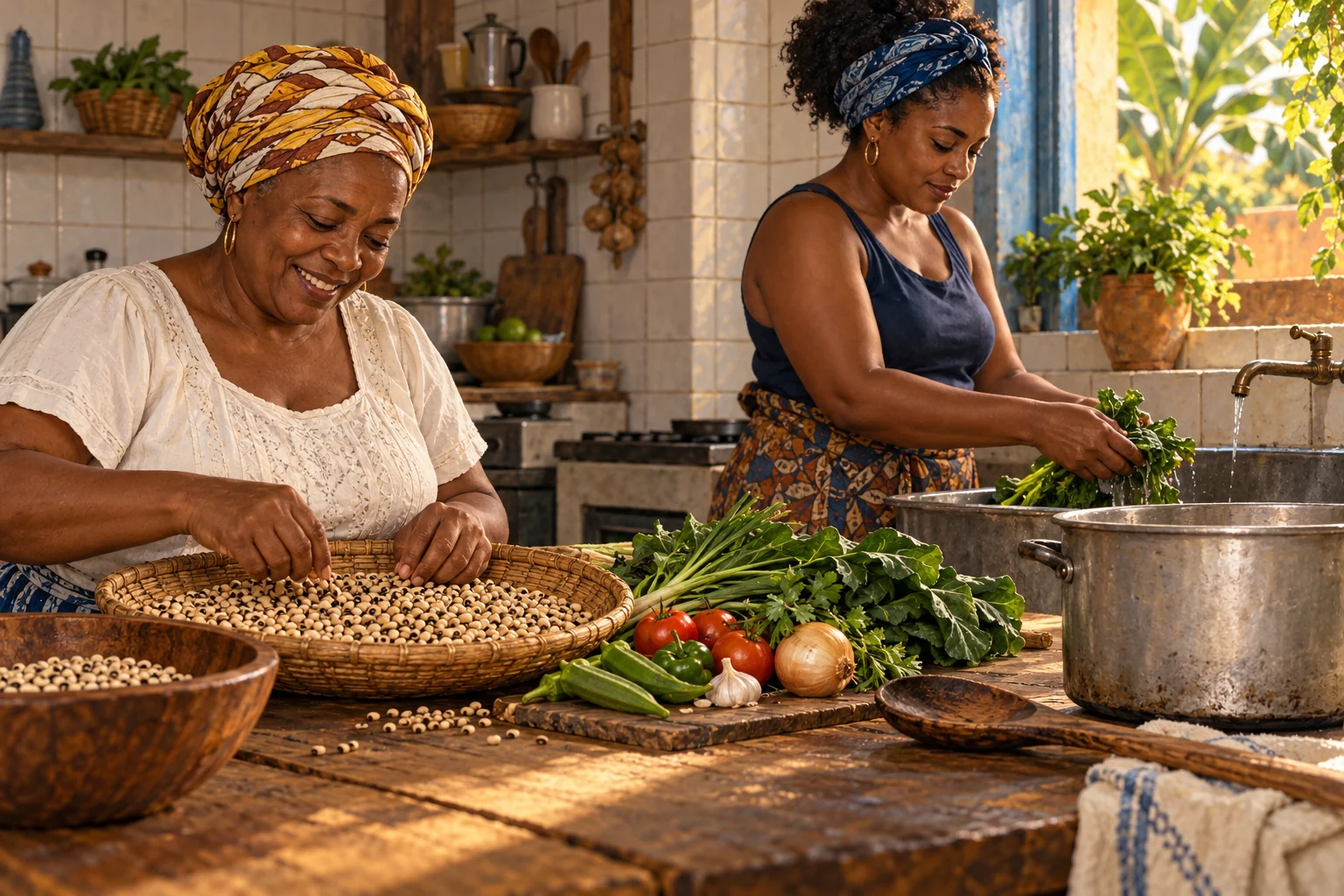
Begin with the craft and its practitioners
Acarajé is made from black-eyed peas and fried in dendê, red palm oil. The IPHAN dossier describes its religious associations in Candomblé, especially with Ṣàngó and Ọya, and distinguishes preparations for offerings from food sold with accompaniments. It also records changes in equipment and selling practices, the participation of men, and disagreements among practitioners. The historical craft is strongly associated with women, but its documented history cannot be reduced to one unchanging female role. [1]
That is a useful starting point for reading the word ofício: a practiced occupation, with knowledge and responsibilities that exceed a list of ingredients. A customer sees the finished food at one moment. The practitioner has had to make decisions that the purchase does not reveal. The difference matters whenever an account celebrates a dish while leaving its makers anonymous.
Naming the craft keeps people within the explanation. It encourages questions about who teaches, who works, who decides, and who receives the benefit when the food becomes famous. Those questions do not require the reader to turn every meal into a lecture. They require a little more care in deciding what, and whom, the story is about.
Sacred associations need a religious context
The link with Òrìṣà worship deserves serious attention. It does not authorize a visitor to identify a vendor’s initiation, house, obligations or personal beliefs from a tray of food. Nor does an institutional description of a sacred preparation supply permission to reproduce a ritual. The distinction between learning about a tradition and being taught a particular religious responsibility should remain visible.
The IPHAN dossier connects street commerce with the work of enslaved and freed women and with religious and community relationships. It documents learning through mothers, grandmothers and other baianas. Its account also shows that commercial and religious identities have been debated, rather than remaining identical for everyone involved. [1]
For an outside reader, the careful response is to hold two thoughts together: Candomblé belongs within the history of acarajé, and an individual practitioner should be allowed to describe her own relationship to that history. Erasing the religious inheritance would impoverish the account. Inventing a religious identity for a living person would misrepresent her.
The Yorùbá spellings Ṣàngó and Ọya are used here for names frequently written Xangô and Oyá or Oiá in Brazilian sources; Iansã is another familiar Brazilian name for Ọya. This spelling choice does not make Candomblé identical to Yorùbá religious life in Nigeria. The discussion concerns a Brazilian craft in its documented settings.
Learning has a teacher, not only an origin
In a Ministry of Culture account published in 2026, Rita Santos describes learning the craft from Clarice Souza dos Anjos in 2001, in a course Clarice taught through Sebrae. The account identifies Clarice as the founder of Abam, the baianas’ association, and Rita as its national coordinator. It presents learning with other baianas alongside transmission within families. [2]
This specific teacher–learner relationship is more informative than a vague statement that knowledge “comes from the ancestors.” Ancestry matters, but a reader can also ask how knowledge reaches a person in a particular generation. Someone makes time to teach. Someone watches, practices and receives correction. A course taught by a recognized practitioner can be one setting for that encounter; a family relationship can be another.
There is also a difference between recording knowledge and sustaining the opportunity to learn it. A written recipe remains available when a teaching relationship has become difficult to maintain. That does not make the recipe worthless. It means that keeping a document and keeping a craft alive are different achievements.
When writing about an inherited practice, name the teacher where the source supplies a name. State what the source actually tells us about the learning. Avoid adding a sentimental family story to make the transmission seem more authentic. Rita’s published account is valuable precisely because it gives a particular route into the work.
The tabuleiro opens onto a wider working world
Bahia’s heritage institute, IPAC, describes a repertoire extending beyond acarajé: abará, lelê, cocadas and bolo de estudante are among the foods it lists. Its account also places skirts, head coverings, the pano-da-costa and beads within the public presentation of the traditional baiana. Food, clothing and selling belong within the same field of attention. [3]
A useful reading of that presentation begins with work. A garment has to be maintained; food has to be prepared and handled; the selling place has to function. Admiration becomes more exact when it asks what enables a practitioner to continue doing these things. The clothing deserves attention without turning the person wearing it into a display arranged for somebody else’s photograph.
Our study of Candomblé clothing explores the religious relationships of garments in their own settings. A street vendor’s clothes should not be treated as a diagram from which a stranger can decode every religious distinction. A public appearance offers an occasion to learn, with consent and context, rather than a shortcut to private knowledge.
There is a practical implication for the visitor: ask before photographing an identifiable person, and accept that a person at work may have neither time nor desire to explain her life. Paying for food buys the food. A longer conversation is an additional relationship, freely offered.
A selling place is more than an empty space
Daniel Bitter and Nina Pinheiro Bitar’s ethnographic study examines the relationships formed around acarajé and tacacá. In its discussion of the baianas, a selling point emerges through repeated encounters and connections with customers. The authors explain why displacement can therefore disturb more than the physical arrangement of a stand. Their fieldwork on acarajé was conducted principally in Rio de Janeiro between 2008 and 2010, with some work in Salvador. It should not be presented as a survey of every baiana today. [4]
The implication is easy to miss in an attractive redesign. A proposal can offer a cleaner-looking space while failing to ask whether the practitioner can reach her customers there. The relevant comparison would include the existing relationships and working conditions, alongside the proposed physical improvements. A photograph of a new kiosk cannot answer those questions on its own.
More recent research by Michele Damasio de Jesus and Juliana Aparecida de Oliveira Camilo, published in 2025, concerns baianas working on Salvador’s Barra beaches. Its reported findings include inadequate infrastructure, urban security problems and restrictions imposed by public authorities. These are findings about the study’s setting, not a numerical measure of conditions throughout Brazil. [5]
Taken together, the studies encourage a more precise question than whether a city “values its culture”: how does a particular decision affect the people who practice it in a particular place?
The working body belongs in the heritage discussion
A 2026 preliminary ergonomic assessment by Lílian Farias Gonçalves, Bruno Basilio Alves and Tila Freitas involved 44 baianas in Salvador. The authors report prolonged postures, handling loads, repetitive movements, exposure to dendê smoke and long working hours. Their findings informed a proposed kiosk design. The published abstract supports that account of the assessment; it does not establish that a new design has already improved every participant’s health. [6]
This brings an easily overlooked issue into view. A craft can be celebrated for surviving while the effort required of its practitioners remains outside the celebration. The ability to endure difficult conditions should not become a reason to leave those conditions unchanged.
For a proposed improvement, useful questions would include whether the practitioner can reach equipment comfortably, how materials move through the workspace, and whether the arrangement supports the tasks she actually performs. These are questions for consultation and competent design, not specifications that can be settled by this article. The important editorial point is that care for a tradition can include care for the body doing the work.
Recognition must lead to usable conditions
IPHAN’s current register records the craft in the Livro dos Saberes and describes the 2022 revalidation, which extended the registration’s geographical scope across Brazil wherever the practice had been or would be identified. National recognition concerns the craft; it is not evidence that all practitioners have the same local circumstances. [7]
A concrete example comes from Rio de Janeiro. IPHAN records that ten baianas received certificates at MUHCAB on 9 April 2025. The certificates enabled them to apply to the municipal public-order authority for permission to work in public space. The careful distinction is between receiving that certificate and receiving the subsequent authorization. The record does not say that a cultural title automatically provided a trading permit to everyone. [8]
Rita Santos, in the Ministry of Culture account, argues that recognition should bring safeguarding, income opportunities and better working conditions. [2] This places a practitioner’s expectation beside the administrative example. A title can be important while further practical work remains necessary.
For readers evaluating a heritage initiative, five questions can help:
- Participation: Which practitioners helped define the problem and proposed response?
- Continuity: Does the initiative make learning and continued practice more feasible?
- Work: What changes in the actual conditions of preparation and selling?
- Benefit: Who receives the income or other material advantage?
- Evidence: What has been completed, and what remains an intention or application?
These are editorial questions, not an official certification scheme. Their purpose is to make praise more accountable. A successful publicity event and a sustainable livelihood may be related, but they need separate evidence.
What a reader can carry away
Acarajé invites attention to a relationship between food, religious history and public work. The strongest account leaves room for the practitioner’s knowledge and choices. It acknowledges the African and Afro-Brazilian inheritance without treating a living occupation as a frozen illustration of the past.
The next time you encounter a story about the baianas, notice whose voice explains the craft. Look for the named teacher, the specific selling place, the practical condition being discussed and the distinction between a promise and a result. These details help a reader see a person making a livelihood, with an inheritance to sustain and a future in which she should have a say.
Continue exploring Ifá, Òrìṣà and Afro-Brazilian traditions with the DAILY IFÁ newsletter.
Sources and reading notes
- IPHAN, Ofício das baianas de acarajé, Dossiê 6, 2007, especially pp. 15–22 and 52–62. Historical documentation; no ritual procedure or proposed etymology is reproduced here.
- Ministério da Cultura, “Ofício das Baianas de Acarajé mantém vivos saberes de matriz africana transmitidos entre gerações”, 15 September 2026, updated 26 October 2026. Rita Santos’s attributed account.
- IPAC, “Oficio das Baianas do Acarajé”. Used for the wider food repertoire and public dress.
- Daniel Bitter and Nina Pinheiro Bitar, “Comida, trabalho e patrimônio”, Horizontes Antropológicos, 2012. Ethnographic discussion of food, work and selling places.
- Michele Damasio de Jesus and Juliana Aparecida de Oliveira Camilo, “No cotidiano das baianas de acarajé”, Trabalho (En)Cena, 10, 2025, e025010. The findings summarized here are those stated in the authors’ abstract.
- Lílian Farias Gonçalves, Bruno Basilio Alves and Tila Freitas, “Ergonomia e patrimônio cultural”, 2026, DOI 10.5007/2175-8018.2026.e111229. Used within the limits of the published abstract.
- IPHAN, current cultural-property record. Used for registration and the 2022 revalidation, rather than conflicting dates in older summaries.
- IPHAN, Rio de Janeiro certification ceremony, April 2025. Certification and a subsequent application for authorization are distinct steps.
The interpretive questions and suggestions for respectful visiting are editorial proposals. No personal fieldwork, interview or ritual instruction is claimed.