
Afro-Brazilian rhythms developed through the knowledge and creativity of African people and their descendants in Brazil. Their histories include forced migration, enslavement, religious community, resistance, and continuing artistic invention. They draw on different African inheritances, particularly West and West Central African ones, and on encounters within Brazil. There is no single source rhythm from which every tradition descends.
This guide follows several of those histories and introduces CORPO DE TAMBOR — Ritmos Afro-Brasileiros, a contemporary collection by Bàbálórìṣà & Bàbáláwo Tilo Plöger de Àjàgùnnà. Its 27 tracks bring Yorùbá vocals into artistic arrangements inspired by this varied musical world. Within the project, each rhythm has been associated with an Òrìṣà. That creative framework should be understood alongside the particular histories of the traditions it draws upon.
Explore the 27 music videos, begin with the 75-second trailer, or hear the complete 95-minute album film.
What does Afro-Brazilian mean here?
“Afro-Brazilian” identifies African and African-descended contributions made within Brazilian histories. It does not mean that a musical form arrived fully finished and remained unchanged. Nor does it mean that every Brazilian form with percussion belongs to the same religion.
In English, “African American” usually refers to Black communities in the United States. The wider subject here is the African diaspora across the Americas, with Brazil as the focus. Related Atlantic histories invite comparison, but Brazilian Candomblé, Cuban Òrìṣà traditions, Haitian Vodou, and African American musical cultures have distinct developments.
One further distinction helps: a playlist may put a named drum pattern beside a dance tradition, a religious repertoire, or a contemporary track title. These are not all the same kind of category. A recorded arrangement offers one composition; a community tradition includes people, occasions, teaching, and ways of participating that exceed any individual recording.
Different African inheritances
Three broad historical connections provide an initial orientation. Yorùbá-related inheritances are important in Ketu/Nagô Candomblé; Gbe-speaking West African histories, including Fon connections, matter in Jeje traditions; and Bantu-speaking West Central African histories are fundamental to Congo-Angola traditions and many other Brazilian cultural forms. Bantu names a large language grouping, not one people with one repertoire.
These categories remain broad. Brazilian nações, or religious nations, developed through actual communities and their relationships. They cannot be mapped mechanically onto modern African countries. A song's language, the name of its divine addressee, and its use in a particular house need to be understood together.
The terms also preserve distinctions among Òrìṣà, voduns, and inquices. Their relationships have long been discussed by practitioners and scholars; simply substituting one set of names for another obscures important differences. The DAILY IFÁ study of Ketu, Jeje, and Angola develops this context. Gaia and Vitória's study of divine names across these nations offers a further scholarly point of entry.
What crossed the Atlantic—and what people remade
The central historical agents were people. Under enslavement, they carried knowledge through memory, language, skill, and relationships. Musical continuity depended on their ability to practice, teach, gather, and create under radically altered conditions. Describing this only as the survival of a beat makes that human work disappear.
Brazilian developments also involved Indigenous knowledge and European forms, including Catholic festive calendars and Portuguese-language poetry. Such encounters occurred within colonial domination and later inequalities. “Mixture” is therefore an incomplete explanation unless it asks who contributed, who was constrained, and who maintained the resulting practice.
The Lorenzo Dow Turner collections at Indiana University offer a concrete historical record. Turner's Brazilian recordings from around 1940–1941 include Portuguese and Yorùbá speech and song, and important figures in Candomblé and capoeira. They let a reader locate musical transmission in named voices and recorded encounters rather than imagine an anonymous African past.
Recordings can preserve an invaluable trace of that work. Their value grows when listeners also know who performed, where the recording was made, and which circumstances it documents. A modern studio piece and an archival recording can both be worth hearing, while answering different questions.
Ijexá: from the terreiro into public music
Ijexá is one of the clearest examples of a rhythm moving between religious and wider cultural settings. Alberto T. Ikeda's historical and ethnographic study traces its passage from Candomblé into afoxé and Brazilian popular music. Its identity cannot be explained by tempo alone: the relation among percussion, song, and movement matters.
The distinction between ijexá and afoxé is useful. Ijexá names a rhythmic practice; afoxé refers to a cultural and processional setting strongly associated with it. The terms are related without being interchangeable in every context. A concert arrangement can carry recognizable ijexá features while serving a different purpose from a house's religious performance.
For a new listener, the productive question is how the arrangement organizes movement and response. Which part supplies continuity? Where does the voice enter? What changes when the pattern moves from a communal procession to a recorded track? The Ijexá video in CORPO DE TAMBOR offers a contemporary starting point for those questions, followed by the historical study above.
Jongo and Caxambu: community memory in the Southeast
Jongo has deep roots in Bantu-speaking African inheritances and in Black communities of southeastern Brazil. IPHAN's heritage account describes a practice joining drumming, communal dance, and sung pontos, whose meanings can include riddles, everyday commentary, and ancestral remembrance. It developed among enslaved workers and continues through community transmission.
Names and instruments vary between groups; Caxambu can identify a drum and appears in local names for the practice. A track called “Jongo Caxambu” should therefore not be treated as the definitive sonic form of every community's jongo.
The distinction makes listening richer. A contemporary piece can prompt interest in the people who carry the tradition, including how children learn and how gatherings connect generations. Listen to the project's Jongo Caxambu interpretation, then follow the heritage documentation for its wider communal setting.
Tambor de Crioula: Maranhão's circle of song and dance
Tambor de Crioula belongs especially to Maranhão. IPHAN describes an Afro-Brazilian expression joining percussion, singing, and circular dance, often associated with devotion to São Benedito. It can occur in religious celebrations and other communal settings, with no single fixed venue or calendar governing all practice.
This is a useful example of why an Òrìṣà chart cannot explain every Afro-Brazilian musical form. Local devotion, social gathering, ancestral memory, and artistic pleasure can intersect in a tradition whose history must be described on its own terms.
CORPO DE TAMBOR includes a track titled Tambor de Crioula. Its Yorùbá vocal and Òrìṣà framework belong to this contemporary project; they do not establish that traditional Tambor de Crioula is uniformly sung in Yorùbá or dedicated to one Òrìṣà.
Samba de roda and the wider Brazilian landscape
UNESCO describes samba de roda of Bahia's Recôncavo as a practice combining music, dance, and poetry, with strong African foundations and Portuguese contributions. Its movement to Rio de Janeiro helped shape urban samba. The circle, the singing, and participation remain central to its identity.
Elsewhere, Maracatu Nação in Pernambuco brings percussion and a royal procession into relationships with Afro-Brazilian religious life. Its Congo coronation histories and present communities are different from the histories of ijexá or jongo. Maracatu is included here as wider context, not as a claimed track in this album.
The point of a short map is to make differences easier to hear. “Brazilian rhythm” can lead to a neighborhood, a house, a festival, an inherited repertoire, or a new composition. Naming the setting turns general admiration into a more exact curiosity.
How to hear the musical relationships
Begin with the recurring cycle. Listen for what gives the piece continuity, then notice how other parts sit around it. A voice may call and a group answer; a bell pattern may remain recognizable while drums vary; an accent may fall where the listener expected a gap. The audible relationships matter more than applying one label to everything.
Syncopation describes accents that work against an expected metrical emphasis. Polyrhythm describes simultaneous contrasting rhythmic groupings. Neither word should become a vague synonym for music that sounds complex or “African.” An accurate technical description requires listening to the particular performance.
Three accessible questions can guide a first hearing: what repeats, what answers, and what changes? On a second hearing, follow a quieter part. You may find that what initially sounded like a single block of percussion contains several different responsibilities. This is a listening proposal, not a transcription of every track or a claim that all of these devices appear throughout the collection.
Sacred music belongs to relationships
In Candomblé, musical knowledge includes an understanding of occasion, repertoire, movement, and religious responsibility. Knowing a pattern does not by itself establish the authority to lead a ceremony. The study of ogãs and ekedis explains the place of recognized offices and attentive care; the Àyàngalú study approaches drumming through Yorùbá voice, ancestry, and transmission.
For a public listener, this need not make music remote or inaccessible. It means that appreciation can coexist with curiosity about what is still unfamiliar. A recording preserves a particular performance or creates a new one. It cannot contain the whole social and religious setting simply because the same instruments or names are heard.
This matters especially when sacred music enters playlists labeled for relaxation. The listener's use is one layer of meaning. The tradition's purpose and the composer's intention are others. Keeping those layers visible allows enjoyment without erasing the people and relationships behind the sound.
CORPO DE TAMBOR and its Òrìṣà associations
CORPO DE TAMBOR presents 27 contemporary tracks with Yorùbá vocals, accompanied by individual films and one continuous album film. Babá Tilo has given each rhythm an artistic association with an Òrìṣà. This is the project's devotional and creative organization; it is not a universal traditional correspondence table.
The collection brings together titles connected with different kinds of musical and cultural material. Some refer to named toques, others to broader practices or contemporary interpretations. The shared Yorùbá vocal language does not make every source tradition Yorùbá. Nor does a track title certify a complete ritual repertoire or an ethnomusicological reconstruction.
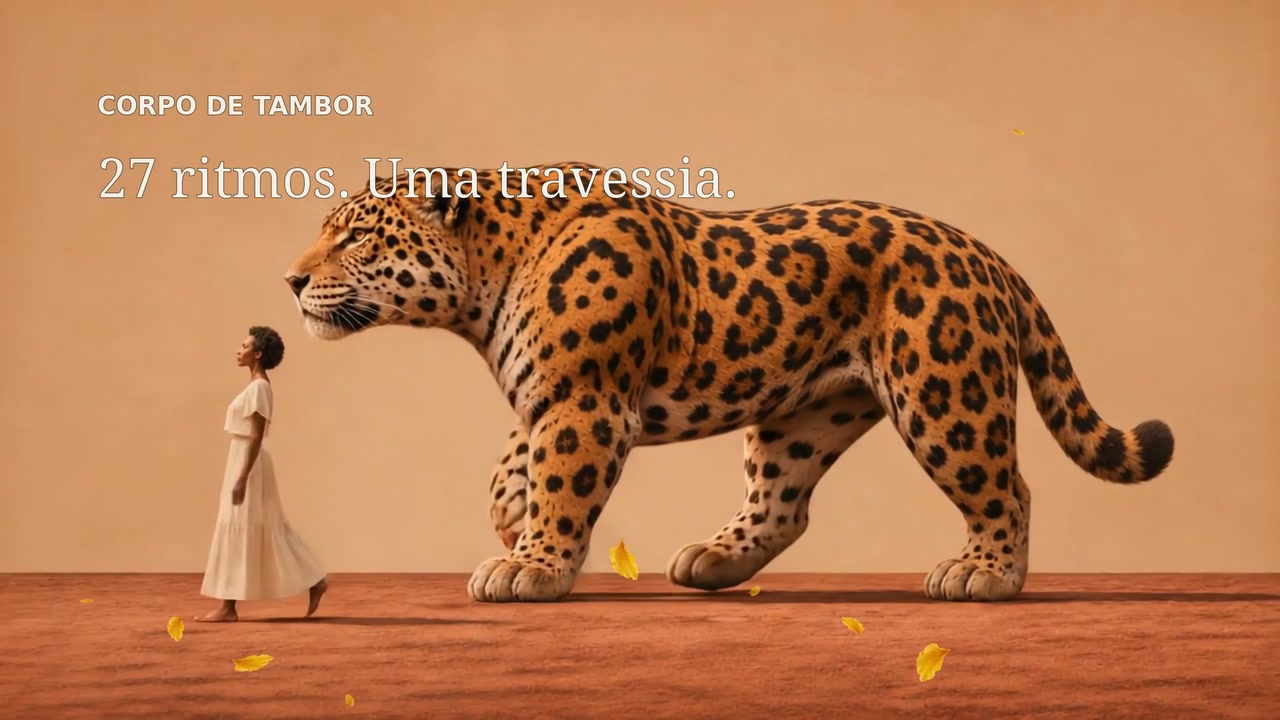
The music was created with Suno and the visuals with AI assistance under Babá Tilo's creative direction. The recurring jaguar is the project's artistic motif: A onça escuta means “The jaguar listens.” It gives the films an image of strength joined to attention, rather than claiming a universal religious correspondence.
Listening for reflection or meditation
The collection can accompany attentive listening, gentle movement, personal reflection, or devotion. A listener who wishes to meditate might choose one track and return attention to its sound when distracted. A person with an existing Òrìṣà relationship may listen with gratitude or a particular reflective intention. Someone else may begin simply with musical interest.
These are optional ways of engaging with art. No special sensation is required. Listening does not determine a person's Òrìṣà, confer initiation, reproduce a terreiro ceremony, or guarantee healing or trance. Established religious practice remains situated in the guidance and responsibilities of its own community.
It can be useful to leave a short silence after a track. Notice what you heard before searching for an interpretation. If a name or rhythm interests you, use that curiosity to pursue its history. Personal attention and cultural learning can develop together.
Where to listen
- The 27-track YouTube playlist — choose individual pieces and return to favorites.
- The complete album film — approximately 95 minutes, with chapters.
- The official trailer — a 75-second introduction.
Distribution to Spotify and other streaming services has been initiated. Availability is awaiting confirmation as of November 13, 2026. The release is titled Corpo de Tambor — Ritmos Afro-Brasileiros, by Tilo Plöger de Àjàgùnnà. YouTube is the confirmed destination in the project's publication record; streaming links will be added when verified.
For continuing essays on Ifá, Òrìṣà, and their human meaning, join the free DAILY IFÁ newsletter.
Sources and further reading
- Alberto T. Ikeda, O ijexá no Brasil, Revista USP 111 (2016), 21–36. Historical and ethnographic orientation; the accessible abstract establishes the movement from Candomblé to popular music.
- Ronan da Silva Parreira Gaia and Alice da Silva Vitória, Orixás, Inquices e Voduns, Revista Calundu 5/1 (2021). Differences and relationships among religious nations and divine vocabularies.
- Indiana University Libraries, Dow Turner Collections. Archival documentation of named performers, languages, and Brazilian recording dates.
- IPHAN, Jongo no Sudeste, Maranhão's intangible heritage, and Maracatu Nação. Institutional accounts; local variations remain significant.
- UNESCO, Samba de Roda of the Recôncavo of Bahia. Historical setting, constituent practices, and transmission.
The listening suggestions and discussion of CORPO DE TAMBOR express the project's contemporary artistic perspective. They are separate from the historical accounts linked above.