
A greeting in Candomblé can acknowledge a person, an office, an Òrìṣà, a sacred place, or several relationships together. Words and bodily gestures make that acknowledgment perceptible. Asking a blessing, lowering the head, waiting to approach, and responding to a call belong to a religious language learned with others. Their meaning depends on who is greeting whom, where, and under what circumstances.
This study takes Bàbálórìṣà and Bàbáláwo Tilo Plöger de Àjàgùnnà's The Sacred Candomblé as its main interpretive foundation, chiefly in its Ketu orientation. Its discussions of blessings, foribalé, dobalé, iká, paó, and invocations offer a vocabulary for understanding public encounters. Practices differ across nations, lineages, houses, and persons. The aim here is to explain the relationships carried by greetings, rather than provide a choreography for reproducing them without guidance.
That distinction matters because a gesture can be copied before it is understood. A person watching a ceremony may see someone touch the ground and immediately assume they know what must be done. Yet the same visible movement can acknowledge different relationships. The important knowledge includes the occasion, the recipient, the person's own position, and the response through which the greeting is received.
A greeting begins before the first word
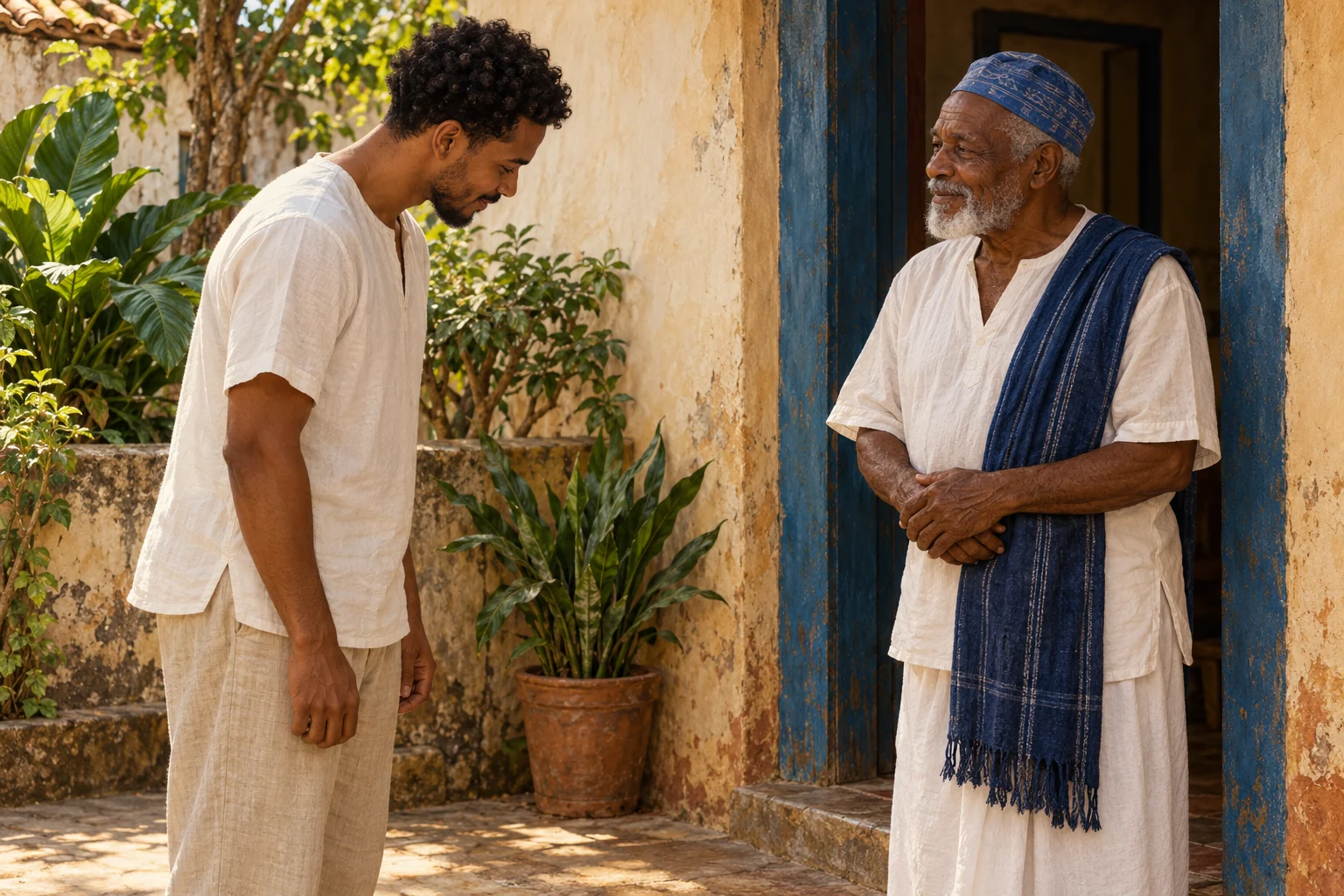
Entering a religious house means entering a place where relationships are already underway. A visitor may be welcomed warmly while still needing guidance about where to stand, when to approach, or whom to greet first. Attending to that guidance is part of the greeting itself. Respect is expressed through the ability to receive the host's directions.
This makes waiting meaningful. In ordinary social life, immediately introducing oneself can appear courteous. During a ceremony, approaching at the wrong moment can interrupt another responsibility. The visitor's intention and the host's situation may differ. A thoughtful greeting brings them into relation instead of assuming that good intention determines the appropriate timing.
The person offering directions may hold a recognized office or may have been entrusted with receiving visitors. Neither role needs to be spectacular to matter. Learning how to enter the occasion starts with listening to the person actually receiving you. A guest who ignores that guidance while searching for the most prestigious figure has already missed part of the house's organization.
Babá Tilo's attention to the behavior of visitors makes a useful point: hospitality and order support one another. A house can welcome people precisely because someone has thought about seating, movement, and appropriate contact. The greeting participates in that shared arrangement. It helps the guest become present without making the entire occasion revolve around their arrival.
Requesting a blessing is a relationship of response
Pedir a bênção, asking a blessing, is central to Babá Tilo's account of relations among members and elders. The request recognizes a religious relationship, often including seniority or office. It is followed by a response. The exchange is therefore not simply a declaration that one person ranks below another; it places both people within a responsibility to receive and answer.
Babá Tilo interprets the blessing as coming through the Òrìṣà rather than being the elder's private possession. That is a theological account of the exchange, and it gives his ethical point force: the blessing should not become a personal reward withheld to demonstrate superiority. The officeholder is being asked to carry a relationship entrusted to them.
The gesture can be intimate without making the participants socially identical. A novice may acknowledge someone with greater religious standing. The elder, in turn, is called to recognize a person seeking connection and guidance. The asymmetry remains, but it has obligations in both directions. A public account that describes only the novice's submission misses half of what makes the exchange meaningful.
This also explains why the words do more than convey information. Both people may already know each other very well. Repeating the greeting renews acknowledgment in the present moment. Familiarity does not make it empty; repetition can be the means through which a relationship is maintained rather than left to assumption.
Motumbá, kolofé, and mukuiu need a setting
Babá Tilo records several blessing formulas. Motumbá and responses such as Motumbaxé occur in his discussion of Yorùbá-derived usage; kolofé or kalofé appears with Olorum kolofé in another context; mukuiu is associated with Bantu-oriented settings. He also records mo jubá and other expressions. These examples introduce a varied vocabulary rather than a single phrase compulsory in every house.
The sound, spelling, response, and appropriate use should be learned from the people using them. Treating a printed list as sufficient can turn a living exchange into a test of pronunciation. A visitor can greet respectfully in ordinary Portuguese while receiving guidance, instead of performing a formula whose place they have not yet learned.
Translation must also remain modest. A short English gloss such as respect or blessing helps orient the reader, but cannot reproduce every association carried by a phrase in its religious setting. Nor should an approximate Brazilian liturgical form automatically be presented as a precise sentence in contemporary standard Yorùbá. Language has histories of transmission, variation, and use.
The study of Ketu, Jeje, and Angola gives these differences a wider frame. Learning the expression a particular house uses is a way of recognizing its inheritance. The goal is not to collect enough greetings to appear universally knowledgeable. It is to enter a specific relationship more attentively.
Foribalé and the religious significance of the head
Foribalé, also written foribalẹ in discussions closer to Yorùbá orthography, is associated in Babá Tilo's account with reverence expressed by bringing the head toward the ground. Bater cabeça is a familiar Portuguese designation. Its literal wording can mislead an English reader: the subject is an act of acknowledgment and devotion, not an instruction to strike or injure the head.
Babá Tilo connects the gesture with humility toward the earth, the sacred, and the Òrìṣà. The head's importance gives the movement depth. Something associated with orientation, personhood, and direction is deliberately lowered within a relationship of reverence. The action can express trust without implying that the person has become worthless.
The study of Orí helps explain why the head cannot be reduced to an anatomical point in this religious vocabulary. That broader study should not be used to force all Candomblé gestures into a single Ifá interpretation, however. A shared concept can travel through related traditions while taking specific forms in each setting.
The observer therefore needs to ask what relationship the action acknowledges here. Is a person greeting an Òrìṣà, a religious parent, another elder, or a sacred place? Babá Tilo describes several possibilities and variations. Their existence is precisely why a public definition should stop short of declaring one movement appropriate for every visitor in every circumstance.
Dobalé and iká are not general personality categories
Dobalé and iká, also written with related forms such as dobá iká, name differentiated greetings in the Ketu framework Babá Tilo presents. He relates them to the person's Òrìṣà and to distinctions between male Òrìṣà and female iyabás. That association belongs to a religious arrangement. It is not simply an instruction that all men greet one way and all women another.
This is an important interpretive difference. A person's sex, gender, or everyday presentation cannot by itself tell an observer what gesture belongs to their religious relationship. Nor can a stranger determine their Òrìṣà from a brief gesture seen across a room. Knowledge of the house's actual practice is required before the movement becomes intelligible.
Babá Tilo also records variations involving particular Òrìṣà and houses. These make it unwise to extract a universal physical sequence from one description. The public names are valuable because they allow a reader to recognize that the tradition differentiates forms. The practical instruction belongs with those who know the person, the occasion, and the relevant religious obligations.
A gesture's precision can matter deeply without becoming a universal visual code. The learner may eventually understand a small difference that once seemed incidental. That understanding grows through repetition with people who can explain or correct it. A photograph freezes the form; a religious relationship teaches when and why it belongs.
Seniority becomes visible through greeting
Greetings can make an initiatory history visible in the present. Someone who has carried a responsibility for years may be acknowledged before someone newer to the house. Chronological age alone does not settle that order. Religious standing includes received obligations, confirmation, knowledge, and recognized office.
This means the greeting is also an education in attention. A person accustomed to measuring status through occupation, wealth, or age encounters another account of standing. The house's religious relationships ask to be noticed on their own terms. Listening to someone younger can be part of learning how the community understands seniority.
The distinction does not make every officeholder superior in every domain of life. A ceremonial responsibility has a particular scope. Respectful acknowledgment need not imply that the person has unrestricted authority over another's employment, healthcare, or personal decisions. Babá Tilo's emphasis on the office rather than personal domination supports a careful reading of these boundaries.
The study of named offices explains why title and seniority intersect without becoming identical. A greeting may acknowledge one relationship while leaving others unchanged. That specificity gives the gesture meaning. It is not a vague declaration that one human being has permanently become more valuable than another.
The recipient also has a body and a responsibility
Descriptions of greeting often focus on the person bowing, kneeling, or asking a blessing. The person receiving the greeting also acts. They may respond verbally, acknowledge the approach, or guide the other person according to the house's practice. The encounter has a rhythm shared by both participants.
This matters because reverence can be misunderstood as a one-way performance. An elder who receives a greeting is being asked to make a relationship present. Their attentiveness, timing, and manner help determine whether the other person feels received or merely inspected. The form can carry kindness without losing religious seriousness.
The same point applies when someone is uncertain. A beginner may pause, mispronounce a word, or not know whether to approach. Guidance can preserve the practice and make future participation more informed. Humiliation teaches a different lesson from correction. The ethical quality of teaching becomes visible in these small encounters, where one person knows the rule and the other does not.
This is interpretation of the responsibilities involved, rather than a claim that every house handles mistakes identically. Precisely because the forms are meaningful, their transmission deserves care. A tradition sustained through bodies and voices depends on how people are helped to learn them.
Paó joins sound, communication, and acknowledgment
Paó is a form of rhythmic handclapping discussed by Babá Tilo in several settings. His account connects it with communication during periods when speech is restricted and with greeting or honoring the Òrìṣà. The relationship between sound and acknowledgment matters more here than a printed counting pattern, which would not establish when a reader should perform it.
Handclapping can look immediately familiar because it also appears in concerts, celebrations, and ordinary applause. Familiar movement does not establish identical purpose. Paó belongs within a religious situation whose participants know what the sound is doing. The physical action can be simple while the coordination around it is complex.
The example also challenges the idea that communication is primarily the transfer of sentences. Sound can announce presence, organize attention, or acknowledge a relationship without replacing itself with a spoken explanation. The people involved learn how to hear the action in context. Their shared understanding gives the sound a place within the occasion.
For a visitor, the practical implication is to follow the house's guidance about participation. Recognizing a name from reading is useful; deciding to lead a gesture because its rhythm looks familiar is another matter. Knowledge becomes respectful when it improves responsiveness to the people already carrying the ceremony.
Greeting an Òrìṣà is not the same as greeting a person
Babá Tilo lists invocations associated with particular Òrìṣà, including forms such as Ogunhê for Ògún, Atotô for Obaluaiê, and Odôia for Yemọja. These are recognizable public examples, not an exhaustive dictionary. Their use in song, acclamation, or greeting belongs to the occasion in which the Òrìṣà is being honored.
A religious salutation should not be treated as a secret password whose correct pronunciation proves belonging. Nor does knowing an invocation authorize someone to address a manifestation however they wish. The house coordinates how people approach, greet, and participate. Words acquire their force through that setting and the relationships carried within it.
Babá Tilo also discusses the ké as a distinctive sound associated with an Òrìṣà's manifestation. The reader should distinguish such a sound from a greeting spoken by a human participant. Both involve recognition, yet they are not the same act. The question of who is sounding, who is being addressed, and who recognizes the sound remains important.
The study of orixás, Orí, and trance develops these distinctions. Understanding them prevents a general article about greetings from absorbing every sacred utterance into one category. Song, praise, prayer, invocation, and a personal exchange can meet in religious life while carrying different responsibilities.
Learning occurs through the whole body
Nina Graeff's ethnographic study of Ilê Obá Sileké in Berlin and the Recôncavo da Bahia describes learning songs and dances through repeated bodily engagement. Her account shows that knowing a practice includes more than memorizing a verbal explanation. Graeff, “Singing by and with heart”.
The connection to greeting is interpretive. A person can understand the definition of reverence while still needing to learn timing, proximity, and how to respond. Those aspects become clearer through doing things with others. The body acquires a memory of encounters that cannot be replaced by a paragraph describing where a hand goes.
This does not make explanation useless. Words can help a beginner notice what matters and prevent an incorrect assumption from hardening. Practice and explanation answer different needs. A good teacher may offer a phrase now, a correction later, and a fuller account after the learner has enough experience to understand it.
The result is more than technical fluency. A greeting can eventually recall people who taught it, earlier encounters, and the feeling of being received. The movement has become inhabited by history. That is one reason repetition can deepen meaning even when its outward shape remains familiar.
Bodily limits belong within respect
Babá Tilo explicitly acknowledges shortened forms for people physically unable to perform a full greeting. This is a significant interpretive point: the relationship is not exhausted by the largest possible movement. The body that greets has a history, capacity, and present condition. Respect is enacted through that actual body.
A visitor with restricted mobility should receive guidance appropriate to the occasion. Public explanations need not prescribe a substitute sequence to recognize this possibility. The house can help determine an appropriate acknowledgment without requiring the visitor to imitate a movement that causes pain or cannot be performed safely.
The same principle helps an observer avoid judgment. A person who remains standing may have a responsibility or limitation invisible to others. Someone using a shorter gesture may be following precise guidance. Outward difference is not sufficient evidence of indifference. Understanding requires knowledge of the relationship rather than an assumption drawn from one visible moment.
This is especially important because embodied traditions can be romanticized as though every participant had an endlessly capable body. Actual communities contain elders, fatigue, disability, injury, and changing strength. A practice endures through people learning to care for one another within those conditions. The meaning of respect should remain connected to that care.
Public images cannot carry the whole encounter
A video of a greeting shows an event through a particular frame. It may omit the instruction that preceded it, the response just outside the image, or the person's relationship to the recipient. Reproducing the visible movement elsewhere can therefore copy only part of what occurred. The missing context is often exactly what made the act appropriate.
This matters when images circulate with captions explaining that all Candomblé practitioners must behave a certain way. One house's practice becomes an apparent universal rule. The people in the image may never have authorized that conclusion. Careful writing identifies the setting where it is known and resists making strangers carry a claim larger than their own action.
Asking before photographing is consequently connected to the ethics of greeting. Both acknowledge that another person's body and relationships are not simply available for an observer's purposes. Being welcomed does not transfer control over the meaning of what one sees. The visitor remains responsible for how an encounter is carried into public memory.
A respectful beginning can be simple
The beginner's most useful preparation is not perfect mastery of every form. It is the willingness to identify oneself honestly, receive guidance, and allow the host's practice to become intelligible over time. Ordinary courteous speech can make room for learning. Uncertainty need not be hidden behind borrowed ceremonial fluency.
For someone already attached to a house, returning to familiar greetings can also deepen attention. The same words are addressed to a person who may be tired, grieving, newly responsible, or needing care. Repetition becomes thoughtful when it recognizes the present encounter instead of assuming the relationship will maintain itself.
Candomblé's greeting practices ask the reader to consider how respect becomes material: through a voice that answers, a body that makes room, a head lowered in reverence, or a teacher who receives uncertainty patiently. Their importance lies in the relationships they renew. The Academy collection and Babá Tilo's books offer further study while each house remains the setting in which its forms are learned.
Sources and further reading
- Tilo Plöger de Àjàgùnnà, The Sacred Candomblé. Substantive discussions of visitor conduct, blessings, foribalé, dobalé, iká, paó, invocations, and bodily adaptations consulted. The account is mainly Ketu; its variations are preserved rather than turned into a universal sequence.
- Tilo Plöger de Àjàgùnnà, Where the Sacred Takes Hold. Selected discussions of embodied relationships, house-specific responsibility, and the limits of transferring ritual authority through public information consulted.
- Nina Graeff, “Singing by and with heart: embodying Candomblé's sensuous knowledge through songs and dances in Berlin”, Orfeu 3, no. 2 (2018): 44–71. Substantive sections on apprenticeship and bodily transmission consulted; application to greeting is the present article's interpretation.