
Ìwòrì Òtúrá is a mixed Odù in Ifá’s 256-part corpus. A worried practitioner calls Oyá and initially flees the wind through which she answers; another young practitioner, separated from his birth parents, gains support from Eshu Gogoro before a reunion. These stories focus on receiving help in an unexpected form and on mentorship as a real relationship. Neither requires adopting the source’s claims that illness follows disobedience or that a successful practitioner can guarantee predictions.
A question to carry through the study: Can you recognize support when it arrives in a form different from the one you expected?

This Academy reads the right column first, then the left. Each row carries a single or double mark.
Where this Odù belongs
Ìwòrì Òtúrá belongs to the Ìwòrì family in this Academy’s study sequence. It is a mixed Odù, distinct from Òtúrá Ìwòrì. The order matters. Its teaching is approached through its own narratives, rather than by adding two general descriptions of the principal signs together.
Key Òrìṣà and sacred relationships
The figures below are selected for their roles in the accounts discussed here. They offer connected reading paths through the tradition.
-
Ọya. She answers Mosawere’s appeal through a sudden wind and directs him toward Obatala; in the second story she returns as a birth parent alongside the mentor.
-
Obàtálá. He receives Mosawere, directs him toward Osanyin, and later acknowledges Eshu Gogoro’s parental role in the young practitioner’s established life.
-
Èṣù. As Gogoro he supplies the displaced youth with resources and a public place to practice, then helps the birth parents recognize the life the youth has built.
Key myths and their meanings
The answer that first frightens its caller
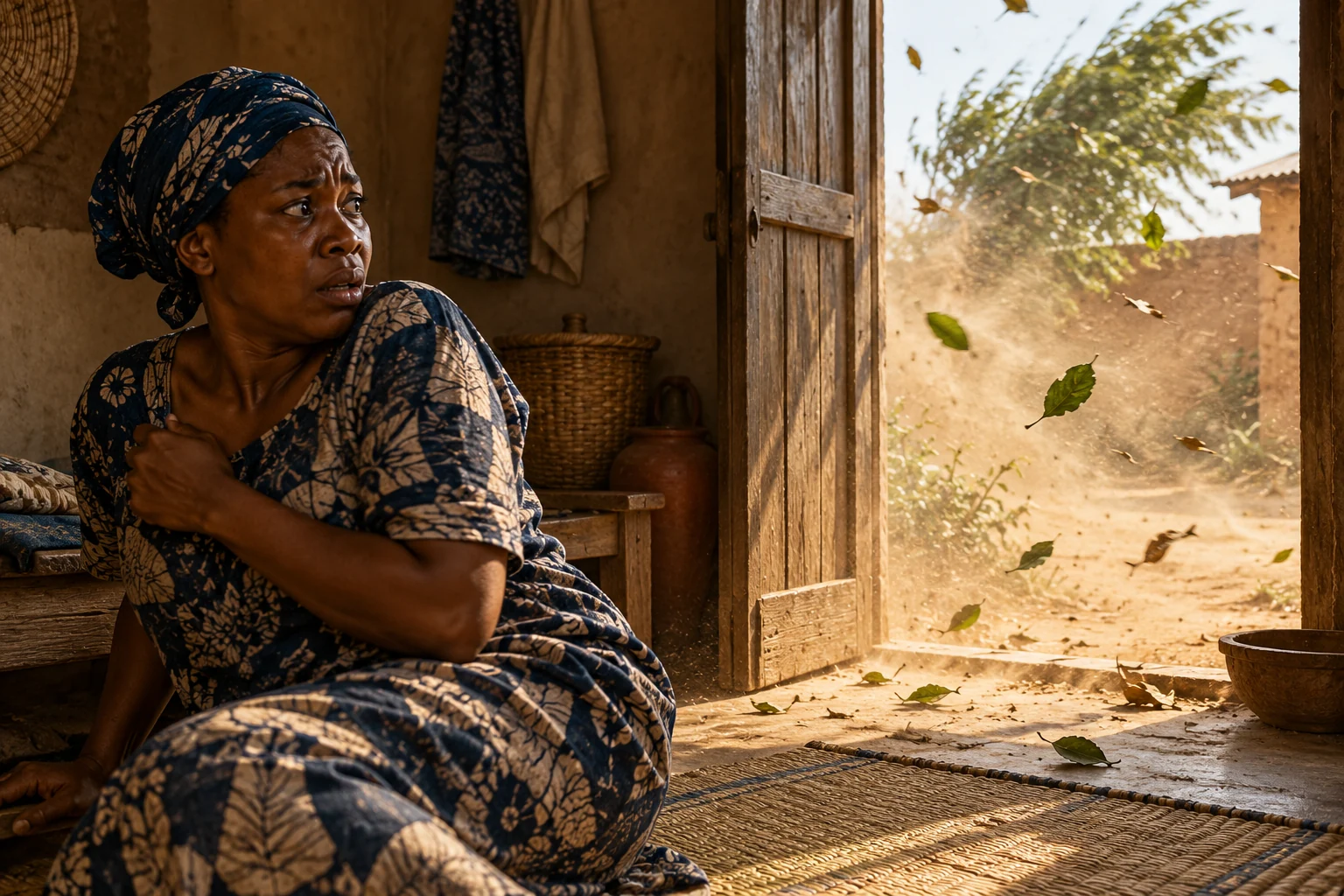
Mosawere feels that his efforts have led nowhere despite attention to several Orishas. Calling Oyá at his doorway, he is frightened by a sudden wind and runs. A voice asks him to stop and listen. Oyá directs him to Obatala, who points him toward Osanyin. He resists at first, later returns, and accepts a continuing relationship with the specialist he had avoided.
The first failure is recognition: the caller does not initially identify the event as the answer sought. The sequence then requires several helpers with different roles. Its later illness language should remain a source claim, not an explanation of real health problems. The tension is whether seeking help includes openness to a referral one did not choose in advance.
Narrative setting: Cuban/Lukumí-labeled patakín in the multilingual compilation; individual narrator and publication history remain unverified.
The mentor acknowledged as another father
A youth has left Oyá and Ayaguna’s household while still small and lives in another land. Eshu Gogoro assists him, supplies materials, and helps establish a market and a public practice. When a couple seeks their missing child, recognition develops through further encounters. The parents eventually see the waiting community and acknowledge that Eshu Gogoro has also become the young practitioner’s father.
The reunion does not erase the mentor’s contribution or require the youth to return to his original dependence. Birth and acquired parenthood are placed side by side. The source shifts between Ayaguna and Obatala in naming the father, so a careful reading preserves the instability rather than invent a consistent genealogy. The strongest motif is acknowledgment of the person who cared during absence.
Narrative setting: Cuban/Lukumí-labeled patakín in the multilingual compilation; individual narrator and publication history remain unverified.
Akpe’s newly acquired covering is unwound at a funeral
Akpe is so poor that he cannot clothe himself. The diviner responds compassionately by substituting modest materials for resources Akpe lacks. A second response is required to preserve what he will gain, with an alternative limit if he cannot complete it. Thread then winds around Akpe until he is well covered and rejoices. He neglects the further obligation and forgets the limit. When a relative dies, Eshu prompts the family to invite him. At the funeral, people use the thread around his body to wrap the dead. All of it is removed, returning Akpe to his earlier exposed condition.
The first response is made possible through the diviner’s accommodation of poverty, so the account does not begin by refusing help to someone without resources. Its sharper distinction concerns acquisition and preservation. Receiving an initial covering does not fulfill the later obligation, and Akpe’s joy makes the second relation easy to overlook. Eshu’s funeral invitation turns forgetfulness into the material unwinding of what was gained. The spindle personification gives this loss an exact form: its wealth is thread, the same thing others can remove for another purpose.
Contemporary interpretation can ask whether the conditions that sustain a benefit receive as much attention as the moment of obtaining it. The source’s restriction around funerals belongs to this narrative and should not be imposed on readers as a taboo or an explanation for actual bereavement. Its religious causality remains particular to Akpe’s response, Eshu’s action, and the object whose covering can be literally unwound.
Narrative witness and setting: Cromwell Osamaro’s explicitly headed account of Akpe, the spinning spindle.
Iyaale’s inherited tree rises and descends through ancestral authority
Iyaale and her husband live from a tree she inherited from her father. Under social pressure, she persuades him to accept another wife, Alume, despite his misgivings. Alume treats the tree’s produce as hers and refuses the household’s acknowledgment of Iyaale’s prior ownership. Iyaale appeals at her father’s grave and addresses the tree, which rises beyond reach with Alume still in it. The husband and neighbors plead for mercy. He also recalls that Iyaale herself pressed for the second marriage. She relents, and her next song lowers the tree. Alume descends, apologizes, and is received back with an embrace.
The tree’s power follows a specific ancestral claim: Iyaale asks her father to confirm a legitimate inheritance through the efficacy of her speech. The episode therefore involves inherited sacred authority as well as a dispute over produce. Her action is effective but also severe, and the husband’s appeal does more than ask an offended superior to be kind. He recalls her participation in creating the household arrangement, bringing a forgotten responsibility into the request for mercy. The ending includes apology and physical welcome, unlike a mere command to submit.
Contemporary interpretation can examine how recognition of ownership and acknowledgment of shared responsibility make repair possible. It should not transfer the story’s household hierarchy into universal rules for women or present lethal threat as a sound method of resolving conflict. The source contains duplicated and unstable wording, but the ancestral invocation, upward transformation, appeal, descent, and embrace are sufficiently clear to support this particular religious and relational sequence.
Narrative witness and setting: Cromwell Osamaro’s explicitly headed Iyaale and Alume account; the compilation also supplies a distinct sibling variation.
What was born in this Odù
“Born” can name an explicit traditional origin association or what emerges through a story: a capacity, relationship, practice or order of life. Interpretations drawn from a narrative are labelled below, so their basis remains clear.
An answer recognized after fear
Contemporary interpretation from the selected myth.
This is a contemporary interpretation of the wind encounter, not a traditional born-list statement. The motif concerns the moment a frightening event is reinterpreted through dialogue, without making wind or fear evidence of an actual supernatural message for readers.
Mentorship becomes acknowledged kinship
Contemporary interpretation from the selected myth.
This contemporary emergence motif comes from the parents’ recognition of Eshu Gogoro as another father. It is grounded in the narrated care and public practice, without claiming a universal origin of adoption or replacing the source’s unstable genealogy with an invented one.
Correlations to life dimensions
These questions bring the selected stories into contemporary life. They are interpretive invitations for study.
Work and resources
Eshu Gogoro’s support includes materials and a market where the young practitioner becomes known. The story makes professional standing dependent on practical sponsorship and a public setting. We can examine those enabling contributions without repeating the promise of infallible predictions.
Reflect: Who given the conditions in which your work became visible?
Relationships and family
The parents recognize another parental relationship formed during the youth’s absence. The reunion therefore enlarges the acknowledged family rather than simply restoring an earlier hierarchy. The story does not narrate every party’s earlier fear or responsibility in sufficient detail to judge it conclusively.
Reflect: Can reunion honor the care given during separation?
Character and inner life
Mosawere seeks answers but resists the direction he receives. The story allows a distinction between asking for help and agreeing only to a preferred form of help. A reflective reading should still preserve the person’s right to question an adviser rather than equating every refusal with obstinacy.
Reflect: What makes a referral worth considering?
Community and responsibility
A waiting crowd makes the young practitioner’s work visible to his returning parents. Public acknowledgment confirms the mentor’s contribution while also bringing new expectations. The episode invites inquiry into how communities remember sponsors rather than attributing a person’s standing only to birth or individual talent.
Reflect: How is a mentor’s contribution publicly remembered?
A deeper reading of the sacred relationships
Ancestral legitimacy makes speech effective in the tree account
Iyaale’s song is preceded by an appeal at her father’s grave concerning the legitimacy of her inheritance. This is not simply an angry person discovering confidence. The account makes speech consequential through a particular ancestral relation, and the later song reverses the tree’s movement when she grants mercy. Akpe’s covering likewise has a religious condition beyond its visible material form. The earlier Mosawere and young exile episodes add other named powers and forms of guidance rather than a single interchangeable energy. A depth study can therefore explain the specific relation in which speech acts, without supplying a recipe, claiming anyone can reproduce the transformation, or reducing ancestral authority to ordinary property enforcement.
Preserving a benefit involves remembering its conditions
Akpe celebrates the covering but overlooks the obligation or alternative limit attached to keeping it. Alume enters a household whose livelihood rests on Iyaale’s inheritance and behaves as though access erases that prior relation. The earlier exiled youth also depends on guidance received before establishing a new life, while Mosawere’s encounter shows a request exceeding the capacity to receive its answer calmly. Contemporary comparison can ask what has been forgotten after a desired change becomes available. The accounts give different conditions rather than one moral debt imposed on every beneficiary. Their sacred relations should be explained before the broader reflection about gratitude, memory, or responsibility is offered to readers.
Mercy can require acknowledging one’s own part in the conflict
The husband’s reminder unsettles Iyaale’s refusal because it recalls her insistence on the second marriage. That does not erase Alume’s conduct or the inherited claim. It adds a responsibility belonging to the person who currently holds the power to release another. The descent then leads to apology and embrace, giving repair more substance than an imposed silence. Akpe’s scene has no comparable restoration after the thread is removed, so the two endings should remain distinct. Contemporary interpretation can ask how a person with a legitimate grievance remembers the choices that helped create the situation. The religious authority of the tree is real within the story, while its exercise still becomes subject to a plea for mercy.
Questions that deepen the study
Does Akpe lose everything because he attends a relative’s funeral?
Within the narrative, the funeral is the setting where an earlier neglected obligation and forgotten alternative limit take effect through Eshu’s invitation. It is not a general explanation of why people become poor after bereavement. Akpe is a personified spindle, so the removal of thread gives the loss a literal material form particular to that character. A responsible account can explain acquisition and preservation as separate religious concerns without imposing a funeral taboo on readers. The diviner’s initial compassionate substitution is also essential: the episode begins by making help possible despite poverty, rather than treating lack of resources as evidence of moral failure.
Does Iyaale’s inherited power make every response justified?
The source confirms the efficacy of her ancestral appeal, but its own ending includes a plea for mercy and a reminder of her responsibility for bringing Alume into the household. Religious effectiveness therefore does not require presenting the threatened harm as beyond ethical discussion. The descent, apology, and embrace are part of the account rather than a modern correction added from outside. Contemporary readers can distinguish a legitimate claim from unlimited entitlement to enforce it. The story’s unequal household order should be reported accurately without converting it into personal advice about submission or a general rule for present marriages.
How do these additions deepen Mosawere and the young exile?
Mosawere seeks a power whose arrival becomes difficult to face, while the exile receives guidance that supports a new place and relation. Akpe shows the risk of receiving a benefit while forgetting what preserves it. Iyaale’s household shows inherited authority becoming destructive until shared responsibility opens a path to mercy. Together the motifs ask what follows after a request is answered or a capacity becomes available. The named powers and ancestral relations remain active, so the comparison should not become only a lesson in emotional regulation. Different endings also matter: the spindle’s loss is not repaired, while the tree account explicitly narrates apology and welcome.
What the four narratives reveal together
The earlier Mosawere and exile episodes distinguish seeking a power from being able to receive or live with its consequences. The new accounts carry that inquiry into preservation and inherited authority. Akpe gains a covering through compassionate religious accommodation but forgets the condition that would sustain it. Iyaale’s ancestral relation makes her speech effective, yet mercy becomes possible only when a forgotten part of her own responsibility is recalled. The four stories therefore give gratitude and restraint specific religious settings rather than treating them as generic virtues. They also resist a single happy ending: Akpe remains stripped, while Alume’s descent includes apology and an embrace. A contemporary reading can examine what follows acquisition, belonging, or power, while preserving Eshu’s action, ancestral agency, and the distinctions among the witnesses’ different relationships and outcomes.
Living with this Odù
A continuing life or initiatory relationship
For someone whose received life or initiatory Odù is Ìwòrì Òtúrá, help may need to be recognized in a form different from the answer initially imagined. Mosawere calls Oyá but flees the wind through which she responds, then resists a sequence of referrals. The separated youth’s reunion requires acknowledgment that Eshu Gogoro’s acquired parenthood is real alongside birth relation. Long development can involve receiving direction without requiring every helper to confirm one preferred route or hierarchy.
Akpe’s covering adds the difference between acquiring and sustaining a benefit. Iyaale’s inherited tree adds the responsibility of someone whose legitimate claim does not remove their part in creating the disputed household arrangement. The reconciliation includes apology and welcome, rather than only a superior’s successful threat. Religious efficacy can make an action decisive without making its severity beyond ethical examination.
A received sign does not identify the responding power in a visitor’s own experience, impose a funeral taboo, or settle the source’s shifting father name. Across changing circumstances, the person can ask which support remains unacknowledged, which continuing condition has been forgotten after initial joy, and what shared responsibility makes repair more than submission to the person whose claim has finally been recognized.
A particular consultation and its question
In consultation, Ìwòrì Òtúrá can distinguish asking for assistance from being willing to receive its actual route. The doorway wind is initially frightening to its caller, while the subsequent referrals require relationships he did not choose in advance. A practitioner can examine expectations without declaring that an unknown disturbance is Oyá or that illness proves resistance to counsel. The mentor account asks whether reunion is being imagined as erasure of acquired care rather than an enlargement of acknowledged parenthood.
Akpe’s thread makes preservation a distinct responsibility from obtaining a covering. Iyaale’s tree asks how a legitimate inheritance and responsibility for a household’s arrangement can be held together. The husband’s reminder changes the appeal for mercy by bringing Iyaale’s own earlier participation back into view. The specific reconciliation should not be replaced by the later sibling variant’s lethal ending.
The actual result determines relevance. It does not prescribe family submission, funeral avoidance, or a universal divine genealogy. Consultation may clarify received help, continuing support, inherited authority, and accountable welcome. It remains a particular religious encounter rather than a permanent identity as resistant seeker, forgotten beneficiary, or offended owner. Effective speech can be recognized while asking what freedom and shared responsibility make its outcome livable.
Constructive and adverse possibilities
Constructively, an unexpected answer can be heard, several helpers can be acknowledged without collapsing their roles, and birth relation can make room for the person who cared during absence. A benefit can remain supported after acquisition, while an inherited claim can enter a reconciliation that includes apology, recalled responsibility, and physical welcome. Religious agency changes relations without requiring their participants to become interchangeable.
Adversely, expectations can make requested help unrecognizable, initial joy can eclipse the conditions sustaining it, and a legitimate grievance can become an unexamined threat from a stronger position. Family reunion can also attempt to erase acquired parenthood. These possibilities do not assign the state of Ìwòrì Òtúrá in advance. Iré and adverse conditions belong to the actual consultation. The motifs ask whether acknowledgment expands the relationship and preserves responsibility, or merely restores one person’s authority while hiding the work and choices of others.
An illustrative situation in everyday life
Hypothetically, an adult returns to her birth family after years supported by an unrelated mentor. Her parents celebrate the reunion but describe the mentor as a temporary substitute whose role is now finished. Eshu Gogoro’s acknowledged parenthood asks whether return can enlarge belonging instead of erasing the care that made return possible. A dispute also arises over a family resource she encouraged relatives to share but later wishes to control alone. Iyaale’s tree motif makes legitimate ownership distinct from immunity to reminders of one’s own participation. The family can acknowledge both inherited claims and created relationships. This hypothetical example concerns expanded recognition and shared responsibility, not a command to reunite, an invented genealogy, or a recommendation to use threats as a path to reconciliation.
Sources and reading context
The first two narrative witnesses
Two Cuban narratives are selected. No explicit born list appears, so emergence motifs are labeled contemporary interpretation and the evidence flag remains partial. The second story alternates Ayaguna and Obatala as father; no universal genealogy, medical causation, or claim of infallible divination is inferred.
Narrative motifs are summarized independently. The life-dimension reflections are contemporary interpretation. How these reference studies are built explains the wider source approach and the distinction between a reference article and personal divination.
Additional named witnesses
- Cromwell Osamaro. The explicit heading governs Akpe’s covering and loss and the Iyaale/Alume inherited tree narrative.
The tree narrative contains duplicated clauses and shifting pronouns; only its clear sequence is used. A later sibling variant has a different lethal ending and is not silently substituted for the reconciliation here. No botanical etymology, funeral taboo, or household submission rule is prescribed.
Bibliographic identification
- C. Osamaro Ibie. Ifism: The Complete Work of Orunmila. Lagos; multivolume publication beginning 1986. Library catalogue record. Related bibliographic record for the named narrative witness. Exact volume, edition and page of the transmitted account have not been independently matched.
Read the source method and wider scholarly context.
The catalogue links identify published works and their authors. They are separate from proof of an individual episode’s wording or attribution. Contemporary comparisons and the synthesis above are editorial interpretation. The author’s books and Academy companions below provide further study; their sales links are separate from the source references.