
Òbàrà Ìká is a mixed Odù in Ifá’s 256-part corpus. Obara Ika joins Orunmila’s improvised search for food with a compact escape into a yagruma tree. The first episode places a sacred specialist inside ordinary household hunger; the second makes a living feature of the path more immediately useful than status. The broader section also includes betrayed confidence and misread appearances, but those claims should not be stretched into an assumption that every client or relative is untrustworthy.
A question to carry through the study: How can you ask for support openly while respecting the resources and judgment of your hosts?

This Academy reads the right column first, then the left. Each row carries a single or double mark.
Where this Odù belongs
Òbàrà Ìká belongs to the Òbàrà family in this Academy’s study sequence. It is a mixed Odù, distinct from Ìká Òbàrà. The order matters. Its teaching is approached through its own narratives, rather than by adding two general descriptions of the principal signs together.
Key Òrìṣà and sacred relationships
The figures below are selected for their roles in the accounts discussed here. They offer connected reading paths through the tradition.
-
Ọ̀rúnmìlà. He is a hungry traveler accompanied by his wife and later a threatened traveler who finds refuge in a tree; these situated roles differ from effortless omnipotence.
-
Orí. The affiliated-figure list associates the inner head with fulfillment and realization. This is a source association, not a separate Academy deity or a participant in the selected stories.
Key myths and their meanings
A meal made larger
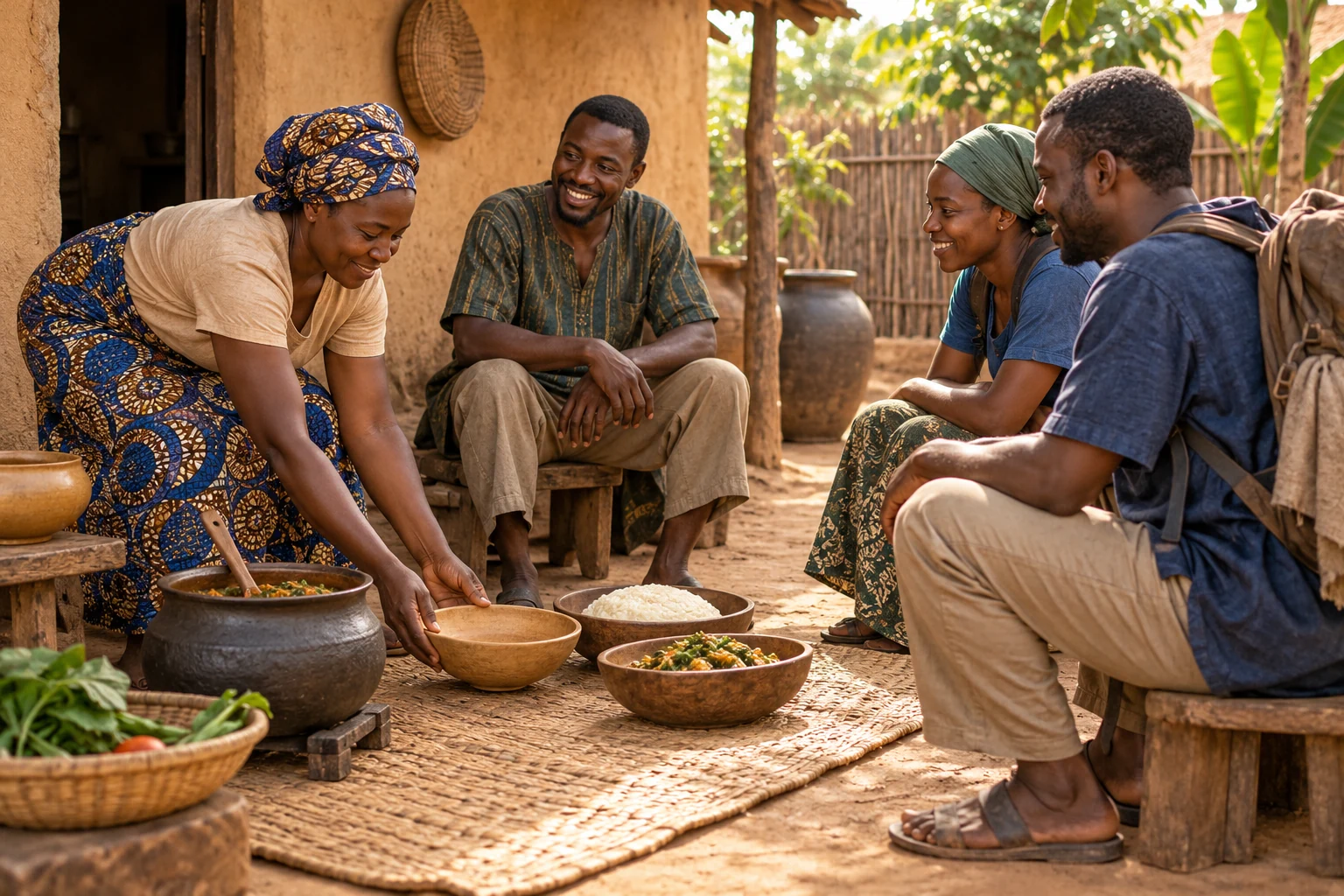
Traveling without food, Orunmila promises his hungry wife that they will eat at the next house. His advice leads a household to prepare more food, allowing the travelers to share. Later a ruler hosts a wider gathering, and a favorable household event brings the diviner a substantial gift.
The episode exposes the ordinary needs of someone who gives counsel. It can be read as hospitality and social provisioning, but it also raises a question about the adviser’s personal interest in the advice. Preserve that ambiguity rather than turning the narrative into a justification for pressuring hosts through spiritual authority or promising favorable outcomes.
Narrative setting: Cuban/Lukumí patakín in a multilingual source compilation; no individual narrator is established.
The yagruma refuge
On a journey, Orunmila encounters a group of animals that threaten him. He notices a yagruma tree and climbs to safety. The short narrative honors the tree as the immediate support that makes his escape possible. Adjacent notes move into betrayal and reputation, without extending the escape plot.
Refuge comes through noticing what is already present on the path. The tree’s importance need not be reduced to a hidden recipe or generalized into a claim that a species always offers protection. Because the source is compact, the account remains brief: a moment of responsive attention, a climb, and survival, rather than an invented adventure.
Narrative setting: Cuban/Lukumí patakín in a multilingual source compilation; no individual narrator is established.
Success changes the claims of close relations
Before earthly life, the protagonist is warned that difficulties will arise within close relations and undertakes the advised sacred commitments. He enters trade and craft, but modest success is followed by opposition from those around him. A further consultation renews his relationships with Esu and Ifa. The account then moves toward itinerant divination and access to rulers, through which his prosperity and reputation expand. The witness identifies a shared family background with priests of Ogun, Olokun, and Osanyin, but gives little detail about each relative’s individual conduct. It is a narrative of changing social scale, not a forecast that relatives inevitably oppose success.
The plot does not begin with an isolated individual becoming rich. It locates the protagonist among religiously differentiated kin and then changes the demands surrounding his work as his position grows. Modest success is a hinge: the same network that once seemed ordinary becomes a source of difficulty. Within the religious account, renewed sacred responsibility alters that field, and travel opens a broader sphere of recognition. A contemporary interpretation can ask whether familiar relationships have adequate terms for changed circumstances without treating family as inherently dangerous.
The earlier traveling-couple story adds another scale, where Orunmila’s needs are immediate and domestic; the yagruma refuge supplies support available within a dangerous moment. These do not all recommend departure. They offer different relations between movement and sustaining help. The new episode also leaves an important limit: it celebrates royal recognition but does not fully describe the obligations that high-status patronage may impose on the practitioner.
Narrative witness and setting: Translated excerpt in the multilingual compilation’s expressly attributed Cromwell Osamaro sequence, with Yoruba/Bini-facing material. The compilation’s language is not evidence of a Brazilian tradition.
Esu’s body interrupts the route to the palace
Alara Isa’s expected visits and tributes stop, despite his established royal position. Esu is said to have placed his legs across the route, and people fear crossing them. At Esu’s prompting, the ruler summons Obara Ika, whose consultation identifies the barrier as a religious relationship requiring attention. After the ruler acts, the path becomes open and visitors return. The account ends with the diviner receiving substantial recognition and gifts. Its spatial image is concrete, but its force belongs to a world in which a divine person can alter public circulation. It is not a physical map of an authenticated palace road.
The barrier makes visible a distinction between owning an office and receiving the movement that sustains it. Alara remains ruler, yet the route of approach has become unusable within the community’s understanding of sacred danger. Esu is not simply a metaphor for a bad attitude at the gate; the witness gives his bodily presence causal reality. Consultation identifies the relation through which access can change, and the diviner’s standing grows as a consequence. That raises a difficult interpretive question because Esu also initiates the solution by directing the ruler toward the practitioner.
An editor should preserve that circular agency instead of recasting the story as neutral technical troubleshooting. Compare the earlier food episode, where the adviser’s own hunger intersects with his counsel: useful help and the helper’s advancement can coexist. The narrative celebrates renewed circulation, while contemporary analysis can still ask how a sacred intermediary’s benefit is acknowledged without making every claim to mediation self-validating.
Narrative witness and setting: Translated excerpt in the multilingual compilation’s expressly attributed Cromwell Osamaro sequence, with Yoruba/Bini-facing material. The compilation’s language is not evidence of a Brazilian tradition.
What was born in this Odù
“Born” can name an explicit traditional origin association or what emerges through a story: a capacity, relationship, practice or order of life. Interpretations drawn from a narrative are labelled below, so their basis remains clear.
A shared meal from scarcity
Contemporary interpretation from the selected myth.
A contemporary interpretation sees communal provisioning emerge when a household expands a meal to include travelers. This is an inferred social motif, not a claim that this sign traditionally originated hospitality.
Attention to available refuge
Contemporary interpretation from the selected myth.
A contemporary interpretation identifies practical attention in Orunmila’s notice of the yagruma tree. This names the story’s movement from danger to a foothold, without adding a traditional origin or botanical promise.
Correlations to life dimensions
These questions bring the selected stories into contemporary life. They are interpretive invitations for study.
Work and resources
Provisioning is made social through a larger meal. The narrative also asks whether an adviser can clearly acknowledge personal need rather than concealing it behind authority.
Reflect: What support could you request in plain terms?
Relationships and family
The wife repeatedly names hunger, keeping bodily and household needs visible while Orunmila strategizes. Her concern is part of the story’s action.
Reflect: Whose ordinary need is being deferred while a larger plan is discussed?
Character and inner life
The tree episode turns attention into practical agency. Recognizing an immediate foothold can matter more than maintaining an image of self-sufficiency.
Reflect: What accessible support are you overlooking?
Community and responsibility
A feast can circulate resources broadly, but religious prestige can also create pressure. Hospitality works best when hosts retain meaningful choice.
Reflect: How can your community offer support without coercion?
A deeper reading of the sacred relationships
Esu’s agency is more than a label for obstruction
In the palace narrative, Esu actively creates the blocked relation, directs the ruler toward consultation, and changes the path after an acknowledgment. In the kinship account, renewed sacred responsibility participates in the protagonist’s movement beyond a constraining situation. This is a particular theology of circulation and recognition, not merely a modern account of networking. It is also not a universal claim that Esu causes every setback. The earlier yagruma story locates immediate refuge in a tree, reminding the reader that the sign’s accounts do not assign every helpful event to the same mechanism. A spiritually faithful article preserves the differences among divine initiative, available landscape, and human response.
Need, benefit, and the adviser’s position
Orunmila’s hungry journey gives his advice an immediate personal interest; the palace episode ends by elevating the diviner who identifies the obstruction. Neither fact alone proves fraud, and neither should be hidden under an image of wholly disinterested authority. The religious setting allows sacred service and material provision to belong together. Contemporary analysis can ask whether participants understand the terms and whether the response answers their actual need. That question is more precise than either dismissing religious specialists because they benefit or accepting every demand because it is called sacred. The accounts provide particular interactions through which support and standing are produced, rather than a blanket rule about compensation.
Movement changes the scale of relationship
The couple moves from house to court in search of food, the threatened traveler moves up a tree, the practitioner moves beyond hostile relations toward royal clients, and visitors regain a route into Alara’s palace. Travel and access therefore differ in direction and purpose. A reference study should not compress them into one command to leave home or to remain rooted. The useful comparison concerns what kind of movement becomes possible and what relation sustains it. Some openings are momentary, some economic, some social, and some explicitly sacred. Their specificity is what allows a reader to reflect without receiving an invented itinerary for their own life.
Questions that deepen the study
Does the kinship episode advise suspicion of family members?
It narrates opposition within one protagonist’s close network, but offers little evidence about individual motives and does not establish a general law of family behavior. A contemporary reader can ask how changed success alters expectations while remaining open to supportive relations. Within the source, consultation and renewed sacred commitments make a different future possible; that is not the same as a psychological diagnosis of relatives. The earlier couple’s shared travel also supplies an internal counterexample to a blanket distrust of intimacy. Close relations can carry need, assistance, conflict, and new obligations without being assigned one permanent role in every story.
Why describe Esu’s legs rather than only call the palace unlucky?
The body across the road gives the obstruction a precise relational form. Visitors are afraid to cross a divine presence, so movement and tribute stop while the ruler’s title remains intact. Within the account, identifying and acknowledging that sacred relation changes the condition. A vague label such as bad luck would erase both agency and response. A modern interpretation may compare access systems or trust, but should make clear that those are analogies. The witness is speaking about a divine person’s action in public space, not offering a verified explanation of every decline in a ruler’s income or reputation.
How can the adviser’s benefit be discussed respectfully?
By stating it without treating religious service and material support as inherently incompatible. The traveling Orunmila eats through hospitality connected with his counsel; the royal practitioner receives gifts after access is restored. Those outcomes belong to the stories’ sacred economy. A contemporary ethical discussion can then ask whether the host or patron has an informed role in the exchange, and what evidence makes the service credible. Respect does not require an image of a specialist who never needs food, recognition, or compensation. It requires attention to the actual relation rather than automatic suspicion or automatic deference.
What the four narratives reveal together
The added witness gives Obara Ika a broader account of how relationships sustain movement. A practitioner’s modest success unsettles close relations before travel opens a larger sphere, while a ruler’s established position proves insufficient when Esu blocks the path of approach. Beside those public changes, the earlier food and tree episodes retain ordinary bodily need and immediate refuge. Their spiritual world should remain substantial: Esu’s presence acts, Ifa discloses relations, and acknowledgment changes what can circulate.
Contemporary questions about adviser benefit, altered family expectations, and access are useful because they follow exact events, not because they replace divine agency. The four accounts do not tell every reader to seek royal patronage, distrust relatives, or interpret a setback as sacred obstruction. They offer different scales at which a needed opening becomes available and responsibility must continue afterward.
Living with this Odù
A continuing life or initiatory relationship
For someone who has received Òbàrà Ìká in a life or initiatory setting, movement can have several purposes that should remain distinguishable. A hungry couple seeks provision, a threatened traveler finds temporary refuge above the path, and a practitioner enters a wider public sphere as close relations become difficult. These accounts do not issue one lasting instruction to leave home. They ask what kind of support makes a particular movement possible and which obligations follow when the scale of recognition changes.
The palace route gives circulation a specifically sacred condition. Alara retains office while Esu's presence prevents visitors from approaching; consultation changes the relation and also increases the diviner's standing. Long-term character can therefore include acknowledging both the usefulness of help and the helper's interest. The hungry adviser's need does not automatically prove fraud, but it should not disappear beneath an ideal of complete disinterest. The sign can invite careful judgment about access, benefit and compensation across a changing life. It does not establish that relatives must oppose success, that every blocked opportunity is caused by Esu or that a particular tree supplies universal protection. The accounts remain different ways support and movement become possible.
A particular consultation and its question
A particular consultation yielding Òbàrà Ìká can help distinguish a problem with location from one with the relationship governing access. The yagruma provides an immediate refuge already present on the journey, whereas Alara's route remains unavailable despite royal standing. Esu's bodily agency is effective within the latter witness; reducing it to an attitude would misdescribe the religious account. At the same time, the sign cannot identify the source of an unknown person's obstacle from this motif alone.
The adviser’s benefit is another useful distinction. The food episode and palace episode both join helpful counsel with the practitioner's material advancement. A question about guidance can examine whether the terms are understood and whether the response addresses the actual need, rather than assuming either perfect disinterest or automatic exploitation. The kinship account adds changing scale: a familiar network may not have adequate arrangements for a person's new circumstances. Its royal recognition leaves later patronage obligations incompletely described. Consultation can hold these gaps open while clarifying the present question. It does not turn an occasion's result into a permanent destiny of hostile family, itinerant prosperity or privileged access to rulers.
Constructive and adverse possibilities
Constructive unfolding might involve finding the particular support a movement requires and making the terms of mediation visible. The couple can receive hospitality; the traveler can notice an available refuge; Alara's circulation can change through an acknowledged sacred relation. In the attributed witness, Esu actively shapes the problem and its resolution rather than merely representing confidence.
Adverse unfolding could include treating office as sufficient to secure approach, assuming every familiar relationship can remain unchanged after success or concealing an adviser's material interest beneath claims of pure authority. Benefit alone establishes neither integrity nor deception. These contrasts do not assign a state to a real reading. They keep the question of support attached to its actual scale and leave room to examine the obligations of royal recognition instead of ending the analysis at the arrival of gifts.
An illustrative situation in everyday life
In a hypothetical professional transition, a practitioner leaves a familiar market after modest success creates disputes over support and credit. A prestigious sponsor offers access to a larger institution, but the terms of representation and payment remain unclear. The changing kinship scale helps distinguish necessary movement from a blanket rejection of family. The palace route adds a question about who actually controls access, while the hungry adviser makes the intermediary's benefit discussable. This is an illustrative interpretation rather than a forecast of betrayal or a claim that Esu blocks a particular institution. The practitioner can examine what support is available, whose interests are acknowledged and which obligations will remain after recognition arrives.
Sources and reading context
The first two narrative witnesses
No explicit born list is present in the inspected section. Two contemporary emergence interpretations are therefore grounded in the selected Cuban narratives, and the card remains partial. The inner-head association comes from a separate affiliated-figure list; neither an African author attribution nor botanical protection claims are inferred.
Narrative motifs are summarized independently. The life-dimension reflections are contemporary interpretation. How these reference studies are built explains the wider source approach and the distinction between a reference article and personal divination.
Additional named witnesses
- Cromwell Osamaro Ibie. The surrounding sequence is expressly attributed to Cromwell Osamaro. These selected episodes are read through the multilingual compilation’s translated renderings; exact edition and original translation chain remain unverified.
The translated shared-kinship sentence is compressed, and individual relatives’ motives are not supplied. The palace story’s sacred spatial claim is not authenticated geography. Royal gifts and the adviser’s material benefit are acknowledged without invented billing rules, diagnoses, or universal claims about Esu.
Bibliographic identification
- C. Osamaro Ibie. Ifism: The Complete Work of Orunmila. Lagos; multivolume publication beginning 1986. Library catalogue record. Related bibliographic record for the named narrative witness. Exact volume, edition and page of the transmitted account have not been independently matched.
Read the source method and wider scholarly context.
The catalogue links identify published works and their authors. They are separate from proof of an individual episode’s wording or attribution. Contemporary comparisons and the synthesis above are editorial interpretation. The author’s books and Academy companions below provide further study; their sales links are separate from the source references.