
Òfún Òtúrá is a mixed Odù in Ifá’s 256-part corpus. Òfún Otura’s selected stories concern a ram whose dream of the throne makes him an agent of a rival ruler and a singer who repeatedly attributes assisted success solely to himself. Both protagonists use a trusted relationship for personal advancement and fail to acknowledge what sustains their position. The source’s extreme endings require critical treatment, while the concrete focus remains the conduct hidden behind service, public talent, and attractive claims of self-sufficiency.
A question to carry through the study: What part of your success depends on a relationship you describe as though it contributes nothing?

This Academy reads the right column first, then the left. Each row carries a single or double mark.
Where this Odù belongs
Òfún Òtúrá belongs to the Òfún family in this Academy’s study sequence. It is a mixed Odù, distinct from Òtúrá Òfún. The order matters. Its teaching is approached through its own narratives, rather than by adding two general descriptions of the principal signs together.
Key Òrìṣà and sacred relationships
The figures below are selected for their roles in the accounts discussed here. They offer connected reading paths through the tradition.
-
Ọ̀rúnmìlà. Under the name Alapini in the ram narrative, Òrúnmìlà investigates the ruler’s predicament and identifies betrayal within the household rather than an exclusively external threat.
-
Ṣàngó. Ṣàngó accompanies the visit to the ruler and later acts in the ram’s punishment; in the singer story he grants support that the performer repeatedly denies and neglects.
-
Èṣù. Elegbá hears the singer’s public claim that his restored ability is entirely his own and reports it to Ṣàngó, exposing the gap between private assistance and public acknowledgment.
Key myths and their meanings
A would-be ruler serves as a rival’s agent
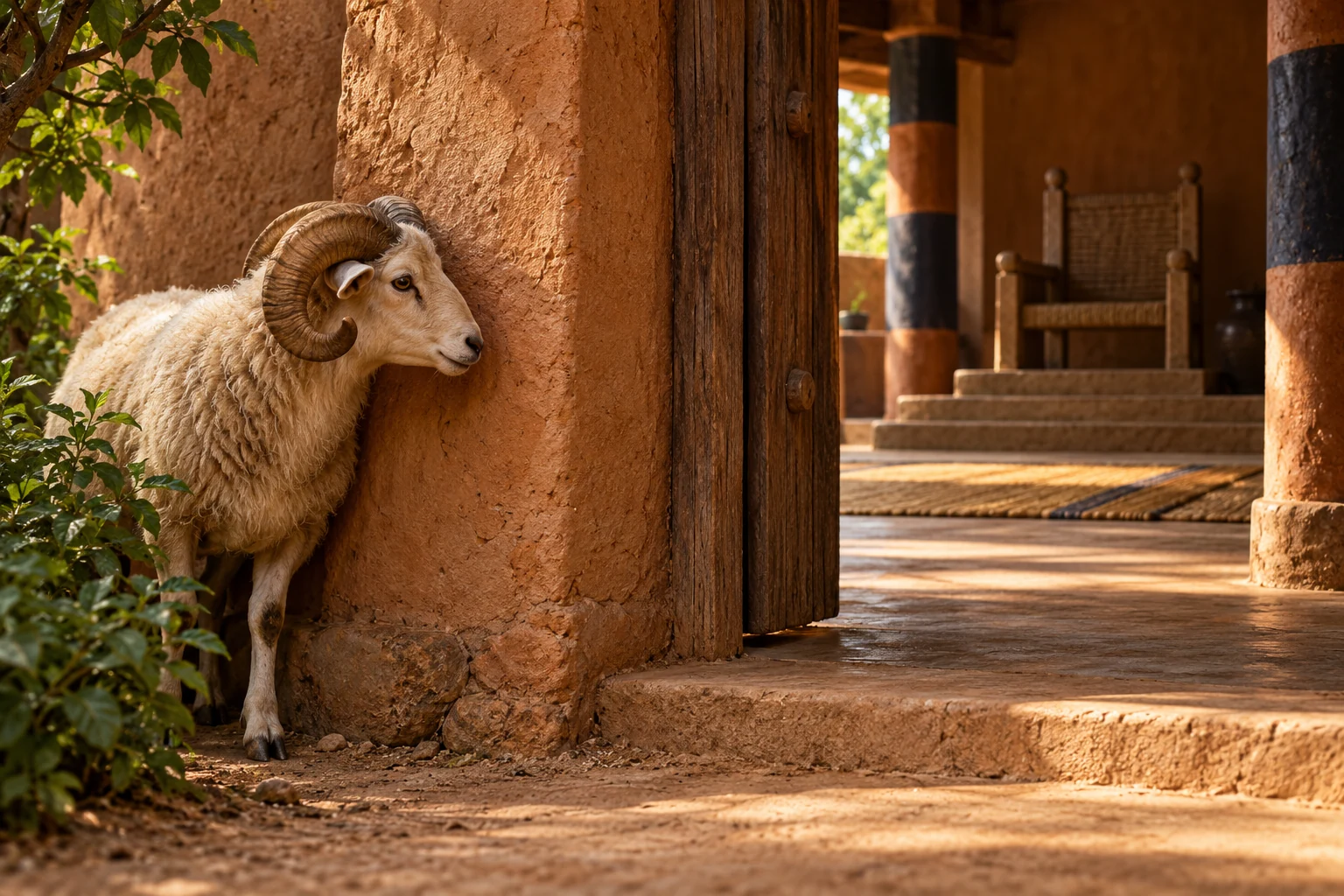
A ram dreams repeatedly of occupying King Ayabo’s throne. A neighboring ruler recognizes the ambition and uses it to place him in Ayabo’s service, where he undermines the household and reports its affairs. Alapini, identified as Òrúnmìlà, arrives with Ṣàngó and investigates the king’s decline. The ram is caught listening, exposed, and punished. His late regret does not reverse the consequences within the source’s violent ending.
The motive is specific: an imagined future identity makes present disloyalty seem useful to the protagonist. The rival manipulates that wish, turning household access into an instrument of external control. Later writing can examine conflicting interests and accountable delegation without treating suspicion of every ambitious junior as wisdom. The narrative’s claim that betrayal causes physical decline and its death sentence remain literary and religious elements, not diagnostic or judicial guidance.
Narrative setting: Cuban/Lukumí patakín identified in the selected account; no individual narrator is named.
The singer claims to be his only teacher
A performer first enjoys applause, then loses vocal reliability and income. Ṣàngó offers help, and the singer returns to success, telling listeners that the recovery is entirely his own faculty. After another failure, he seeks forgiveness and accepts an obligation to remember the support. Renewed fame again erases the promise. The final account transforms the singer into the ram he had promised and ends in his destruction.
The repeated cycle makes temporary regret different from changed conduct. The performer remembers help only when public approval disappears, then rewrites the successful period as solitary achievement. That provides a concrete question about credit and maintenance of support. The source’s final punishment is disproportionate as a model for human relationships and should not be endorsed. Artistic difficulty must not be interpreted as evidence that a real singer has offended a deity or failed morally.
Narrative setting: Cuban/Lukumí patakín identified in the selected account; no individual narrator is named.
Ontòólá’s sheep speaks only when the sword is raised
Ontòólá is a poor farmer who takes his sheep to the farm. One day it speaks sympathetically about his poverty, and he reports the extraordinary event to the king. Brought before the court, the sheep refuses to repeat its words. The king orders Ontòólá arrested and executed for wasting royal time. Only when the executioner raises his sword does the animal speak, stopping the killing and affirming the encounter with difficulty. Ontòólá is released and receives abundant goods. The concluding praise returns the episode to prior divination and an advised response he performed, rather than ending with royal generosity alone.
The animal’s timing gives the same truthful report two very different public meanings. Without the repeated voice, Ontòólá appears to the king as a liar; when it speaks, the court’s judgment reverses. The source’s framing interprets difficulty before prosperity through patience and the reliability of counsel, but the execution scene should not be softened into a harmless test. Royal power nearly kills a person whose report is true. A contemporary interpretation can examine the danger of demanding immediate proof of an extraordinary experience under coercion.
It should not infer that the king’s threatened violence is therefore an ideal way to discover truth. Within the religious sequence, the final praise also places the rescue inside Ifá’s earlier declaration and the farmer’s response. That spiritual explanation deserves to remain explicit, while the story’s particular favorable reversal cannot promise that every truthful person facing violence will receive a last-moment vindication or that suffering automatically creates wealth.
Narrative witness and setting: Passage explicitly labeled Ayo Salami, with Yoruba verse and Spanish translation in the supplied compilation.
Ògúndìran renews the Ògún relation within his family
Ògúndìran asks Ifá whether his life can become favorable. The counsel identifies an Ògún presence in his extended household and recalls a hunter in the family who had honored Ògún. He is told not to let that devotion disappear and to combine his work with hunting. The verse situates his consultation in a descent from heaven to earth. After acting on the counsel, he enters the forest, encounters favorable conditions, rejoices, and praises the diviners, who praise Ifá. No personal genealogy, dated settlement, named hunted animal, or detailed account of his later household is supplied by the selected unit.
The favorable future is linked to a relation already present in the family, rather than to inventing an unrelated spiritual identity. Ògún is not merely a symbol for the hunter’s occupation: the counsel treats the deity’s presence and the continuation of devotion as consequential realities. Work and religious responsibility are joined, since Ògúndìran is also directed toward the forest rather than told to wait passively for a result. A contemporary interpretation can ask what forms of knowledge and obligation have become neglected across generations.
That question should not become a universal instruction that descendants must reproduce every ancestor’s livelihood or worship. The witness describes a particular consultation and a particular family relation. It does not establish the reader’s ancestry, authorize unsupervised hunting, or explain prosperity as proof of a superior lineage. The religious continuity is specific, and the account leaves unreported how household members maintained that relation together after Ògúndìran’s initial favorable response.
Narrative witness and setting: Passage explicitly labeled Ayo Salami, with Yoruba verse and Spanish translation in the supplied compilation.
What was born in this Odù
“Born” can name an explicit traditional origin association or what emerges through a story: a capacity, relationship, practice or order of life. Interpretations drawn from a narrative are labelled below, so their basis remains clear.
Ṣàngó’s power
Selected traditional source association.
The explicit beginning list locates Ṣàngó’s power in this sign. In the selected stories that power is active in support and punishment, but the catalog claim remains local and does not imply that Ṣàngó lacks authority in other Odù or traditions.
The intelligence of Ọ̀ṣọ́ọ̀sì and Oyá
Selected traditional source association.
The source jointly names these figures’ intelligence among the sign’s beginnings. This is a section association rather than a role in the two selected plots; it should not be expanded into a fabricated account of their instruction or a universal hierarchy of intelligence.
Correlations to life dimensions
These questions bring the selected stories into contemporary life. They are interpretive invitations for study.
Work and resources
The singer’s livelihood depends on sustained ability and a supportive relationship, but public success encourages him to erase that dependence. Professional acknowledgment should describe the actual contribution of teachers, collaborators, and care rather than only the visible performer.
Reflect: Whose contribution belongs in the account of how your work became possible?
Relationships and family
The ram receives access through service while pursuing a concealed competing objective. A relationship of trust needs room to identify conflicting interests and ambitions without assuming that loyalty requires the permanent suppression of another person’s aspirations.
Reflect: Which ambition needs to be discussed openly before it becomes a hidden conflict?
Character and inner life
Both stories show a gap between an attractive self-image and repeated behavior. The singer’s brief remorse does not prevent the next cycle, making dependable change more important than the intensity of apology after embarrassment within the singer’s livelihood.
Reflect: What observable change would show that your regret has become a new habit?
Community and responsibility
The rival ruler exploits an insider’s aspiration, and the audience rewards a performer without seeing the support behind him. Communities need transparency about interests and contributions so that trust does not depend entirely on public appearance.
Reflect: What information would help your community judge trusted roles more fairly?
A deeper reading of the sacred relationships
Religious continuity is active rather than decorative
Ògúndìran’s family relation to Ògún becomes meaningful through renewed attention and work. The deity is not an ornamental reference attached to an otherwise independent success story. Ontòólá’s concluding praise likewise locates his deliverance in prior divination and a response actually performed. These accounts present counsel as a relation enacted over time, although their concrete actions differ. One concerns continuation of a household devotion; the other reaches a favorable reversal after a frightening delay in public confirmation. A contemporary account can discuss patience and inheritance, but should keep those themes attached to the sources’ sacred agencies. Neither a family name nor an Odù label alone supplies the specific obligations narrated for these participants.
Truthful testimony can remain publicly vulnerable
Ontòólá does not retract his report when the king doubts him. Yet his own insistence cannot make the sheep repeat its speech, and political authority controls what follows from the silence. The animal’s intervention reverses the judgment only at the edge of execution. Contemporary reflection can distinguish the truth of an experience from a person’s immediate power to demonstrate it, especially before an authority with punitive control. That interpretation does not prove every extraordinary report true, nor does the account provide a general procedure for evaluating claims. Its particular force lies in the king’s mistaken certainty and the farmer’s dependence on an agency that he cannot simply command to perform on demand.
Delayed confirmation differs from forgotten inheritance
The sheep story turns on a voice whose public confirmation is delayed. The Ògún story turns on a religious relation whose continuation risks being neglected. These are distinct forms of uncertainty: one participant knows what he heard but cannot reproduce it, while another learns through consultation what his family already carries. Comparison encourages careful attention to what is actually missing before prescribing a response. A contemporary reader might need evidence, recollection, instruction, or patience in different situations; the narratives do not make these interchangeable. Their outcomes also depend on active relations with others, including an animal, a court, a household deity, and diviners, rather than on an isolated attitude of confidence.
Questions that deepen the study
Is Ontòólá’s near execution presented as a harmless lesson?
The account explicitly has him bound and an executioner raise a sword before the sheep speaks. Its favorable ending should not erase that danger or excuse the king’s mistaken judgment as an ideal method of testing testimony. The framing associates the eventual reversal with patience and prior religious counsel, but it does not report Ontòólá consenting to the threat or describe a deliberate benevolent plan by the king. A contemporary interpretation may question coercive authority while preserving the source’s spiritual account of rescue. The particular ending gives no guarantee that danger will always resolve safely for someone who waits or tells the truth.
Does Ògúndìran establish a duty for every descendant of a hunter?
The witness records counsel for a named person whose family has a particular Ògún relation. It does not establish the ancestry or religious obligations of everyone who reads the story, nor does it say that all descendants must take the same occupation. What matters within the account is the danger of letting an existing sacred relation disappear and the favorable result of responding to that counsel. Contemporary reflection can ask how inheritance is recognized and responsibly continued. The specific religious decision still belongs to the narrated consultation, rather than being deduced from an occupational resemblance, a surname, or a broad interest in this Odù.
Why keep the sheep’s agency separate from royal generosity?
Ontòólá receives goods only after the sheep’s voice stops the execution and changes the court’s understanding. Presenting the king alone as the source of rescue would omit the decisive intervention and the danger that same authority created. The closing praise then relates the result to Ifá and the farmer’s earlier response. These multiple agencies give the outcome its particular shape. A contemporary comparison can ask who makes a favorable reversal possible and who receives credit afterward. It should not invent a motive for the sheep’s delay, identify the animal as a disguised deity, or claim that the king had secretly planned the whole encounter.
What the four narratives reveal together
The additional Salami accounts deepen Òfún Otura through public testimony and remembered religious continuity. Ontòólá’s truthful report depends on an animal’s delayed voice for vindication, while Ògúndìran learns that a favorable path includes renewing an existing household relation with Ògún. The first account confronts mistaken royal certainty; the second locates responsibility within inherited sacred practice and work. Both retain divination as an effective relation rather than an ornamental moral conclusion.
Beside the earlier stories of a compromised royal aspiration and forgotten assistance, these units ask how knowledge is confirmed and how consequential relationships are acknowledged. Contemporary questions about evidence, authority, patience, and inheritance can follow, while the threatening execution, the sheep’s independent timing, and the specificity of the family devotion remain visible. No general promise of prosperity, occupational destiny, or miraculous public vindication follows from the selected narratives.
Living with this Odù
A continuing life or initiatory relationship
For a person whose received life or initiatory Odù is Òfún Òtúrá, these accounts distinguish an imagined future role from the obligations of a position already held. The ram’s desire for kingship makes present access available to another ruler’s manipulation. The singer’s repeated recovery is followed by repeated denial of support. Long-term development therefore includes recognizing whether ambition and acclaim have begun rewriting a relationship as solitary achievement or permission to betray.
Ontòólá’s truthful report introduces a different vulnerability: knowing what happened does not give him control over the sheep’s public speech. Royal certainty nearly destroys him before the sacredly framed reversal. Ògúndìran’s renewed household relation to Ògún then makes continuity active through religious response and work, rather than a family label alone. Across changing circumstances, a person may need to acknowledge help, understand a trusted role’s limits or recover a neglected relation without claiming every ancestor’s path as compulsory. Ifá, Ṣàngó, Ògún and the speaking animal retain agency. The sign predicts no betrayal or artistic failure. Its enduring task is to distinguish unreceived evidence, forgotten support and unfulfilled responsibility rather than treating all difficulty as a failure of confidence.
A particular consultation and its question
When Òfún Òtúrá appears in consultation, its narratives can help distinguish legitimate aspiration from a wish someone else is using to redirect loyalty. The ram’s ambition does not justify suspicion of every younger or ambitious colleague. The singer’s cycle instead concerns acknowledgment that disappears when applause returns; temporary regret and altered conduct are different questions. These distinctions need the actual situation brought to divination.
The matter may concern testimony or inherited relation instead. Ontòólá cannot command the sheep to repeat its words, and his eventual deliverance cannot validate the king’s coercive test. Ògúndìran learns through Ifá about a particular family Ògún relation; neither his name nor the sign establishes the client’s ancestry or authorizes hunting. A consultation result is not permanent identity or a diagnosis of why a performer struggles. Reflection can ask what is missing: evidence, acknowledgment, instruction or a continued practice. Those are not interchangeable needs. The actual religious interpretation determines relevance, while prior counsel, sacred speech and household deity remain active realities in the source rather than decorative names for ordinary patience, networking or career planning alone.
Constructive and adverse possibilities
Constructive unfolding can involve support remaining acknowledged after success, entrusted access being used responsibly and a neglected sacred relation becoming active through response and work. Ontòólá’s vindication also distinguishes a truthful encounter from an authority’s mistaken certainty. Ifá’s earlier guidance remains part of that witness’s deliverance.
Adverse possibilities include ambition becoming another actor’s instrument, gratitude surviving only during failure or political power making uncertainty lethal. The singer’s punishment cannot become a human model of proportionate consequence, and a real loss of voice cannot prove spiritual offense. The ram’s ending does not make every ambition disloyal. These contrasts can help consider constructive and adverse relationships without determining a reading’s state or assigning a permanent trait. The task is to identify the actual obligation and source of uncertainty rather than make every difficult outcome confirm a predetermined moral story.
An illustrative situation in everyday life
Hypothetically, an artist credits a mentor while seeking help after a failed season, then describes the next success as entirely self-made. When problems return, the artist again promises acknowledgment but repeats the erasure once praise resumes. The singer’s structure distinguishes an emotional apology from a changed account of the relationship. A constructive response could make credit durable through actual conduct without granting the mentor ownership of the artist’s future. The ram’s witness adds another question about whether the hunger for a larger role leaves someone vulnerable to manipulation. This is a hypothetical interpretation, not a claim that artistic difficulty signals divine displeasure, that severe punishment is justified or that a consultation has established anyone’s motive.
Sources and reading context
The first two narrative witnesses
These Cuban/Lukumí narratives contain repeated violent conclusions and bodily consequences that are not adopted as ethical or clinical claims. The descriptive section unexpectedly repeats an Ofun Batrupon heading and bird-strength material; the card therefore relies on the clearly headed Òfún Otura stories and its own explicit beginning list.
Narrative motifs are summarized independently. The life-dimension reflections are contemporary interpretation. How these reference studies are built explains the wider source approach and the distinction between a reference article and personal divination.
Additional named witnesses
- Ayo Salami. The named bilingual block provides both Ontòólá’s speaking-sheep account and Ògúndìran’s continuity with Ògún.
The sheep’s motive for delaying its speech is not supplied, and no disguised identity is assigned. The Ògún relation belongs to a particular narrated household. A duplicated earlier Ofun Batrupon description heading does not override the clearly headed Otura units used here.
Bibliographic identification
- Ayo Salami. Ifá: A Complete Divination. Lagos: NIDD, 2002 catalogue record. Library catalogue record. Bibliographic identification of the named author and work; the edition behind the transmitted account remains to be matched.
Read the source method and wider scholarly context.
The catalogue links identify published works and their authors. They are separate from proof of an individual episode’s wording or attribution. Contemporary comparisons and the synthesis above are editorial interpretation. The author’s books and Academy companions below provide further study; their sales links are separate from the source references.