
Òkànràn Ìká is a mixed Odù in Ifá’s 256-part corpus. Okanran Ika places a hunted bird’s dismissed warning beside an insect’s attempt to reproduce another creature’s craft. The bird substitutes companions’ confidence for its own inquiry; the would-be honey maker receives incomplete information and mistakes imitation for knowledge. These motifs concern how advice is evaluated, not simple obedience. Both leave responsibility distributed between the person acting, the people reassuring them, and the authority or teacher who shapes their options.
A question to carry through the study: What part of the knowledge you are relying on has never actually been demonstrated?
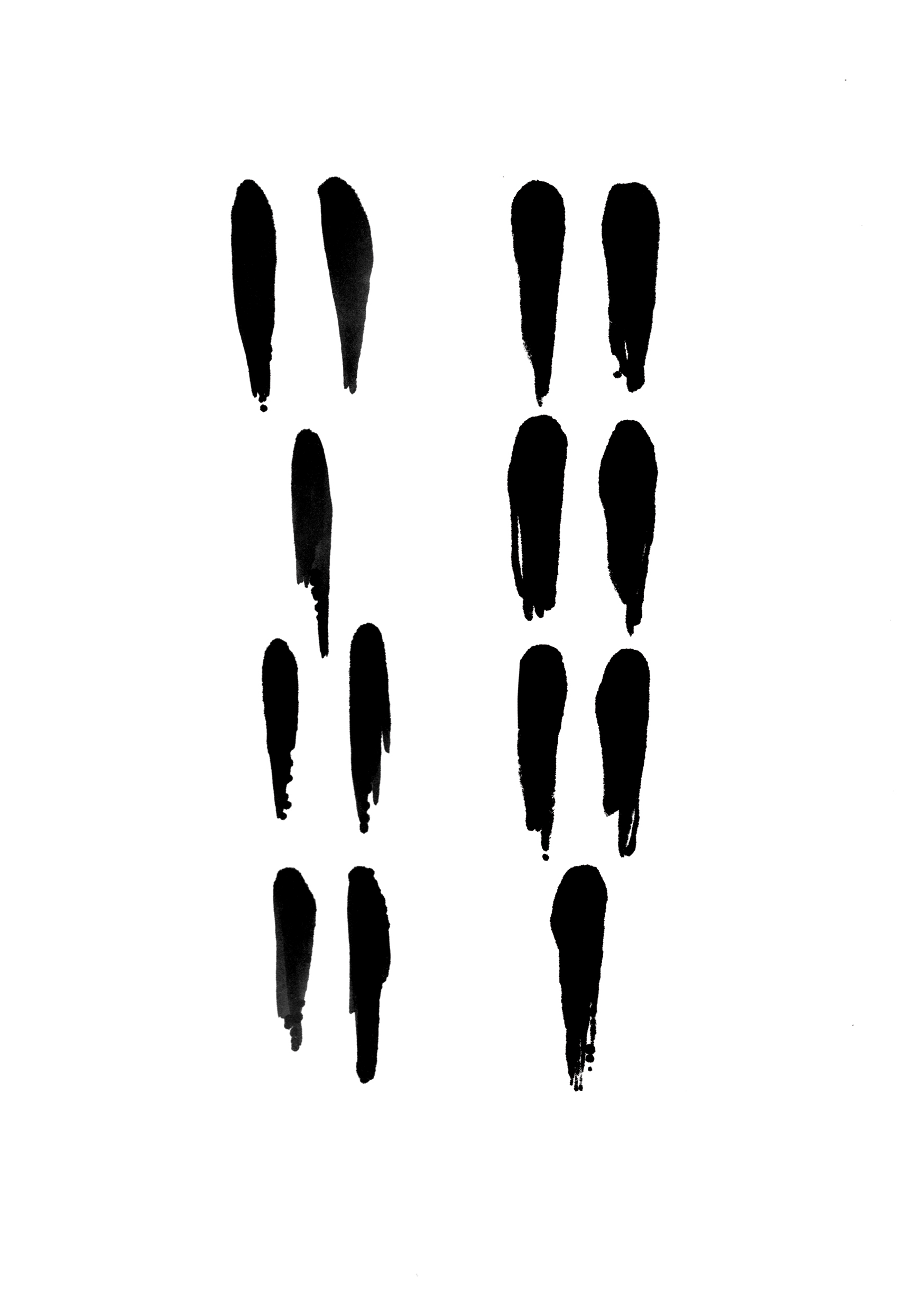
This Academy reads the right column first, then the left. Each row carries a single or double mark.

Where this Odù belongs
Òkànràn Ìká belongs to the Òkànràn family in this Academy’s study sequence. It is a mixed Odù, distinct from Ìká Òkànràn. The order matters. Its teaching is approached through its own narratives, rather than by adding two general descriptions of the principal signs together.
Key Òrìṣà and sacred relationships
The figures below are selected for their roles in the accounts discussed here. They offer connected reading paths through the tradition.
-
Ọ̀rúnmìlà. He counsels both the threatened birds and the unsuccessful hunter in the same story, a tension that prevents presenting his role as aligned only with one party’s interests.
-
Orí. The affiliated list associates the inner head with fulfillment and support. It is included as a distinct source association, not made an actor in the animal tales.
Key myths and their meanings
The birds follow the group
A guinea fowl consults because hunters threaten it. Outside, companions dismiss the advice and assert confidence around food. A hunter also consults and prepares a means of capture. The birds approach the grain together and discover too late that the easy resource is arranged to prevent their escape.
The useful issue is how collective assurance can replace assessment of a particular setting. Yet the same adviser assists both sides, so the story is not a straightforward model of benevolent instruction. A careful article can discuss incentives, enticing offers, and exit conditions without repeating capture procedures or treating noncompliance as a sufficient explanation for suffering.
Narrative setting: Cuban/Lukumí patakín in a multilingual source compilation; no individual narrator is established.
A borrowed craft without its substance
An insect asks a bee for the means of making honey while trying to establish a home. The bee supplies an incomplete account. The learner imitates outward features and gathers unsuitable material, but the household deteriorates and the intended home becomes a structure of mud rather than the desired product.
The source blames several choices at once, including incomplete instruction and strained domestic relationships. It should not be reduced to a claim that a learner failed through stupidity. What matters is the difference between a visible form and a working process. A teacher’s responsibility for truthful guidance remains a question rather than disappearing behind the learner’s failure.
Narrative setting: Cuban/Lukumí patakín in a multilingual source compilation; no individual narrator is established.
The sun acquires an unanswerable glare
The Sun consults before assuming its earthly role and accepts the advised sacred commitment. It receives an implement that the narrative identifies with extending rays. Anyone who confronts it directly is met by a glare that prevents sustained looking. The witness thus gives the Sun’s visible power a sacred origin connected with preparation and a capacity to impose a boundary. The surrounding applications turn toward social respect, but those extensions are not the same as the origin motif. The story is not an account of optics, an instruction to test looking at the Sun, or a claim that an imposing person deserves unquestioned authority.
The religious effect is a limit on direct access. The Sun’s visibility does not make it fully available to the observer; what is most publicly present can also resist being held by another’s gaze. That is a different position from the guinea fowl, whose attraction to accessible grain exposes it to capture, and from the learner who receives an incomplete account of another creature’s craft. The Sun’s boundary is effective within the witness because sacred preparation gives its implement and rays that agency.
A contemporary interpretation can ask about visibility and respect while resisting an easy human analogy in which intimidation proves legitimacy. The later Agbe episode supplies another alternative: a successful practitioner protects a return by leaving rather than overpowering rivals. These differences enrich the sign’s relation to exposure. There is no single ideal of being seen, hidden, approachable, or impressive. The narrative asks what a particular capacity permits and how its limit relates to the surrounding world.
Narrative witness and setting: Translated excerpt in the multilingual compilation’s expressly attributed Cromwell Osamaro sequence, with Yoruba/Bini-facing material. The compilation’s language is not evidence of a Brazilian tradition.
Agbe brings the gifts home before rivals act
Agbe, a bird also named in Bini vocabulary, prepares for religious practice along coastal and river settings. The work there is successful and brings substantial gifts. Colleagues become envious and plan to prevent a return with those rewards. Agbe hears their boasting, gathers the gifts, and leaves while they sleep. Once home, the bird celebrates the completed journey. The witness connects that cry with a continuing avian sound. Its focus is not merely success abroad, but carrying the result beyond a setting where the same success has changed relations. It does not establish that every colleague resents another person’s achievement.
The threat is specified by an overheard plan rather than assumed from prosperity alone. Agbe responds to that information through timing and departure, not a contest to prove greater force. Within the witness, the prior religious preparation belongs to how the safe return becomes possible. The action should therefore not be reduced to secular cunning, although the bird’s agency is concrete. The earlier guinea fowl story provides a contrast: companions’ reassurance helps a group enter a setting whose exit conditions have not been examined.
The incomplete teaching episode offers another relation in which another person’s word cannot be accepted as sufficient. The Sun adds a boundary that does not depend on retreat. Together these stories support a disciplined attention to actual signals and available movement. A contemporary reader may ask when to leave a deteriorating arrangement, but the study should not turn the motif into generalized professional suspicion or advise interpreting every success as evidence of hidden enemies.
Narrative witness and setting: Translated excerpt in the multilingual compilation’s expressly attributed Cromwell Osamaro sequence, with Yoruba/Bini-facing material. The compilation’s language is not evidence of a Brazilian tradition.
What was born in this Odù
“Born” can name an explicit traditional origin association or what emerges through a story: a capacity, relationship, practice or order of life. Interpretations drawn from a narrative are labelled below, so their basis remains clear.
Drought
Selected traditional source association.
Drought is named in the origin list without a developed explanation in the selected passages. It can frame resource scarcity but does not establish that the sign causes or predicts weather.
Three named aspects of Orula
Selected traditional source association.
The list groups Orun, Ifa, and Orunmila as three faces of Orula. This is a localized formulation; the study does not impose it as a universally accepted theology or merge the terms without explanation.
Correlations to life dimensions
These questions bring the selected stories into contemporary life. They are interpretive invitations for study.
Work and resources
The honey maker copies features without receiving a complete process. Training should include what success looks like and what remains unlearned.
Reflect: How will you verify that your instruction is complete?
Relationships and family
Domestic conflict appears alongside the failed craft, but the narrative does not establish that one caused the other in ordinary life. Shared aims need explicit discussion.
Reflect: Does everyone involved want the same kind of home or project?
Character and inner life
The birds feel safer in a group, although the setting has changed. Agreement among companions is not independent evidence of safety.
Reflect: Which assumption has everyone repeated without checking?
Community and responsibility
The teacher’s partial account and the adviser’s dual role raise accountability questions. Expertise should be assessed through incentives as well as confidence.
Reflect: Whose interests does the advice actually serve?
A deeper reading of the sacred relationships
Sacred preparation supports different kinds of agency
The Sun’s accepted commitment leads to a powerful limit on direct approach; Agbe’s preparation accompanies work, information, and a completed return. The earlier hunted birds and incomplete learner have different relations to counsel, so their outcomes cannot all be explained through one personality trait. Within the witness, divine and material agencies remain part of how action is effective. A modern lens about confidence or risk assessment may follow, but should not replace the religious origin of rays or the supported journey. The sign’s depth lies in differentiated capacities: a boundary can be maintained through radiance, movement, consultation, or the refusal of an inadequate account, depending on the particular story.
Visibility does not determine accessibility
The Sun is visible yet cannot be held by the gaze, grain is visible but arranged within a capture setting, and Agbe’s public success conceals an emerging threat until the plan becomes audible. The learner sees another craft’s outward form without receiving its complete process. These are distinct relations between what appears and what is available. The study should not summarize them as all appearances being false. Some signs are accurate but incomplete, and some reveal a capacity that has limits. A contemporary comparison can ask what visibility authorizes an observer to infer, while leaving the sacred and animal etiologies at their proper scale rather than treating them as science.
A response needs a specific signal
Agbe hears the rivals’ plan, the guinea fowl receives counsel then companions’ contrary assurance, and the learner receives information that the narrator identifies as incomplete. The Sun’s direct confrontation is another explicit occasion for action. These details matter because they distinguish situated judgment from a default belief that everyone is hostile. A reference article can trace what was actually known before an action, what remained uncertain, and which decision followed. That discipline is itself contemporary interpretation, not a hidden doctrinal formula. It allows readers to reflect on evidence while preserving the stories’ religious explanation of why certain preparations and powers make their responses effective.
Questions that deepen the study
Does Agbe’s success prove that other practitioners were enemies all along?
The account establishes a later plan arising around visible success and says Agbe hears it. It does not provide grounds to characterize every colleague, every stage of the earlier visit, or a reader’s real professional circle. The source’s religious preparation and concrete departure both belong to the narrative. A contemporary interpretation can focus on responding to reliable information rather than maintaining constant suspicion. That distinction preserves the episode’s specificity: the bird does not leave merely because it is praised or paid, but because a stated threat changes the conditions of return. The study should not supply a hidden enemy where the evidence has not done so.
How is the Sun’s limit different from a lesson to dominate other people?
The selected account gives a cosmic presence an etiological power within a religious world. It is not a human charter for intimidating a spouse, student, or community, despite such extensions in the surrounding application. A contemporary reader can consider the difference between visibility and access without treating glare as moral authority. The same sign’s other episodes offer less dominating responses, including learning accurately and leaving a dangerous setting. Those differences prevent one image from governing the whole reference. The account is also not a challenge to test the boundary physically; its religious explanation should not be confused with an instruction about looking at the actual Sun.
What distinguishes these new motifs from a general warning not to trust advice?
They specify different grounds for judgment. Agbe hears a concrete plan, the learner receives incomplete instruction, the guinea fowl follows companions against prior counsel, and the Sun possesses an effective boundary rather than needing another person’s reassurance. The lesson cannot therefore be simply to trust or distrust. A contemporary study asks which information is relevant and what relation supports it. Within the religious witness, consultation has its own effective role and should not be treated as one interchangeable opinion among many. That role still does not authorize inventing a threatening motive for actual people outside the narrated cases.
What the four narratives reveal together
The added witness develops Okanran Ika through two very different relations to exposure. The Sun receives a sacredly effective boundary within its public radiance; Agbe completes a return by responding to an overheard threat with timely movement. The earlier guinea fowl and incomplete craft teaching then remain distinct cases of misplaced reassurance and partial information. Their comparison should retain religious preparation and divine efficacy while distinguishing contemporary questions about evidence and access.
The four stories do not yield a general distrust of companions, teachers, or rivals, nor do they make domination the preferred response. They show why what is visible, what is known, and what can safely be approached are different matters. A strong study explains the particular signal and capacity in each episode, preserving the limits of the source rather than filling every uncertainty with a new enemy or a personal prediction.
Living with this Odù
A continuing life or initiatory relationship
For someone whose received life or initiatory Odù is Òkànràn Ìká, visibility can be different from genuine access. The grain is easy to see but stands within a capture arrangement; the learner sees a productive craft without receiving its complete process. Across changing opportunities, these narratives can develop the capacity to ask what an appearance actually permits one to infer. Collective reassurance does not replace examining the setting, and a learner's failure does not erase the teacher's responsibility for incomplete instruction.
The Sun and Agbe add different ways exposure can be managed. The Sun's sacredly received boundary limits direct approach, while Agbe hears an actual plan and leaves before rivals can act. Long-term character can include responding to specific information rather than treating prominence as proof that everyone is hostile. Within the attributed witness, preparation remains part of efficacy, not merely confidence or clever escape. The sign does not prescribe staring at the Sun, supply capture methods or predict betrayal by colleagues. It keeps several relations open: an impressive presence may resist access, an inviting resource may conceal constraints and a completed return may require movement rather than a contest for greater force.
A particular consultation and its question
A consultation yielding Òkànràn Ìká can invite examination of what is visible and what remains unavailable. Does an offer include a workable exit, does instruction contain the process needed to act or has public success changed the surrounding relationships? The guinea fowl, incomplete craft and Agbe narratives illuminate different questions. The practitioner's task is to identify the actual signal, not make suspicion the default response to an attractive opportunity.
The religious arrangements are also differentiated. The same adviser assists opposing sides in the capture account, while the Sun's preparation establishes an effective boundary and Agbe's preparation supports a journey completed through timely action. None supplies a scientific mechanism, universal benevolent-advice model or permanent identity for a client. The consultation can ask what has actually been heard, what was only assured by companions and which part of a skill was never taught. It cannot establish that the unknown person's colleagues plan harm or that imposing radiance proves rightful authority. A particular result may make a limited response clearer while leaving other uncertainties intact. Its narrative grounds should remain explicit rather than becoming a general warning against learning, visibility or shared work.
Constructive and adverse possibilities
Constructive relations may connect preparation with a response fitted to a known circumstance: a boundary limits access, a journey ends before an overheard threat is enacted or a learner seeks the missing process rather than copying the surface. The attributed Sun and Agbe remain sacredly supported beings, with different capacities and modes of action.
Adverse unfolding could involve group confidence replacing assessment, an incomplete teacher's account being treated as full instruction or intimidation mistaken for legitimate authority. Agbe's rivals supply an actual plan; that does not make every successful person's colleagues enemies. These contrasts do not determine ìrè or òṣogbo for a real reading. They ask what a particular signal establishes, where movement remains possible and whether an available appearance has been mistaken for a complete account of the relationship.
An illustrative situation in everyday life
In a hypothetical apprenticeship, a learner is shown the outward structure of a profitable process but not the decisions that make it work. Peers insist the missing details will be obvious once the learner invests. The borrowed craft and grain motifs help distinguish collective assurance from adequate instruction and actual exit conditions. If the learner later hears a specific plan to withhold their earnings, Agbe offers a different structure of timely departure based on information. The example does not predict professional jealousy or justify assuming every teacher dishonest. It asks what has been taught, what remains unavailable and whether proceeding would depend on evidence or on the pressure to appear confident before a group.
Sources and reading context
The first two narrative witnesses
The selected Cuban narratives contain animal etiologies and bodily descriptions that are not repeated as science or health guidance. Several versions differ in the birds’ stated rule about grain; that inconsistency is not silently resolved. The three-face formulation remains a source-specific religious association.
Narrative motifs are summarized independently. The life-dimension reflections are contemporary interpretation. How these reference studies are built explains the wider source approach and the distinction between a reference article and personal divination.
Additional named witnesses
- Cromwell Osamaro Ibie. The surrounding sequence is expressly attributed to Cromwell Osamaro. These selected episodes are read through the multilingual compilation’s translated renderings; exact edition and original translation chain remain unverified.
The Sun and bird accounts are sacred etiologies, not optics or zoology. Color-based and coercive marital applications are excluded. Agbe’s rival plan is narrated evidence in this one episode, without a generalized claim about the reader’s colleagues or professional future.
Bibliographic identification
- C. Osamaro Ibie. Ifism: The Complete Work of Orunmila. Lagos; multivolume publication beginning 1986. Library catalogue record. Related bibliographic record for the named narrative witness. Exact volume, edition and page of the transmitted account have not been independently matched.
Read the source method and wider scholarly context.
The catalogue links identify published works and their authors. They are separate from proof of an individual episode’s wording or attribution. Contemporary comparisons and the synthesis above are editorial interpretation. The author’s books and Academy companions below provide further study; their sales links are separate from the source references.