
Òsá Òfún is a mixed Odù in Ifá’s 256-part corpus. The selected Òsá Òfún stories turn on a mismatch between appearance and value. Ogún arrives with agricultural produce and poor clothing yet is chosen by Olofin’s daughter; a powerful king remains inwardly empty until an encounter with Alaguedé leads to an exchange of garments. Neither wealth nor rank supplies purpose by itself. Productive work, an unexpected relationship, and willingness to change an established presentation become the concrete images around which this study turns.
A question to carry through the study: What source of purpose am I overlooking because its outward appearance seems too ordinary?

This Academy reads the right column first, then the left. Each row carries a single or double mark.
Where this Odù belongs
Òsá Òfún belongs to the Òsá family in this Academy’s study sequence. It is a mixed Odù, distinct from Òfún Òsá. The order matters. Its teaching is approached through its own narratives, rather than by adding two general descriptions of the principal signs together.
Key Òrìṣà and sacred relationships
The figures below are selected for their roles in the accounts discussed here. They offer connected reading paths through the tradition.
-
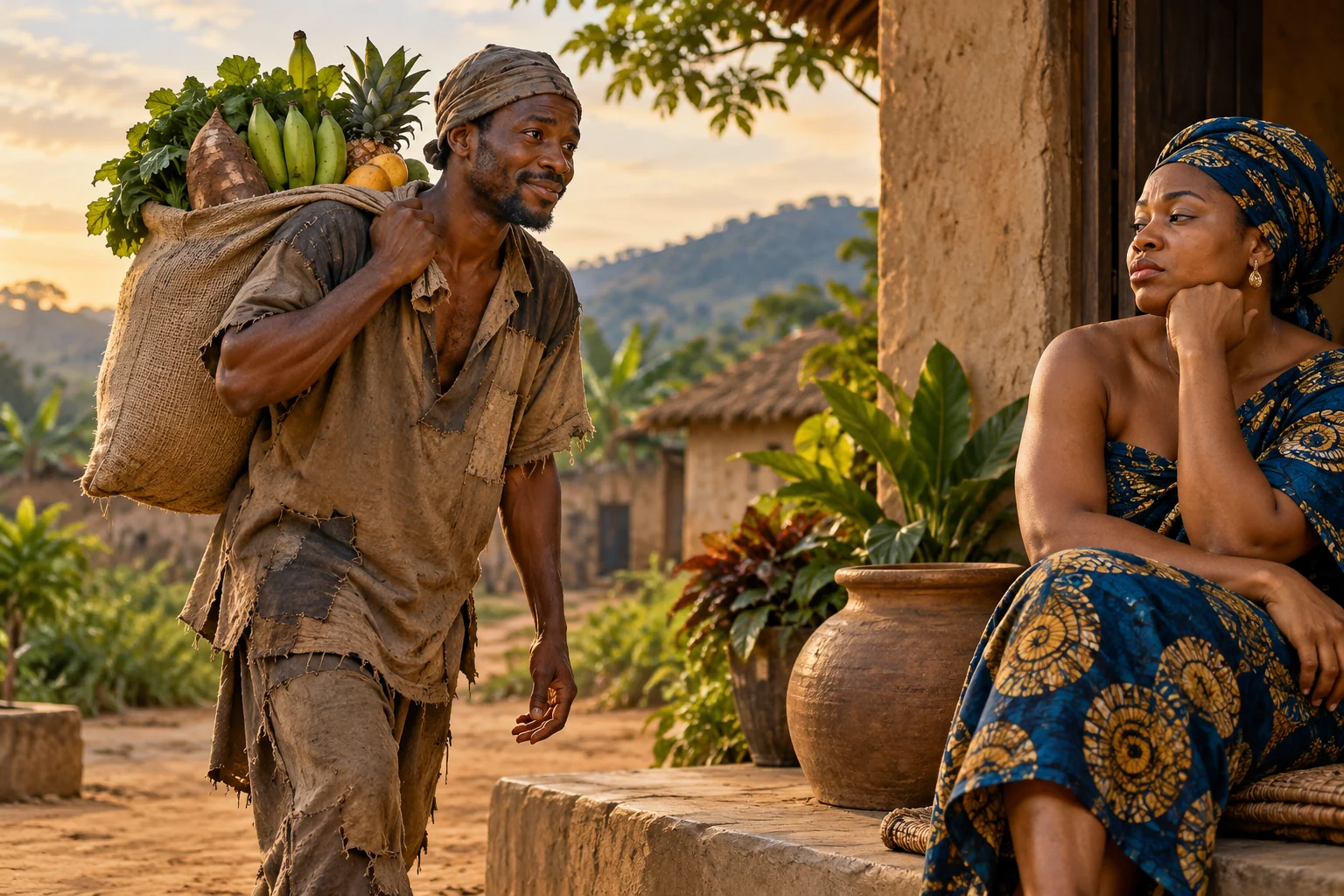
Ògún. Ogún appears as a poorly dressed suitor carrying produce; the harvest narrative makes demonstrated provision more consequential than the status suggested by his clothing.
-
Ọ̀rúnmìlà. Orunmila hears the king’s dissatisfaction despite his power and popularity, then directs the journey on which a different relationship and exchange become possible.
Key myths and their meanings
The suitor with a harvest
Olofin’s daughter rejects prominent suitors but chooses Ogún when he arrives carrying crops and fruit in worn clothes. Olofin initially mistakes him for a beggar. The marriage is linked to a period of planting and a successful harvest, so the ordinary materials in the visitor’s sack become part of the story’s measure of readiness. The account overturns the assumption that ceremonial status is visible from clothing alone.
The daughter’s choice matters because it disrupts the selection already implied by the line of distinguished men. The harvest adds time and demonstrated provision rather than instantaneous prestige. Yet the narrative remains organized through a father’s conversation with a prospective husband, and its brief form gives little access to the daughter’s reasoning. It supports questioning appearances without pretending to provide a complete account of equal marital choice.
Narrative setting: Cuban/Lukumí narrative in the accounts considered here; no individual author established for this passage.
The king exchanges his clothing
A ruler is powerful, popular, and surrounded by subjects who work for the kingdom, yet feels persistently dissatisfied. He consults Orunmila and carries an offering on a journey. Alaguedé appears, dances, and takes an interest in the king’s shirt. They exchange clothes; after putting on the purple garment, the king experiences a renewed desire to live. The change occurs through encounter rather than an additional royal possession.
The story distinguishes public success from an inward sense of purpose. A changed garment gives that inward shift a visible form, but the account does not establish a treatment for depression or an assurance that changing appearance resolves distress. Its useful tension is that the king must receive something outside the image of his own completeness. Exchange makes him a participant in a relationship rather than only a beneficiary of service.
Narrative setting: Cuban/Lukumí narrative in the accounts considered here; no individual author established for this passage.
Ogún’s craft finds a public his earlier appearance did not
Ogún and Uja prepare to come from heaven and receive counsel about honoring their heads. Ogún does not act on it, while Uja involves one of her children in doing so. On earth Ogún helps people but receives little appreciation, and his dancing fails to attract the public response enjoyed by other powers. Uja suggests that their child appear, and the child is welcomed. Ogún then turns toward making decorative objects, which people willingly acquire and which bring him prosperity and recognition. The narrative connects heavenly preparation, family participation, performance, and a different public expression of capacity rather than locating value in one stable outward image.
The addition is especially useful beside the earlier poorly dressed suitor and dissatisfied king. In all three, the visible form through which a person approaches others fails to disclose or fulfill what they can contribute. But the new story gives that change an explicit relation to the head and to Uja’s prior responsiveness, so recognition cannot be explained as marketing alone. It also makes a spouse and child participants in a process that might otherwise be described as Ogún’s isolated breakthrough. The child’s welcome does not mean that Ogún becomes worthless; another activity lets his capacity take a form people can receive.
Contemporary interpretation can distinguish changing a mode of expression from surrendering a calling. The narrative does not explain the ornaments’ material or establish a historical invention of a decorative craft. Nor does the public’s later purchasing behavior prove that popularity is the only proper measure of sacred value. The relation between heavenly responsibility and earthly reception remains the account’s primary frame.
Narrative witness and setting: Portuguese rendering in the explicitly headed Cromwell Osamaro revelations; an African Ifá witness mediated by the compilation, not a Brazilian provenance established by language alone.
Monkey turns a mistaken bowl into a public allegation
Monkey receives counsel about the danger of speech and makes the indicated sacred response. Later it sees Orisa holding a bowl in the forest and assumes that the contents are palm wine. It reports that interpretation to the other divinities as a fact that contradicts Orisa’s known conduct, then leads them to see for themselves. Orisa shows that the bowl contains a different food. Monkey acknowledges the false allegation and asks forgiveness. Orisa grants pardon but declares that the disturbance inflicted on the divine company will leave Monkey without settled peace. The account preserves both mercy and a continuing consequence rather than making the correction erase the event.
The error moves through three stages: seeing a container, supplying an unverified content, and recruiting witnesses to an accusation framed as certainty. The other divinities’ eventual presence could clarify the matter, but it was first mobilized by the mistaken claim. This differs from the earlier harvest story, where a poor appearance conceals practical provision, and from the king’s changed clothing, where an exchange gives an inward change an outward form. Here there is no hidden wrongdoing behind the surface; the observer manufactures it through interpretation.
The prior completed offering makes the narrative theologically demanding. Ritual responsiveness does not make Monkey’s later assertion true, and the source does not explain that tension away. Sacred pardon also coexists with an enduring condition of restlessness. Contemporary questions about evidence and reputational harm can be developed from the sequence, provided an editor does not reduce Orisa’s authoritative speech to a merely psychological reaction or treat actual restlessness as evidence that someone has falsely accused a sacred figure.
Narrative witness and setting: Portuguese rendering in the explicitly headed Cromwell Osamaro revelations; an African Ifá witness mediated by the compilation, not a Brazilian provenance established by language alone.
What was born in this Odù
“Born” can name an explicit traditional origin association or what emerges through a story: a capacity, relationship, practice or order of life. Interpretations drawn from a narrative are labelled below, so their basis remains clear.
Ogún begins wearing purple
Selected traditional source association.
The descriptive section explicitly locates the beginning of Ogún’s purple clothing here, and the king’s exchange repeats the color. The association is local and narrative-specific, not a universal rule about Ogún’s dress.
Readiness demonstrated through cultivation
Contemporary interpretation from the selected myth.
As a contemporary interpretation, marital readiness emerges through a period of productive cultivation instead of prestigious appearance. The harvest episode supports this analytical motif without proving a traditional origin of marriage or identifying Alaguedé with Ogún.
Correlations to life dimensions
These questions bring the selected stories into contemporary life. They are interpretive invitations for study.
Work and resources
Ogún’s produce is initially hidden behind the interpretation of poverty suggested by his clothes. The episode supports attending to demonstrated capacity, sustained labor, and readiness rather than using presentation as a shortcut for value. The sack contains provision requiring cultivation and time to mature.
Reflect: What useful capacity is being discounted because of appearance?
Relationships and family
The marriage account gives the daughter a decisive expression of preference. Its surrounding paternal negotiations remain part of the source’s social world, so the episode can open questions about choice without being treated as a complete ideal.
Reflect: Whose preference needs to be heard directly in this decision?
Character and inner life
The king’s distress persists despite affection and authority. The narrative makes it possible to name dissatisfaction without denying existing advantages; he needs an encounter that changes his participation in life rather than more public praise.
Reflect: What kind of participation would make my current advantages feel meaningful?
Community and responsibility
The ruler’s subjects are already invested in enlarging the kingdom. His inward emptiness raises a reciprocal question: what does he contribute to the life they are building, beyond occupying its most honored position? The exchange occurs outside the normal management of royal status.
Reflect: How does my role serve the shared life that sustains it?
A deeper reading of the sacred relationships
The head’s relation to how capacity is received
The Ogún and Uja account places earthly reception after distinct responses to heavenly counsel. Uja’s honoring of the head and the child’s later welcome are part of a sacred continuity, while Ogún’s unacknowledged service does not automatically substitute for his own obligation. The head here is neither an accessory nor simply a synonym for self-confidence. It belongs to the relation through which a life’s capacities can become effective. The earlier suitor story gives agricultural time a similar role in making a claimed readiness visible, though its emphasis is different. Explaining these accounts from within their traditions requires preserving that difference between possessing strength, being publicly received, and maintaining the sacred relation that supports a particular person’s unfolding life.
A completed sacred response does not authorize an invented fact
Monkey’s compliance appears before its false report, so an editor should resist a simplified sequence in which every bad outcome proves that an offering was refused. The source joins sacred responsibility with a continuing demand about speech. That combination is useful beside the king’s material exchange: accepting help can open a different participation in life, but does not make subsequent judgment infallible. A contemporary epistemic reading should distinguish perception, inference, and public assertion while leaving the authority of Orisa’s pardon and pronouncement intact within the account. The unresolved coexistence of compliance and consequence is itself valuable evidence. It prevents a mechanically transactional model of religious practice from being imposed where the narrated events do not support one.
Family and public recognition operate on different scales
Uja notices a different possibility before the public acknowledges Ogún’s decorative work, while the daughter in the earlier marriage account expresses a preference that her father’s first impression does not anticipate. Neither episode makes the family a perfectly unified judge. The former contains differentiated ritual responses and a child whose welcome contrasts with a parent’s; the latter retains paternal negotiation around the daughter’s stated choice. The king’s exchange adds an encounter outside the household that changes his relation to life. Together these stories show recognition moving across intimate and public settings rather than arriving from one authoritative audience. A contemporary reading can ask which setting helps a capacity become visible and which merely repeats an established expectation about rank or appearance.
Questions that deepen the study
Does Ogún’s move into ornament-making mean his first identity was a failure?
The narrative presents a change in the expression and reception of capacity, not a clear abandonment of his sacred identity. Uja and the child participate in that development, and the earlier heavenly counsel remains part of its explanation. Calling the episode an isolated act of reinvention would therefore miss the relations that make it meaningful. A contemporary reader can ask whether an ability needs a different form or audience without concluding that an unrecognized person has no value. The passage supplies no technical description or historical date for the craft, so it should not be expanded into an invention claim. Its evidence concerns recognition becoming possible through a changed relation.
Why is Monkey still responsible after following the earlier counsel?
The source reports both actions and does not offer a rule making the first cancel the second. Monkey performs a sacred response but later turns an assumption about a bowl into a damaging public allegation. Orisa’s pardon acknowledges the request for forgiveness, while the continuing pronouncement preserves the event’s seriousness. This is not evidence that ritual practice is ineffective or that every mistake deserves an enduring penalty. It is a particular account in which sacred responsiveness and responsibility for speech remain distinct. A contemporary discussion can examine how a false report is corrected without pretending to know the unrecorded theological explanation for every part of the outcome.
How should the reference handle Alaguedé’s identity across the older variants?
The first selected rendering of the dissatisfied king names Alaguedé without expressly identifying him as Ogún. A later Spanish version explicitly names Ogún Alaguede. The reference should state that difference rather than silently importing the later identification into every sentence of the earlier version. The newly selected Ogún and Uja story offers independent evidence of Ogún’s changing public reception, but does not itself settle the identity of each figure in the king tale. This is a useful example of responsible comparison: a variant can clarify an available tradition without erasing the wording and limits of another witness or manufacturing a single uniform account.
What the four narratives reveal together
The African-attributed additions make appearance and recognition more than matters of personal presentation. Ogún’s capacity must become publicly receivable through relations that include head, spouse, child, and craft; Monkey’s apparent observation becomes false when inference is presented as knowledge. The earlier harvest and king stories add time, provision, preference, and exchange. Together they distinguish four movements often collapsed into a generic promise of transformation: demonstrating readiness, receiving a new relation to life, finding another expression of capacity, and correcting an unwarranted assertion.
The sacred order remains active throughout, but does not erase differentiated obligations or resolve every ambiguity. In particular, the variant that explicitly names Ogún Alaguede should be presented as a variant, not a license to overwrite a less explicit passage. Contemporary interpretation can then discuss recognition and evidence while showing readers what the particular accounts actually contribute and what they leave open.
Living with this Odù
A continuing life or initiatory relationship
For someone carrying Òsá Òfún through a received life or initiatory relationship, readiness and public appearance may need repeated differentiation. The daughter recognizes the provision carried by a worn visitor where Olofin initially sees a beggar. The dissatisfied king finds renewed participation through an exchange rather than another display of rank. Ogún's craft discovers a public form different from an unsuccessful performance, while Monkey turns an uncertain observation into an allegation. Across a life, these witnesses can invite attention to what an appearance actually supports and what it cannot prove.
Character may develop through allowing a capacity to find a different expression, receiving encounter without assuming status secures meaning, and keeping interpretation separate from fact. The inner temptation can be either shame at not appearing impressive or confidence that a familiar sign has only one possible explanation. Sacred preparation, the head's relationship and the consequences pronounced by Orisa remain active in the source. The sign does not diagnose dissatisfaction or promise that marriage, clothing or craft will restore wellbeing. It offers changing questions about provision, exchange, recognition and responsible speech, while Alaguedé remains distinct from Ogún where the narrative does not identify them.
A particular consultation and its question
In a particular consultation, these accounts can distinguish the value a person carries from the form in which an audience expects to see it. The harvest visitor asks what practical readiness has been missed beneath clothing or status. Ogún's craft asks whether a capacity needs another public expression, with heavenly preparation and family participation remaining part of the religious account. The king's exchange concerns encounter rather than a generic prescription to acquire a different garment. Monkey's bowl supplies a separate test: what was observed, what was inferred and what has already been repeated as a fact?
A practitioner should not conclude that an unknown client has made a false accusation or that a rejected suitor is necessarily the right partner. The actual question may concern work, recognition, speech or a difficulty in receiving life through an established role. Contemporary reflection can clarify the distinction between informed judgment and social comparison without explaining away the sacred relations. The result is situational rather than a total personality description. Its useful effect may be a more accurate account of evidence, a less rigid attachment to one mode of display or acknowledgment that public success does not by itself produce a meaningful encounter.
Constructive and adverse possibilities
Constructive movement can include provision being recognized despite worn appearance, useful craft finding a public and a mistaken allegation being admitted. The exchange narrative also permits renewal without adding royal possessions. Adverse unfolding appears when rank substitutes for readiness or uncertain contents are publicly named before they are known. Monkey's pardon retains a continuing consequence, so correction does not make the disturbance unreal. Yet this ending should not become a prediction that a reader's speech error will prevent lasting peace. Iré and osogbo require the actual religious situation.
Neither clothing, applause nor an attractive proposal determines the state alone. The narratives keep exchange, sacred preparation, public recognition and accountable speech related but distinct. Their human relevance is strongest when a person's worth is neither inflated nor dismissed on the basis of an appearance that has not been adequately understood.
An illustrative situation in everyday life
Hypothetically, an experienced craft worker arrives at a formal selection meeting in worn clothes carrying useful samples. The panel initially favors a polished candidate whose proposal remains vague. Later, a panel member sees the craft worker holding a familiar bottle and circulates an allegation about its contents without asking. The harvest visitor and Monkey's bowl distinguish material readiness from social appearance and observation from inference. Ogún's craft adds that a capacity may need an appropriate public form to become recognized. This is an illustrative interpretation, not a prediction about a particular applicant or a sacred guarantee of success. The inward conflict belongs to an audience defending its first impression. The external task is to examine the work and correct the unsupported allegation before appearance becomes a verdict.
Sources and reading context
The first two narrative witnesses
The Cuban section lacks a dedicated origin list. Ogún’s purple clothing is an explicit descriptive association; the harvest motif is marked interpretation. The English harvest rendering has uncertain botanical wording. Alaguedé is not explicitly identified with Ogún in the second story, and no clinical inference is drawn.
Narrative motifs are summarized independently. The life-dimension reflections are contemporary interpretation. How these reference studies are built explains the wider source approach and the distinction between a reference article and personal divination.
Additional named witnesses
-
Cromwell Osamaro. The Ogún/Uja and Monkey/Orisa passages occur within the explicitly named African-attributed revelation division.
-
Cuban/Lukumí-labelled collection. The earlier harvest marriage and dissatisfied-king passages supply distinct comparisons, including a later explicit Ogún Alaguede variant.
The child’s name varies in translation, and the decorative craft is unspecified. Orisa in Monkey’s account is not automatically expanded into a full Obatalá identity. The king variants differ in explicit naming. No clinical interpretation of dissatisfaction or restlessness is inferred from their sacred resolutions.
Bibliographic identification
- C. Osamaro Ibie. Ifism: The Complete Work of Orunmila. Lagos; multivolume publication beginning 1986. Library catalogue record. Related bibliographic record for the named narrative witness. Exact volume, edition and page of the transmitted account have not been independently matched.
Read the source method and wider scholarly context.
The catalogue links identify published works and their authors. They are separate from proof of an individual episode’s wording or attribution. Contemporary comparisons and the synthesis above are editorial interpretation. The author’s books and Academy companions below provide further study; their sales links are separate from the source references.