
Òsá Ògúndá is a mixed Odù in Ifá’s 256-part corpus. The selected stories give Òsá Ògúndá a distinctive pair of material images: a drum whose weak voice fails a ruler and a buffalo skin that conceals Shangó’s identity. The first concerns expertise, public communication, and a false explanation for a ruler’s demand. The second concerns a relationship secured through leverage and later endangered by disclosure. Libraries and the name Iyanzan appear among the origins, linking stored knowledge with the responsibilities that accompany it.
A question to carry through the study: What does the information I hold allow me to protect, and what could it let me coerce?

This Academy reads the right column first, then the left. Each row carries a single or double mark.
Where this Odù belongs
Òsá Ògúndá belongs to the Òsá family in this Academy’s study sequence. It is a mixed Odù, distinct from Ògúndá Òsá. The order matters. Its teaching is approached through its own narratives, rather than by adding two general descriptions of the principal signs together.
Key Òrìṣà and sacred relationships
The figures below are selected for their roles in the accounts discussed here. They offer connected reading paths through the tradition.
-
Ọ̀rúnmìlà. Orunmila appears as the knowledgeable outsider who solves the drum problem without needing access to the ruler’s secret room; he also counsels Oyá before the buffalo confrontation.
-
Ọya. Oyá acquires Shangó’s hidden buffalo skin and uses it to negotiate intimacy; later she gives up her own provision to protect the twins and reaches Olokun’s refuge.
-
Ṣàngó. Shangó is the buffalo-identified partner whose secret becomes public through a chain of disclosure; his pursuit transforms a hidden agreement into danger for Oyá and the children.
-
Ògún. Ogún participates in exposing and confronting Shangó’s buffalo identity, taking a horn as a trophy; this is a particular antagonistic role, not the deity’s universal relationship to Shangó.
Key myths and their meanings
The drum’s hidden problem
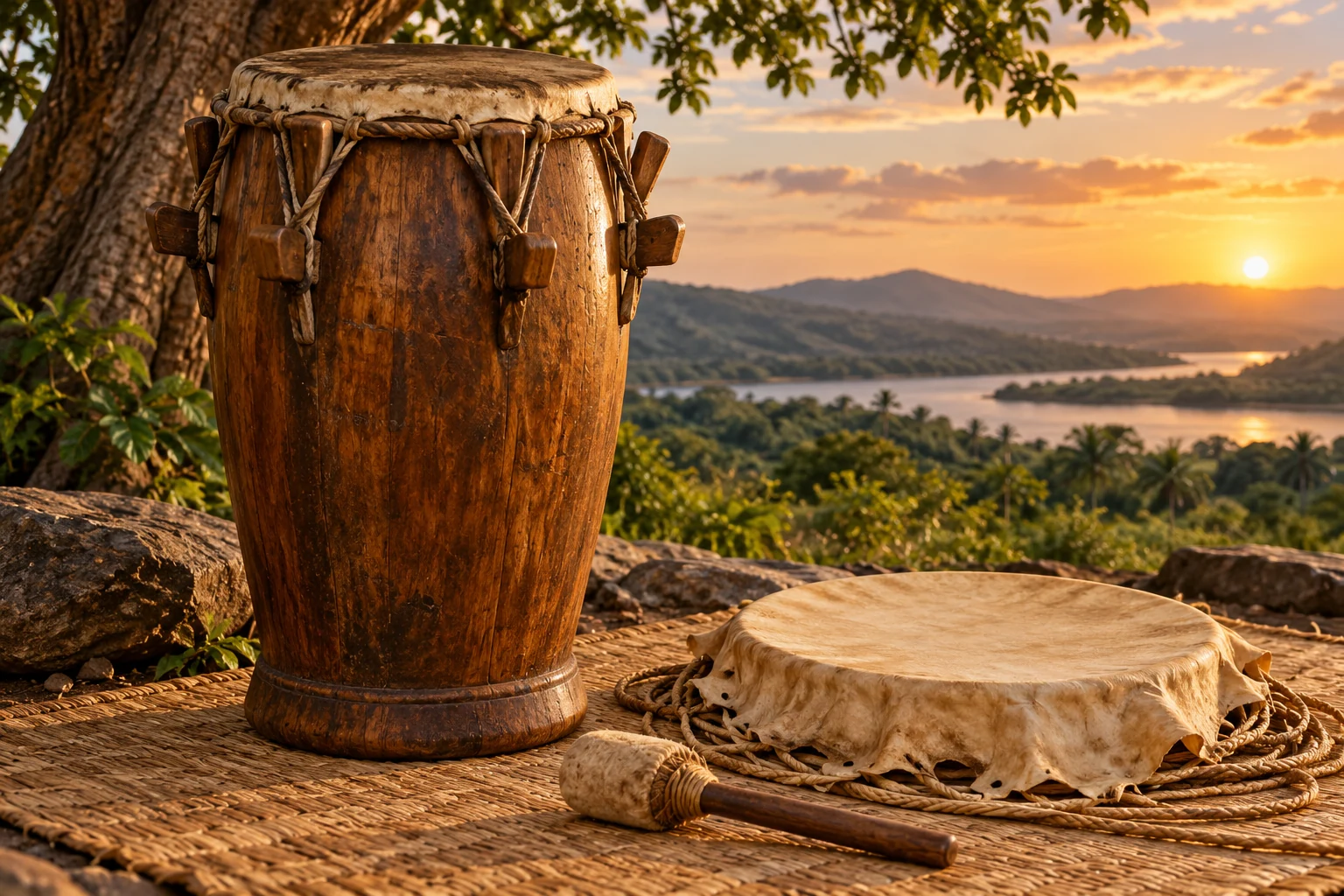
A ruler relies on a drum for messages, ceremonies, and commands, but its covering produces an unsatisfactory sound. On an adviser’s suggestion he tells the town that a special skin is needed to prevent an approaching epidemic, concealing the actual purpose. A knowledgeable stranger arrives with the appropriate material and playing implement. The ruler recognizes his expertise and offers privileged access; the stranger, revealed as Orunmila, is content to be his adviser.
The episode ties technical knowledge to political communication. It also exposes the use of public fear to solve a private royal problem: the people are mobilized under a misleading explanation. Orunmila’s refusal to seek a more inflated identity offers a counterimage to that manipulation. The narrative’s account of drum materials is a mythic origin setting, not a documentary history of instrument construction.
Narrative setting: Cuban/Lukumí narrative in the accounts considered here; no individual author established for this passage.
The borrowed skin and the twins
Oyá sees Shangó remove a buffalo skin and takes it, using its return to secure a relationship under a promise of secrecy. They have twins, but the secret circulates through others and Shangó resumes his animal form in anger. After an encounter with Ogún, he reaches Oyá and the children. Oyá redirects his charge by surrendering the ram that sustains her, then takes the twins to Olokun.
The story offers no innocent chain of control: a hidden identity becomes leverage, disclosure intensifies rivalry, and children are exposed to the adults’ conflict. Oyá’s final act changes the immediate priority from possessing a partner to protecting dependents. A careful treatment can discuss secrecy, coercion, and caregiving without converting the tale into a universal account of Oyá’s marriage, children, or food restrictions.
Narrative setting: Cuban/Lukumí narrative in the accounts considered here; no individual author established for this passage.
Osanyin repays through knowledge that clearing would destroy
Orunmila’s three wives have left for different towns, and Osanyin owes him a loan to be repaid through work. Sent to clear the farm, Osanyin leaves the plants standing because he recognizes their capacities and will not simply destroy them. Orunmila arranges clearing by others, then gives Osanyin seed to plant. At harvest, Osanyin’s sacred knowledge produces extraordinary abundance and directs its public arrival at the market. The wives see the changed circumstances and return. Orunmila’s earlier prayer for reunion is thus fulfilled through the agricultural event, while Osanyin’s debt is forgiven and his contribution receives a share of the yield.
The disagreement begins with a mismatch in the meaning of work. Orunmila expects a debtor to perform a defined clearing task; Osanyin sees a field of beings and capacities whose destruction would erase another kind of value. The account does not resolve that conflict by declaring physical cultivation unnecessary. Others clear, Osanyin plants, women transport, and a market receives the harvest. His distinctive contribution becomes effective within that larger activity. The source also makes sacred knowledge and answered divination explicit, so the abundance is not merely a reward for a clever business strategy.
Compared with the earlier drum story, expertise again supplies what a ruler or employer cannot obtain through routine effort, but here its worth becomes visible only after an initial apparent refusal. The returning wives belong to the narrated restoration, yet their own histories remain abbreviated. A contemporary interpretation can ask how contribution is recognized without treating prosperity as an entitlement to another person’s return or as proof that every estrangement has been repaired.
Narrative witness and setting: Portuguese rendering in the explicitly headed Cromwell Osamaro revelations; an African Ifá witness mediated by the compilation, not a Brazilian provenance established by language alone.
Shangó’s thunder changes a dismissed voice into an acknowledged presence
A short account describes Songo, the source’s form of Shangó’s name, as a power whom people treat lightly and ridicule. He receives counsel and makes a sacred preparation privately rather than arguing his importance before the same audience. Later the casting of a prepared stone produces a thunderous event extending across heaven and earth. The people respond with acknowledgment and homage. The passage connects the deity’s feared public presence with a prior relationship to divination and a concealed preparation, not simply with force displayed at random. It is concise and gives little detail about the preceding ridicule or the lasting quality of the recognition that follows.
The scene gives sound a sacred capacity to change the terms of an encounter. Shangó does not merely win a discussion; thunder makes his presence effective in a register the audience cannot dismiss as ordinary speech. That point belongs to the account’s religious understanding of divine power, while the human response remains open to a contemporary distinction between fear, respect, and affection. The earlier drum narrative offers a productive comparison because a weak instrument fails to carry authority and a new material produces an adequate voice.
The accounts are not interchangeable: one concerns technical knowledge and concealed royal demands, the other a deity’s divinely prepared manifestation. Their relation lies in how audible form makes a capacity publicly consequential. The short passage does not show whether homage becomes mutual responsibility or remains an immediate reaction to overwhelming force. A careful reference should preserve that limit rather than extending the account into an assurance that intimidating others produces durable esteem or that every disregarded person possesses a thunderous answer.
Narrative witness and setting: Portuguese rendering in the explicitly headed Cromwell Osamaro revelations; an African Ifá witness mediated by the compilation, not a Brazilian provenance established by language alone.
What was born in this Odù
“Born” can name an explicit traditional origin association or what emerges through a story: a capacity, relationship, practice or order of life. Interpretations drawn from a narrative are labelled below, so their basis remains clear.
Libraries
Selected traditional source association.
Libraries are explicitly assigned to this sign’s origins. Alongside a story about specialized knowledge, this can support reflection on preserving expertise; it is not a claim about the historical first library.
The name Iyanzan
Selected traditional source association.
The origin list places the name Yanza or Iyanzan here. The selected Oyá narrative gives a contextual divine association, but the entry does not supply a reliable etymology and no derivation is invented.
Bringing Ogún from the forest
Selected traditional source association.
A ceremony concerning Ogún’s movement from forest to a public initiation setting appears in the origins. The association can be described as a transition of sacred authority without reproducing its procedure.
Correlations to life dimensions
These questions bring the selected stories into contemporary life. They are interpretive invitations for study.
Work and resources
The drum problem requires actual expertise, not a frightened population searching without accurate information. The ruler’s success depends on someone capable of identifying the real technical need beneath the official explanation. The public explanation conceals the ruler’s actual communication problem.
Reflect: What problem are contributors actually being asked to solve?
Relationships and family
Possession of Shangó’s skin creates leverage over intimacy. The later danger to the twins shows why a relationship built on constrained choice cannot be discussed only in terms of devotion or secrecy. The twins depend on adults whose secret agreement is breaking.
Reflect: Where has knowledge become a means of controlling a partner?
Character and inner life
Orunmila’s satisfaction with his own identity contrasts with the ruler’s management of appearances. Competence can be acknowledged without turning every contribution into a competition for a more elevated title. The adviser declines to make recognition a new inflated identity.
Reflect: What recognition is enough for the work I have actually done?
Community and responsibility
Both stories involve dependents affected by decisions they did not make: townspeople misled about the drum and children endangered by a secret dispute. Authority is accountable for those secondary effects. The townspeople search because they have been given another reason.
Reflect: Who will bear consequences without having participated in the agreement?
A deeper reading of the sacred relationships
A sacred capacity becomes manifest through an appropriate form
Osanyin’s knowledge of leaves is not presented as a catalogue of useful information detachable from his being. It determines why he refuses clearing and how his planting becomes extraordinary. Shangó’s thunder likewise follows a divinely directed preparation that changes the efficacy of his public presence. The earlier drum and buffalo-skin stories also give material form spiritual consequence: a covering carries a voice, and a skin mediates a divine identity whose concealment matters. This lens explains religious agency before translating it into a human lesson. The forms are not inert symbols placed on top of ordinary events. Within their respective accounts, they participate in what a power can do, how it is encountered, and what responsibilities attach to revealing or using it.
The first task may be a poor measure of the contributor
Osanyin appears unhelpful when assessed solely against the clearing assignment, yet later produces the event through which the farm’s value becomes extraordinary. The drum-maker’s knowledge similarly matters because it identifies a different material and method, not because it repeats the ruler’s unsuccessful attempts more energetically. A contemporary comparison can distinguish failure to cooperate from refusal grounded in another responsibility or competence. It should still ask how that refusal is communicated, since Orunmila remains responsible for a working farm and a loan cannot be settled by an unexplained claim of importance. The new account records an eventual shared result and forgiven debt; those outcomes give evidence of value that an editor should not presume whenever someone declines ordinary work.
Public acknowledgment and restored intimacy are different returns
Shangó receives homage from an audience that had diminished him, while Orunmila receives the return of wives through visible abundance. The earlier buffalo story includes a relationship negotiated through control of a hidden skin, and the drum story produces an invitation into the ruler’s confidence. These returns are unlike: acclaim, household reunion, leverage over intimacy, and advisory standing do not establish the same kind of consent or continuing duty. A contemporary reading can ask which form of recognition a participant seeks and whether the method actually supplies it. The sacred outcomes should remain faithfully described, but an editor need not infer that fear creates affection, restored provision resolves every household wound, or possession of a secret makes a relationship freely chosen.
Questions that deepen the study
Is Osanyin’s refusal to clear the farm simply an evasion of debt?
The source explains the refusal through his knowledge of the plants’ powers, then gives him substantial work in planting and bringing the harvest into public abundance. That sequence distinguishes an initially misunderstood contribution from a bare claim to exemption. Orunmila also obtains clearing by others, so practical cultivation is not discarded. Within the religious account, the result manifests Osanyin’s sacred capacity and an earlier divinatory response about reunion. A contemporary application should therefore examine both what responsibility motivated the refusal and what accountable contribution followed. The story would not justify treating every objection as hidden expertise or every ordinary debt as cancelled by a person’s self-description.
Does thunder resolve the difference between being feared and being respected?
The account records homage after an overwhelming sacred manifestation, but does not describe the audience’s long-term relation to Shangó. It therefore supports his effective acknowledgment without settling every modern distinction among fear, respect, trust, and love. Those questions can be introduced as contemporary reflection, not attributed to an unrecorded dialogue in the passage. The earlier drum story similarly shows that a clearer voice can extend authority, while leaving the ruler’s misleading public explanation ethically relevant. A reference should explain the religious reality of thunder in this witness and also preserve what the short scene does not tell us about responsibility after power becomes undeniable.
What can be said about the wives’ return without inventing their motives?
The source links their return with seeing the extraordinary harvest and presents the event as fulfillment of Orunmila’s earlier sacred response. That is the available narrative claim. It does not give a developed account from each wife or explain the original departures in comparable detail. An editor can therefore discuss restored material capacity and the religious logic of reunion while refusing to assert that affection has been fully repaired or that wealth creates a right to a partner. The older buffalo account supplies a useful contrast in which relationship, secrecy, and coercive leverage are explicit. Comparing the witnesses makes those different evidentiary limits visible instead of supplying one imagined psychology for all of them.
What the four narratives reveal together
The added African-attributed episodes extend Òsá Ògúndá through two forms of manifestation. Osanyin’s apparently withheld labor becomes an abundant harvest through knowledge whose sacred and botanical character the employer initially misses. Shangó’s dismissed presence becomes publicly effective through thunder following private divinatory preparation. The earlier drum and buffalo-skin narratives likewise show material forms carrying capacities whose consequences exceed outward appearance. Their differences remain essential. A technical solution can be evaluated through sound, an extraordinary harvest through shared yield, a divine manifestation through homage, and a concealed skin through the dangerous relations around its possession.
None is a universal substitute for the others. The reference can preserve their spiritual realities while asking contemporary questions about contribution, acknowledgment, and consent, provided it marks where the source gives an outcome without giving every participant’s voice or demonstrating a durable restoration of trust.
Living with this Odù
A continuing life or initiatory relationship
For someone whose received life or initiatory Odù is Òsá Ògúndá, these witnesses make effective expression and recognition recurring questions. The ruler's weak drum requires a competence he lacks, but he obtains public effort through a misleading account of danger. Shangó's thunder establishes a sacred presence in a different register, leaving fear and durable regard distinguishable. Osanyin's apparently failed clearing then reveals a knowledge that routine production would destroy. Finally, the local buffalo account places concealed identity and leverage inside a family whose children require protection from the adults' conflict.
A long relationship with the sign can invite discernment about how a capacity becomes audible, whose expertise is dismissed and whether authority depends on fear. It does not predict hidden animal identities or promise that a disregarded person's eventual display will secure esteem. The inner response may include frustration at not being recognized, temptation to exaggerate a crisis or resentment when a contributor resists the assigned task. Character develops through making the real need intelligible and receiving knowledge that may alter it. The narratives preserve divine preparation, counsel and answered prayer, without turning agricultural abundance into entitlement to a spouse's return.
A particular consultation and its question
In consultation, the actual question can be differentiated through several forms of power becoming effective. The drum's material problem asks whether a technical lack is being concealed beneath a public emergency. Osanyin's refusal asks whether an apparent failure of obedience contains a different competence, without declaring every refusal wise. The thunder account raises the distinction between recognition obtained through overwhelming presence and an ongoing relation of respect. The buffalo witness asks whether private knowledge has become leverage and whether dependents are exposed to a dispute they did not create.
Its identities and kinship must remain local rather than merged with other buffalo traditions. A practitioner can use these distinctions to examine a present workplace, family or authority question without announcing hidden facts about the client. Sacred agency remains important: Osanyin's knowledge and Shangó's preparation do not become merely clever publicity. The consultation is also different from receiving the sign as a lifelong relationship. It may direct attention to one current mismatch between task and competence, or one harmful use of secrecy. Contemporary reflection should ask whose voice is missing and what would make care or expertise effective, while declining to infer a guaranteed outcome from the narrative's restoration.
Constructive and adverse possibilities
Constructive possibilities include expertise finding an appropriate place, a misunderstood contribution receiving a share and care shifting toward the safety of children. The drum adviser can serve without needing an inflated title. Adverse unfolding appears when public fear is used to solve a private problem, secrecy becomes coercive leverage or force produces homage that is mistaken for affection. Osanyin's harvest does not justify demanding an estranged spouse return when prosperity improves. The thunder scene also does not establish that intimidation creates lasting esteem. Iré and osogbo require the actual religious reading and its conditions.
The narratives can sharpen attention to voice, recognition and protection while preserving their different mechanisms. A technical solution, an agricultural event, a family escape and a deity's manifestation should not be compressed into one moral rule about the best way to command attention.
An illustrative situation in everyday life
Hypothetically, a school director calls an ordinary equipment failure a public safety emergency to mobilize donors quickly. A technician questions the proposed replacement because it would destroy a valuable existing function, and the director hears the objection as insubordination. The drum and Osanyin structures ask whether the stated need is truthful and whether resistance contains knowledge. The director's inner fear is that admitting a limited technical problem will weaken authority. Shangó's sound motif adds a distinction between being impossible to ignore and being trusted. This is an illustrative comparison, not a factual claim about any institution or a secular explanation of divine thunder. The choice is whether to receive the competence needed for the real task without manufacturing fear to make the request effective.
Sources and reading context
The first two narrative witnesses
These Cuban-labelled passages include a Spanish drum narrative and an edited English buffalo account. The latter differs from other well-known buffalo traditions, so its identities and kinships remain local. This study does not merge versions or reproduce ceremonial directions and food prohibitions.
Narrative motifs are summarized independently. The life-dimension reflections are contemporary interpretation. How these reference studies are built explains the wider source approach and the distinction between a reference article and personal divination.
Additional named witnesses
-
Cromwell Osamaro. The Osanyin farm-debt and Songo thunder episodes stand in the explicitly named African-attributed division.
-
Cuban/Lukumí-labelled collection. The earlier drum-covering and buffalo-skin accounts provide separate comparisons of sacred material capacity.
The witness names Shangó as Songo in the shorter account. Botanical capacities and thunder are retained as religious claims, not recipes or scientific proof. The wives’ reasons and the long-term audience response are not supplied. The Bascom buffalo variant is not reused as a new motif because the earlier research already selected that narrative family.
Bibliographic identification
- C. Osamaro Ibie. Ifism: The Complete Work of Orunmila. Lagos; multivolume publication beginning 1986. Library catalogue record. Related bibliographic record for the named narrative witness. Exact volume, edition and page of the transmitted account have not been independently matched.
Read the source method and wider scholarly context.
The catalogue links identify published works and their authors. They are separate from proof of an individual episode’s wording or attribution. Contemporary comparisons and the synthesis above are editorial interpretation. The author’s books and Academy companions below provide further study; their sales links are separate from the source references.