
Òyèkú Òsá is a mixed Odù in Ifá’s 256-part corpus. Shango survives an armed pursuit by using the cover of a poplar; Dariko’s sheltering of Obatala opens a prosperous period that later collapses after a dismissive encounter with Orunmila. These selected episodes focus on refuge, timely hospitality, and the difficulty of maintaining respect when circumstances improve. They avoid the incomplete Agoi story while retaining its explicit Arara-linked association only as a limited origin motif.
A question to carry through the study: Which relationship mattered in hardship but now receives only a hurried acknowledgment?

This Academy reads the right column first, then the left. Each row carries a single or double mark.
Where this Odù belongs
Òyèkú Òsá belongs to the Òyèkú family in this Academy’s study sequence. It is a mixed Odù, distinct from Òsá Òyèkú. The order matters. Its teaching is approached through its own narratives, rather than by adding two general descriptions of the principal signs together.
Key Òrìṣà and sacred relationships
The figures below are selected for their roles in the accounts discussed here. They offer connected reading paths through the tradition.
-
Ṣàngó. He escapes an armed pursuer by climbing into a poplar, then reverses the encounter from the cover the tree provides; shelter is the story’s decisive resource.
-
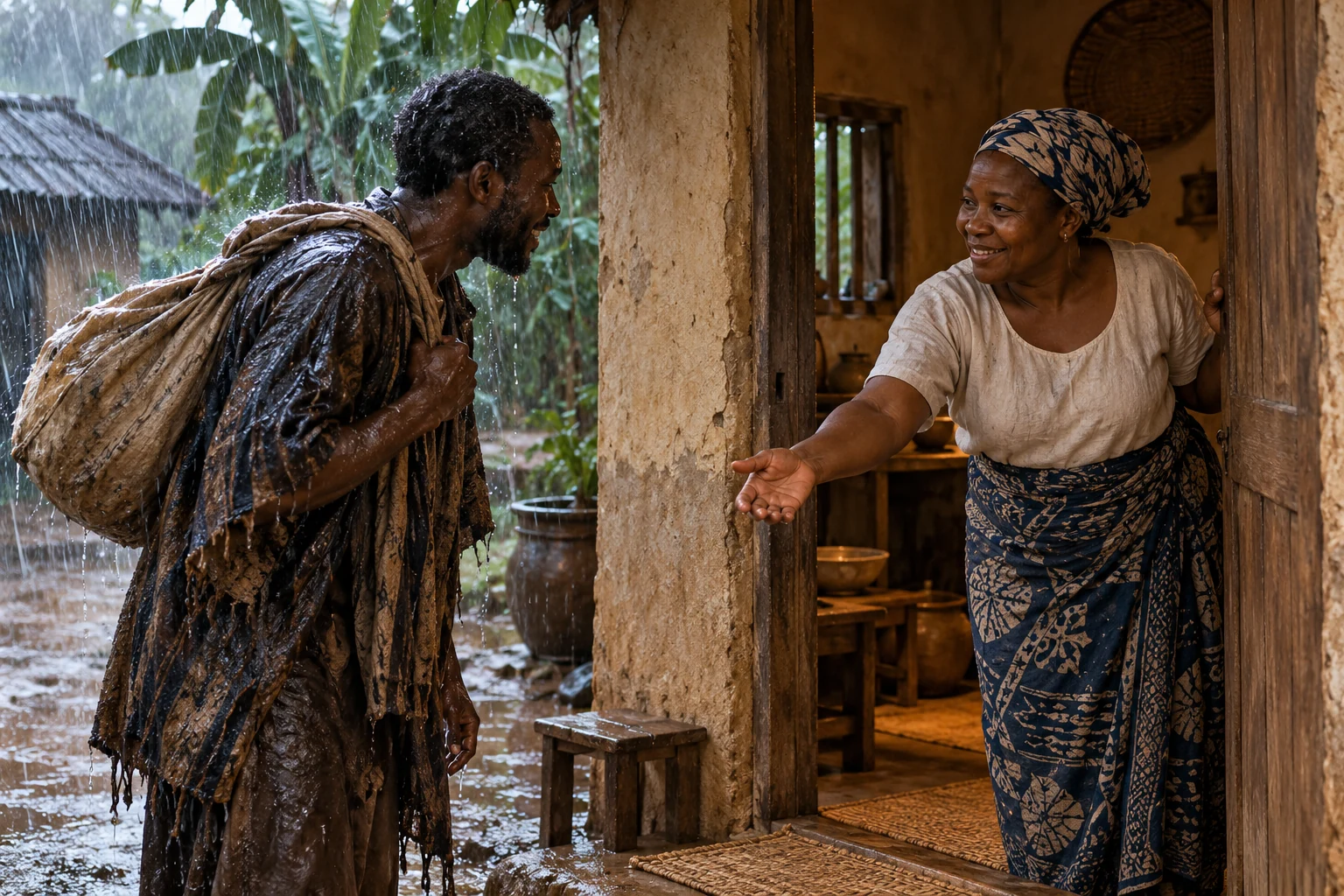
Obàtálá. Caught by rain, he takes refuge in Dariko’s house and responds to the hospitality he receives, making an ordinary act of shelter narratively consequential.
-
Ọ̀rúnmìlà. He advises Dariko before the period of prosperity and later receives a dismissive greeting, giving the account its question about gratitude after success.
Key myths and their meanings
The poplar during pursuit
Shango is pursued by an armed son of Elegba while he himself lacks a weapon. Gaining a little distance, he climbs a poplar and hides among its branches. The pursuer loses sight of him. Shango then drops from the tree and overcomes the attacker. A nearby note identifies the poplar with Shango, making shelter the concrete source of the reversal.
The story gives attention to a living feature of the landscape at a moment when equal force is unavailable. Its tactical reversal should remain a mythic event rather than an instruction for a confrontation. The question is in distinguishing survival through a place of refuge from an assumption that strength always means meeting force on its own terms.
Narrative setting: Cuban/Lukumí-labeled patakín in the multilingual source compilation; individual narrator and publication history are not established.
Dariko’s house in the rain
After consulting Orunmila, Dariko prepares his house. Rain catches Obatala in the street, and he shelters there, receiving attentive hospitality. Dariko’s circumstances improve and he prospers in horse trading. Later he meets Orunmila in a hurry and greets him indifferently. Orunmila tells Eshu, and the narrative returns Dariko to poverty, linking the reversal to an abandoned relationship.
The early hospitality is concrete and attentive; the later greeting is formally present but relationally empty. That contrast permits a focused inquiry into how prosperity changes attention to earlier helpers. The punitive ending is disproportionate if treated as ordinary social policy, so it should remain part of the religious narrative rather than a forecast about anyone who makes a hurried greeting.
Narrative setting: Cuban/Lukumí-labeled patakín in the multilingual source compilation; individual narrator and publication history are not established.
Eshu confronts the counterpart he thought beneath challenge
Eshu rejects counsel about encountering a force beyond his assumed power, then develops a productive farm. Its thief is Onne, described as a protective counterpart connected with Eshu, who has also rejected a response involving Eshu but has fed children. A trap catches Onne. Eshu assumes the still figure is dead and approaches; a prolonged struggle follows. The children Onne has helped intervene, enabling escape into water. Eshu returns frustrated and strikes his own child, causing a fatal loss. Only then does he recall and complete the earlier religious response. The account makes invulnerability a mistaken claim even within a powerful figure’s own relations.
The story’s force comes from locating the challenge inside a presumed supporting relation. Eshu and Onne each believe their standing makes another religious response unnecessary, yet neither controls the full consequences of the encounter. Feeding children becomes an active relation that matters at the moment of danger, while Eshu’s later act at home shows frustration being redirected toward someone more vulnerable. This is not an account in which a simple good party defeats a simple evil one. Both protagonists have partial responses, substantial power, and limits they fail to recognize.
The religious reality includes consultation and a counterpart whose identity should not be casually equated with Ori or another named power. Contemporary interpretation can ask how an assumption of superiority narrows judgment and how one prevents a failed contest from becoming harm to a dependent person. The child’s death remains a severe narrative event rather than a forecast about actual families, and the conclusion does not erase that loss merely because Eshu later fulfills the response.
Narrative witness and setting: Section explicitly headed revelations of Cromwell Osamaro; Yoruba/Bini-framed Eshu and Onne narrative.
Agoi escapes the beautiful stranger’s borrowed body
Agoi chooses a magnificent stranger and leaves with him after a rapid marriage. Along the road, owners reclaim the clothing and body parts he has borrowed, revealing Dobligodo in a form unlike the admired man. The journey exposes further extraordinary scenes before the couple reaches a household intending to consume her. A turtle with a horn repeatedly alerts the captors when she tries to escape. Agoi finally blocks the instrument with food, and the watcher eats instead of sounding it. She runs beyond pursuit, meets a hunter, and returns to her parents. The complete telling supplies an escape absent from the shorter Cuban-associated version.
The stranger’s attractiveness is assembled from relations he does not disclose. Each reclaimed part changes what Agoi can know, but knowledge comes after the marriage has already moved her into another household’s control. Her escape later depends on understanding the watcher’s mechanism rather than waiting for the original appearance to return. The account belongs to a religiously populated world in which borrowed bodies, speaking landscapes, and predatory households are real participants, not merely symbols of anxiety. At the same time, the source explicitly questions whether this tale belongs to Fá and points to wider comparative folklore.
A depth treatment should therefore present it as a related witness preserved alongside the sign, not as an unquestioned canonical revelation or a universal warning about marriage. Contemporary interpretation can ask what a person needs to know before entering a relation that changes their freedom of movement, while retaining Agoi’s resourcefulness and the hunter’s assistance rather than ending the story with punishment for an impulsive choice.
Narrative witness and setting: Folktale preserved under a Bernard Maupoil heading in a Fon setting; the source itself notes disputed membership in the Fá cycle.
What was born in this Odù
“Born” can name an explicit traditional origin association or what emerges through a story: a capacity, relationship, practice or order of life. Interpretations drawn from a narrative are labelled below, so their basis remains clear.
Spiritual plasma
Selected traditional source association.
The origin inventory uses a translated phrase equivalent to spiritual plasma. Its intended referent is not explained reliably, so retain only the existence of the expression as a local association and do not supply a scientific or esoteric definition.
Agoi in an Arara-linked setting
Selected traditional source association.
The inventory names Agoi as a female San Lazaro-associated figure. A separate, explicitly incomplete story places her among Arara-linked spirit imagery. This should not be collapsed into Babalu Aye, Soponna, or a universal account of one deity.
Correlations to life dimensions
These questions bring the selected stories into contemporary life. They are interpretive invitations for study.
Work and resources
Dariko’s horse trading grows after a hospitable encounter, but the narrative does not make commerce alone the measure of success. Continued relational responsibility remains at issue. The story invites us to ask what supports an enterprise besides its visible transactions and accumulated goods.
Reflect: Which noncommercial relationship supports your work?
Relationships and family
A sheltering household receives a visitor without knowing the full consequences. The story values attention given in the moment, then contrasts it with the dismissal of an earlier adviser. This offers a precise distinction between hospitality as a practice and courtesy as a formula.
Reflect: Does the greeting include actual attention?
Character and inner life
The two episodes place protagonists under different pressures: immediate danger and the distraction of prosperity. Each tests what they notice in their surroundings. We can compare urgent alertness with the slower attentiveness needed to maintain relationships when life becomes easier.
Reflect: What becomes less visible when your circumstances improve?
Community and responsibility
The poplar’s shelter gives a landscape feature a remembered place in religious association. Dariko’s house similarly becomes a refuge. Together they support inquiry into how communities preserve and acknowledge the places and hosts on which safety depends.
Reflect: Which refuge deserves continuing care?
A deeper reading of the sacred relationships
Power remains relational even when it appears self-sufficient
Eshu’s contest with Onne exposes a supporting relation that does not function as an unquestioning extension of his will. The children’s response to earlier care becomes consequential when strength alone cannot settle the encounter. The earlier Dariko story likewise connects hospitality and prosperity with a continuing acknowledgment, while Shango’s poplar refuge places safety within a living landscape. These accounts supply distinct religious actions rather than one abstract force of luck. A depth lens can explain consultation, sacred reciprocity, and protective relations from inside the stories before making modern comparisons. Agoi’s folktale adds a limit to synthesis because its Fá placement is explicitly disputed, even though its inhabited spiritual world remains narratively concrete.
The capacity to leave changes the meaning of an encounter
Agoi discovers what the stranger is only after leaving her parents, and her later knowledge does not immediately allow escape. Onne’s apparent stillness draws Eshu into a contest whose end neither simply controls. Shango’s tree cover supplies a temporary change in position, while Dariko’s open house first permits a beneficial meeting. The four accounts therefore give movement more than scenic importance. A contemporary reading can ask what information and support accompany a change of place and whether a participant can withdraw once the terms become clearer. It should not assume that every uncertain encounter is predatory or make a fantastic escape into a practical method for actual danger.
A favorable ending may leave the original injury intact
Agoi returns safely, but the source does not narrate a complete account of the parents’ earlier decision. Eshu completes the neglected religious response only after a child has died, and Dariko’s earlier prosperity does not prevent a later reversal. Shango’s escape ends with the adversary overcome rather than a restored friendship. These endings should not be merged into a general promise that correct action erases previous harm. A depth study can distinguish rescue, recognition, remorse, and retaliation, asking which one the narrative actually supplies. The religious changes remain real within their accounts, while contemporary reflection may still name losses or silences that a concluding success does not fill.
Questions that deepen the study
Is Onne simply another name for Eshu’s obedient helper?
The passage describes a connected protective counterpart, but gives Onne independent decisions, children, and a refusal of counsel. The conflict is meaningful precisely because the relation is not one of effortless command. No secure identification with Ori or another supported figure should be supplied from functional resemblance alone. Within the religious narrative, both powerful actors encounter limits and partial obligations. Contemporary interpretation can ask what happens when someone treats a relationship as an automatic extension of their own power. That question preserves the account’s spiritual specificity while declining to diagnose a real person’s inner head or household through the narrated contest.
Why use the complete Agoi tale with its provenance warning?
It offers a distinct and substantially fuller witness than the abbreviated, explicitly incomplete Cuban-associated passage. The complete telling follows loss of the stranger’s borrowed appearance through repeated escape attempts to Agoi’s return. Its own note also says some dispute its Fá membership and recognizes a wider folktale pattern. Those facts permit responsible comparison without presenting the tale as indisputable Odù canon. Contemporary reflection can examine knowledge, movement, and agency, while the source witness remains what it is: related religious folklore preserved in the sign’s compilation. That transparency gives the story more authority than hiding the uncertainty would.
What connects these witnesses to shelter in the poplar and house?
Each relation changes what support is available when a protagonist’s immediate resources are insufficient. Shango uses a living refuge, Obatala receives household hospitality, Onne benefits from children previously fed, and Agoi finds help after making her own escape. These are not identical transactions or universal reward rules. The first three belong to explicitly religious encounters, while the fourth has a contested relation to Fá. Their comparison can ask how care becomes available without assuming the helper’s benefit cancels every earlier mistake. It also keeps the meaning of refuge concrete: a tree, a home, a social tie, and a route back each provide something different.
What the four narratives reveal together
The earlier Cuban pair centers refuge and gratitude: Shango survives through a poplar, and Dariko’s hospitality becomes a relation he later neglects. The Osamaro-headed counterpart story adds limits within Eshu’s own network, while the complete Maupoil-headed Agoi folktale follows a dangerous relation through disclosure to escape. Together they give support, knowledge, and movement distinct roles. Their spiritual worlds remain inhabited by active powers rather than reduced to psychological shorthand. Their source statuses also differ, since the Agoi note itself contests placement in the Fá cycle.
A depth treatment can therefore compare without falsely harmonizing. It can ask what an encounter allows a participant to know, what relation sustains them when strength fails, and what remains after an immediate danger ends. A returned daughter or completed religious response is a real change in its story, but not an automatic repair of every prior loss or decision.
Living with this Odù
A continuing life or initiatory relationship
For someone whose received life or initiatory Odù is Òyèkú Òsá, refuge and hospitality may remain consequential after danger or deprivation has passed. Shango’s shelter in the poplar interrupts an unequal pursuit. Dariko’s attentive welcome gives a particular religious relationship a place, while later prosperity makes his acknowledgment hurried and empty. Long development can involve remembering what supported survival without turning gratitude into a claim that every lapse deserves catastrophe.
The Eshu and Onne narrative makes superiority difficult even within presumed supporting relations. Both figures neglect counsel, and a failed contest produces harm directed at a dependent child. The related Agoi tale adds an inquiry into appearances assembled from undisclosed dependencies. Her resourcefulness and eventual assistance matter, but the source itself questions the tale’s Fá membership.
A received sign does not predict a fatal family loss, impoverishment after a rushed greeting, or danger in marriage. The religious agency of tree shelter, counsel, children previously fed, and extraordinary bodies remains within distinct accounts. Across changing circumstances, a person may ask which relationship has been treated as automatic, how frustration is prevented from traveling toward the vulnerable, and what must be known before an attractive invitation changes the freedom to leave.
A particular consultation and its question
In consultation, Òyèkú Òsá can distinguish receiving refuge from assuming one can always meet force directly. The poplar motif makes place consequential when equal equipment is unavailable. Dariko’s house asks how an earlier relation is acknowledged after circumstances improve. A practitioner can examine attention and continuity without announcing that every hurried greeting brings a religious reversal or that poverty reveals ingratitude.
The Onne contest asks whether a person has mistaken a supporting counterpart for something wholly under their control. Its aftermath directs attention to where frustration goes after a failed struggle. The Agoi witness raises a different issue: what information becomes available only after a relationship has already changed someone’s freedom of movement? Its contested place in the Fá cycle must limit canonical claims rather than disappear behind a compelling plot.
The actual divinatory result belongs to the visitor’s question. It cannot identify Onne with Orí, diagnose another person’s hidden nature, or prescribe a tactic for confrontation or escape. Interpretation can clarify refuge, gratitude, limits of power, and informed entry while preserving religious reality and source uncertainty together. A temporary consultation does not make the person permanently indebted to every helper or naturally vulnerable to deceptive attraction.
Constructive and adverse possibilities
Constructively, a place can offer refuge when direct strength is unavailable, and attentive hospitality can remain an acknowledged relation after prosperity arrives. Previous care can also become active assistance during danger, as the children supported by Onne intervene. Agoi’s related tale preserves resourcefulness and help rather than ending only in punishment for a choice.
Adversely, success can empty acknowledgment of attention, presumed superiority can obscure dependence, and frustration can be displaced onto a person with less power. An attractive appearance can also conceal relations that become visible only after leaving familiar support. The severe losses narrated do not establish what any real family will experience. Iré and adverse circumstances remain consultative findings. The motifs ask whether shelter leads to renewed relation and whether power can meet its limit without making somebody more vulnerable bear the cost of that discovery.
An illustrative situation in everyday life
Hypothetically, a musician receives rehearsal space from an older neighbor during a difficult year. Later, with paid work available, she acknowledges him only with rushed messages and begins treating access as an automatic convenience. Dariko’s hospitality motif makes the changed quality of attention visible without predicting punishment. After a performance goes badly, she snaps at a younger assistant who had no control over the failure. The Onne aftermath asks where frustration has traveled and what responsibility remains with the disappointed person. She can renew an attentive agreement about the space and acknowledge the assistant’s mistreatment separately. This hypothetical example concerns maintained relations and restraint after defeat; it does not equate either person with Eshu or claim that gratitude purchases continuing prosperity.
Sources and reading context
The first two narrative witnesses
Two complete Cuban episodes are selected, while the Agoi narrative is explicitly marked incomplete in the source and is not used as a finished myth. The origin phrase spiritual plasma remains undefined. Religious reversals are not predictions, and Arara figures are not collapsed into Yoruba equivalents.
Narrative motifs are summarized independently. The life-dimension reflections are contemporary interpretation. How these reference studies are built explains the wider source approach and the distinction between a reference article and personal divination.
Additional named witnesses
-
Cromwell Osamaro. Explicit heading precedes the Eshu/Onne contest and its aftermath.
-
Bernard Maupoil; related Fon folktale. The full Agoi/Dobligodo tale is preserved under this heading; its own note disputes Fá-cycle membership and identifies a comparative tradition.
The full Agoi tale is related folklore with explicitly contested Fá membership, not quietly promoted to universal Odù canon. Onne’s identity remains local and unresolved. Child death, borrowed bodies, and escape are narrative events; the research gives no personal prognosis or practical harmful procedure.
Bibliographic identification
-
C. Osamaro Ibie. Ifism: The Complete Work of Orunmila. Lagos; multivolume publication beginning 1986. Library catalogue record. Related bibliographic record for the named narrative witness. Exact volume, edition and page of the transmitted account have not been independently matched.
-
Bernard Maupoil. La Géomancie à l’ancienne Côte des Esclaves. Paris: Institut d’ethnologie, 1943. Library catalogue record. Historical bibliographic context for the Fon Fá witness; Fon and Yorùbá traditions retain their distinct settings.
Read the source method and wider scholarly context.
The catalogue links identify published works and their authors. They are separate from proof of an individual episode’s wording or attribution. Contemporary comparisons and the synthesis above are editorial interpretation. The author’s books and Academy companions below provide further study; their sales links are separate from the source references.