
A similar spelling can lead a reader into a different religious world. Agué deserves precision at the outset. This Academy entry approaches Agué or Aguê through a Jeje forest-and-leaves context, rather than identifying the figure with the Haitian sea lwa Agwe. The distinction makes further learning possible instead of allowing a name to do the work of evidence.
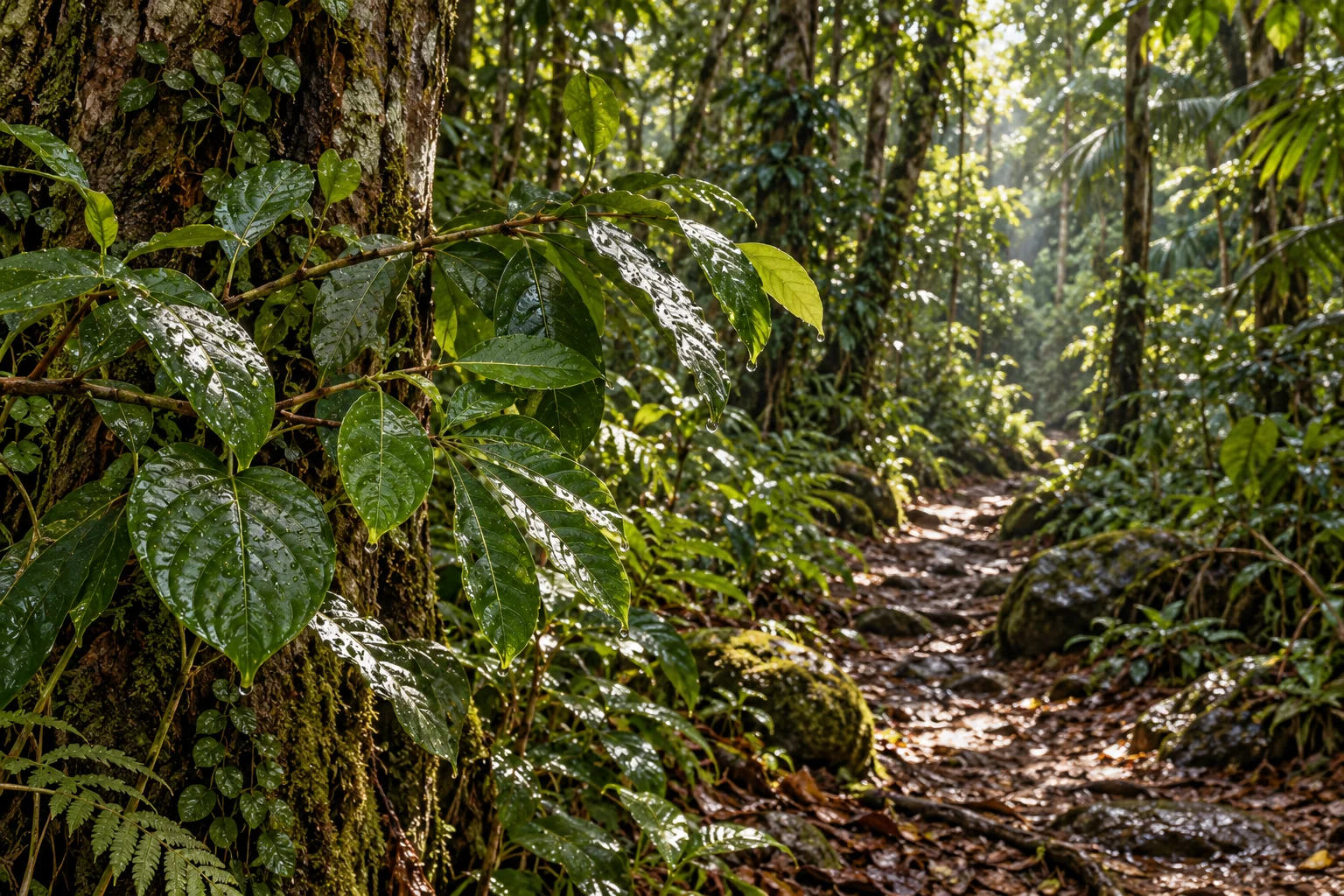
Leaves locate this study within Agué’s Jeje forest context.
1. A Jeje documentary anchor
Research at the Federal University of Bahia identifies Agué in a leaf-related Jeje religious setting. A casa do velho documents a named community’s sacred landscape, while research on Pedra de Xangô provides further context for Agué and leaves.
These are situated records. They should not be expanded into a universal family tree assembled from Gbe, Brazilian and Haitian names. In particular, Agwe’s sea-related Vodou setting needs its own account rather than a spelling-based equation.
2. Key theme: the forest contains relationships, not only materials
Knowledge of leaves involves a place and the people who have learned to attend to it. A forest is not made fully known by producing a list of useful species. Gathering can involve limits, permissions and obligations that belong to a religious relationship as well as practical experience.
For contemporary reflection, this challenges a habit of treating any valuable environment as an inventory. The question becomes what changes when we enter as learners and guests rather than as owners who need only identify what can be taken. That is an ethical interpretation, not a reconstructed Jeje ritual instruction.
3. Comparison with Òsanyìn
Òsanyìn offers a related study of leaves and trained knowledge in Yorùbá and diaspora settings. The connection is useful precisely when it keeps the distinct traditions visible. Shared plant associations are not proof that a Jeje vodun is merely a Yorùbá figure under a different name.
The same care is needed when discussing healing-related meanings. A sacred leaf domain does not authorize a website to prescribe plants, diagnose a condition or promise a treatment result. Respect for the knowledge includes recognizing the difference between a public introduction and the training required to act responsibly.
4. Religious identity and the scope of this study
Agué or Aguê is approached here through a Jeje forest-and-leaves field in Brazil. It is not identified with the Haitian sea lwa Agwe by similarity of spelling, and it is not renamed a Yorùbá Òrìṣà. Denis Alex Barboza de Matos’s UFBA research documents Agué within a named terreiro’s sacred landscape. Other university research discusses leaf knowledge and the figure’s appearance in local cultural memory. The sources establish a situated vodun relation, not a universal account valid for every Gbe, Brazilian, or Caribbean community.
The figure-specific sacred logic concerns a living environment that contains differentiated knowledge and relationships. Leaves are not simply an inventory of substances available for any purpose. They belong to forms of learning, stewardship, and religious competence carried by people in places. A contemporary psychological application can therefore examine the difference between possessing material and understanding a relation. That application uses the book’s symbolic ecology and general framework; the supplied book contains no dedicated Agué portrait. The distinction matters because a familiar comparison with Ọ̀sányìn can help readers begin, yet can also erase the Jeje identity if allowed to stand as a complete explanation.
5. Knowledge that gives the figure depth
5.1 What does a named sacred tree add to a forest-deity description?
Matos’s study includes Agué among the named sacred-tree relations of Huntolóji. That is a precise material and geographical anchor. It avoids the vagueness of calling a figure a generic nature spirit while also avoiding the opposite error of making one terreiro’s arrangement a universal law. Public interpretation can discuss a sacred landscape without reproducing restricted movements, preparations, or ritual sequences described in an academic source.
The analytical point is that knowledge is located. A tree is not only a specimen belonging to a species; in this setting it participates in a community’s memory and organization of sacred space. Its significance depends on relationships that a botanical label cannot replace. Conversely, the religious account does not eliminate the tree’s material vulnerability or the work required to care for its environment. This double attention gives a substantive contemporary lesson: a place can be more than a resource without becoming less real. An outsider seeking only a list of useful plants misses the people who teach how the place is known. Agué’s field can therefore orient a reader toward situated learning, where attention to the environment includes attention to its custodians and to the obligations that make continued access possible.
Evidence: Denis Alex Barboza de Matos, A casa do “velho”: o significado da matéria no candomblé — UFBA master’s research, 2017; indexed plans/text document Agué sacred-tree relation in Huntolóji. Does not prove all-house universality.
5.2 How should the leaf-distribution account be used?
The UFBA study on Pedra de Xangô records a Jeje-framed leaf-distribution narrative attributed to Everaldo Duarte during the author’s research. Its central distinction is between the wider possession of leaves and Agué’s continuing knowledge of their secrets. The attribution to a named teller and a particular research setting is part of the account’s evidentiary meaning. Similar narrative structures elsewhere do not by themselves establish that all the named powers are interchangeable.
The contemporary interpretive question is wonderfully exact: what changes when a material becomes widely available but competence remains uneven? An archive, a medicine cabinet, a seed bank, or a digital collection can be accessible without everyone knowing how to use it responsibly. The gap is not merely a defense of professional prestige. It concerns judgment, context, limits, and consequences. The narrative also keeps knowledge from becoming identical with ownership. A person may hold a leaf and still lack the relation that makes its use intelligible. The book’s ecology method supports examining this tension without offering a plant prescription. Agué’s specific value here is to make discernment more important than acquisition, and to ask how expertise can be honored without becoming a pretext for domination or the permanent exclusion of learners.
Evidence: Maria Alice Pereira da Silva; narrative attributed in the work to Everaldo Duarte, Pedra de Xangô: um lugar sagrado afro-brasileiro na cidade de Salvador — UFBA research, section 4.5; Jeje-framed distribution-of-leaves account, explicit attribution to Everaldo Duarte. Do not rename the teller or make it a universal ancient version.
5.3 What does Agué’s appearance in cultural performance establish?
Monilson dos Santos Pinto’s USP thesis discusses Agué within its study of Nego Fugido and the cultural memory of Acupe. It connects leaf and forest knowledge to the interpretation of a performance narrative concerning enslavement. This is evidence of an author’s situated analysis of oral and performative material. It is not a license to transfer every genealogy or healing claim in the thesis to all Jeje houses, nor to treat performance as a transparent transcript of one religious system.
The analytical value is that a sacred name can work across religious memory and public expressive life without becoming a mere decoration. Performance can hold histories that are difficult to reduce to a single explanatory sentence. It can also make knowledge embodied through rhythm, repetition, and a community’s shared recognition. The name allows inquiry into what people remember and what kinds of relation the performance activates. The point is not that the forest secretly means one psychological condition. It is that a living repertoire can connect material environments, histories of violence, and the wish for restored agency. Such connections require attribution. They become more informative when the reader can distinguish a documented interpretation from an editor’s own new application.
Evidence: Monilson dos Santos Pinto (Mony Tolonã), A bananeira que sangra: desobediência epistêmica, pedagogias e poéticas insurgentes nas aparições do Nego Fugido — USP thesis, 2021, pp.111–112 and other song analysis: Agué and leaf knowledge in interpretation of Acupe performance. Author-specific broader genealogies not universalized.
6. A depth-psychological reading
Interpretive basis: A contemporary application of the wider interpretive framework in Babá Tilo de Àjàgùnnà’s The Orishas and the Human Soul, especially “Before the Òrìṣà Become Archetypes”, “Trees, Plants, Leaves, and the Living Intelligence of the World”. No dedicated chapter for this figure exists in the supplied book. The historical and devotional orientation comes from the separately identified public sources. Psychological lenses and contemporary examples are NEW DAILY IFÁ applications of the book’s interpretive framework, not a recovered author portrait, doctrine of the source community, or clinical finding.
6.1 Knowledge without appropriation: the anxiety of not yet knowing
A new application of the book’s vegetal ecology asks how a person meets knowledge they cannot immediately possess. Agué’s leaf-related field makes a distinction between access, information, and competence. The impatient learner may experience that distinction as humiliation: if the material is visible, why should another person still mediate its meaning? The wish to skip apprenticeship can then disguise itself as independence or openness.
The light is curiosity capable of relationship. Such a learner can ask, observe, practice within appropriate limits, and accept that good judgment develops through time. The shadow is acquisitive knowing, in which the person gathers names and correspondences to avoid the vulnerability of being a beginner. An illustrative researcher may accumulate an impressive plant list while remaining unable to identify which claims belong to which community. The appearance of mastery grows as actual discrimination weakens. Development requires a more secure relation to not knowing. One can be intelligent without already being entitled to every use of a thing. The book’s warning against static symbolic dictionaries supports this question directly, while its application to Agué is new. The sacred presence is not reduced to an educational metaphor. The metaphor simply helps a contemporary reader notice how a desire to learn can become a desire to own, and how respect for expertise can coexist with a clear expectation of accountable teaching.
6.2 Relational ecology: from resource consumption to reciprocal attention
A second lens examines the tendency to approach a sustaining environment only when something is needed from it. The person notices a forest when seeking medicine, a teacher when seeking access, or a community when seeking legitimacy. Once the immediate need is met, the relationship disappears from attention. Agué’s situated leaf field offers a new way to investigate this pattern without assuming that the religious tradition is merely a conservation lesson.
The light is reciprocal attention: the learner recognizes the continued existence of the place and people beyond personal demand. The shadow is instrumental dependence, where gratitude remains a feeling while costs are left to others. An illustrative urban seeker may celebrate sacred nature but ignore the caretakers who preserve a local green space or the pressures that limit access to it. The book’s account of plant life as social and economic supports asking where labor, food, exchange, and maintenance enter the picture. Development means moving from admiring an ideal forest to recognizing a specific environment with conditions and limits. The same dynamic can be heard relationally: does a person value another’s knowledge while disregarding the life that makes that knowledge possible? Agué’s psychological relevance lies in this exact link between receiving and sustaining. It asks whether nourishment can deepen responsibility rather than intensify consumption.
6.3 Expertise and its shadow: secrecy that protects or inflates
A third lens concerns the knowledgeable person rather than the beginner. Possessing specialized knowledge can support restraint, careful care, and the ability to recognize complexity. It can also become the basis of an inflated identity: I know what others cannot know, therefore my judgment should not be examined. The leaf-distribution narrative’s distinction between material possession and knowledge opens this tension without settling it by a simple celebration of secrecy.
The light is competence that can state its scope, transmit responsibly, and remain aware of limits. The shadow is mystification used to secure dependence. An illustrative teacher might invoke tradition whenever asked to clarify a public claim, while offering grand assurances beyond their actual knowledge. A more mature teacher can distinguish what is private, what is uncertain, and what can be explained. The book’s method supports this differentiation because symbolic meaning, religious authority, and therapeutic claims are related but distinct. A contemporary Agué reflection can therefore ask whether expertise makes a person more exact or merely more impressive. Development includes the capacity to say that one does not know, to direct a learner to the appropriate source, and to resist promises that convert reverence into certainty. These are ethical applications, not an external judgment that a particular Jeje community conceals knowledge improperly. The religious field remains larger than the psychological question, yet it can sharpen how a person carries responsibility for what others trust them to know.
7. What this relationship means for a person
7.1 In an established devotional or initiatory relationship
For someone already connected to Agué through a Jeje house or another explicitly identified tradition, the relationship is learned through that setting’s language, people, and sacred landscape. Those relations differ from an Ọ̀sányìn profile or a Haitian Agwe account even where comparison offers an initial point of contact. Nor does the existence of one documented initiatory account prove that every community has the same form of affiliation. The person’s established relationship has a specificity that an internet correspondence table cannot supply.
The new psychological application asks how ongoing devotion shapes the capacity to learn and care. Can the devotee receive knowledge without treating it as a possession that confers superiority? Do they recognize the labor of elders and caretakers as part of what sustains access to the sacred environment? Can they identify the difference between a meaningful limit and a claim that has simply never been examined? These questions are meant to deepen responsible participation, not authorize someone to overrule their community’s teaching.
A continuing relationship also places learning in time. Repeated attention to a place may reveal changes that a one-time visitor misses: an elder’s knowledge becomes harder to replace, a material environment becomes fragile, or a familiar comparison begins to conceal a difference. Such details make continuity and change visible in the actual relationship. It offers an interpretive companion to an already lived relation while keeping religious competence distinct from reading, symbolic insight, and any claim about the medical use of plants.
7.2 When the figure becomes relevant in consultation
If Agué is encountered in consultation, the interpretation must identify the tradition and the actual concern before assigning meaning. Similar spelling is not enough to decide that the consultation concerns a Haitian sea lwa, a Jeje leaf vodun, or an account carried by a particular Brazilian house. That initial precision helps situate the encounter; the diviner’s authority remains a different kind of knowledge from public research. A situational encounter also does not automatically establish a lifelong initiatory affiliation.
The outer configuration might concern access to knowledge, an environment under strain, dependence on a specialist, or the misuse of a resource. The inner question would examine how the client participates: acquiring information too quickly, distrusting every limit, using knowledge to control others, or forgetting the relationships that sustain them. These are possibilities for discernment rather than a universal Agué message. The book’s distinction between pattern and presence helps prevent the figure from becoming merely another name for an Odù or a fixed personality style.
A contemporary consultation discussion may lead to clearer questions about who knows what, which claim belongs to which source, and what responsibility accompanies access. It may also expose a wish for certainty that no amount of collecting can satisfy. Where leaves or health are involved, symbolic reflection does not authorize self-prescription. The practical interpretive gain is a more truthful relation to competence, dependence, and place. Any religious instruction or continuing obligation must remain within the relevant accountable tradition.
8. Nature, materials and human knowledge
Agué’s strongest documented associations in the intended scope are forest, leaves, knowledge, and a named Jeje sacred landscape. Matos’s work provides a material location, while the attributed leaf-distribution account in the Pedra de Xangô research distinguishes possession of leaves from knowledge of them. Pinto’s thesis adds a specific cultural-performance interpretation. These sources should be kept separate rather than combined into one invented universal mythology.
The book’s vegetal ecology supplies the new analytical method: attend to habitat, growth, use, relationship, and the context in which a plant becomes meaningful. A leaf is not a free-floating symbol of healing, and forest is not simply an image of the unconscious. Both belong to an environment inhabited by people with histories and obligations. Contemporary reflection can ask how the desire to receive nourishment changes when one recognizes the conditions that keep nourishment possible. Material care, transmission of knowledge, and limits on taking then become part of the subject. The ecology remains figure-specific because the central tension is not raw power over nature, but knowledge held within relationship. No recipe, medicinal dose, universal species list, or guarantee of cure follows from this interpretive account.
9. Diaspora, comparison and syncretism
A comparative relationship with Ọ̀sányìn is intelligible through leaf knowledge, and Brazilian scholarly tables sometimes place Agué beside Ossaim and Katendê. Such mapping records a way of comparison; it does not erase Jeje, Ketu, and Angola differences. A table that includes a Catholic saint in an Ossaim row also does not automatically prove a direct Agué–saint identification in every house. No independently verified, house-specific saint correspondence is asserted here.
The Haitian sea lwa Agwe must likewise remain distinct from the forest-and-leaves Agué intended by this Academy entry. A spelling resemblance is not historical evidence. University research also records other house-specific uses of the name Agué, including a narrative connected with an Angola setting; that is a reason for closer identification, not for blending all accounts. The useful questions identify the community, the genre of account, and the relationship being discussed. Contemporary psychological comparison should follow the same rule. Recognizing shared themes of knowledge and care does not make different sacred presences expressions of one concealed archetype. Comparison becomes more informative when it preserves the distinct vocabulary and lets each tradition clarify what the shared theme means within its own world.
10. Questions for a fuller understanding
10.1 Why is identifying the tradition behind the name a form of care?
Because a name carries relationships, and similar spellings can lead into different religious worlds. Identifying Agué’s Jeje leaf-and-forest setting prevents a reader from importing the Haitian sea domain or assuming that an Ọ̀sányìn account explains everything. It also helps the reader know which custodians and sources can answer the next question. This precision is not a minor academic detail. It protects a living community’s vocabulary and prevents a seeker from acting on a mistaken assumption. The contemporary psychological parallel is learning to hear a person’s actual account before fitting them into a familiar category. In both cases, careful attention keeps resemblance from doing the work of understanding.
10.2 What does the distinction between leaves and their knowledge offer an ordinary reader?
It offers a precise way to think about the difference between possession and competence. Having a resource, a text, or a tool does not automatically supply the judgment needed to use it. The same applies to sacred information: access can begin learning without completing it. A contemporary Agué interpretation asks whether the person can tolerate that gap and enter a responsible relationship with teachers, places, and limits. This does not mean knowledge should be used to make others permanently dependent. It means good learning includes context, consequences, and the ability to recognize what remains unknown. The narrative’s force lies in making those distinctions visible through a material world.
11. Correlations to life dimensions
| Dimension | A question for reflection |
|---|---|
| Knowledge | Have I identified the tradition behind the name before drawing a comparison? |
| Ecology | Does my interest in a forest include a relationship with its limits? |
| Care | Am I confusing a symbolic association with the competence to prescribe? |
| Belonging | Whose situated knowledge makes this landscape intelligible? |
12. A precise beginning
This entry preserves the intended forest-and-leaves field while leaving room for a house-specific explanation. If a received teaching uses a similar name differently, identify that context before combining the accounts. A small distinction in spelling can protect a large distinction in religious history.
13. Sources for the expanded interpretation
Interpretive basis: A contemporary application of the wider interpretive framework in Babá Tilo de Àjàgùnnà’s The Orishas and the Human Soul, especially “Before the Òrìṣà Become Archetypes”, “Trees, Plants, Leaves, and the Living Intelligence of the World”. No dedicated chapter for this figure exists in the supplied book. The historical and devotional orientation comes from the separately identified public sources. Psychological lenses and contemporary examples are NEW DAILY IFÁ applications of the book’s interpretive framework, not a recovered author portrait, doctrine of the source community, or clinical finding.
-
Denis Alex Barboza de Matos. A casa do “velho”: o significado da matéria no candomblé. UFBA master’s research, 2017; indexed plans/text document Agué sacred-tree relation in Huntolóji. Does not prove all-house universality. University original text indexed; direct PDF intermittently unavailable.
-
Maria Alice Pereira da Silva; narrative attributed in the work to Everaldo Duarte. Pedra de Xangô: um lugar sagrado afro-brasileiro na cidade de Salvador. UFBA research, section 4.5; Jeje-framed distribution-of-leaves account, explicit attribution to Everaldo Duarte. Do not rename the teller or make it a universal ancient version. Relevant indexed full-text passage verified; confirm title-page year before final formal bibliography.
-
Monilson dos Santos Pinto (Mony Tolonã). A bananeira que sangra: desobediência epistêmica, pedagogias e poéticas insurgentes nas aparições do Nego Fugido. USP thesis, 2021, pp.111–112 and other song analysis: Agué and leaf knowledge in interpretation of Acupe performance. Author-specific broader genealogies not universalized. Public original source verified; scope as stated.
-
Reginaldo Prandi. Deuses africanos no Brasil contemporâneo (introdução sociológica ao candomblé de hoje). 1995 comparative table juxtaposes Ossaim, Agué and Catendê; table structure is not proof of direct universal saint identity. Public original source verified; scope as stated.
-
Tássio Ferreira. Pedagogia da circularidade afrocênica. University research records a different house-specific Agué account associated with Tumba Junsara and Riasú; used only to demonstrate need to identify local referent. Indexed original passage; no universal identity inferred.
The scope here is Jeje leaf and forest knowledge with identified authored witnesses. Different uses of the name remain distinct; the available evidence does not establish a universal genealogy or ritual procedure.