
Money can arrive in a life without becoming a blessing for the people around it. Ajé opens a study of prosperity through exchange, work and the relationships that make value possible. The subject becomes more useful when wealth is approached as something to carry responsibly rather than a force that excuses every method of acquiring it.
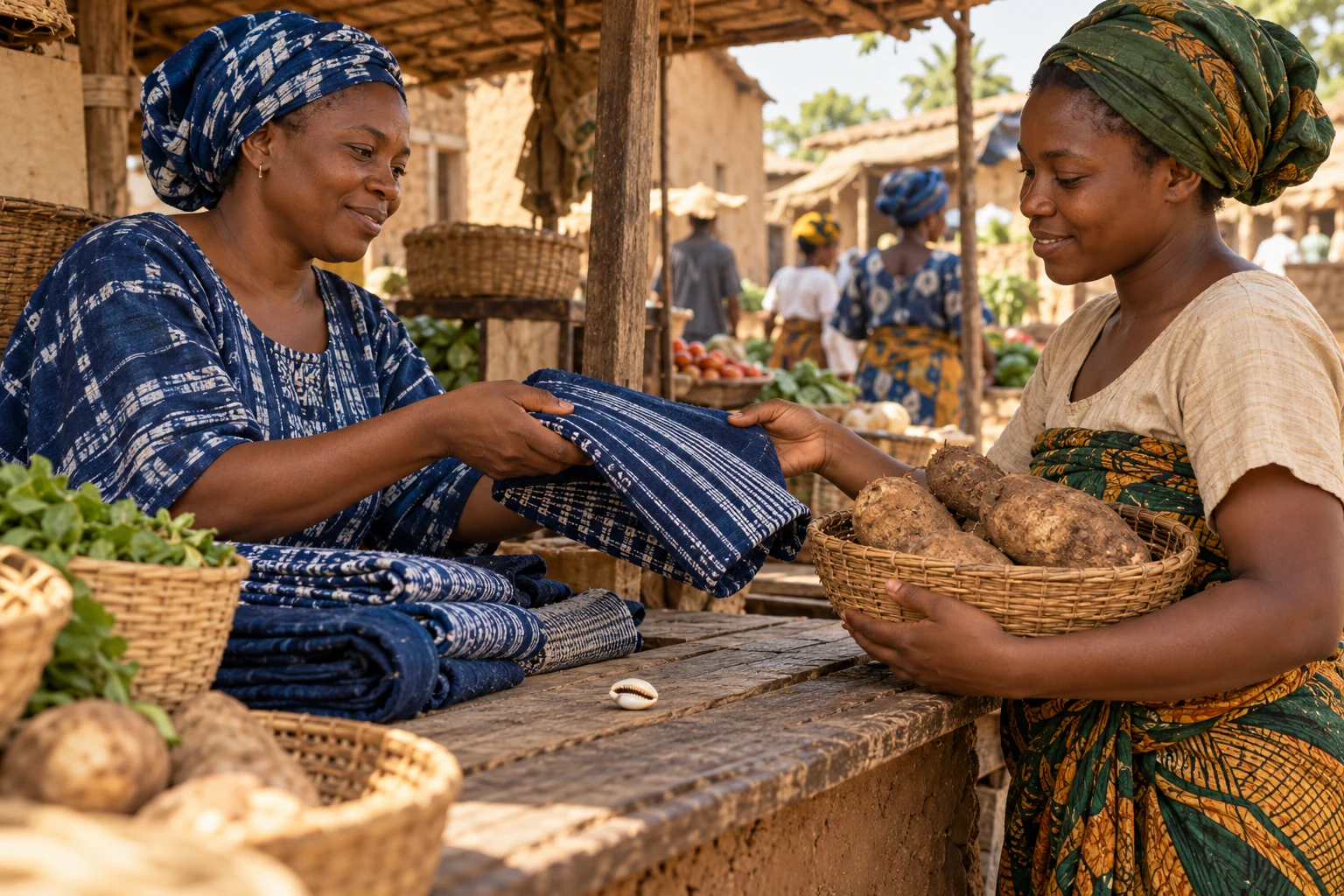
A shell opens a question about value, exchange and responsibility.
1. A name that needs its accents and context
Ajé is associated with wealth and profitable exchange. The Nigerian National Institute for Cultural Orientation’s published festival address discusses that religious field while also attending to practical work. The source is useful for this particular subject; its incidental claims about other figures need not be adopted.
Ajé of wealth should not be confused automatically with àjẹ́ and Ìyámi Òṣoronga. Removing accents from Yorùbá words can conceal distinctions. A sound educational system preserves spelling variants for search while making the intended meaning clear in the article.
2. Key theme: prosperity occurs between people
Exchange requires more than an object and a price. It also requires recognition of value, some expectation that an agreement will hold and the possibility of encountering others again. Even a highly individual success therefore rests on relationships that the successful person did not create alone.
This contemporary interpretation brings character into the study of wealth. A person may secure a favorable transaction by damaging trust, but the immediate gain can weaken the conditions of future exchange. The important question is not only whether something was profitable, but what kind of economic relationship it leaves behind.
3. Desire, security and the moving finish line
The wish for financial security is understandable. It becomes harder to satisfy when the definition of enough changes every time a goal is reached. Status can then turn prosperity into a comparison that no amount of acquisition resolves.
A religious association with wealth does not justify promises that devotion will guarantee income. A more substantial public study asks how a person recognizes a blessing, plans for its continuity and avoids consuming tomorrow’s stability to display today’s success. Those questions concern conduct as well as possession.
4. Work and the unseen conditions of value
Òrìṣà Òkò directs attention to cultivation. Ògún brings instruments and skilled work. Òṣun opens reciprocity and recognition. Together, these connected studies make it possible to think about an economy as a field of obligations without claiming that the figures are merely symbolic job descriptions.
5. Religious identity and the scope of this study
Ajé in this entry concerns wealth, profitable exchange and the conditions through which value becomes usable within human life. The intended name must remain distinct from àjẹ́ in discussions of Ìyámi and female powers; removing tonal marks can conceal an important difference. The book has a dedicated Ajé Ṣálúgà chapter that develops a marine and market interpretation of prosperity, including hidden reserve, visible success, timing and circulation. That interpretive field should not be presented as a complete description of every community's Ajé practice. Dipo Kalejaiye's festival address, published by NICO, supplies a different public voice that joins religious regard with actual trading, work and cooperation.
We can keep those voices distinct while learning from both. Its psychological question is how people receive and carry increase: money changes visibility, obligations and the stories people tell about their worth. Success may relieve deprivation while introducing unfamiliar pressures. This does not mean poverty proves spiritual failure or prosperity proves virtuous character. Ajé's relevance is more demanding than either conclusion. Wealth becomes a field in which effort, chance, social relations and ethical responsibility meet, rather than a private quantity that explains itself or a reward guaranteed by devotion.
6. Knowledge that gives the figure depth
6.1 Why must prosperity remain tied to actual work?
Kalejaiye's address places Ajé within ordinary economic activity. A trader needs something to sell and a place or route through which exchange can occur; religious understanding does not remove those material tasks. That is a useful corrective to the fantasy that spiritual prosperity can bypass preparation. The address is a situated speech with its own theological assumptions, not a neutral census of all Yorùbá economic practice. Its central juxtaposition nevertheless gives the article substance: livelihood joins visible action to relations through which people understand fortune and responsibility.
A contemporary interpretation can ask what must exist before a sale becomes possible. Goods, labor, customers, transport, trust and a shared recognition of value are among the conditions. No individual creates all of them alone. Recognizing that dependence does not deny skill or initiative; it prevents success from becoming a story in which everyone else disappears. The book's emphasis on circulation extends the point inward. A gift or capacity may be real before it finds a workable form of exchange. Learning to offer it responsibly includes understanding demand, setting boundaries and allowing appropriate compensation. This is reflective analysis of value becoming social, not a promise that every hidden talent will eventually find a profitable market.
Evidence: Dipo Kalejaiye; published by National Institute for Cultural Orientation, Understanding Wealth Creation (Aje) Through the Concept of Yoruba Traditional Religion — 2011 festival address identifies Ajé with wealth, market profit and cooperation; includes attributed origin narrative and practical work examples. Incidental errors about other deities are not adopted.
6.2 How does a shell open a question of value?
The book's cowry image connects natural material with recognized social value. A shell does not arrive bearing a universal price; value becomes exchangeable through history, agreement and use. In the dedicated chapter, this movement supports an interpretation of wealth emerging from a reserve that was not initially visible. The article should keep the image's analytic function clear rather than inventing an economic history from it. A contemporary question follows: what changes when something meaningful becomes something saleable? Artists, teachers and caregivers can experience compensation as both recognition and exposure.
Charging may make a gift sustainable, while also inviting comparison and evaluation. Refusing all compensation can preserve a sense of purity at the cost of exhausting the maker. Conversely, monetizing every relation can destroy forms of care whose meaning depends on a different exchange. Ajé's field helps explore the boundary rather than declaring everything either priceless or profitable. It asks whether material support allows value to continue serving life. The answer depends on the specific activity, its recipients and the obligations already involved. Prosperity is therefore not simply acquiring more units. It includes the capacity to establish relations through which useful work can endure without being consumed or cheapened by its price.
Evidence: Dipo Kalejaiye; published by National Institute for Cultural Orientation, Understanding Wealth Creation (Aje) Through the Concept of Yoruba Traditional Religion — 2011 festival address identifies Ajé with wealth, market profit and cooperation; includes attributed origin narrative and practical work examples. Incidental errors about other deities are not adopted.
6.3 What does timing change?
Timing has an exact role in the book's Ajé interpretation. The chapter uses a proverb about a later caravan receiving favor to question the assumption that first arrival establishes greatest worth. This should remain attributed to the author's account unless an independent source is supplied for a particular version. Its contemporary significance is the difference between delayed recognition and absence of value. A person can be capable while facing conditions that make exchange difficult. That does not make patient waiting sufficient in itself. The relevant inquiry is what can be prepared or changed while a desired opening remains unavailable.
Timing can be used defensively: someone may call every practical difficulty a sign that their moment has not come, avoiding feedback that would improve the work. It can also be used cruelly: observers may treat delayed success as evidence of laziness. The Ajé field keeps both errors visible. It supports patience with a real process while preserving accountability for choices within it. An illustrative case would be a skilled maker adjusting how work reaches an audience without reducing artistic worth to current sales. The interpretation honors the difference between recognition and intrinsic value while asking how livelihood can become more viable in actual conditions.
Evidence: Dipo Kalejaiye; published by National Institute for Cultural Orientation, Understanding Wealth Creation (Aje) Through the Concept of Yoruba Traditional Religion — 2011 festival address identifies Ajé with wealth, market profit and cooperation; includes attributed origin narrative and practical work examples. Incidental errors about other deities are not adopted.
7. A depth-psychological reading
Interpretive basis: The dedicated chapter in Babá Tilo de Àjàgùnnà’s The Orishas and the Human Soul, especially “Ajé Ṣálúgà”, “Before the Òrìṣà Become Archetypes”. Dedicated chapter provides prosperity as emergence, timing, visibility and circulation. Public NICO address is a separate situated account. Named psychological lenses and contemporary examples extend the author framework.
7.1 Depth psychology: visibility and dazzlement
A depth psychological lens can examine the relation between money and permission to be seen. The book's brightness and dazzlement motifs locate a tension inside success itself. A person may consciously seek prosperity while recoiling when their work begins attracting attention. Increased visibility can feel like exposure, an invitation to judgment or a loss of protection previously supplied by obscurity. An illustrative professional might consistently underprice new work after receiving public praise, as though reducing compensation could make prominence safer. The relevant question is not whether the person secretly dislikes money, but what they imagine will happen when value becomes openly acknowledged.
Another person responds in the opposite direction, adopting an inflated public image to conceal continued uncertainty. Both examples concern a difficult transition from private capacity to social visibility. Ajé's image permits careful differentiation between receiving recognition and requiring admiration. The article should not turn this into a personality diagnosis or suggest that financial outcomes are controlled by unconscious wishes alone. Structural constraints, discrimination and practical conditions remain real. The author's psychological interpretation adds a question about how increase is carried once it occurs. Mature reception can acknowledge pleasure and vulnerability together, allowing the person to be seen without surrendering judgment to applause or hiding all evidence of success in shame.
7.2 Relational development: generosity and consent
A relational lens can explore giving and receiving without treating either as automatically virtuous. The book emphasizes generosity and movement, but circulation is more than indiscriminate distribution. Some people give because they can share freely; others give to prevent envy, purchase affection or escape the discomfort of holding something for themselves. A contemporary example is someone who immediately commits every financial improvement to relatives and then becomes resentful when no reserve remains. The problem is not family care itself. It concerns whether the agreement is speakable and sustainable, and whether generosity leaves room for the giver's actual obligations.
Conversely, a person may call every request intrusive in order to conceal an inability to acknowledge dependence on others. Ajé's field becomes psychologically exact when it asks how value moves through a relationship: is there gratitude, coercion, reciprocity, secrecy or a demand for control? A gift can support autonomy or establish an unpayable debt. The same amount of money can therefore have different relational meanings. This is a contemporary reading of the chapter's circulation argument, not a traditional rule governing every household transfer. Its ethical center is proportionate generosity joined with clear consent. Receiving can then become part of a relationship rather than evidence of weakness, while giving need not require self depletion or ownership of the recipient.
7.3 Family systems: class movement and loyalty
A family systems lens attends to prosperity as a change in group position. The book raises the possibility that success becomes entangled with loyalty, class memory and guilt. In an illustrative case, a person earning more than previous generations may feel that comfort betrays relatives whose hardship helped make the opportunity possible. They might minimize their success, overextend support or avoid decisions that would make the difference visible. Another family may make the successful member into a symbol of collective triumph while denying them ordinary uncertainty.
The question is how increased resources can honor relationships without requiring permanent repayment of an impossible debt. This interpretation should not accuse families of secretly blocking prosperity or explain poverty through loyalty alone. It concerns narratives and expectations that can be heard and discussed. Ajé's field helps distinguish gratitude from submission and independence from contempt. A person can acknowledge the conditions that supported them while choosing a sustainable form of contribution. The economic environment also matters: unequal access cannot be repaired by positive thinking about wealth.
Inner development here means becoming able to carry a changed position without either denying one's origins or using success to erase them. Prosperity acquires ethical depth when it enlarges capacity for relationship, rather than becoming proof that one has finally escaped the need for others.
8. What this relationship means for a person
8.1 In an established devotional or initiatory relationship
For someone with an established devotional relationship involving Ajé, prosperity is a continuing religious responsibility rather than a single transaction for desired income. The actual form of that relationship must be learned within the relevant community; public prose should not invent a universal head initiation or present every merchant as a devotee. The dedicated chapter can deepen reflection on conduct across changing circumstances. Increase may ask how value is shared, how workers are compensated and whether public success has altered one's ability to hear correction.
A lean period may require practical revision and support without treating hardship as proof of rejection. Sustained relationship can hold both conditions because wealth is not a simple moral score. The book's tidal interpretation is especially useful when it prevents possession from becoming an entitlement that must never change. That image should not be used to spiritualize avoidable harm or tell a person that exploitation is necessary rebalancing. It invites examination of one's own response to arrival and loss. Devotion can also bring attention to ordinary economic relations that are easily excluded from religious self description: paying on time, honoring agreements and acknowledging invisible contributions.
These are contemporary ethical applications, not a substitute for lineage instruction. Established relation remains broader than feeling abundant. It joins reverence with an ongoing willingness to ask what prosperity is doing to character and community, and how material stability can support a life rather than become its only measure.
8.2 When the figure becomes relevant in consultation
When Ajé appears in consultation, the specific issue may involve livelihood, exchange, timing, fairness or the ability to receive. Those possible themes should not be collapsed into a prediction that money will arrive. The consultation's configuration, the client's circumstances and the practitioner's trained account determine what is relevant. Someone struggling to offer a skill may need to examine practical access and compensation; someone enjoying rapid profit may need to consider obligations and the reliability of the arrangement. The name alone does not determine which person is before the consultant.
The book offers a differentiated vocabulary: concealed value, emerging visibility, dazzlement, circulation and ethical testing. Used carefully, those distinctions can improve questions without replacing divination. What is actually valuable here? Who recognizes it? What conditions permit exchange? What would make an increase sustainable? These questions can be useful even when no forecast is offered. A public article should not assign an Odù based on a financial concern, establish a permanent affiliation from one encounter or turn spiritual counsel into investment guidance. It can instead show how the outer arrangement and inner response interact.
Market conditions, work and resources form part of the situation; fear, generosity, shame or inflation shape how a person participates. Neither dimension explains the whole. Consultation becomes more useful when it clarifies that relationship and leaves the person with a more exact understanding of what requires attention now.
9. Nature, materials and human knowledge
Ajé's material and social ecology includes the market, the household, circulating goods and the marine imagery developed in the book. Cowries join shell, beauty and exchange within the author's interpretation, while the market brings value into relations among strangers and neighbors. These should remain differentiated associations rather than a claim that every form of money has the same sacred meaning. Kalejaiye's situated address also discusses cooperation as part of economic continuity. An original ecological application can follow what prosperity requires but does not always display: land, transport, energy, skilled work, care and trust.
A profitable transaction can damage those supporting conditions if immediate gain is treated as the only outcome. Conversely, a fair exchange can help maintain skills and households beyond the moment of sale. The book's tide image makes movement visible, but money does not circulate harmlessly merely because it moves quickly. The direction and consequences of movement matter. The contemporary ethical question is whether increase keeps the relations of future livelihood workable. This adds material seriousness to abundance language. Prosperity can be celebrated while asking whose depletion financed it, what remains supported afterward and whether recognition reaches the people whose contributions made the visible success possible.
10. Diaspora, comparison and syncretism
The first necessary distinction is linguistic and theological: Ajé of wealth is not automatically àjẹ́ in the field of Ìyámi. Accentless search terms can unite material that should be separated in explanation. The book explicitly identifies this problem. Its Atlantic variants and marine relations also require source specific treatment; a similar spelling or an association with Olókun does not establish a single universal genealogy. The inspected NICO speech does not supply a Catholic saint identification, so the article should not invent one. Comparisons with prosperity saints or other wealth deities can be educational only if marked as comparison rather than historical syncretism.
Likewise, Ajé is not merely Òṣun under an economic name, nor a financial aspect of every water power. Different relations to attraction, reserve, exchange and livelihood can be explored while retaining separate identities. The section can teach why this matters: correspondences shape what a reader believes they are learning and whom they seek as a teacher. A precise account states whose practice or interpretation creates the relation. Where that evidence is absent, the honest outcome is a clearly bounded difference. The religious field gains depth from its particularity and does not need a universal equivalence chart to make wealth spiritually consequential.
Evidence: Dipo Kalejaiye; published by National Institute for Cultural Orientation, Understanding Wealth Creation (Aje) Through the Concept of Yoruba Traditional Religion — 2011 festival address identifies Ajé with wealth, market profit and cooperation; includes attributed origin narrative and practical work examples. Incidental errors about other deities are not adopted.
11. Questions for a fuller understanding
11.1 Does prosperity prove divine approval?
Does honoring Ajé mean wealth is proof of divine approval? The book's distinction between blessing and dazzlement directly complicates that conclusion. Increase can expose generosity, vanity, fear or injustice; it does not settle character in advance. Material hardship also has many causes and should not be read as evidence of spiritual failure. Contemporary reflection asks what resources permit, how they were obtained and what relationships they leave behind. That inquiry can coexist with devotion without turning it into a guarantee of income. A person may celebrate prosperity while remaining answerable for its consequences. The reflective purpose is to carry value more responsibly, including recognition of the practical and social conditions that a purely individual success story would omit.
11.2 How does receiving differ from greed?
How is receiving different from greed? Receiving acknowledges that a person and their work can legitimately require support. Greed makes increase its own justification, disregarding proportion and consequences. The book's Ajé chapter is useful because it also distinguishes generosity from compulsive depletion: refusing all support does not necessarily express virtue. A contemporary example is a teacher who needs appropriate payment to keep teaching well, while still recognizing obligations to students and colleagues. The precise arrangement depends on context; the symbol supplies no universal price. The question is whether exchange sustains value and preserves fair relationship. Ajé's interpretive field can therefore help someone examine both excessive taking and the shame that prevents them from accepting a reasonable return.
12. Correlations to life dimensions
| Dimension | A question for reflection |
|---|---|
| Wealth | What conditions make this prosperity durable? |
| Work | Whose contribution is missing from the story I tell about earning success? |
| Exchange | Does the gain preserve the trust on which future dealings depend? |
| Desire | What would enough allow me to do besides seek more? |
13. A grounded study of prosperity
If Ajé matters in your practice, begin with the account carried by your teachers. The public entry is an invitation to understand the religious name and examine how value moves through a life. It is not an investment recommendation or a promise that spiritual practice removes material uncertainty.
14. Sources for the expanded interpretation
Interpretive basis: The dedicated chapter in Babá Tilo de Àjàgùnnà’s The Orishas and the Human Soul, especially “Ajé Ṣálúgà”, “Before the Òrìṣà Become Archetypes”. Dedicated chapter provides prosperity as emergence, timing, visibility and circulation. Public NICO address is a separate situated account. Named psychological lenses and contemporary examples extend the author framework.
- Dipo Kalejaiye; published by National Institute for Cultural Orientation. Understanding Wealth Creation (Aje) Through the Concept of Yoruba Traditional Religion. 2011 festival address identifies Ajé with wealth, market profit and cooperation; includes attributed origin narrative and practical work examples. Incidental errors about other deities are not adopted. Public address retrieved through indexed institutional text; not peer reviewed ethnographic proof of all regional customs.
NICO address contains incidental theological simplifications not adopted. Marine genealogies and Atlantic variants remain author presented, not independently verified here. No prosperity guarantee, universal initiation or saint identification.