
A tree can outlive the people who remember why it was spared. Its continued presence may make a place recognizable even as everything around it changes. Ìrókò brings a living material body into the study of sacred continuity. The question is not only what a tree symbolizes, but how people act toward a being whose life exceeds their own immediate purposes.
Ìrókò’s study follows a living tree through memory, care and time.
1. A tree in an inhabited world
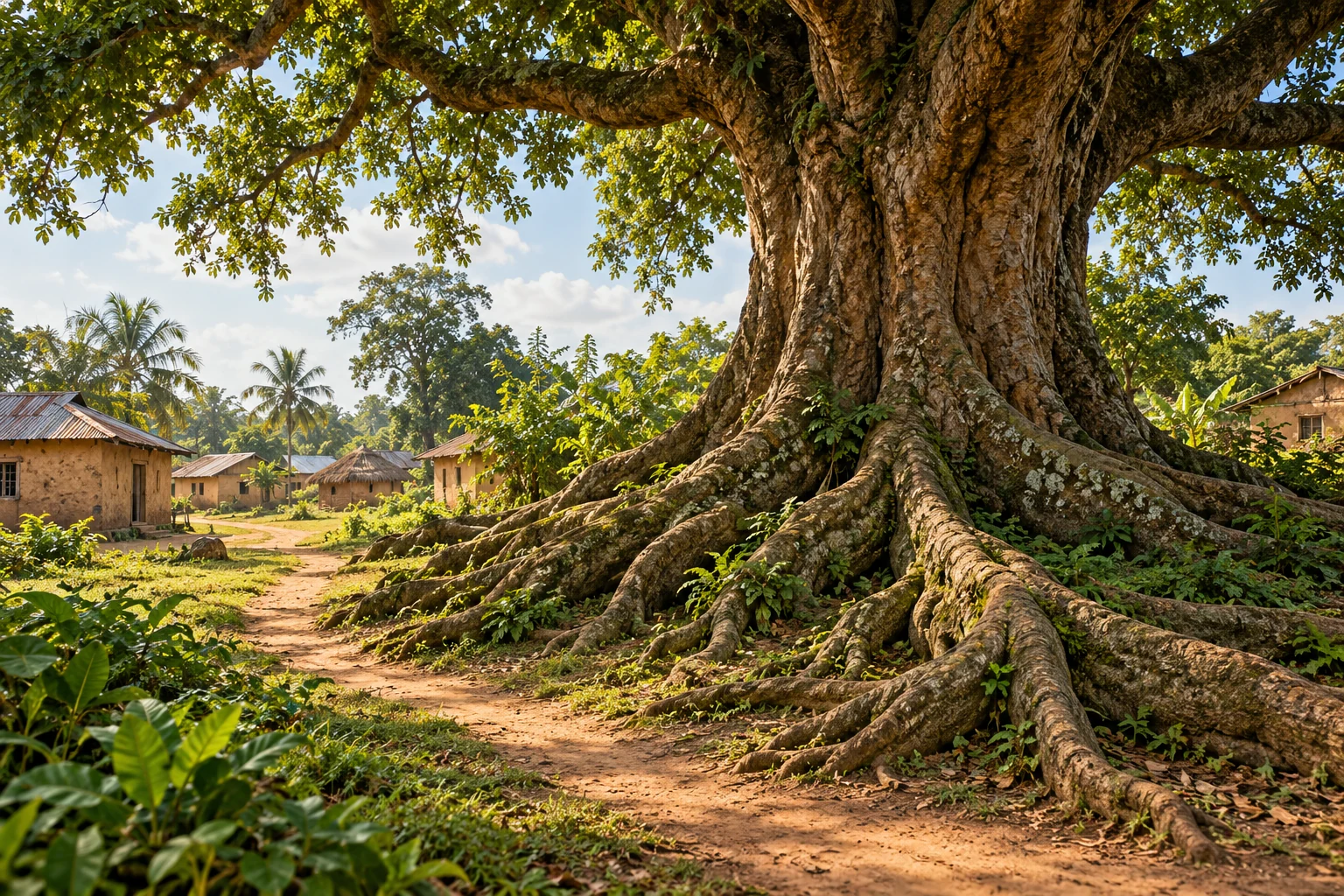
The iroko is commonly identified botanically as Milicia excelsa. The IITA Forest Center’s account discusses its sacred significance and the preservation of particular trees. A field-based study by Borokini also documents beliefs concerning iroko and resident spiritual presence.
These sources locate the subject in lived relationships with trees. They do not establish that every community understands every old tree as Ìrókò, or that one botanical description supplies the whole religious meaning. Species, place and account all contribute to the study.
2. Key theme: a presence that interrupts convenience
A sacred tree may stand where development would find it convenient to remove one. Its protection creates a limit on the assumption that human use is the only measure of value. This can open an ecological interpretation while remaining distinct from the particular religious reasons for honoring that tree.
The contemporary question is what deserves continuity even when it cannot explain its value in the language of immediate profit. A place, skill or relationship may have been sustaining a community for so long that its work has become invisible. Removing it can reveal its importance only after the loss is difficult to repair.
3. Time and the person who will not see the result
Planting or protecting a slow-growing tree involves a future that may not reward the person acting. That relationship can challenge an overly personal measure of success. Some good work becomes meaningful precisely because others will inherit it.
The same applies to education and religious transmission. A teacher cannot decide which future person will benefit from the patience invested now. They can still preserve the conditions that make learning possible. Continuity is carried through such acts before it becomes a proud statement about heritage.
4. Ìrókò and Kitembo remain distinct
Brazilian comparisons between Ìrókò and Kitembo deserve context. Shared associations with time, trees or sacred presence do not make a Yorùbá Òrìṣà and a Kongo-Angola nkisi interchangeable. Their comparison should help readers learn different religious histories rather than erase one through the vocabulary of the other.
5. Religious identity and the scope of this study
Ìrókò should be approached as a sacred tree presence with particular botanical, local and religious relations. The book gives Iroko a dedicated portrait, emphasizing rooted height, long memory, shelter and the disturbing possibility that a refuge is also inhabited by powers beyond human control. That is a richer field than an uncomplicated symbol of calm. Independent ecological context comes from IITA's account of Milicia excelsa trees left standing on its Ibadan campus because of their sacred regard. Borokini's field based study also reports religious understandings of resident presence associated with iroko.
Neither source establishes one identical account for every community or every old tree. This interpretation retains the opening discussion's insistence on that specificity. A living tree is not merely an object onto which people project an idea of time. Its growth, vulnerability, reproduction and surroundings matter to the relationship. Psychological interpretation can then ask how endurance supports a person, when inherited structures protect and when they confine. It must not turn every quiet elder into an Iroko personality or treat a botanical species as a portable initiation system. The central subject remains a religious presence encountered through place, narrative and community, with interpretation opening an additional conversation about human development.
6. Knowledge that gives the figure depth
6.1 What did sacred regard preserve at Ibadan?
IITA's campus account records large iroko left standing when surrounding forest was cleared. Sacred regard therefore had a visible consequence for the landscape: certain trees survived a transformation that removed others. The account also describes slow establishment and very old specimens. These facts support a bounded ecological question about continuity. A decision made quickly can remove something whose replacement requires generations and conditions no longer available. That asymmetry gives preservation an ethical seriousness different from simply disliking change. Contemporary analysis can ask how a community recognizes a value that cannot be reproduced on demand.
The answer need not assume that every old structure deserves protection. A tree's continued life and an institution's inherited authority are different matters. The useful connection is temporal: both invite attention to what is difficult to restore after a convenient decision. Iroko's symbolic force becomes stronger when its material body remains visible. It needs living conditions, rather than respect expressed only after damage. The opening discussion's account of ecological regard can be deepened by following the relation between the mature tree and the sheltered young tree. Continuity involves more than protecting a monument; it also requires conditions under which future life can become established.
Evidence: International Institute of Tropical Agriculture Forest Center, Iroko tree — Milicia excelsa at Ibadan campus; sacred regard contributed to preservation; old trees, reproduction and slow establishment; Temitope Israel Borokini, Sanctuary of the Spirits: Okwu-muo, Ori Oke and Mammy Water in the Veneration of Sacred Natural Sites in Southern Nigeria — 2016 fieldwork article reports sacred iroko, indwelling spirits and context specific conservation concerns; not universal belief.
6.2 Why can shelter also fail?
The book's mythic account combines sanctuary with danger. It discusses refuge during overwhelming waters and the possibility that a supporting branch fails under pressure. Those narratives should be attributed to the author's interpretive presentation rather than treated as independently verified universal Iroko scripture. Their structure is nonetheless analytically exact: surviving danger by finding shelter does not mean the shelter has unlimited capacity. An original contemporary application can consider a household or institution that receives everyone in crisis while never acknowledging its own strain. The public image of strength may hide the conditions under which support is becoming unsafe.
The tree image asks a concrete question: who notices the branch before it breaks? This is not an allegorical diagnosis of actual trees or a recommendation to distrust sacred refuge. It differentiates gratitude for support from a fantasy of inexhaustibility. The same distinction matters for people who become reliable centers. Others may interpret their steadiness as an absence of need. The mythic tension allows the article to honor holding power while asking how its capacity is maintained. A refuge that can name limits may protect more faithfully than one whose authority depends on appearing incapable of failure. Endurance requires renewal and realistic relation.
Evidence: International Institute of Tropical Agriculture Forest Center, Iroko tree — Milicia excelsa at Ibadan campus; sacred regard contributed to preservation; old trees, reproduction and slow establishment; Temitope Israel Borokini, Sanctuary of the Spirits: Okwu-muo, Ori Oke and Mammy Water in the Veneration of Sacred Natural Sites in Southern Nigeria — 2016 fieldwork article reports sacred iroko, indwelling spirits and context specific conservation concerns; not universal belief.
6.3 What does a long lived witness ask of promises?
Promises form another specific line in the book's Iroko portrait. A vow made in relation to a tree binds an urgent present to a future in which the original emotion may have passed. The author distinguishes such stories from a single standardized cult narrative. That distinction should remain explicit. The contemporary ethical issue is how commitments survive a change of feeling. A promise made during fear can remain consequential after safety returns because other lives have organized themselves around it. Yet endurance alone does not settle whether every inherited vow should continue unchanged.
Some commitments require renegotiation when circumstances, consent or responsibilities alter. Iroko's long duration makes the tension visible without providing an automatic answer. The relevant questions are who was bound, what was actually promised and what obligations now exist toward those affected. A person can confuse release with denial, pretending that a past commitment no longer matters. They can also confuse fidelity with permanent captivity. The book's contrast between living rootedness and dead structure supports a middle inquiry: how can truth be preserved while a relationship changes form? This develops the opening discussion's attention to future generations into a more exact study of promises, memory and ethical revision.
Evidence: International Institute of Tropical Agriculture Forest Center, Iroko tree — Milicia excelsa at Ibadan campus; sacred regard contributed to preservation; old trees, reproduction and slow establishment; Temitope Israel Borokini, Sanctuary of the Spirits: Okwu-muo, Ori Oke and Mammy Water in the Veneration of Sacred Natural Sites in Southern Nigeria — 2016 fieldwork article reports sacred iroko, indwelling spirits and context specific conservation concerns; not universal belief.
7. A depth-psychological reading
Interpretive basis: The dedicated chapter in Babá Tilo de Àjàgùnnà’s The Orishas and the Human Soul, especially “Iroko”, “Before the Òrìṣà Become Archetypes”, “Trees, Plants, Leaves, and the Living Intelligence of the World”. Dedicated portrait supplies rootedness, refuge, danger, vows and inherited structure; botanical and conservation details rely on IITA/Borokini. Named lenses and illustrative cases are original applications.
7.1 Depth psychology: the pillar that can still grow
A depth psychological lens can explore the inward pillar: the identity organized around remaining steady while others move. The book's Iroko portrait recognizes the value of people who hold a family or community through repeated changes. Their stability can provide orientation without demanding public attention. The shadow appears when standing becomes an inability to revise. A person may preserve an old role long after it has ceased to nourish anyone, because change feels like collapse rather than growth. An illustrative case is a respected elder who interprets every suggestion from younger members as contempt for the past.
The problem is not age itself; it is a rigid equation between continuity and personal authority. Iroko's living body offers a more differentiated image. Roots support branches that extend into new conditions. Maintaining a center need not require freezing every surface. Contemporary interpretation can therefore ask which commitments make adaptation possible and which merely protect a threatened self image. The symbol is particularly useful because it refuses the false choice between fashionable novelty and unexamined endurance. A person can remain faithful while learning. This is a reflective use of the author's account, not evidence that Iroko initiates are stubborn or that resistance to change reveals a deity. It helps name a tension between mature constancy and the fear of becoming unnecessary.
7.2 Relational development: refuge and reentry
A relational lens concerns refuge that supports later movement. The book's shelter and concealment motifs recognize that withdrawal can preserve life under pressure. A person may need routine, privacy, an institution or another dependable relationship before they can respond freely. The interpretive challenge appears when the same protection becomes a condition of permanent dependency. In an illustrative example, someone who once found safety in a tightly organized household continues to avoid every outside relationship because uncertainty feels like exposure to the original danger. Iroko's shelter image can honor what protected them without assuming that remaining hidden is their final vocation.
The question becomes what forms of support allow safe reentry, at a pace that can be borne. This is not a clinical claim that a particular practice cures trauma, nor a demand that vulnerable people disclose what they need to keep private. The book's method distinguishes symbolic insight from diagnosis and from religious authority. A contemporary article can say that refuge has a purpose beyond the glorification of the refuge itself. It protects the possibility of life continuing. Relationships become more supportive when they do not require recipients to prove gratitude by remaining dependent. The tree can provide a place to pause without becoming the whole horizon; the meaning of shelter changes when departure is possible without being framed as betrayal.
7.3 Family systems: memory without captivity
A family systems lens can follow memory held by a place. An old house, grove or family institution may organize stories across generations, giving individuals a sense of continuity larger than their private biography. The book also observes that such structures can preserve silence, grievance and fear. A contemporary interpretation should distinguish remembering from keeping everyone under the rule of an unspoken past. An illustrative family might repeatedly invoke an ancestor's sacrifice to prohibit disagreement about a present decision. The sacrifice may be real and worthy of respect, while the use made of it narrows the lives of those who follow.
Iroko's inhabited branches make an evocative image for that layered inheritance, but the image should never be used to diagnose curses or accuse named relatives of invisible harm. The useful inquiry concerns actual narratives, permissions and consequences. Who may speak? Which losses can be mourned? What disagreement is treated as disloyalty? A living tradition can preserve memory while changing how authority is distributed. It may even become more faithful by ending a pattern that damaged earlier members. The mature Iroko reading therefore joins continuity with renewal: the future is supported by the past without being required to repeat all of it. Long memory acquires ethical value when it enlarges truthful relation rather than functioning as permanent accusation.
8. What this relationship means for a person
8.1 In an established devotional or initiatory relationship
For someone in an established religious relationship involving Iroko, the local tree, shrine or house is essential. The article should not invent a universal personal head initiation or assume that every community organizes devotion through the same institution. What sustains the relation is what its accountable teachers recognize: the particular presence, inherited account and responsibilities carried over time. The dedicated chapter can offer reflective language for examining how rootedness is lived through different seasons. Early devotion may emphasize refuge; later maturity may emphasize becoming a reliable support for others; elderhood may bring the challenge of transmitting without controlling.
These are possible interpretive movements rather than a prescribed devotional life cycle. The tree's material needs also complicate an exclusively interior account. Honoring continuity involves attention to the place and people through whom the relationship remains possible. A devotee's respect can become more exact when it includes learning the tree's setting, hearing custodial accounts and noticing the conditions that sustain future growth. The author's psychological analysis may illuminate how someone holds vows or responds to change, but it cannot overrule community knowledge or make a crisis into proof of divine punishment.
Established relationship is broader than feeling calm beneath a tree. It includes an answerability that persists when the symbol is unsettling, when heritage is contested and when the person must reconsider how their own steadiness affects others. Reverence and critical self examination can therefore remain in conversation.
8.2 When the figure becomes relevant in consultation
In consultation, Iroko may become relevant to the question of what holds a situation together, what requires patience or what inherited structure has become too rigid. These are interpretive possibilities rather than universal meanings mechanically assigned to the name. The actual consultation must determine which question is present. Someone facing rapid change may need a dependable routine or relationship before making a major decision. Someone else may use an apparently venerable structure to avoid acknowledging that it no longer supports life. The same tree image can illuminate opposing needs because the relevant relation differs.
The book's distinction between living rootedness and stagnation is especially useful here. A public article can help the client understand that endurance is not always delay and movement is not always growth. It should not infer a particular Odù, pronounce a curse or recommend contact with any tree as though species alone established religious permission. Nor does the encounter declare the person's permanent spiritual identity. A bounded question might ask which promise remains alive, which refuge has become confining or whose capacity is being treated as unlimited.
Answering requires attention to actual circumstances, not only admiration for a mythic image. Consultation can orient a person toward a more truthful relationship with time and support while leaving ritual decisions to trained practice. The aim of reflection is better discrimination within this moment, rather than a new label explaining every part of the client's personality.
9. Nature, materials and human knowledge
The material ecology begins with Milicia excelsa in the Nigerian sources and with attention to actual location. IITA describes solitary old trees, male and female reproductive forms, fruit attracting bats and sensitive young growth needing shelter. Those observations bring time into a living network rather than reducing it to size. Borokini's study adds religious regard and warns that sacred status does not automatically demonstrate successful conservation at every site. The book's symbolic ecology likewise treats a tree differently when it shelters, houses presence or provides worked wood.
For contemporary analysis, this means preservation must attend to relationships around the mature tree: surrounding habitat, recruitment, human access and the people who maintain the place. A surviving old specimen can be a sign of continuity and also evidence of a damaged wider forest. No medical recommendation should be drawn from incidental botanical comments about traditional uses. The relevant spiritual and ethical association is respect for a living body whose duration exceeds a human planning cycle. An ecological reading becomes precise when it asks how future iroko can grow, rather than treating a single ancient tree as an inexhaustible symbol. Religious presence and biological conditions meet without either fully explaining the other.
10. Diaspora, comparison and syncretism
The comparison with Kitembo must preserve two traditions. Iroko belongs to Yorùbá related religious worlds; Kitembo or Tempo is approached within Kongo Angola Candomblé as a nkisi. Brazilian comparisons through time, trees and atmospheric processes can be studied, but they do not establish identical initiation systems, myths or genealogies. The book's dedicated Iroko portrait supplies its own account of rooted duration; it does not function as a dedicated Kitembo chapter. The present card therefore treats the comparison as a distinct research topic rather than silently incorporating Kitembo into Iroko's manifestations.
A correspondence used within a particular house may have genuine practical meaning there while remaining historically and institutionally specific. The same is true of botanical substitutions across the Atlantic: resemblance or functional adaptation does not mean every large tree is the same species or every spirit dwelling in one is interchangeable. No verified saint identification is needed to make this section complete. Its intellectual value lies in showing what an equals sign hides: language, custodial memory and the particular relationships by which a presence becomes known. Learning through comparison should leave the reader better able to name each subject separately and to ask where, by whom and for what purpose the relation is made.
Evidence: International Institute of Tropical Agriculture Forest Center, Iroko tree — Milicia excelsa at Ibadan campus; sacred regard contributed to preservation; old trees, reproduction and slow establishment; Temitope Israel Borokini, Sanctuary of the Spirits: Okwu-muo, Ori Oke and Mammy Water in the Veneration of Sacred Natural Sites in Southern Nigeria — 2016 fieldwork article reports sacred iroko, indwelling spirits and context specific conservation concerns; not universal belief.
11. Questions for a fuller understanding
11.1 How does rootedness remain living?
How can rootedness remain alive rather than become resistance to everything new? The book's distinction concerns function, not simply duration. A sustaining commitment allows life to continue, including the development of people whose needs differ from those of the past. A rigid arrangement demands its own preservation regardless of consequences. Contemporary reflection can ask what must remain dependable and what can change without betraying that basis. The answer may involve transmitting a value through a different role or medium. This is not permission for outsiders to redesign a community's rites. It is a question about one's own conduct within acknowledged responsibilities. A living tree supports extension precisely because its roots remain engaged with changing conditions around it.
11.2 Does reverence ensure conservation?
Does sacred regard automatically protect an iroko ecosystem? It can contribute to protection, as the IITA account of preserved campus trees shows. It does not guarantee every ecological outcome. A very old tree can survive while surrounding habitat and future recruitment disappear. Borokini's study explicitly calls for case specific assessment of sacred sites rather than assuming that reverence always equals conservation. A contemporary ethical interpretation should therefore join gratitude with observation: what conditions support the existing tree, what supports younger life and who maintains those conditions? This does not replace custodial religion with ecology. It recognizes that honoring a living presence has material consequences and that the symbol's future depends on more than admiration for its past.
12. Correlations to life dimensions
| Dimension | A question for reflection |
|---|---|
| Ecology | What living presence have I valued only through its possible use? |
| Time | Which worthwhile act may benefit someone I will never meet? |
| Heritage | What has been sustaining this place so reliably that we no longer notice it? |
| Change | What should be preserved before a convenient decision makes its loss permanent? |
13. A patient study
If Ìrókò is important in your religious life, learn the account of the particular tree, shrine or house involved. A public introduction cannot make that relationship universal. It can help restore attention to a demanding possibility: a living world may ask something of us before we decide what it is worth.
14. Sources for the expanded interpretation
Interpretive basis: The dedicated chapter in Babá Tilo de Àjàgùnnà’s The Orishas and the Human Soul, especially “Iroko”, “Before the Òrìṣà Become Archetypes”, “Trees, Plants, Leaves, and the Living Intelligence of the World”. Dedicated portrait supplies rootedness, refuge, danger, vows and inherited structure; botanical and conservation details rely on IITA/Borokini. Named lenses and illustrative cases are original applications.
-
International Institute of Tropical Agriculture Forest Center. Iroko tree. Milicia excelsa at Ibadan campus; sacred regard contributed to preservation; old trees, reproduction and slow establishment. Public institutional record or research text inspected; claim scope stated.
-
Temitope Israel Borokini. Sanctuary of the Spirits: Okwu-muo, Ori Oke and Mammy Water in the Veneration of Sacred Natural Sites in Southern Nigeria. 2016 fieldwork article reports sacred iroko, indwelling spirits and context specific conservation concerns; not universal belief. Public institutional record or research text inspected; claim scope stated.
Dedicated chapter includes archive based and variant mythic material, not independent historical verification. No universal cult or head initiation is inferred; Kitembo is separate. Botanical and conservation claims are site specific.