
An indigo cloth can be admired for its beauty while the labor that produced it remains unnamed. Ìyá Mapo brings that labor into the religious and social field of attention. Craft is not merely a useful activity placed below abstract thought. It is knowledge carried through materials, trained hands and relationships among makers.
Indigo cloth recalls the skilled women’s work discussed in this study.
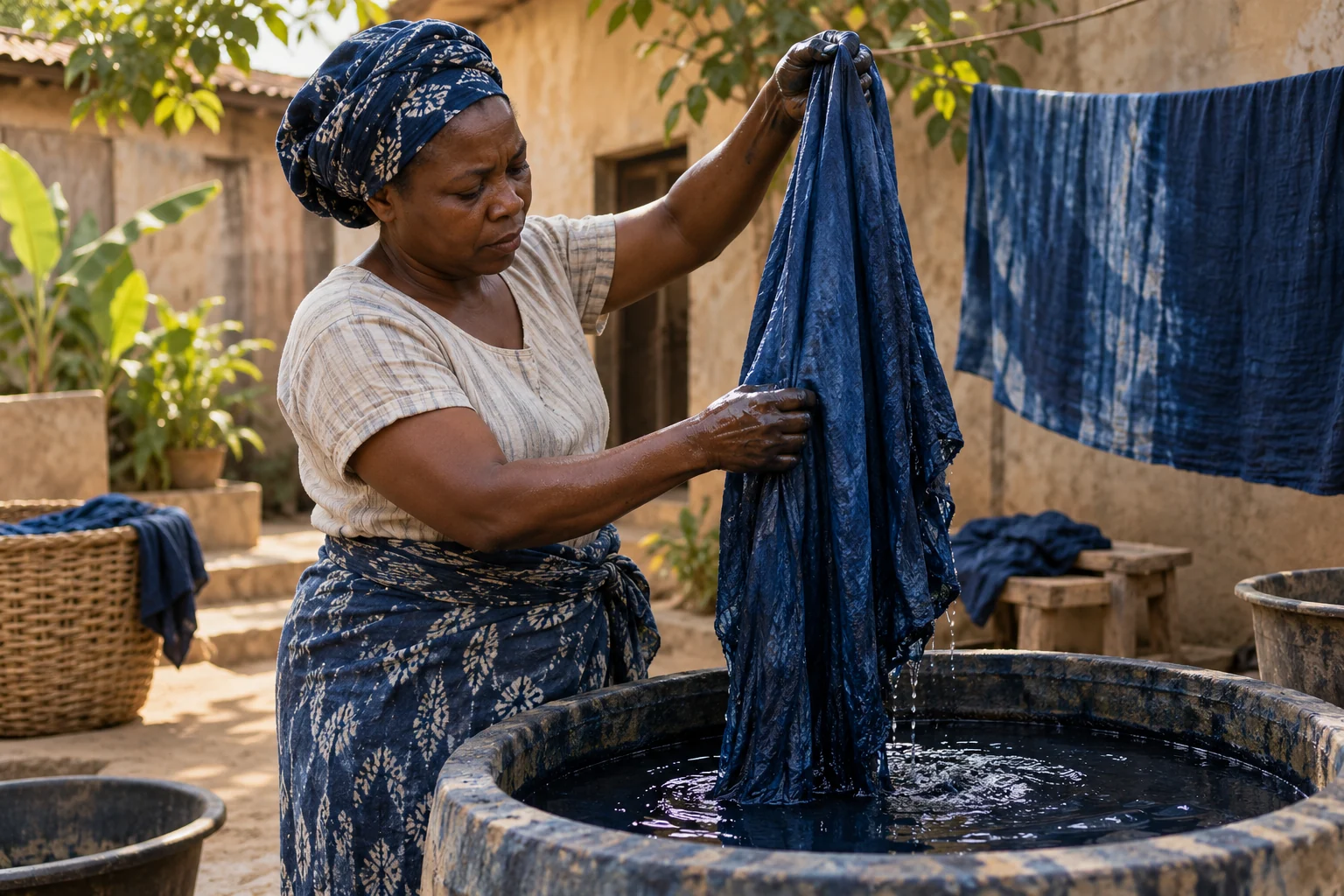
1. A grounded craft context
The Horniman Museum’s account of adire archives connects Ìyá Mapo with indigo dyeing and women’s skilled work. Indexed material from Owoeye’s textile research identifies differing attributions involving Ìyá Mapo and Ọ̀ṣun. The complete thesis was not accessed here, so its detailed arguments remain a reading lead rather than independently checked support.
That distinction matters. A shared relationship with a town, women’s work or dyeing does not make every sacred figure in the setting interchangeable. The Academy gives Ìyá Mapo a separate entry so the craft relationship can be learned with its own name.
2. Key theme: material has conditions
A skilled maker does not simply impose an idea on passive matter. Material responds. Color, timing, pressure and repeated handling can change the result. Knowing how to act requires attention to what is happening rather than confidence in an intention alone.
For contemporary reflection, this is a lesson in practical humility. Expertise becomes visible through the ability to notice a small difference and adjust. The novice may see repetition where the trained maker sees a sequence of judgments. Respecting the craft includes learning to recognize those judgments instead of calling the finished result natural talent.
3. Women’s work and the distribution of authority
Work can be economically essential while being socially undervalued. A community may admire the product and still fail to recognize the maker’s knowledge or bargaining power. A sacred craft association opens a way to examine that inequality without assuming that every woman is naturally suited to the same task.
The contemporary question concerns the difference between celebration and material recognition. Is the maker paid fairly? Can knowledge be passed on under workable conditions? Does public praise leave the person doing the work with any greater authority over their own life?
4. Religious identity and the scope of this study
Ìyá Mápó should be studied through particular relations among indigo dyeing, women's skilled work and religious regard. Powerhouse's wrapper record and the Horniman's archival discussion supply credible material settings for those relations. They do not establish that all women practice the same trades, that craft knowledge is biologically feminine or that every dyeing community shares a single origin narrative. The opening discussion's emphasis on intelligence carried through hands and materials can therefore be deepened without turning occupational history into gender essence. The book contains no dedicated Ìyá Mápó portrait.
Its crafted matter and vegetal ecology chapters provide an interpretive framework for considering how living materials, trained judgment and social relations become meaningful together. Figure specific claims require the external sources. Contemporary psychological analysis can ask how skill develops through responsive attention, how makers receive recognition and how inherited knowledge is carried without freezing the next generation. The deity remains larger than those questions. A religious relation cannot be inferred from liking indigo or identifying as creative. The article should let the named craft setting teach specificity: finished beauty has a history of labor, learning and dependence that an admiring viewer can easily overlook, especially when the maker's expertise is treated as ordinary women's work.
5. Knowledge that gives the figure depth
5.1 How does resist patterning clarify form and limit?
The Powerhouse object is an indigo resist dyed wrapper made by a Yorùbá woman in the mid twentieth century. The record links the work with mother to daughter teaching and religious regard for Ìyá Mápó. It therefore provides a concrete social history rather than an abstract statement that craft and religion are connected. The article should not turn the museum's short technical description into instructions or assume that its terminology settles every question of dye chemistry. What matters for interpretation is that a patterned cloth emerges through skilled control of where color enters and where it is held back.
An original psychological application can ask how form depends on selective limits as well as expression. The visible pattern includes boundaries that preserve difference; unrestricted saturation would not produce the same result. This is not a traditional doctrine that every pale area symbolizes a boundary in the psyche. It is a contemporary reflection on a documented material relation. The craft image becomes useful when it restores attention to judgment: the maker must understand how an intended form can become legible through matter. Beauty is not merely an inspiration placed on cloth. It is the result of knowing how conditions and limits participate in a design.
Evidence: Powerhouse Museum, Yoruba adire oniko cotton wrapper from Western Nigeria, 2008/59/19 — Museum record links indigo dyeing, mother to daughter craft transmission and offerings to Iya Mapo; object dated 1950–1966. Technical wording not treated as safe instruction; Amanda Kirby Okoye / Horniman Museum and Gardens, Nigeria60: Adire Archives — 2020 museum account revisits Stanfield collection and Wenger/Beier archival descriptions connecting Iya Mapo with women craft trades, indigo and distinct named patterns; Owoeye, University of Pretoria, Textiles texts and symbols: women dyers and symbols in the Indigo textile dyeing production process in Osogbo Nigeria — Repository metadata and indexed thesis passage identify research on women dyers and a contested attribution between Osun-Osogbo and Iya Mapo.
5.2 What does a craft complex reveal about authority?
The Horniman discussion revisits archival descriptions in which Ìyá Mápó is connected with several trades historically associated with women, including dyeing, pottery, oil pressing and soap making. This is an attributed historical account, not a complete map of current practice or proof that every trade is exclusively female everywhere. Its importance is to make a field of knowledge visible. Work can be indispensable while being described as domestic routine rather than expertise. A contemporary interpretation can ask how a community recognizes the maker's authority, not simply the usefulness of the product.
Public praise may celebrate heritage while leaving bargaining power, teaching time and working conditions unchanged. The distinction between celebration and recognition is therefore material. A skilled person needs conditions under which knowledge can continue to be practiced and transmitted. The book's crafted matter framework supports attention to labor as part of sacred form rather than a lower activity beneath thought. Applied to Ìyá Mápó, this challenges a hierarchy in which design is credited to inspiration while bodily judgment remains unnamed. The article should avoid romanticizing hardship as the source of authenticity. Respect for craft includes recognizing that essential knowledge can be lost when people cannot afford to sustain it, even if the finished objects remain admired in collections.
Evidence: Powerhouse Museum, Yoruba adire oniko cotton wrapper from Western Nigeria, 2008/59/19 — Museum record links indigo dyeing, mother to daughter craft transmission and offerings to Iya Mapo; object dated 1950–1966. Technical wording not treated as safe instruction; Amanda Kirby Okoye / Horniman Museum and Gardens, Nigeria60: Adire Archives — 2020 museum account revisits Stanfield collection and Wenger/Beier archival descriptions connecting Iya Mapo with women craft trades, indigo and distinct named patterns; Owoeye, University of Pretoria, Textiles texts and symbols: women dyers and symbols in the Indigo textile dyeing production process in Osogbo Nigeria — Repository metadata and indexed thesis passage identify research on women dyers and a contested attribution between Osun-Osogbo and Iya Mapo.
5.3 How do names and contested attributions affect seeing?
A named textile pattern can carry information a viewer initially mistakes for abstraction. The Horniman account discusses cloth through particular motifs and their names, showing that visual enjoyment may precede understanding. This gives the entry a specific knowledge problem: how does one learn to see a material language? The answer involves listening to makers and learning context, rather than assuming every shape has a universal psychological meaning. The opening discussion's Owoeye reference is especially relevant as a research direction because the indexed thesis passage notes disagreement over attribution to Ìyá Mápó and Ọ̀ṣun in Osogbo.
Complete access was blocked, so the article should not claim to have settled that debate from unseen pages. The limited evidence is enough to prevent an automatic merger of the two figures. Contemporary analysis can explore how competing accounts of origin reveal the importance of a craft without deciding which community must be wrong. A learner can preserve the names and ask who supplies each account, where it is used and what relation it supports. That method makes the article richer than a single confident story. It also respects knowledge as something distributed among people, places and practices, rather than a set of attractive meanings an outsider can extract from a finished cloth.
Evidence: Powerhouse Museum, Yoruba adire oniko cotton wrapper from Western Nigeria, 2008/59/19 — Museum record links indigo dyeing, mother to daughter craft transmission and offerings to Iya Mapo; object dated 1950–1966. Technical wording not treated as safe instruction; Amanda Kirby Okoye / Horniman Museum and Gardens, Nigeria60: Adire Archives — 2020 museum account revisits Stanfield collection and Wenger/Beier archival descriptions connecting Iya Mapo with women craft trades, indigo and distinct named patterns; Owoeye, University of Pretoria, Textiles texts and symbols: women dyers and symbols in the Indigo textile dyeing production process in Osogbo Nigeria — Repository metadata and indexed thesis passage identify research on women dyers and a contested attribution between Osun-Osogbo and Iya Mapo.
6. A depth-psychological reading
Interpretive basis: A contemporary application of the wider interpretive framework in Babá Tilo de Àjàgùnnà’s The Orishas and the Human Soul, especially “Before the Òrìṣà Become Archetypes”, “Metals, Tools, Fire, Cloth, Stones, and the Crafted Body of Power”, “Trees, Plants, Leaves, and the Living Intelligence of the World”. No dedicated Ìyá Mápó chapter. Material/vegetal framework supports a contemporary analysis; specific craft relations rest on museum accounts and bounded Owoeye metadata/indexed evidence.
6.1 Depth psychology: shaping without total control
A depth psychological lens can examine the difference between shaping a material and controlling it. The book's crafted matter discussion recognizes that making involves process, discipline and transformation. Applied contemporarily to Ìyá Mápó's dyeing field, it suggests a tension between an ideal design and the conditions through which that design can become real. An illustrative maker may interpret every deviation as a humiliation, insisting on the original plan even when the material calls for adjustment. The difficulty is not commitment to quality. It is a self image that cannot tolerate learning from what resists intention.
Another person may surrender intention too quickly, calling every unfinished result spontaneous in order to avoid the exposure of developing skill. The craft image can hold both extremes in view. Maturity involves enough form to guide work and enough receptivity to revise. This is an interpretive account, not a personality description of devotees or a claim that craft practice treats a psychological condition. Its specificity lies in the maker's relationship with feedback. Material does not flatter the intention; it makes consequences visible. A person can learn to meet that visibility without collapsing into shame or claiming total mastery. The inner development is a more durable capacity to remain in relation with a process that is partly theirs and partly governed by conditions beyond their preference.
6.2 Relational development: correction without humiliation
A relational and developmental lens concerns how a learner receives correction from someone whose knowledge is carried through action. Mother to daughter teaching in the museum account offers a concrete setting, but the contemporary analysis need not presume that every such relationship is harmonious or biologically determined. An illustrative apprentice may experience correction as rejection because the product feels inseparable from personal worth. A teacher may respond by becoming harsher, believing intensity proves commitment. The work then carries a relational strain that can obstruct learning.
The book's framework permits a more exact distinction: skill develops through attention to process, while dignity need not depend on already being skilled. A correction can identify a material consequence without defining the learner as inadequate. Conversely, encouragement that refuses every correction can leave someone unsupported when real demands arrive. Ìyá Mápó's craft field helps consider how care and standards can coexist. This is not a claim about traditional pedagogy or a universal recommendation for families; it is an original interpretation of the learning relationship.
The psychological question is whether knowledge can be transmitted without humiliation and whether a learner can accept dependence without surrendering curiosity. A sustaining relation makes room for repetition, questions and gradual responsibility, so the next generation receives more than a demand to reproduce the teacher's public success.
6.3 Collective systems: beauty, credit and working conditions
A collective systems lens can follow the distribution of recognition around a finished object. A cloth may become a sign of a community's beauty while the maker's name and conditions remain obscure. The public viewer receives pleasure; traders or institutions may receive visibility; the person who holds practical knowledge may receive little authority. The external museum settings make this a concrete question about how objects travel, though this study does not claim to reconstruct every object's acquisition history. The book's material framework helps retain the hand and labor within the meaning of the object.
An illustrative family craft business may depend on one woman's skill while presenting a different member as the entrepreneurial genius. Correcting that story is not merely giving praise. It may require making decision power, compensation and teaching responsibilities discussable. The inner dimension concerns how a maker internalizes the distribution: some accept invisibility as the price of belonging, while others may feel that asking recognition threatens the group. These possibilities are contemporary interpretations, not claims about all women dyers. Ìyá Mápó's field allows appreciation to become more accountable.
Heritage remains living when the people carrying it can sustain dignified lives and when the next generation can learn under workable conditions. Admiring products while neglecting those relations preserves objects more easily than knowledge.
7. What this relationship means for a person
7.1 In an established devotional or initiatory relationship
An established devotional relationship involving Ìyá Mápó belongs within the community and craft setting that recognizes it. The museum accounts establish religious regard in dyeing contexts; they do not establish one universal personal head initiation or authorize a public article to prescribe forms of worship. A person may inherit a trade, learn a skill or participate in devotion through relations that need their own accountable teachers. The book's broader framework can serve as a reflective companion to an already acknowledged relationship. It can ask whether making has become a site of attention or a measure by which the person relentlessly judges their worth.
It can also deepen appreciation for the people who taught the work and for the material conditions that permit it to continue. Sustained relation is not confined to moments when the result is beautiful. Mistakes, changing demand, interrupted transmission and the need to teach others can all expose how skill is carried. These are contemporary possibilities rather than an imposed religious life cycle. This interpretation retains craft's economic reality: devotion does not remove the need for fair compensation, safe working conditions and adequate learning time.
Nor does religious association make every maker's judgment unquestionable. Inner development may include hearing correction and making one's knowledge communicable without using dependence to secure authority. Established relation therefore remains larger than creative affinity, joining reverence with the actual people, work and responsibilities through which the craft field is lived.
7.2 When the figure becomes relevant in consultation
If Ìyá Mápó is encountered through consultation, the discussion must remain grounded in the actual consultation's tradition. This research does not establish a universal divination protocol attached to the figure. The public text can describe possible interpretive questions about craft, material responsiveness, recognition and transmission without claiming that each is a fixed message. An illustrative person may have many ideas but little willingness to enter the repeated judgments required to make one workable. Another may possess mature expertise yet remain unable to claim compensation or authority.
The craft field could orient attention toward disciplined learning in the first case and rightful recognition in the second. A generic instruction to be more creative would miss both. The book's method keeps contemporary analysis distinct from religious determination: encountering a presence in consultation does not automatically establish a head affiliation or authorize the learner to perform protected work. Useful questions concern what is being made, whose knowledge supports it, what material feedback has been ignored and who benefits from the result. Answers may involve ordinary practical changes as well as the practitioner's religious counsel.
The article should avoid translating every livelihood problem into a spiritual deficiency or promising that devotion guarantees a successful product. Its contribution is to make the relation among intention, skill and social value more exact. Consultation then becomes an occasion for clearer participation in a particular process rather than a label explaining a person's entire creative identity.
8. Nature, materials and human knowledge
Ìyá Mápó's verified material setting includes indigo cloth and the social relations of dyeing. Leaves, dye, textile, pattern and trained handling meet, so vegetal life and crafted matter are already intertwined. The book's ecology method is useful because it asks what a material does within a relation, rather than assigning a single stable meaning to blue cloth or a leaf. A contemporary ecological application can ask how materials are obtained, how skills remain viable and what conditions support continued work. This should not claim a verified ancient conservation program or reproduce technical procedures from a short catalogue.
The social ecology includes teachers, apprentices, traders, wearers and collectors, each encountering a different part of the work's history. A finished wrapper can preserve evidence of skill while the practical knowledge required to make another one becomes less available. Sustaining heritage therefore involves living people and opportunities to learn as well as preserved objects. The entry should avoid adding unsourced animals, numbers or universal colors to make the field look complete. Indigo's actual appearance belongs to this documented craft setting, but its interpretation varies with motif, use and community. Specific material attention opens a deeper understanding than a decorative association table detached from the maker.
9. Diaspora, comparison and syncretism
Ìyá Mápó should remain distinguishable from Ọ̀ṣun even when sources discuss both within Osogbo and dyeing traditions. Owoeye's indexed passage indicates contested attribution, which is evidence that the relation needs careful study rather than an invitation to select the most familiar deity. The blocked full text limits how much can be said about the debate. We can explain that shared locality, women's work or dyeing does not by itself establish identity. Horniman's archival craft account is likewise a particular historical voice, not proof of one universally accepted genealogy.
No inspected source supplies a general Catholic saint correspondence, and none should be invented. Comparisons with other craft patron figures can illuminate skill, gendered labor and religious authority while preserving different histories. The book's psychological framework also does not turn every skilled mother into a representation of Ìyá Mápó. A resemblance is an interpretive opening, not a religious classification. This section can teach a useful discipline: ask who names a correspondence and what it does in practice. Where the evidence supports only relation or disagreement, retain that result. It allows the figure to remain specific and gives readers a more honest account of living knowledge than a simplified equivalence that erases the very makers whose work the article seeks to honor.
Evidence: Powerhouse Museum, Yoruba adire oniko cotton wrapper from Western Nigeria, 2008/59/19 — Museum record links indigo dyeing, mother to daughter craft transmission and offerings to Iya Mapo; object dated 1950–1966. Technical wording not treated as safe instruction; Amanda Kirby Okoye / Horniman Museum and Gardens, Nigeria60: Adire Archives — 2020 museum account revisits Stanfield collection and Wenger/Beier archival descriptions connecting Iya Mapo with women craft trades, indigo and distinct named patterns; Owoeye, University of Pretoria, Textiles texts and symbols: women dyers and symbols in the Indigo textile dyeing production process in Osogbo Nigeria — Repository metadata and indexed thesis passage identify research on women dyers and a contested attribution between Osun-Osogbo and Iya Mapo.
10. Questions for a fuller understanding
10.1 Why is craft more than a recipe?
Why is craft knowledge more than following a recipe? A written sequence can identify steps while leaving the judgments within them unlearned. A maker notices differences in material, timing and result that may not be obvious to a novice. The book's crafted matter framework helps make that intelligence visible. Applied contemporarily to Ìyá Mápó's documented dyeing field, the point is to respect training rather than romanticize effortless talent. A learner needs opportunities to observe, try, receive correction and understand context. This does not mean every detail is secret or that writing is useless. It means information and skill are related achievements, with different requirements. Honoring a finished object includes recognizing the process of judgment through which it became possible.
10.2 Does heritage praise ensure recognition?
Does celebrating women's heritage automatically improve makers' conditions? No. Public admiration can coexist with weak compensation, limited authority and inadequate time for teaching. The contemporary ethical question is what recognition changes materially. The museum accounts make women's craft work visible; the book's framework allows analysis of how that work becomes socially valued. Neither proves the conditions of every current workshop. A careful article can ask concrete questions without speaking for all makers: who receives credit, who sets terms and can another generation afford to learn? Ìyá Mápó's field becomes deeper when beauty and responsibility remain connected. The aim is not to reduce sacred craft to economics but to acknowledge that living knowledge requires people who are able to keep practicing and teaching it.
11. Correlations to life dimensions
| Dimension | A question for reflection |
|---|---|
| Work | Which trained judgments have I mistaken for effortless talent? |
| Creativity | Am I listening to the material or merely insisting on my intention? |
| Recognition | Does admiration change the conditions under which the maker works? |
| Heritage | What is needed for the next generation to learn this skill well? |
12. A connected study
Òṣun opens a different account of recognition and reciprocity. Ògún makes skilled material work visible through iron. Their comparison can challenge the hierarchy between thought and making while preserving Ìyá Mapo’s particular craft setting.
13. Sources for the expanded interpretation
Interpretive basis: A contemporary application of the wider interpretive framework in Babá Tilo de Àjàgùnnà’s The Orishas and the Human Soul, especially “Before the Òrìṣà Become Archetypes”, “Metals, Tools, Fire, Cloth, Stones, and the Crafted Body of Power”, “Trees, Plants, Leaves, and the Living Intelligence of the World”. No dedicated Ìyá Mápó chapter. Material/vegetal framework supports a contemporary analysis; specific craft relations rest on museum accounts and bounded Owoeye metadata/indexed evidence.
-
Powerhouse Museum. Yoruba adire oniko cotton wrapper from Western Nigeria, 2008/59/19. Museum record links indigo dyeing, mother to daughter craft transmission and offerings to Iya Mapo; object dated 1950–1966. Technical wording not treated as safe instruction. Public institutional record or research text inspected; claim scope stated.
-
Amanda Kirby Okoye / Horniman Museum and Gardens. Nigeria60: Adire Archives. 2020 museum account revisits Stanfield collection and Wenger/Beier archival descriptions connecting Iya Mapo with women craft trades, indigo and distinct named patterns. Public institutional record or research text inspected; claim scope stated.
-
Owoeye, University of Pretoria. Textiles texts and symbols: women dyers and symbols in the Indigo textile dyeing production process in Osogbo Nigeria. Repository metadata and indexed thesis passage identify research on women dyers and a contested attribution between Osun-Osogbo and Iya Mapo. 2017 thesis identity and indexed passage verified; repository/PDF returned 403 for complete reading. No full-text specific claim inferred.
Owoeye complete text blocked; contested-attribution claim is limited to verified indexed passage. Museum technical summaries are not practical instruction. No universal head initiation, saint correspondence or essential gender aptitude is inferred.