
A child’s well-being is often described as a family concern, but no family lives outside a wider community. Kórìkóto opens the study of how children are recognized, protected and received through religious relationships. The subject becomes more substantial when care is understood as a shared practice rather than a promise of effortless fertility or safety.
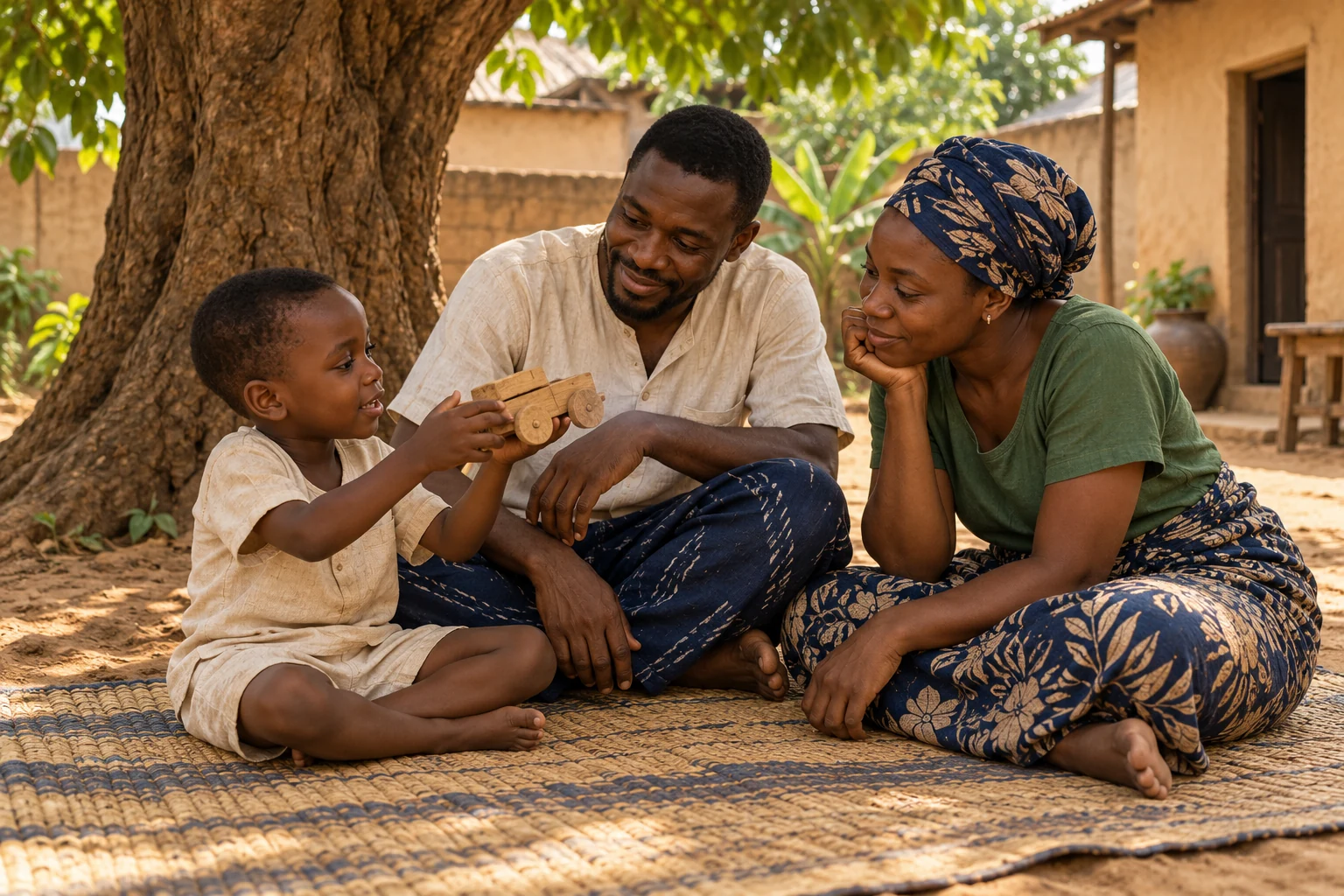
Shelter and growth evoke communal care without making fertility a measure of worth.
1. A regional Yorùbá context
Original research published through Obafemi Awolowo University places Kórìkóto in Yewa-Àwórì, Ẹ̀gbá and Ìjẹ̀bú settings and examines orature and symbolism associated with children’s sacred protection. This is a stronger beginning than a generic description copied across every region.
A related interview-based study emphasizes communal care. These sources concern religious and social meaning. They do not justify a guarantee that devotion will produce pregnancy, prevent illness or remove every danger from a child’s life.
2. Key theme: welcoming life creates obligations
The birth of a child can be celebrated intensely while the long work of care becomes invisible soon afterward. A religious recognition of children can ask a community to sustain attention beyond the moment of welcome. Food, safety, affection, education and relief for caregivers are practical forms through which that attention becomes real.
This is a contemporary application, not a ritual prescription. It also avoids treating a child as a symbol of adult success. A child is a person whose emerging needs may challenge the expectations attached to their arrival.
3. Vulnerability and the dignity of caregivers
The person closest to the child can be praised for devotion while being left alone with every difficulty. Calling care sacred should not make exhaustion untouchable. The care of caregivers belongs to the same field of responsibility.
The study can also help a reader examine how a community speaks about people who do not have children. A religious appreciation of fertility should not become an accusation, a measure of personal worth or a reason to make private medical circumstances public.
4. Religious identity and the scope of this study
Kórìkóto is a children-related sacred presence documented in regional Yorùbá settings, including Yewa-Àwórì, Ẹ̀gbá, and Ìjẹ̀bú communities in the study published by Obafemi Awolowo University’s education journal. Its research concerns orature and symbolic materials among several children’s deities. This is a better foundation than a universal profile assembled from unsourced fertility claims. It places Kórìkóto within social life, learning, protection, and the relationship between children and the adults responsible for receiving them.
The identity question is not only who grants a child, but what a community becomes answerable for when it values children religiously. A birth can be celebrated while the long labor of care remains unevenly distributed. Kórìkóto’s field brings those two moments together. The newer interview-based study by Adeoti Damilola Adedeji and Abidemi Olusola Bolarinwa explicitly connects the tradition to communal child welfare; its proposal should be presented as the authors’ interpretation rather than proven clinical effectiveness. The contemporary DAILY IFÁ reading adds a further psychological analysis. It does not claim a dedicated Kórìkóto chapter in the supplied book, a single practice shared across all regions, or a guarantee about conception, health, or a child’s future.
5. Knowledge that gives the figure depth
5.1 How do orature and objects make children’s belonging visible?
The OAU-published study examines chanting, songs, and shrine materials across three children-related sacred traditions. Its abstract lists several kinds of objects and places, but those items should not all be assigned to Kórìkóto indiscriminately. The defensible point is that belonging is expressed in more than a theological definition: voice, shared memory, and material settings give it a perceptible form. The relationship between voice, memory, and material setting is intelligible at a public level, distinct from the private repertoire of a community.
The interpretive value concerns how adults learn to recognize a child as a participant in communal life. An object associated with childhood may draw attention to dependence, play, growth, and the duties of those who care. A repeated song can make a value memorable long before a child can explain it abstractly. Yet the adult interpreter should still ask who gets to explain the meaning and whether the child’s actual experience is heard. A religious language of protection can be generous while leaving some forms of ordinary exclusion unnoticed. Kórìkóto therefore opens a concrete inquiry into the passage between symbolic welcome and lived inclusion. The material is not merely decorative, and the child is not merely a symbol of an adult’s fulfilled expectation.
Evidence: Sauban Alade Ishola and Ayobami Mistura Tabi-Agoro (journal typography imperfect), An Analysis of Orature and Symbolic Elements of Selected Children’s Deities among Yewa-Àwórì, Ẹ̀gbá and Ìjẹ̀bú in Ògùn State — OAU-hosted Ife Journal of Theory and Research in Education 24, 2023; three distinct children-deity traditions, regional orature and material symbols. Aggregate object list must not be assigned to one deity without text verification.
5.2 What does communal care add to an individual account of parenting?
Adedeji and Bolarinwa use interviews and oral materials to discuss Kórìkóto in relation to modern child welfare. Their article draws on attachment and bonding theory and proposes that communal values can enrich approaches focused mainly on the individual. This verifies a contemporary scholarly conversation; it does not establish that a religious model has been tested as a treatment or that all Yorùbá families organize care identically.
The substantive question is how a child’s well-being depends on relationships beyond the most visible caregiver. Housing, predictable support, education, protection, and relief for exhausted adults shape what care can become. A community that praises maternal devotion while leaving the mother alone has not solved that problem. Nor does collective responsibility mean that every adult is entitled to override the child or parent. It requires identifiable duties and attention to consent, competence, and continuity. A new interpretive application can therefore ask who notices when the ordinary work fails: a child stops participating, a caregiver becomes depleted, or a household becomes isolated. Kórìkóto’s relevance lies in connecting sacred recognition to the daily conditions of welcome. The question is not how loudly a community declares that children matter, but how that declaration organizes shared attention over time.
Evidence: Adeoti Damilola Adedeji and Abidemi Olusola Bolarinwa, Replicating The Place of Kórìkóto Òrìṣa Èwe in The Modern Yorùbá Child Welfarism — 2026 primary qualitative article, University of Ibadan authors, interviews and oral materials; communal care interpreted through attachment/bonding framework. Proposals are not clinical validation.
5.3 How can fertility be valued without making it a measure of worth?
The OAU abstract reports childbearing and healing-related meanings among the traditions studied. Present these as the concerns and beliefs examined by the authors, rather than promised outcomes. Religious concern for fertility can be understood as an appreciation of continuity, relationship, and the vulnerability of new life. It need not imply that every adult’s dignity depends on becoming a biological parent or that difficulties with conception reveal spiritual failure.
The social tension is direct and consequential. A person may deeply desire children and also need privacy, competent care, and freedom from public speculation. Another may not seek parenthood. A third may care for children through extended kinship, teaching, or everyday responsibility. These lives should not disappear behind a single success narrative. Contemporary interpretation becomes more humane when it separates the value of life from the prestige attached to producing it. Kórìkóto’s child-related field can then expand the circle of care rather than become a mechanism of comparison. It invites attention to how adults speak around children as well: a wanted child should not be made responsible for validating the parents, repairing a marriage, or carrying a family’s unrealized ambitions. Sacred welcome creates responsibility toward a person, not ownership of an outcome.
Evidence: Sauban Alade Ishola and Ayobami Mistura Tabi-Agoro (journal typography imperfect), An Analysis of Orature and Symbolic Elements of Selected Children’s Deities among Yewa-Àwórì, Ẹ̀gbá and Ìjẹ̀bú in Ògùn State — OAU-hosted Ife Journal of Theory and Research in Education 24, 2023; three distinct children-deity traditions, regional orature and material symbols. Aggregate object list must not be assigned to one deity without text verification.
6. A depth-psychological reading
Interpretive basis: A contemporary application of the wider interpretive framework in Babá Tilo de Àjàgùnnà’s The Orishas and the Human Soul, especially “Before the Òrìṣà Become Archetypes”, “Metals, Tools, Fire, Cloth, Stones, and the Crafted Body of Power”, “Numbers, Colors, Directions, Thresholds, and the Grammar of Sacred Pattern”. No dedicated chapter for this figure exists in the supplied book. The historical and devotional orientation comes from the separately identified public sources. Psychological lenses and contemporary examples are NEW DAILY IFÁ applications of the book’s interpretive framework, not a recovered author portrait, doctrine of the source community, or clinical finding.
6.1 Attachment: being received as a person rather than a project
A relational application of the book asks how a child is welcomed before they can meet anyone’s expectations. Kórìkóto’s field makes the tension precise: adults may passionately want a child yet struggle to receive the particular child who arrives. The child’s temperament, pace, interests, or needs may differ from the imagined future around which the welcome was organized. Attachment in this interpretive sense concerns the quality of availability, not a claim that devotion determines a psychological outcome.
The light is a relationship in which dependence can be met without making the dependent person responsible for the caregiver’s identity. The shadow is conditional welcome: affection remains generous only while the child confirms the adult’s hopes. An illustrative parent may praise a child as a blessing but become withdrawn when the child resists the family’s preferred vocation. The developmental task for the adult is to mourn an expectation without making the child experience that mourning as rejection. For the growing child, the task is to discover agency within belonging rather than choose between obedience and abandonment. The book’s relational lens supports such questions, while the application to Kórìkóto is new. Sacred protection remains a religious relationship beyond the model. Psychological reflection simply asks whether the everyday environment can make room for the child’s emerging reality, including the parts that interrupt the adults’ cherished picture of care.
6.2 The caregiver’s invisible burden and the ethics of shared holding
A second lens concerns the adult who becomes the sole container of everyone’s anxiety about a child. Families can claim that children belong to the whole community while leaving one person to perform nearly all the work. The caregiver may then become both indispensable and invisible. They are noticed when something goes wrong, less often when their sustained attention makes ordinary life possible. A Kórìkóto-centered contemporary reflection asks how communal language becomes concrete support.
The light is shared holding: other people provide predictable help without taking over the caregiver’s judgment or using assistance to claim possession of the child. The shadow is idealization of selfless care. Praise can become an inexpensive substitute for rest, resources, and reliable participation. An illustrative grandmother might be called the family’s strength while no one checks whether she can continue the responsibilities they assign. The book’s family-systems and relational approaches help examine the bargain underneath the admiration. Does the caregiver feel entitled to need anything? Can the community respond before exhaustion becomes a crisis? Development involves redistributing work and acknowledging dependency on the caregiver’s labor. This is more than a recommendation for personal resilience. It locates the problem in the arrangement of relationships. Kórìkóto’s sacred field gives the question weight because the child’s protection and the caregiver’s dignity cannot be separated indefinitely without weakening both.
6.3 Intergenerational expectation and the child’s right to become
The book’s transgenerational method permits a new inquiry into the future a child is expected to carry. Families often invest children with hopes shaped by earlier deprivation: educational success, repaired status, economic security, or proof that suffering had a purpose. Those hopes can convey love and real resources. They can also become a burden when the child’s own development is understood as disloyalty to sacrifices already made.
Kórìkóto’s relevance is not that children should be freed from every inherited relationship. The sharper question is whether inheritance leaves room for becoming. An illustrative adolescent may feel unable to admit a different ambition because a parent repeatedly invokes the difficulty of bringing them into the world. The fact of being welcomed becomes an emotional debt with no clear limit. The light of intergenerational care is continuity with room for difference. Its shadow makes the child an instrument through which adults settle unfinished accounts with their own past. Development requires adults to own their hopes and disappointments without transferring the whole task of resolution to the next generation. It also requires listening as the child’s capacities and choices become clearer. This is a contemporary psychological application, not a diagnosis of devotees or a doctrinal claim about Kórìkóto. It honors children by asking how protection can include space to acquire a life that belongs to them within the relationships that sustain it.
7. What this relationship means for a person
7.1 In an established devotional or initiatory relationship
For someone already connected with Kórìkóto through family, regional devotion, or a recognized religious community, reflection deepens a relationship carried through actual people. The supplied sources do not establish one universal personal-head initiation framework. They also do not make every children-related deity identical. The person’s own tradition is the place to learn the meaning of participation, obligations, and the relation between public knowledge and local teaching.
The contemporary interpretive question concerns whether sacred appreciation of children is reflected in the quality of everyday relationships. Can the devotee remain attentive to the child who does not match family expectations? Is the caregiver’s need for rest treated as part of protection rather than a failure of devotion? Can people without children participate with dignity in a community that values fertility? These questions make a devotional life more exact without replacing it with psychology. They direct attention to the human consequences of an already established relationship.
A long-term affiliation may also support reflection across life stages. Someone once protected as a child may become a caregiver, teacher, elder, or advocate. The relevant question changes as their position changes. They may need to receive help at one time and to notice another person’s unnoticed labor later. That movement gives reflection substance without making a reproductive or health outcome its measure. Kórìkóto remains a sacred presence within the regional tradition, while the analytical study examines how recognition, dependency, and responsibility mature in human life.
7.2 When the figure becomes relevant in consultation
If Kórìkóto becomes relevant during consultation, the specific concern must lead the interpretation. A child-related sacred presence does not automatically announce pregnancy, explain infertility, or reveal a medical condition. It also does not establish that the client is destined for a particular religious initiation. The account should ask what the consultation actually discloses and how the practitioner’s tradition distinguishes a situational concern from a continuing relationship.
The outer configuration might include a caregiving strain, a dispute about a child’s future, an overwhelmed household, or an adult’s longing to welcome new life. Inner development would concern how the person responds: holding a fantasy too tightly, concealing exhaustion, equating fertility with worth, or overlooking the child’s own voice. These are different tensions, and no name alone determines which one is active. The book’s method helps connect circumstance and character while keeping them distinct. It does not turn a child into a symbol whose actual needs can be ignored.
A constructive contemporary discussion could identify who is doing the daily work, what support is absent, and which expectations belong to the adults rather than the child. It may also make room for grief or uncertainty without assigning blame. Where a concrete health or welfare issue exists, symbolic interpretation does not settle that issue by itself. A careful language of welcome and responsibility complements the religious obligation discerned within the accountable tradition of the consultation.
8. Nature, materials and human knowledge
Kórìkóto’s documented field joins children, voice, objects, shrine space, and communal relationships. The OAU study’s material inventory belongs to several selected traditions; assigning each item specifically to Kórìkóto would go beyond the verified scope. This matters because a list of white cloth, toys, stones, plants, and wooden objects can otherwise acquire a false authority as a universal correspondence table.
The book’s material and pattern chapters suggest a different approach. Ask how a thing or repeated form makes belonging tangible. A toy can direct attention to play and emerging agency; a shared place can give care continuity beyond a private household; a familiar song can hold memory between generations. These are interpretive possibilities and should be identified as such. The child’s environment is also human: caregivers, peers, elders, and people whose labor remains unnoticed. A meaningful ecology therefore asks whether the places and relationships actually permit children to flourish, speak, and be protected. This expands the subject beyond a fertility label while keeping the sources’ regional scope intact. The documented relations remain meaningful without an asserted universal medicinal plant, animal, color prescription, or promised outcome.
9. Diaspora, comparison and syncretism
No verified Catholic saint correspondence or standardized diaspora equivalence was established for Kórìkóto in the sources consulted. Nor should Kórìkóto be merged with Ìbejì, Yemọja, Aláráagbó, or Ẹgbẹ́ simply because several fields concern children. The OAU study’s very selection of distinct deities gives a useful lesson: proximity in concern can coexist with differentiated names, symbolic forms, and communities. Comparison is a beginning of inquiry, not permission to erase those differences.
A substantive syncretism discussion can therefore explain the questions a valid correspondence would need to answer. Which community uses the association? Is the claim a devotional identification, a teaching comparison, a translation, or an editor’s inference? What historical evidence establishes its use? Without those answers, a saint identification would conceal uncertainty instead of adding knowledge. The more fruitful comparative path concerns how different traditions protect the vulnerable and make adults responsible for new life. That question can bring Kórìkóto into dialogue with other studies while preserving the regional sacred presence. Contemporary welfare language is another kind of encounter: scholars can use attachment theory to interpret communal care, but the conceptual bridge does not prove that the deity is secretly an attachment archetype or that religious practice is reducible to social policy.
10. Questions for a fuller understanding
10.1 Is Kórìkóto only relevant to people seeking biological children?
The documented children-related field supports a broader discussion of care, social belonging, and the responsibility of adults toward children. A person may participate as a parent, relative, teacher, elder, or community member, depending on the actual tradition. That broader relevance should not be converted into a universal claim about religious entitlement. It means that valuing children has consequences beyond conception. The contemporary psychological study asks whether people can receive a child’s individuality, support caregivers, and make room for those whose lives do not follow a parental path. Those questions deepen the subject without making fertility a test of worth or promising a particular outcome.
10.2 How can protection include listening to a child rather than only speaking for them?
Adults often understand protection as deciding what should happen. That responsibility is real, yet it can become more exact when the child’s experience is heard in ways appropriate to their age and situation. A child may reveal a difficulty that the adult’s preferred story leaves invisible. Listening does not abandon care or require treating every wish as a final decision. It lets the actual person affect the form of care. A Kórìkóto-centered contemporary interpretation can therefore ask whether welcome continues when the child disagrees, develops differently, or needs something unexpected. Protection becomes relational rather than merely a declaration of adult intention.
11. Correlations to life dimensions
| Dimension | A question for reflection |
|---|---|
| Care | What practical support continues after the celebration of a child’s arrival? |
| Community | Who is caring for the person who carries most of the daily work? |
| Dignity | Have I allowed fertility to become a measure of someone’s value? |
| Attention | Can the child’s actual needs alter the expectations adults brought? |
12. Where to continue
Ìbejì opens a distinct study of twinship and continuing care. Yemọja brings maternity, holding and release. Personal religious questions concerning Kórìkóto should remain with the accountable practitioners of the relevant tradition. Public study can make the communal responsibility clearer without promising an outcome no article can guarantee.
13. Sources for the expanded interpretation
Interpretive basis: A contemporary application of the wider interpretive framework in Babá Tilo de Àjàgùnnà’s The Orishas and the Human Soul, especially “Before the Òrìṣà Become Archetypes”, “Metals, Tools, Fire, Cloth, Stones, and the Crafted Body of Power”, “Numbers, Colors, Directions, Thresholds, and the Grammar of Sacred Pattern”. No dedicated chapter for this figure exists in the supplied book. The historical and devotional orientation comes from the separately identified public sources. Psychological lenses and contemporary examples are NEW DAILY IFÁ applications of the book’s interpretive framework, not a recovered author portrait, doctrine of the source community, or clinical finding.
-
Sauban Alade Ishola and Ayobami Mistura Tabi-Agoro (journal typography imperfect). An Analysis of Orature and Symbolic Elements of Selected Children’s Deities among Yewa-Àwórì, Ẹ̀gbá and Ìjẹ̀bú in Ògùn State. OAU-hosted Ife Journal of Theory and Research in Education 24, 2023; three distinct children-deity traditions, regional orature and material symbols. Aggregate object list must not be assigned to one deity without text verification. Original journal abstract/indexed PDF verified; direct full PDF download failed.
-
Adeoti Damilola Adedeji and Abidemi Olusola Bolarinwa. Replicating The Place of Kórìkóto Òrìṣa Èwe in The Modern Yorùbá Child Welfarism. 2026 primary qualitative article, University of Ibadan authors, interviews and oral materials; communal care interpreted through attachment/bonding framework. Proposals are not clinical validation. Original full 8-page PDF verified at https://journals.stecab.com/jahss/article/download/1806/820/10287 . Title page gives both named authors, University of Ibadan affiliation, May 9, 2026, DOI and pp.43–50. Bolarinwa’s scholarly authorship/affiliation independently corroborated in NOUN YOR282 title page and Tydskrif vir Letterkunde 60(3), 2023. Use the qualitative interpretation, not clinical efficacy.
No dedicated book chapter, universal initiation profile, confirmed saint equivalent, guaranteed fertility/healing result, or verified individual allocation of every object listed collectively in the OAU abstract.