
An object can help authority appear permanent. A mask, crown or commissioned image makes a political relationship visible long after the voices around its creation have disappeared. Obalufon opens a study of that meeting between sacred kingship and the arts, asking how a community remembers power and how power asks to be remembered.
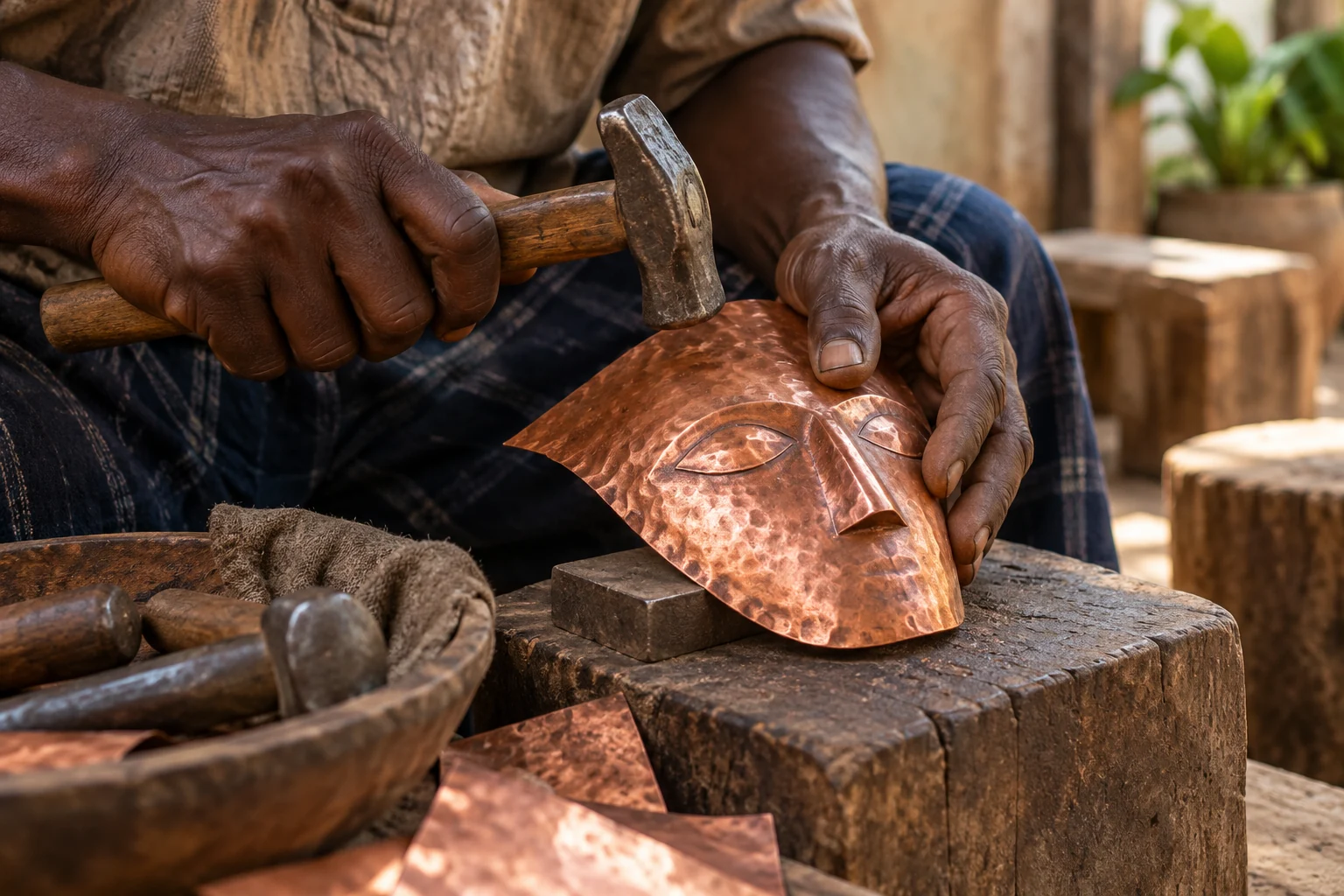
The face introduces metal arts and royal representation without copying a documented mask.
1. Ifẹ̀, royal memory and metalwork
Obalufon belongs to Ifẹ̀-centered royal and sacred histories. The name should not be confused with Olúfọ̀n merely because a quick reading finds similar letters. Their individual entries allow the reader to learn the relevant settings instead of losing the distinctions inside a compressed list.
In her original research on the Obalufon copper mask, Suzanne Preston Blier examines connections among Obalufon II, succession and metal arts. Some proposals about early object functions remain interpretations. A source can offer powerful evidence and still ask the reader to distinguish established material facts from historical reconstruction.
2. Key question: what does a royal image make visible?
A metal face is durable in a way that a human body is not. Its endurance can help an office appear to outlast the person who occupies it. Yet the object also carries the labor and technical knowledge of makers. Sacred royal art therefore raises a question about whose work is present inside a sovereign image.
For contemporary reflection, this applies to the logos, buildings and portraits through which institutions describe themselves. A polished image may preserve a useful shared identity. It may also make contested authority look natural. Looking carefully means asking who commissioned the representation, whose skill formed it and which relationships the finished object leaves outside the frame.
3. Art as thought, rather than decoration
It is tempting to treat artistic form as a beautiful container for ideas developed elsewhere. Ifẹ̀ art challenges that separation. Material, likeness, surface and the presentation of the body can participate in thinking about presence and authority. The work is not made intellectually secondary by being visible and tangible.
This is also a question for religious education. An image can hold knowledge that a short caption does not exhaust. Respecting the object requires more than assigning it a convenient symbolic meaning. It includes attention to its making, history and the limits of what can currently be known about its use.
4. Religious identity and the scope of this study
Obalufon belongs to Ifẹ̀'s sacred royal and artistic histories, particularly the remembered figure of Obalufon II and the metal face associated with his name. Suzanne Preston Blier's original study makes that meeting of kingship, succession, art and communal legitimacy the proper starting point. The figure should remain distinct from Olúfọ̀n: similar spelling is not historical evidence of identity. Obalufon's divine significance cannot be reduced to an example of effective political branding. The arts and material forms belong to a religious world in which presence, office and relationships may be carried through objects.
Human Soul has no dedicated Obalufon chapter and does not supply a hidden independent biography. Its broad material ecology offers a method for asking how crafted matter makes power visible, while its introductory method distinguishes devotional truth from psychological comparison. The present psychological work is consequently a new DAILY IFÁ application. It examines the relation between office and person, the desire to appear legitimate, the labor concealed by a sovereign image and the possibility of repair after contested authority. Those questions become figure specific through the copper mask and the art historical setting rather than by borrowing all of Obàtálá's attributes. The result should connect religion, making and political memory while preserving the limits of what the surviving object can prove.
5. Knowledge that gives the figure depth
5.1 What can the copper mask establish?
Blier opens with a technically accomplished life size copper mask preserved at Ifẹ̀ and identified in royal testimony with Obalufon II. Her historical argument links its interpretation to succession and royal legitimacy, while acknowledging that some proposed functions remain conjectural. A reference should keep these evidentiary levels distinct. Material, scale and visible features can be described as properties of an object; a proposed original use requires a historical argument; a remembered association belongs to a transmitted account. Their combination can be persuasive without each level becoming the same kind of proof.
The contemporary extension asks what a durable face does for an office carried by mortal people. It can make continuity perceptible across individual change. It can also encourage the public to mistake an institution's composed appearance for the condition of its actual relationships. An illustrative organization may commission an impressive portrait while neglecting the workers whose confidence would make the authority dependable. The picture then represents a claim that practice has not fulfilled. Obalufon's mask field lets an article ask about such claims without accusing the historical work of deception. The object is an occasion to study how legitimacy is made visible, and why visibility must remain answerable to the relations an image gathers around itself.
Evidence: Suzanne Preston Blier, Kings, Crowns, and Rights of Succession: Obalufon Arts at Ife and Other Yoruba Centers — Original art historical study of copper mask, Obalufon II, succession, peace and art patronage; author explicitly qualifies reconstructions.
5.2 How do skilled makers participate in legitimate power?
The art historical study treats Obalufon in relation to good government, peace and several arts, including metal casting, beadwork and weaving. These are situated associations rather than a license to assign every crafted object to him. Their interpretive value is that legitimate power and skilled making meet in something tangible. An office is rarely sustained by the office holder alone. Makers give authority a face, a surface, a garment, a recognizable form. Their work can be highly intelligent while remaining less publicly visible than the person who wears or commissions it.
The contemporary question is therefore how an institution acknowledges the knowledge inside its own appearance. A founder's celebrated presentation may depend on a designer, translator, administrator and maintenance worker. Calling those contributions merely decorative conceals the way they produce meaning and trust. Obalufon's specific arts make this more precise than a generic celebration of creativity. Beads, cloth and metal involve different kinds of preparation and material judgment. Their coordination can produce an image of unity without making the contributors identical. Psychologically, the person receiving the finished form must tolerate the truth that authority is composed through dependence. Recognition of the maker can then become part of good government, rather than a courtesy added after legitimacy has already been secured.
Evidence: Suzanne Preston Blier, Kings, Crowns, and Rights of Succession: Obalufon Arts at Ife and Other Yoruba Centers — Original art historical study of copper mask, Obalufon II, succession, peace and art patronage; author explicitly qualifies reconstructions.
5.3 Why is restored office different from repaired trust?
Blier's account also connects remembered political conflict and a return to rule with the problem of a durable peace. The article should attribute that reconstruction rather than present every narrated detail as an established chronological event. Its contemporary relevance lies in the difference between being restored to an office and repairing the relations that make the office viable. A person can win a dispute and remain unable to govern because the losing parties have been humiliated or excluded. A return that merely displays victory may recreate the conditions of conflict.
Repair requires an arrangement through which people can inhabit the shared order without continually rehearsing defeat. In an illustrative community organization, reinstating a chair after a contested election does not settle the question of trust. Clear decision processes, acknowledged mistakes and a meaningful place for dissent may matter more than a celebration of the chair's vindication. This is an analogy, not a claim that modern management explains Ifẹ̀'s sacred history. It follows Obalufon's specific conjunction of contested rule, peace and art toward a psychological question: can the person in power tolerate legitimacy that depends on reconciliation rather than personal triumph? The visible image may help a community hold continuity, but it cannot perform every act of repair on behalf of living people.
Evidence: Suzanne Preston Blier, Kings, Crowns, and Rights of Succession: Obalufon Arts at Ife and Other Yoruba Centers — Original art historical study of copper mask, Obalufon II, succession, peace and art patronage; author explicitly qualifies reconstructions.
6. A depth-psychological reading
Interpretive basis: A contemporary application of the wider interpretive framework in Babá Tilo de Àjàgùnnà’s The Orishas and the Human Soul, especially “Before the Òrìṣà Become Archetypes”, “Metals, Tools, Fire, Cloth, Stones, and the Crafted Body of Power”. No dedicated or shared Obalufon portrait is established. Historical facts come from Blier; all psychological readings are new DAILY IFÁ applications of the book’s material/relational method, not the author’s dedicated Obalufon teaching.
6.1 Confusing the person with the office
One inner dynamic concerns identification with office. A person entrusted with authority can gradually lose the distinction between an injury to their feelings and a threat to the institution. Criticism of a decision then becomes disrespect toward everything the office represents. The copper face offers a concrete comparison: an enduring image can carry continuity, but the individual who serves the office remains finite and correctable. Human Soul's material framework helps ask how visible form organizes a person's relation to power. In an illustrative director, the institution's logo, portrait and formal title become supports for a self that cannot tolerate ordinary disagreement.
The more complete the public image appears, the harder it becomes to admit uncertainty. This produces a paradox. Symbols intended to stabilize authority make the office holder brittle because any gap in performance feels like exposure of the entire institution as false. A more mature relation permits an individual to say that the office has standards they have not met on a particular occasion. Accountability can then affirm the institution rather than destroy it. This new psychological application is especially fitting to Obalufon's mask and succession field because it asks what can endure when persons change.
It does not diagnose historical rulers or devotees. Its practical force lies in separating the responsibility of carrying a role from the fantasy of becoming identical with its idealized appearance.
6.2 A polished face as expression or concealment
Another dynamic concerns the polished presentation that protects shame. A person who fears that their actual life would not command respect may invest heavily in the appearance of composure, taste or authority. Art and beauty are not the problem; they can express truth and sustain communal belonging. The difficulty begins when the image has to prevent every encounter with limitation. In the Obalufon application, a crafted face invites an examination of this relation between durable form and vulnerable personhood. An illustrative creative leader may produce meticulous public work while becoming harsh toward collaborators who see the disorder behind it.
Those collaborators threaten the fiction that excellence emerges without dependence or error. The person therefore receives their labor while denying them full recognition. The inward task is to let beauty become expression rather than concealment. This does not require exposing every private matter or discarding a professional form. It requires that the visible image remain permeable to accurate knowledge. A well made institutional presentation can acknowledge unfinished work, credit others and survive a corrected mistake. Human Soul's distinction between a crafted symbol and the relationship that charges it supports this interpretation.
A form becomes morally substantial through the relations it carries, rather than through finish alone. The figure specific question is thus what the mask allows a community to recognize, and what a living person might be tempted to hide behind the wish for a seamless face.
6.3 Vindication and the work of reconciliation
A third dynamic is the wish to secure legitimacy through victory alone. Someone whose position has been challenged may become so occupied with being proven right that they lose sight of what the position exists to serve. Every later decision is organized around preventing another humiliation. The historical question of restored rule and peace supplies an unusually exact point of comparison. An illustrative committee leader returns after a successful appeal but continues excluding everyone associated with the challenge. They have recovered the chair while weakening the shared body that gives the chair meaning.
The psychological task is not to pretend the conflict never mattered. It is to distinguish vindication, accountability and reconciliation. Some conduct needs to be named and corrected. Some differences must remain discussable. Some fears belong to the leader's injured pride rather than to a continuing threat. A legitimacy that includes these distinctions is less theatrical than one built around unanimous praise, but more capable of surviving change. Obalufon's relation to art adds another layer: a unifying image can help a community imagine continuity while the actual work of relation proceeds.
It becomes dangerous when it is asked to erase dissent rather than carry a plural social world. This is a contemporary interpretation based on the book's framework, not an assertion that the ancient mask had a single psychological purpose or that peace requires every injured party to reconcile.
7. What this relationship means for a person
7.1 In an established devotional or initiatory relationship
An established devotional relationship with Obalufon must be described through the actual local community or lineage in which it exists. The present sources support sacred art and royal associations, but do not establish that there is one universal personal head initiation available in the same form everywhere. A public article should therefore avoid borrowing the language of better known initiation systems as though it automatically applies. Sacred efficacy, the presence carried through particular forms, and the communal responsibility of those who tend them come first.
Within that living setting, a psychological comparison may ask how a person holds office, skill or public recognition. Does beauty deepen attention to the people and labor gathered into it? Does an entrusted role make its bearer more accountable, or provide a shield against correction? These are reflective questions that may accompany devotion without defining its entire meaning. Someone responsible for a community object may learn care through maintenance, patience with material limits and accurate transmission of what is known about it. Someone associated with an office may learn to separate personal prestige from the continuity of the community.
The details cannot be generalized from a museum object. The article's contribution is to honor the conjunction of making and legitimate power as a serious spiritual field. It should equip the reader to ask more informed questions of the people who carry that field, while being candid that a framework based interpretation offers neither liturgical credentials nor an independent account of a devotee's destiny.
7.2 When the figure becomes relevant in consultation
If Obalufon is named in a consultation, the interpretive priority is the actual system and community through which that naming occurs. This study does not establish that every form of Ifá or Òrìṣà consultation invokes the figure in an identical manner. The contemporary reflection can nevertheless remain exact when authority, artistic labor or a contested role is at issue. An illustrative person might ask about being passed over for a leadership position. The symbolic field would invite examination of both their real contribution and their investment in public recognition.
Are they seeking the responsibility of an office, the protection of a title or proof that a previous humiliation was undeserved? These possibilities can coexist and need careful discrimination. Another person might be making a commemorative object for a community. The relevant question could concern whose memory the work gathers and whose account remains absent. Such reflection should not decide the sacred answer in advance. It can help the person receive guidance without immediately translating it into a flattering story about rightful sovereignty. Any concrete devotional response must come from qualified interpretation, not from the appearance of copper, beads or a mask in an article.
A situational encounter may ask for a better relationship with makers, a truthful account of conflict or an acknowledgment that a polished presentation has outrun the reality it represents. These are possible ethical directions rather than prescribed outcomes. The figure remains a sacred power with a particular history, not merely a metaphor for professional success.
8. Nature, materials and human knowledge
Obalufon's material ecology is unusually inseparable from human technical intelligence. Copper and other cast metal arts, beads and weaving appear in the scholarly account as part of the figure's sacred and political field. Each material carries a different relation to time. Metal can give a face durability beyond an individual lifespan. Cloth allows a form to be worn and renewed. Beads gather small repeated elements into a socially legible whole. These are contemporary observations about material behavior, not claims about an undocumented universal symbolism. Human Soul provides the methodological basis by treating crafted objects as carriers of relation rather than inert illustrations.
The maker's judgment, the community's recognition and the circumstances of use matter alongside physical properties. This also keeps the ecology from becoming a list of luxury substances. Technical skill can sustain public meaning, while maintenance keeps that meaning available after the moment of commissioning. The psychological question concerns dependence made visible or concealed by the finished object. A sovereign image gathers many hands into one face. An ethical account should notice those hands without reducing sacred presence to labor alone. Obalufon's distinct contribution is the conjunction: crafted power, remembered rule and the relationships that allow a material form to remain more than an impressive surface.
9. Diaspora, comparison and syncretism
No independently verified Catholic saint correspondence for Obalufon has been established by the sources used here. That absence should remain explicit without turning into a long invented account of what must have happened in the diaspora. More fundamentally, the figure cannot be assigned Obàtálá's or Olúfọ̀n's correspondences through similar spelling or adjacent associations. A sacred figure linked to Ifẹ̀ kingship and arts has a specific field that requires its own evidence. The relation between royal memory, deification and material presence is already rich enough to study without a matching chart.
A useful comparative paragraph can distinguish forms of translation: an art historian may compare royal images across cultures; a community may preserve an inherited divine name; a devotee may relate an Òrìṣà to a saint; and a museum may catalogue a visual resemblance. Each relation makes a different claim. This study supports the first two far more directly than the third. Psychologically, the distinction guards against a familiar habit of recognizing something only after it has been assigned an already known equivalent. Respectful encounter can allow an object and a sacred name to remain unfamiliar while their historical setting becomes clearer. Obalufon's separate entry thereby preserves a real path of learning rather than filling uncertainty with borrowed identity.
Evidence: Suzanne Preston Blier, Kings, Crowns, and Rights of Succession: Obalufon Arts at Ife and Other Yoruba Centers — Original art historical study of copper mask, Obalufon II, succession, peace and art patronage; author explicitly qualifies reconstructions.
10. Questions for a fuller understanding
10.1 Can beauty establish that authority is legitimate?
A beautiful image can help a community hold a meaningful shared form, but it cannot establish that those represented are treated justly. The contemporary test is whether the relationships behind the appearance can tolerate truthful examination. In an illustrative institution, a commemorative portrait may acknowledge a founder while also crediting collaborators and admitting unfinished obligations. That makes the image more truthful rather than less dignified. Human Soul's material method supports attention to the relation carried through the object, not only its visual finish. Applied to Obalufon, the question should remain a modern interpretation of a specific sacred artistic field, never a claim that the ancient mask served to conceal wrongdoing.
10.2 Why distinguish an interpretation from an established fact?
Historical care distinguishes what can be seen, what a transmitted account says and what a researcher proposes. Blier's own qualification of some reconstructions is a strength of the source. It lets a reader appreciate an argument without treating every possibility as a settled fact. The psychological parallel is a willingness to hold an incomplete picture without rushing to a total judgment. In ordinary conflict, people often turn a plausible interpretation into certainty because uncertainty threatens their authority. Obalufon's art historical setting offers a more disciplined habit: name the evidence, credit the account and preserve room for revision. Such restraint is part of responsible representation rather than a failure to tell a compelling story.
11. Correlations to life dimensions
| Dimension | A question for reflection |
|---|---|
| Leadership | Does the image of my authority leave room for accountability? |
| Creativity | Whose labor is concealed by the finished representation? |
| Memory | Which story becomes durable, and which voices remain absent? |
| Study | Can I distinguish an object’s documented history from a persuasive hypothesis? |
12. Where to continue
Odùdùwà opens sacred origin and descent. Òrànmíyàn leads toward other royal memories of Ifẹ̀. Studying them together can clarify the relation among office, art and inheritance without inventing one seamless chronology. Obalufon’s distinctiveness lies partly in that concrete meeting of making and sovereignty.
13. Sources for the expanded interpretation
Interpretive basis: A contemporary application of the wider interpretive framework in Babá Tilo de Àjàgùnnà’s The Orishas and the Human Soul, especially “Before the Òrìṣà Become Archetypes”, “Metals, Tools, Fire, Cloth, Stones, and the Crafted Body of Power”. No dedicated or shared Obalufon portrait is established. Historical facts come from Blier; all psychological readings are new DAILY IFÁ applications of the book’s material/relational method, not the author’s dedicated Obalufon teaching.
- Suzanne Preston Blier. Kings, Crowns, and Rights of Succession: Obalufon Arts at Ife and Other Yoruba Centers. Original art historical study of copper mask, Obalufon II, succession, peace and art patronage; author explicitly qualifies reconstructions. The Art Bulletin 67(3), 1985; paper text inspected, especially opening and sections on return to rule and art patronage.
No dedicated Human Soul Obalufon chapter, no universal personal initiation, and no saint equivalence verified. Blier distinguishes material evidence, testimony and historical reconstruction; do not collapse them.