
The preparation of food rarely receives the attention given to a finished feast. Yet a community’s continuity depends on repeated work that can seem ordinary until it stops. Ògìyán invites a study of strength through nourishment, preparation and the relationship between a sacred celebration and the people who make it possible.
Preparation joins strength to the responsibility of feeding others.
1. Èjìgbò as a concrete starting point
The Osun State account of Èjìgbò locates Ogiyan worship in the town’s history and describes its new-yam celebration and Ewo tradition. This local setting is an important anchor. It prevents a globally familiar Brazilian description from becoming the only account available to a new reader.
In Brazilian Candomblé, Oxaguiã is commonly understood through relationships with Oxalá, youthfulness and active force. Connections with the pounding and preparation of yam are significant in public accounts. The African town’s religious history and the Brazilian form can be read together without treating them as identical in every detail.
2. Key theme: nourishment requires transformation
Yam is not simply found as a finished communal meal. Cultivation, harvest and preparation stand between the earth’s gift and the act of eating. The contemporary lesson concerns the work that makes abundance usable. A person may possess resources while neglecting the processes through which they become sustaining.
In a household, that can be the difference between buying food and carrying responsibility for meals. In an institution, it may concern training, coordination and the people who turn an ambitious plan into something others can actually use. Preparation is intelligence applied repeatedly, often without applause.
3. Youthfulness without contempt for elders
Energy and renewal can challenge a stagnant order. They become less useful when they assume that everything inherited is an obstacle. Reading Ògìyán alongside Olúfọ̀n offers a conversation between movement and seniority without requiring the reader to choose one against the other.
This is a contemporary interpretive pairing. Particular houses explain the sacred relationship in their own ways. For study, the useful question is how strength can renew a tradition without destroying the relationships through which the tradition was received.
4. Religious identity and the scope of this study
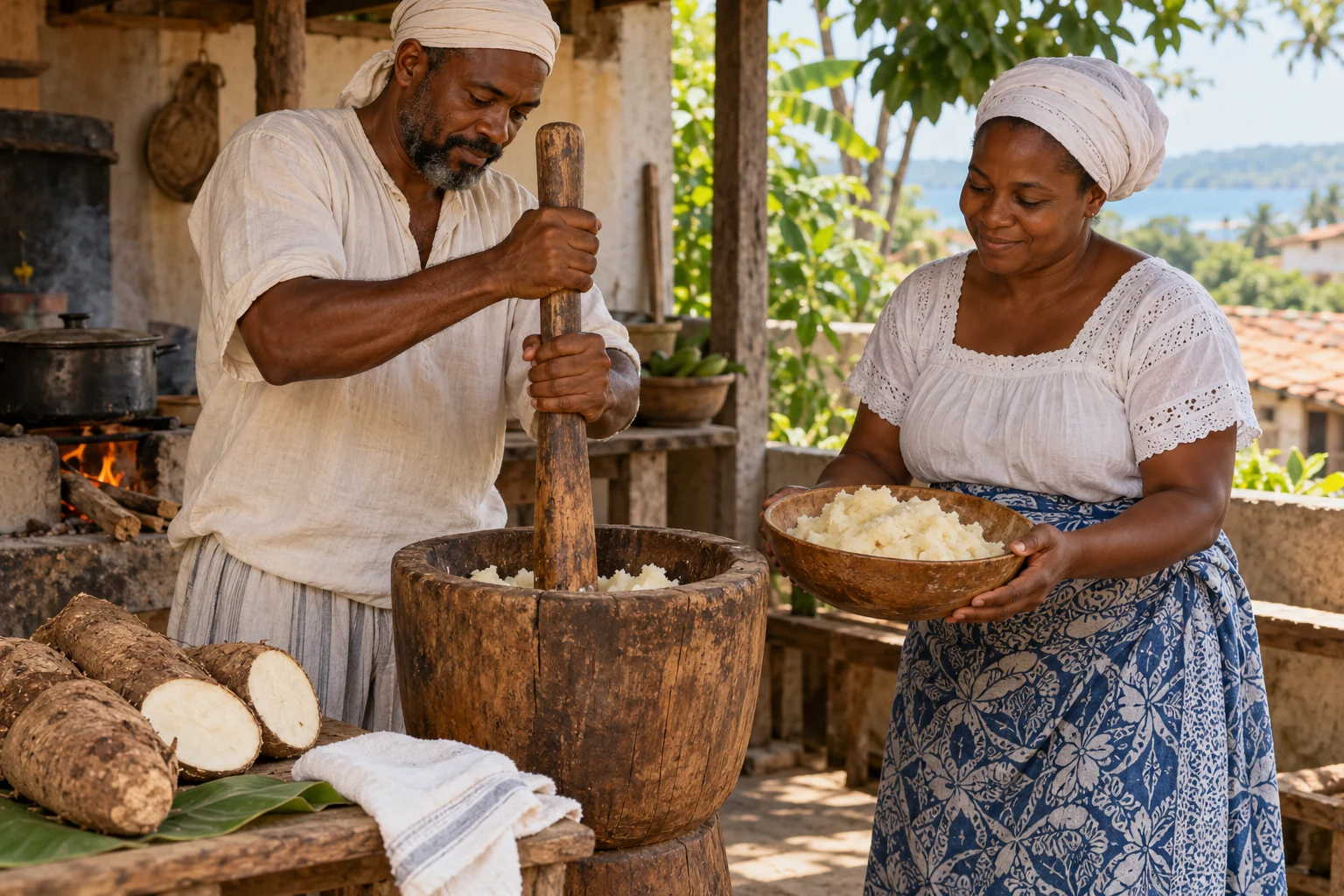
Ògìyán is anchored in Èjìgbò's sacred history and in diaspora relationships that commonly place Oxaguiã within the Oxalá field. The local setting matters. Osun State's account identifies an annual Orisa Ogiyan festival at the new yam harvest and describes its Ewo tradition. This is substantially more specific than an image of a youthful warrior detached from a town. Human Soul has no separate Ògìyán chapter; its Obàtálá portrait explicitly treats Òṣàgiyán as the active, yam and pestle associated pole of the broader field. The present card uses that shared treatment while retaining the Academy's independent entry.
The central interpretive issue is force made nourishing. Yam preparation, agricultural instruments and youthful renewal raise questions about how strength becomes useful to others. They do not establish that all Brazilian and Yorùbá communities tell the same biography, or that a resemblance to industriousness identifies someone's personal Òrìṣà. Sacred efficacy and a community's living relationship come first. Contemporary psychological reading then examines preparation, dependence on collaborators, the frustration involved in learning, and the difference between reform and the pursuit of attention. Ògìyán becomes distinctive when the meal, the labor and the people who must be fed remain visible inside the account of action.
5. Knowledge that gives the figure depth
5.1 What does Èjìgbò contribute beyond a youthful image?
Èjìgbò's harvest setting gives time and provision a concrete place in the research. A harvest festival depends on a world in which growth, seasonal expectation and shared recognition matter. The Osun account also locates conflict inside the festival rather than presenting nourishment and force as unrelated subjects. Its specific account of Ewo and Sawoleje should be attributed as local narrative, not rewritten as the universally accepted history of Oxaguiã. An English reference need not reproduce violent details to learn from the conjunction. It can ask how a community remembers a crisis, recognizes obligations and connects present wellbeing with a recurring sacred relationship.
The psychological extension concerns the temptation to isolate a dramatic event from the slower system that sustains it. A feast is visible for a day; the work of cultivation and preparation extends far beyond it. A team likewise celebrates a launch while forgetting the repeated coordination that made the event possible. Ògìyán's yam field brings that hidden duration forward. The useful question is not merely whether someone is energetic, but whether they can enter the time required for nourishment to become available. An action that ignores seasons, training and actual capacity may feel vigorous while undermining the continuity it claims to renew.
Evidence: Osun State Government, Èjìgbò — Official town account documents Orisa Ogiyan, annual new-yam festival, Ewo and local narrative about Sawoleje; this is a situated account, not independent verification of every narrated event; Océlio Lima de Oliveira, O léxico da língua de santo: a língua do povo de santo em terreiros de candomblé de Rio Branco, Acre — Original Rio Branco Candomblé lexical study records Oxalufã as elder Oxalá and Oxaguiã as youthful; this verifies situated Brazilian usage, not universal genealogy.
5.2 Why is the pestle more than a symbol of intensity?
The pestle is unusually exact because force applied through it changes the condition of food. In the book's interpretation, transformation has a purpose outside the actor's feeling of power: what was raw becomes capable of sustaining communal life. This image should not be simplified into a claim that more pressure always makes a person better. Food preparation involves a material, a purpose, learned technique and limits. Applying the wrong force at the wrong stage can waste rather than prepare. The contemporary comparison therefore asks whether action is responsive to what is actually being worked with.
In teaching, repeated pressure can build skill when it is matched to capacity and supported by explanation. The same repetition becomes humiliation when a teacher treats every difficulty as laziness. In leadership, an energetic demand for improvement may conceal the absence of the resources people need to act. The pestle image brings the difference back to an observable result: who is fed, who is exhausted and who receives credit? It also makes repetitive labor intellectually serious. Knowing how to prepare something reliably is a form of intelligence, even when it produces no spectacle. Ògìyán's distinctive field thus places nourishment inside transformation and asks that force answer to its outcome.
Evidence: Osun State Government, Èjìgbò — Official town account documents Orisa Ogiyan, annual new-yam festival, Ewo and local narrative about Sawoleje; this is a situated account, not independent verification of every narrated event; Océlio Lima de Oliveira, O léxico da língua de santo: a língua do povo de santo em terreiros de candomblé de Rio Branco, Acre — Original Rio Branco Candomblé lexical study records Oxalufã as elder Oxalá and Oxaguiã as youthful; this verifies situated Brazilian usage, not universal genealogy.
5.3 What does the alliance with Ògún reveal about renewal?
Human Soul links Òṣàgiyán's agricultural renewal with Ògún's provision of instruments. The interpretive significance lies in a limit to self sufficiency. A desire to cultivate is not the same as having the means to cultivate. The person or institution that announces renewal depends on makers, maintainers and trained collaborators. A contemporary article can follow that relation without claiming that a single myth has the same liturgical status in every community. In an illustrative project, a founder may describe themselves as the visionary who feeds a community while a cook, technician or organizer repeatedly solves the practical failures.
If the alliance remains unacknowledged, charisma appropriates labor and the project becomes brittle. The more responsible arrangement names competence, distributes credit and allows the person doing the work to influence decisions. This is not merely a lesson in gratitude. It changes how power is organized. An instrument also brings obligations: maintenance, appropriate use, recognition of the maker and attention to those exposed to its effects. Read beside Ògún, Ògìyán shows renewal as coordinated work rather than heroic appetite. The comparison makes youthfulness more demanding than enthusiasm. The renewing force must become teachable enough to receive the skill that will let its intention nourish anyone.
Evidence: Osun State Government, Èjìgbò — Official town account documents Orisa Ogiyan, annual new-yam festival, Ewo and local narrative about Sawoleje; this is a situated account, not independent verification of every narrated event; Océlio Lima de Oliveira, O léxico da língua de santo: a língua do povo de santo em terreiros de candomblé de Rio Branco, Acre — Original Rio Branco Candomblé lexical study records Oxalufã as elder Oxalá and Oxaguiã as youthful; this verifies situated Brazilian usage, not universal genealogy.
6. A depth-psychological reading
Interpretive basis: The shared chapter discussion in Babá Tilo de Àjàgùnnà’s The Orishas and the Human Soul, especially “Obàtálá / Òṣàlá”, “Ògún”. No dedicated Ògìyán portrait. Explicit shared discussion of Òṣàgiyán, pestle and transformative force supports the interpretation. Èjìgbò details are independently localized in Osun State account; examples are new applications.
6.1 Impatience with the labor of becoming capable
One inner dynamic is impatience with preparation. A person may want the recognition attached to a completed contribution while feeling offended by the ordinary repetitions needed to produce it. They identify with vision and regard practice as evidence that others fail to understand their exceptional potential. The yam and pestle field places this conflict in material terms. An appetite is real, but appetite cannot replace preparation. Human Soul's treatment of reforming force becomes useful here because it gives energy a task rather than merely praising it.
In an illustrative adult learner, the excitement of beginning a craft repeatedly disappears when progress becomes incremental. They interpret frustration as proof that the craft is not their calling. The issue may instead be their inability to remain a beginner after imagining themselves accomplished. The comparison does not demand endurance of every bad teaching situation; instruction can be incompetent or degrading. It asks what the frustration contains. Does it reveal a condition that should change, or the loss of a fantasy of immediate mastery? Ògìyán's contemporary relevance is that active strength can be measured by sustained preparation rather than by repeated fresh starts.
The psychological movement is from wanting to be seen as capable toward doing what makes capability real. This original extension remains distinct from any claim about a devotee's innate temperament or required ceremonial discipline.
6.2 Renewal without contempt for inheritance
A second tension is the difference between renewal and contempt for what came before. Youthful force may correctly perceive a rigid arrangement while underestimating the knowledge it protects. An institution can need decisive reform without requiring the humiliation of everyone who maintained it. Human Soul places Òṣàgiyán beside Òṣàlúfọ̀n, making movement and containment part of a shared field. The psychological extension is a task of discrimination. An illustrative younger manager sees a slow approval process and assumes that senior colleagues are merely afraid. Closer study may reveal that one delay prevents a serious error while another simply preserves rank.
Effective reform separates those functions. It retains the protection and removes the unnecessary obstruction. The young person's challenge is to learn without surrendering the capacity to question; the elder's challenge is to explain without treating every question as disloyalty. This is psychologically specific because both people may be defending an image of worth. Youth protects its claim to innovation, and age protects its claim to indispensable knowledge. A nourishing reform gives each a responsibility larger than winning. It asks what will allow the community to continue more reliably.
Ògìyán's warrior energy then becomes accountable to provision, while continuity acquires enough movement to remain alive. Neither speed nor slowness can settle the question independently of what the arrangement does to people.
6.3 Appetite and the invisibility of preparatory labor
A third dynamic concerns appetite and the invisibility of other people's labor. A person can experience themselves as generous because they enjoy hosting, providing and creating abundance. Yet the work that makes their generosity possible may be carried by others who never receive comparable rest or recognition. The sacred food field invites a close examination of this contradiction. The psychological issue is not that appetite is shameful. It is that desire can become so central that the people satisfying it cease to appear as full persons with limits.
An illustrative host insists that every family gathering express love through an elaborate meal while treating the preparer's exhaustion as a failure of devotion. The visible feast conceals an unequal distribution of obligation. Ògìyán's relation to transformed nourishment gives a more exact question: can the person who receives abundance recognize and participate in the preparation? Receiving well may include gratitude, fair division of work and willingness to alter a plan when the labor is unsustainable. For the preparer, the parallel challenge may be relinquishing an identity built around feeding everyone while never asking for support.
The contemporary reading follows the full circuit of nourishment, from desire to work to sharing to recovery. It prevents the warrior and the feast from becoming flattering images of personal strength while the relationships sustaining them remain hungry.
7. What this relationship means for a person
7.1 In an established devotional or initiatory relationship
For an established devotee of Ògìyán or Oxaguiã, sacred relationship precedes the interpretation of work, youth or nourishment. The person's house may teach specific names, narratives, obligations and material relationships that cannot be inferred from a public article. The shared Human Soul portrait can give language to the inward meaning of that relationship while allowing the tradition to remain larger than the comparison. One reflective question is whether the capacity for decisive action is becoming more answerable to those affected by it. Another concerns the devotee's relation to preparation: can they honor the repeated, often unrecognized work through which a collective responsibility is fulfilled?
Such questions can deepen devotion because they connect a sacred image with actual character. They do not form a test that decides whether someone is truly a child of the Òrìṣà. Long relationship may also expose contradictions that a flattering personality profile would hide. A person admired for initiative may have difficulty receiving instruction. A person who feeds others tirelessly may have difficulty permitting others to contribute. An established devotional framework can hold those tensions over time, connecting intention with responsibility rather than demanding instant psychological completion.
The separate Academy entry should help the reader bring more precise questions to elders: how does this house understand Ògìyán's relation to Olúfọ̀n, Àjàgùnnà and Obàtálá, and what makes those distinctions meaningful in practice? We can prepare that conversation while leaving its sacred answers with the people accountable for transmitting them.
7.2 When the figure becomes relevant in consultation
In consultation, Ògìyán's field may illuminate an immediate need for preparation, active renewal or a more responsible use of strength. Its relevance must be understood through the actual divinatory interpretation rather than assumed from an appealing food or warrior symbol. A person might be eager to begin a business but have neglected the training and infrastructure required to serve customers reliably. Another may have prepared extensively and now use further preparation to avoid the risk of acting. Both situations concern the relation between capacity and movement, but their next responsibilities differ.
This is why a fixed instruction to work harder would miss the symbolic precision. An illustrative family question may concern the person doing all the preparation while someone else receives recognition as provider. The reflective task is to see the distribution of labor clearly enough for a truthful conversation. An illustrative institutional question may concern a necessary reform whose method would damage the people it is supposed to help. The pestle and nourishment field asks what useful form will emerge from the pressure being applied.
The consultation's sacred guidance, including any particular response, belongs to its authorized setting. The public psychological application can clarify conduct without replacing that guidance: learn the missing skill, recognize a collaborator, distinguish a real obstruction from wounded pride, or accept that a plan must change to feed actual people. These are possible questions, not remote determinations. The encounter need not confer a permanent identity to redirect action meaningfully.
8. Nature, materials and human knowledge
Ògìyán's ecology joins cultivated yam, prepared food, instruments and collective time. The book's shared portrait emphasizes the pestle, while its Ògún chapter stresses the instruments required for agricultural work. The associations become meaningful as a network: earth and rain do not by themselves produce a shared meal, and technical force without growth cannot produce nourishment either. The human labor of cultivating, harvesting, preparing and distributing is part of the material field. The official Èjìgbò account supplies the local new yam festival anchor; it should not be converted into a set of instructions for readers elsewhere.
Psychologically, this ecology resists the illusion that abundance is the private creation of a visibly successful individual. It draws attention to conditions and contributors that the finished result can hide. It also differentiates useful intensity from unregulated pressure. The motion of preparation has a rhythm and a material purpose, not an unlimited mandate to strike. A contemporary household or institution can learn from this without sacralizing every kitchen implement. The exact point is that transformation answers to nourishment, and nourishment answers to relations. Keeping those relations visible makes the ecological discussion more specific than a general celebration of food, agriculture or youthful energy.
9. Diaspora, comparison and syncretism
The documented connections available here concern Ògìyán's local Èjìgbò setting and Brazilian Oxaguiã within the wider Oxalá field. These relations should not be silently recast as a universal syncretic identity. The university lexical record supports a Brazilian youthful classification; Human Soul supplies a shared theological and psychological interpretation. Neither establishes that Ògìyán, Àjàgùnnà, Olúfọ̀n and Obàtálá can be substituted for one another in every community. No independently verified figure specific Catholic correspondence has been established in this study. The article should therefore explain the limits of a matching chart rather than assign a saint from general resemblance.
A warrior carrying an instrument does not become equivalent to every martial saint, and the existence of a broader Oxalá correspondence cannot decide every named form. The contemporary significance of careful differentiation is substantial. A reader who is attracted to the active image can still learn its local history and ask how their house understands the relationship. This preserves room for both connection and disagreement. Syncretism is most informative when it names the communities, objects and practices through which an association is lived. Where those particulars have not been verified, an honest account can still teach how sacred names travel without pretending that travel leaves every relation unchanged.
Evidence: Osun State Government, Èjìgbò — Official town account documents Orisa Ogiyan, annual new-yam festival, Ewo and local narrative about Sawoleje; this is a situated account, not independent verification of every narrated event; Océlio Lima de Oliveira, O léxico da língua de santo: a língua do povo de santo em terreiros de candomblé de Rio Branco, Acre — Original Rio Branco Candomblé lexical study records Oxalufã as elder Oxalá and Oxaguiã as youthful; this verifies situated Brazilian usage, not universal genealogy.
10. Questions for a fuller understanding
10.1 When does force become nourishing?
Force becomes nourishing when it is organized around what people actually need and what the material can sustain. A dramatic intervention that leaves others exhausted may express power without providing anything durable. The pestle image in the shared chapter suggests a practical test: what usable form emerges, and who can live from it? In an illustrative team, improved process should make work more reliable rather than simply increase the leader's visibility. This comparison does not make every conflict wrong or every strenuous task oppressive. It asks that pressure remain proportionate to purpose. Ògìyán's distinction lies in connecting action to provision, so the people who prepare and receive the result remain part of the judgment.
10.2 Can renewal remain faithful to an inheritance?
Renewal can honor an inheritance by learning what it protects before deciding what must change. That does not oblige younger people to preserve every arrangement. It gives criticism more accuracy. Human Soul's pairing of elder containment and youthful movement offers a shared responsibility: an elder explains and receives evidence, while a younger person learns enough to distinguish accumulated knowledge from protected privilege. In ordinary life, a revised family responsibility or institutional procedure succeeds when it keeps what supports people and alters what prevents them from participating. The parallel is interpretive. Actual religious changes require authority within the tradition rather than an outsider's conclusion that youthfulness means permission to innovate.
11. Correlations to life dimensions
| Dimension | A question for reflection |
|---|---|
| Work | Who performs the preparation that makes my visible success possible? |
| Leadership | Does my energy create nourishment or merely demand attention? |
| Community | How is the work of the shared meal distributed? |
| Tradition | What needs renewing, and what deserves patient learning before it is changed? |
12. A connected reading
Obàtálá opens questions of formation and dignity. Àjàgùnnà provides a related study of active, disciplined force. The separate entries preserve room for local names and house histories. If Ògìyán is part of your religious path, let those relationships guide the study before accepting a universal chart of attributes.
13. Sources for the expanded interpretation
Interpretive basis: The shared chapter discussion in Babá Tilo de Àjàgùnnà’s The Orishas and the Human Soul, especially “Obàtálá / Òṣàlá”, “Ògún”. No dedicated Ògìyán portrait. Explicit shared discussion of Òṣàgiyán, pestle and transformative force supports the interpretation. Èjìgbò details are independently localized in Osun State account; examples are new applications.
-
Osun State Government. Èjìgbò. Official town account documents Orisa Ogiyan, annual new-yam festival, Ewo and local narrative about Sawoleje; this is a situated account, not independent verification of every narrated event. Full cultural heritage section inspected; historical page contains dated administrative information irrelevant to this study.
-
Océlio Lima de Oliveira. O léxico da língua de santo: a língua do povo de santo em terreiros de candomblé de Rio Branco, Acre. Original Rio Branco Candomblé lexical study records Oxalufã as elder Oxalá and Oxaguiã as youthful; this verifies situated Brazilian usage, not universal genealogy. Edufac,2019; institutional publication entry and indexed lexical text inspected; direct PDF fetch returned502. Author and full title verified from original book cover in indexed reproduction.
No universal identity with Ajagunna established. Osun State account is a local public narrative, not proof of the narrated historical event. No figure specific saint correspondence verified.