
A rock can appear immovable while the lives around it change completely. Olumo’s importance in Abeokuta involves more than that visual endurance. It is remembered through refuge, collective survival and religious relationships that cannot be exhausted by a tourist’s view of a striking landscape.
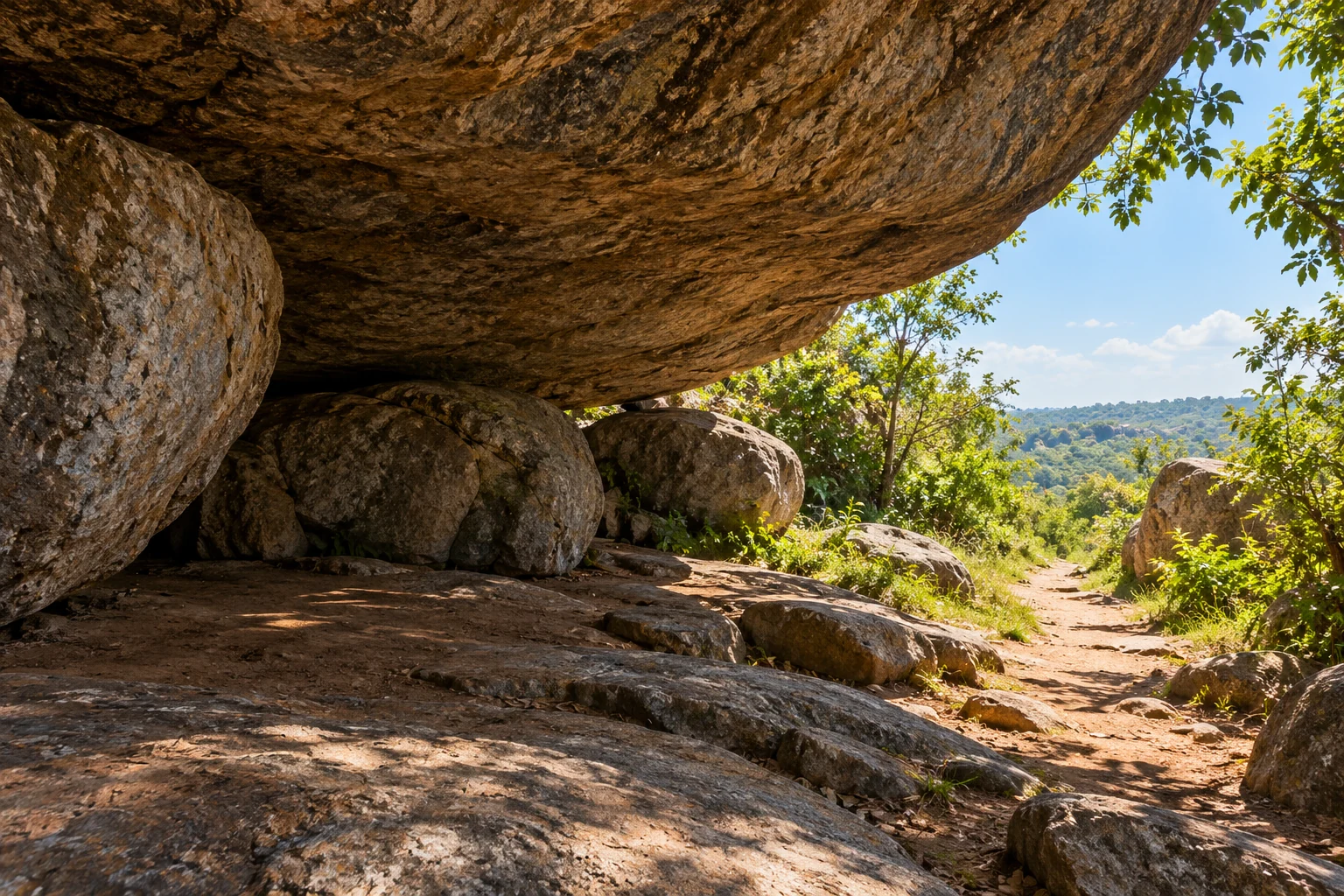
Rock shelter evokes refuge while the article preserves Olumo’s particular Abeokuta setting.
1. Abeokuta and a distinct sacred place
Ogun State’s tourism account and field research on sacred sites provide public starting points for Olumo. The place belongs to Abeokuta and Egba historical memory. It should remain distinct from Ibadan’s Òkèbàdàn, even when the two are compared through refuge and commemoration.
Tourism, civic heritage and devotion may meet at the same site without becoming one relationship. A visitor can appreciate the view while still needing to learn what the place means to its custodians.
2. Key theme: survival leaves a claim on memory
When a community remembers shelter, it also remembers a period in which safety could not be assumed. The story can teach gratitude, vigilance and an awareness of dependence. It can also become simplified into triumph if the experience of vulnerability is left out.
A contemporary reading asks whether a person can remember having needed protection without converting the memory into fear of everyone outside. The more difficult form of strength may be the ability to preserve what sustained the community while remaining open to the needs of others.
3. Endurance and maintenance
Stone suggests permanence, but the relationships around a sacred site require ongoing care. Paths, stories, boundaries and the practical life of custodians do not maintain themselves. A place can remain materially present while its meaning becomes available only as a slogan.
The same is true of family and institutional inheritance. A durable building does not guarantee a living tradition. People have to learn, remember and decide what forms of care allow the place to remain more than an object left standing.
4. Religious identity and the scope of this study
Olúmọ is a particular rock and sacred place associated with Abeokuta and Egba historical memory. Its study begins with that setting, rather than with a generic claim about all mountains. Borokini's field based article identifies Oke Olumo in Abeokuta and connects its commemoration with ancestral refuge. Ogun State's official tourism presentation independently places Olumo Rock within the state's heritage landscape, although a promotional listing cannot supply the full religious account. The book has no dedicated Olúmọ chapter. Its discussion of Oke in a combined terrestrial portrait offers an interpretive vocabulary of height, refuge, silence and perspective that may be applied carefully here.
The distinction between evidence and application should remain visible throughout. A rock can endure materially while the lives and meanings around it change, making Olúmọ especially useful for considering the difference between survival and maintenance. Contemporary inner development concerns how people remember vulnerability, receive protection and carry inherited places into the future. Those questions add a layer of analysis without replacing local custodial knowledge or treating a visitor's emotional response as a religious affiliation. The article's task is to deepen an encounter with a named place, not to make one landscape stand for every experience of resilience.
5. Knowledge that gives the figure depth
5.1 What does the documented refuge relation establish?
The strongest historical point established by the inspected research is the relation between remembered refuge and continuing sacred commemoration. Borokini groups Olúmọ and Òkèbàdàn under that theme while identifying their separate cities. The account does not provide enough detail to settle every founding narrative, chronology or named actor associated with the rock. An expanded article should resist turning an evocative summary into an invented historical reconstruction. What can be developed analytically is the relation between apparently stable stone and vulnerable human life. Protection becomes meaningful because danger was real and human beings could not secure survival entirely through their own control.
A contemporary reading can ask whether later generations remember that dependence or convert it into an effortless story of strength. The difference matters because gratitude can be more truthful than triumph. It recognizes the conditions that allowed a future to remain possible. This does not imply that a community should remain defined by its danger. It asks how survival can be integrated without either denial or permanent fear. Olúmọ's specificity grounds that inquiry: it is a place carrying an account of shelter, not an abstract motivational emblem that promises every difficulty will make a person stronger or that material endurance automatically produces wisdom.
Evidence: Temitope Israel Borokini, Sanctuary of the Spirits: Okwu-muo, Ori Oke and Mammy Water in the Veneration of Sacred Natural Sites in Southern Nigeria — 2016 field study identifies Òkèbàdàn in Ibadan and Olúmọ in Abeokuta as distinct commemorative sacred heights related to ancestral refuge; differentiates indigenous Christian prayer mountains; Ogun State Investment Promotion and Facilitation Agency, Tourism and Creative Economy — Official page names Olumo Rock in state heritage/tourism presentation; does not substantiate a full sacred history.
5.2 How do tourism and custodianship differ?
The rock's heritage and tourism presence creates an encounter among different relationships to one site. A visitor may seek a view or photograph; a resident may carry family memory; a custodian may hold religious responsibility. These positions can coexist without being interchangeable. Ogun State's promotional page verifies that Olumo appears in an official tourism setting, while Borokini supplies the sacred-sites context. Neither source allows the article to claim that tourism has replaced devotion or that every commercial development is welcomed or rejected by custodians. The contemporary interpretive question concerns how a guest becomes more attentive.
Admiration can remain a form of consumption if the visitor assumes that paying for access purchases every story and permission. A more relational encounter recognizes that public presentation may be only one layer of the place. This applies beyond travel. People entering a family, school or religious house often learn its visible identity before understanding the responsibilities that sustain it. Respect grows through attention to who maintains the place and what boundaries mean there. The rock offers a concrete study of that movement from attraction toward relationship. It need not be romanticized as untouched nature to carry sacred significance; its present complexity is part of what careful learning must address.
Evidence: Temitope Israel Borokini, Sanctuary of the Spirits: Okwu-muo, Ori Oke and Mammy Water in the Veneration of Sacred Natural Sites in Southern Nigeria — 2016 field study identifies Òkèbàdàn in Ibadan and Olúmọ in Abeokuta as distinct commemorative sacred heights related to ancestral refuge; differentiates indigenous Christian prayer mountains; Ogun State Investment Promotion and Facilitation Agency, Tourism and Creative Economy — Official page names Olumo Rock in state heritage/tourism presentation; does not substantiate a full sacred history.
5.3 Why does enduring stone still need maintenance?
Maintenance is a specific knowledge question because geological endurance can conceal social fragility. Stone may remain while paths deteriorate, stories are simplified or the people who carry an account lose support. The opening discussion rightly distinguishes a permanent object from a living tradition. The book's crafted matter and earth sections help extend that distinction: materials become meaningful through relation, use and continuity, not through durability alone. This is a general interpretive principle rather than direct ethnographic proof about the current condition of Olúmọ. A contemporary application can examine institutions that rely on a building's age to prove their vitality.
Their strongest symbols may survive while teaching, hospitality or care weaken. The question is what must be renewed so inheritance remains available as lived knowledge. At a sacred site, that inquiry belongs first to the people responsible for it; public readers should not dictate local solutions from afar. They can nevertheless learn to notice maintenance as a form of memory. It often occurs without spectacle and may be overlooked because it succeeds quietly. Olúmọ's rock image becomes more exact when endurance is joined with the human acts that keep a place intelligible. Survival leaves something standing; stewardship helps it continue to mean something to those who follow.
Evidence: Temitope Israel Borokini, Sanctuary of the Spirits: Okwu-muo, Ori Oke and Mammy Water in the Veneration of Sacred Natural Sites in Southern Nigeria — 2016 field study identifies Òkèbàdàn in Ibadan and Olúmọ in Abeokuta as distinct commemorative sacred heights related to ancestral refuge; differentiates indigenous Christian prayer mountains; Ogun State Investment Promotion and Facilitation Agency, Tourism and Creative Economy — Official page names Olumo Rock in state heritage/tourism presentation; does not substantiate a full sacred history.
6. A depth-psychological reading
Interpretive basis: The shared chapter discussion in Babá Tilo de Àjàgùnnà’s The Orishas and the Human Soul, especially “Onílẹ̀, Oke, and Oko”, “Before the Òrìṣà Become Archetypes”, “Metals, Tools, Fire, Cloth, Stones, and the Crafted Body of Power”. Oke passages supply a shared height/refuge framework, not a dedicated Olúmọ chapter. External evidence supplies the distinct Abeokuta site; psychological lenses are new applications.
6.1 Depth psychology: protection without invulnerability
A depth psychological lens can examine the wish to become as invulnerable as stone. After danger, a person may imagine that the safest future is one in which nothing can affect them. The book's Oke distinction between refuge and remoteness offers a framework for questioning that aspiration. In an illustrative case, someone who rebuilt life after a severe disruption becomes admired for composure, yet treats every request for closeness as an attempt to weaken their hard won stability. Their strength is real, but it has become organized around preventing all exposure.
Olúmọ's remembered shelter supports a different question: what protected life so that relationship could continue? The answer need not glorify hardness. A refuge is valuable partly because it allows vulnerable beings to survive, not because it proves vulnerability can be abolished. Contemporary interpretation can therefore distinguish resilience from emotional impermeability. The person may preserve boundaries while allowing selected forms of trust, and may acknowledge fear without surrendering their capacity to act. This is not a clinical theory of survivors or a claim about the rock's devotees.
It is a new psychological application of the author's height and refuge themes. The inner task is to carry protection as a resource for living, rather than making the avoidance of all dependence the central purpose of life.
6.2 Relational development: gratitude without captivity
A relational lens asks how safety is experienced when it has been received from a place, person or institution. Gratitude can deepen connection, but it may also become entangled with debt. An illustrative person who found refuge in a household may believe that leaving or disagreeing would betray the people who helped them. The shelter then continues as an internal prohibition long after immediate need changes. Olúmọ's refuge theme can help distinguish acknowledging support from surrendering all future choice. The book's Oke passages provide the contrast between retreat that clarifies and withdrawal that becomes permanent.
A contemporary application adds a question about the giver: can those who protect allow the protected person to become more capable and independent? If gratitude is measured only by continued dependency, support has become control. Conversely, independence need not require pretending that the refuge never mattered. The relationship can change form through remembrance, appropriate contribution or continued regard. No single form should be prescribed from a public symbolic reading. This lens holds two developmental capacities together: receiving help without humiliation and moving beyond the emergency without erasing the help.
It respects that people and places have limits. Mature safety supports a wider range of truthful responses, including grief, disagreement and departure, rather than demanding a permanent performance of either toughness or indebtedness.
6.3 Collective systems: survival story and heritage image
A collective systems lens follows how a survival story is transmitted. Later generations may inherit pride without direct experience of the danger, while custodians carry details that public narratives omit. The book's account of relational personhood and inherited place gives a method for considering those differences. It does not establish what every Egba family remembers or how current institutions distribute authority. An original interpretation can ask what changes when a community's vulnerability is converted into a heritage brand. A concise slogan can make a place visible, but it may remove the uncertainty, labor and disagreement through which survival occurred.
People then inherit an ideal they cannot question without seeming disloyal. A more sustaining transmission can preserve multiple voices, including those who maintained everyday life while others became the named heroes. The point is not to replace local history with a modern moral lesson. It is to make learning more exact by asking whose account is being heard and what it is designed to do. Olúmọ's enduring rock provides a focus around which such memory gathers, but the rock cannot speak all those histories for itself.
Inner development within collective belonging includes the capacity to honor an inherited story while remaining curious about its omissions. Gratitude becomes stronger when it can tolerate complexity rather than requiring an immaculate past.
7. What this relationship means for a person
7.1 In an established devotional or initiatory relationship
An established religious or custodial relationship with Olúmọ belongs to the particular place and its recognized authorities. The available sources do not justify presenting a standard personal head initiation for every interested reader, nor a single universal form of devotion. A community's ongoing relation can include obligations that tourism and general symbolic study do not confer. The article should orient the reader toward that difference without pretending to explain protected practice. The book's Oke framework can serve as a reflective companion: how is refuge remembered, when is distance useful and what practical care keeps inherited protection meaningful?
For someone whose relation is already established, these questions may change as life moves from receiving support toward maintaining a place for others. That is an interpretive possibility, not a traditional sequence imposed on the devotee. Sustained relationship may also require resisting the temptation to turn heritage into personal prestige. Connection with an enduring place does not make an individual immune to error or entitle them to dismiss others' needs. Contemporary analysis can ask whether reverence becomes maintenance, whether memory remains truthful and whether authority can acknowledge vulnerability.
It should not make future safety a guaranteed reward for fidelity. The religious relation is broader and more particular than a psychological lesson, while inner reflection can deepen the way someone carries the responsibilities they have actually received. Learning the place remains central even when the rock is used as a powerful image of endurance.
7.2 When the figure becomes relevant in consultation
If Olúmọ is encountered within consultation, the discussion should remain specific to that consultation's tradition and purpose. Research here does not establish a universal divination protocol attached to the rock. This study can instead explain how a named sacred place might become relevant to questions of shelter, memory and participation without claiming that the name alone determines a prescription. An illustrative client may feel ashamed of having depended on a community during a crisis and now distance themselves from everything associated with that period. A refuge interpretation could ask whether gratitude and self respect can coexist.
Another may be unable to leave a protective arrangement even though it now limits necessary growth. Their question would concern the difference between honoring support and remaining confined by it. Those possibilities cannot be resolved through a generic resilience message. The actual circumstances and reading matter. Encountering Olúmọ in this setting does not automatically establish an initiatory identity, authorize ritual access to the site or make every stone dream a directive. The book's methodological distinctions help keep religious relation, symbol and contemporary inference separate. Useful reflection may clarify what endured, what needs repair and what responsibility remains toward those who offered safety.
It should leave ordinary historical, practical and interpersonal questions available for investigation. The consultation gains depth by making the present relation clearer, rather than turning a particular place into a universal explanation for the client's life.
8. Nature, materials and human knowledge
Olúmọ's material ecology is rock within a lived urban and heritage landscape. Stone's duration, height and sheltering possibilities form part of its significance, but the social world around it continually changes. The book's Oke material supports attention to perspective and exposure, while its discussion of charged matter stresses relation rather than physical substance alone. These are interpretive connections, not a verified list of Olúmọ's ritual materials. No particular plant, animal, color or sacred number has been established by the inspected sources, so an association table should leave those claims absent.
The human ecology includes residents, custodians, visitors and the work needed to keep paths, knowledge and responsibilities available. Contemporary environmental reflection can ask how access and preservation are balanced without assuming an answer on behalf of the community. Borokini's case specific caution about conservation is relevant: sacred status does not automatically establish healthy ecological conditions, and public use needs observation. The rock's enduring appearance can make care seem unnecessary, yet the relationships that make it a place are less permanent. Olúmọ therefore invites a joined material and ethical inquiry about what survives naturally and what must be sustained through human attention if future generations are to encounter more than a monument.
9. Diaspora, comparison and syncretism
Olúmọ and Òkèbàdàn can be compared through documented refuge and commemoration, while remaining distinct places connected with different cities and histories. The shared Oke framework is a method for interpreting height; it does not merge them into one universally organized deity. The article should also distinguish Olúmọ's sacred significance from Christian prayer mountains discussed by Borokini. Shared retreat topography can support different accounts of authority, devotion and purpose. That coexistence is a subject for comparative study, not proof of an automatic religious identity. No inspected source establishes a Catholic saint correspondence or one standardized diaspora counterpart for Olúmọ.
Introducing such a name merely to complete a syncretism category would create false information. The section can instead explain the kind of evidence required: a specified community, a documented practice and a clear account of what the correspondence means there. A personal impression that two places feel similar is weaker evidence and belongs to reflection. The psychological value of endurance likewise does not make every strong rock a representation of Olúmọ. Keeping these distinctions gives the entry more, not less, substance. It allows the learner to approach a particular sacred geography with curiosity while resisting the habit of translating it immediately into a familiar landscape or imported religious label.
Evidence: Temitope Israel Borokini, Sanctuary of the Spirits: Okwu-muo, Ori Oke and Mammy Water in the Veneration of Sacred Natural Sites in Southern Nigeria — 2016 field study identifies Òkèbàdàn in Ibadan and Olúmọ in Abeokuta as distinct commemorative sacred heights related to ancestral refuge; differentiates indigenous Christian prayer mountains; Ogun State Investment Promotion and Facilitation Agency, Tourism and Creative Economy — Official page names Olumo Rock in state heritage/tourism presentation; does not substantiate a full sacred history.
10. Questions for a fuller understanding
10.1 Why is tourism evidence bounded?
Why is a tourism source insufficient for a complete religious account? An official tourism page verifies that a site is publicly presented within a heritage economy. Its purpose may be promotion, access or investment, so its selection of details differs from a custodian's account of sacred relationship. The Ogun page is useful evidence that Olumo Rock appears in that setting; Borokini adds a field based sacred-sites context. Neither should be stretched into proof of every origin story or ritual claim. A careful article can name both purposes and learn from their difference. Visitors then understand that seeing a place and understanding its religious life are related beginnings rather than identical achievements, and that local accountable teaching remains necessary for deeper involvement.
10.2 How does endurance differ from hardness?
How can endurance differ from hardness? Endurance keeps something life supporting available through change. Hardness may resist every influence, including the relationships that would allow renewal. The book's Oke framework helps ask whether distance restores perspective or becomes permanent remoteness. Applied contemporarily to Olúmọ's refuge theme, the question is what safety makes possible after danger. A person can retain boundaries while receiving care, acknowledge vulnerability while acting and remember help without surrendering autonomy. This is reflective analysis rather than a clinical claim or a report about devotees' personalities. Its purpose is to prevent a stone image from turning strength into emotional inaccessibility. A refuge matters because life can continue around and beyond it, with needs that cannot all be met by remaining untouched.
11. Correlations to life dimensions
| Dimension | A question for reflection |
|---|---|
| Safety | Can I remember vulnerability without letting fear govern every future relation? |
| Heritage | Who maintains the living account behind a permanent monument? |
| Travel | What changes when I encounter a place as a guest rather than a consumer? |
| Community | Which acts keep shelter available to others? |
12. A place-based beginning
Olumo’s Academy entry supports study of a specific sacred landscape. It does not imply that every hill or rock belongs to one universal cult. The useful movement is from admiration toward relationship: learning the place’s history, hearing its custodians and recognizing the obligations carried by survival.
13. Sources for the expanded interpretation
Interpretive basis: The shared chapter discussion in Babá Tilo de Àjàgùnnà’s The Orishas and the Human Soul, especially “Onílẹ̀, Oke, and Oko”, “Before the Òrìṣà Become Archetypes”, “Metals, Tools, Fire, Cloth, Stones, and the Crafted Body of Power”. Oke passages supply a shared height/refuge framework, not a dedicated Olúmọ chapter. External evidence supplies the distinct Abeokuta site; psychological lenses are new applications.
-
Temitope Israel Borokini. Sanctuary of the Spirits: Okwu-muo, Ori Oke and Mammy Water in the Veneration of Sacred Natural Sites in Southern Nigeria. 2016 field study identifies Òkèbàdàn in Ibadan and Olúmọ in Abeokuta as distinct commemorative sacred heights related to ancestral refuge; differentiates indigenous Christian prayer mountains. Article full text inspected; local historical detail is brief and does not establish complete cult histories.
-
Ogun State Investment Promotion and Facilitation Agency. Tourism and Creative Economy. Official page names Olumo Rock in state heritage/tourism presentation; does not substantiate a full sacred history. Official promotional page inspected 2026; contextual only.
Local history sources are brief. No unverified founder, date, etymology, saint, ritual calendar, universal initiation or consultation system is supplied. Official promotional page is contextual evidence only.